
Why Horizontal BPA Lists Fail Regulated Industries
Most "best business process automation tools" articles sort platforms by features, user ratings, or pricing tiers. For a marketing team or a small SaaS company, that approach works. For a hospital network handling protected health information, a bank processing payments under PCI-DSS rules, a manufacturer running an ERP system that controls the shop floor, or an ecommerce operation managing thousands of daily transactions, a horizontal feature list is worse than useless — it is misleading.
The core problem is that compliance requirements and workflow patterns vary so dramatically between industries that a tool that excels in one vertical can be a compliance liability in another. Zapier connects 8,000+ apps and is a fine choice for general-purpose automation, but it cannot sign a Business Associate Agreement, which means it cannot touch any patient data under HIPAA. Make and n8n have the same limitation. A platform like Appian, on the other hand, holds certifications across PCI-DSS, HIPAA, SOC 2, FedRAMP, ISO 27001, GxP, and FDA 21 CFR Part 11 — a compliance breadth that matters only if you operate in a regulated environment.
This article maps BPA platforms to four verticals using three criteria: compliance certifications held, pre-built integrations available, and the specific workflow patterns each tool was designed to handle. The goal is not to declare a single winner — it is to help operations leaders identify which tool category fits their regulatory and operational context before they evaluate features.
The BPA Market in 2026: $17.1B and Growing Fast
The business process automation market was valued at $17.1 billion in 2025 and is projected to reach $52.2 billion by 2035, growing at an 11.8% compound annual growth rate, according to Future Market Insights data cited by 2am.tech. Banking, financial services, and insurance (BFSI) is the leading vertical in the global intelligent process automation market, while healthcare is expected to see the fastest growth through 2030, per Grand View Research.
Several data points illustrate why vertical-specific tool selection matters more than ever:
- Healthcare systems run more than 30 billion automated tasks per year across scheduling, claims, and medication workflows, representing about $250 billion in processing value (VegamAI).
- Finance teams that adopted automated payment processing freed up more than 500 work hours per year (American Express Trendex Report).
- Workflow automation reduces processing errors by up to 70% across industries (Gitnux).
- Nearly 60% of BPA initiatives report positive ROI within 12 months, and 73% of IT leaders say these solutions have reduced process time by half (McKinsey & Company, VegamAI).
For a deeper look at the cost-benefit side of BPA adoption — including payback periods and error reduction data — see our BPA ROI analysis.
Healthcare: HIPAA Compliance by Design vs. Configurable vs. Not Compliant
Healthcare automation is not a single problem. It spans patient scheduling, claims processing, prior authorization, lab result routing, medication management, and revenue cycle workflows. Each of these involves protected health information (PHI), which means the automation platform must either be HIPAA compliant by design or configurable within a HIPAA-eligible infrastructure. There is no middle ground, and the consequences of choosing the wrong tool range from audit findings to federal penalties.
The healthcare BPA landscape breaks into three tiers:
| Compliance Tier | Tool | Key Details | Best For |
|---|---|---|---|
| HIPAA by design | Keragon | SOC 2 Type II certified, built-in BAA, encryption, audit logging, 7-day data retention. $99/month, 300+ healthcare connectors. | Mid-market clinics and specialty practices that need a dedicated healthcare automation platform without custom enterprise contracts. |
| HIPAA by design | Redox | Single standardized API connecting to 95+ EHR systems across 12,000+ healthcare organizations. | Health systems and digital health companies that need broad EHR interoperability without building point-to-point integrations. |
| HIPAA by design | Rhapsody (Lyniate) | #1 KLAS-rated integration engine for 15 consecutive years, deployed across 1,900+ healthcare organizations. | Large hospital networks and health information exchanges that need a proven, enterprise-grade integration backbone. |
| HIPAA configurable | Workato | Enterprise iPaaS, signs BAAs, holds third-party HIPAA and SOC 2 audits. Custom enterprise pricing. | Enterprise health systems that already use Workato for other business functions and need a single platform for both clinical and administrative workflows. |
| HIPAA configurable | Power Automate | HIPAA configurable when deployed within a HIPAA-eligible Microsoft 365 or Azure subscription. Not compliant out of the box. | Healthcare organizations already on Microsoft enterprise agreements who can configure the environment correctly. |
| Not HIPAA compliant | Zapier, Make, n8n | None of these platforms sign BAAs. Self-hosting n8n does not make it HIPAA compliant — the vendor must also provide compliance guarantees. | Administrative workflows that never touch PHI (e.g., internal HR approvals, IT ticket routing). Not suitable for patient-facing or clinical automation. |
For operations leaders evaluating healthcare BPA, the first question is not "which tool has the most features" — it is "does this platform sign a BAA and can it handle PHI in its default configuration?" If the answer is no, the tool is not a candidate for any workflow that touches patient data, regardless of how many healthcare connectors it claims.
Finance: PCI-DSS, SOX, and SOC 2 Compliance at Enterprise Scale
Financial services automation operates under a different compliance regime than healthcare, but the stakes are equally high. PCI-DSS governs payment card data, SOX controls financial reporting and internal controls, and SOC 2 reports cover data security and availability. A BPA platform in finance must not only hold these certifications — it must also support the audit trails, role-based access controls, and data retention policies that regulators expect.
The financial impact of automation in this vertical is substantial. Finance teams that adopted automated payment processing freed up more than 500 work hours per year, according to the American Express Trendex Report. Invoice processing costs drop from approximately $12.88 per invoice to about $2.78 — a reduction of nearly 80%, per Ardent Research data cited by Elementum. For an enterprise processing 500,000 invoices per year, that single workflow translates to over $5 million in annual savings. AP automation alone eliminates 60% of manual invoice errors.
| Tool | Compliance Certifications | Deployment Model | Best For |
|---|---|---|---|
| Appian | PCI-DSS, HIPAA, SOC 1/2/3, FedRAMP Moderate & High, ISO 27001/27017/27018/9001, GxP, FDA 21 CFR Part 11, HITRUST, DISA IL2/IL4/IL5, FISMA, UK G-Cloud, CSA STAR, Cyber Essentials, IRAP (Australia up to Protected level), Canada Protected B, C5 (Germany) | Cloud (Appian Cloud), on-premise available | Financial institutions that need the broadest compliance coverage across multiple regulatory frameworks — especially those serving government clients or operating internationally. |
| ServiceNow FSO | SOC 2, HIPAA (configurable), ISO 27001. Custom enterprise pricing. | Cloud (ServiceNow Cloud) | Financial services operations teams that need pre-built workflows for customer requests like card replacements, payment inquiries, and account servicing. |
| Workato | SOC 2, HIPAA (signs BAAs), third-party audits. Custom enterprise pricing. | Cloud (multi-tenant and dedicated VPC) | Enterprise finance teams that need a single iPaaS for both financial and cross-departmental workflows. |
| Tray.io | SOC 2, HIPAA (configurable). Custom enterprise pricing. | Cloud | Mid-market to enterprise finance teams that need flexible, developer-oriented automation with strong API support. |
For readers interested in the governance angle specific to financial services — including how Blue Prism handles audit trails and separation of duties in banking environments — see our Blue Prism governance analysis.
Manufacturing: ERP Integration Depth Is the Single Biggest Differentiator
Manufacturing BPA is fundamentally different from healthcare or finance automation because the primary data source is not a patient record or a financial transaction — it is an Enterprise Resource Planning (ERP) system that controls production schedules, inventory levels, supply chain logistics, and quality management. The depth of a BPA platform's integration with the manufacturer's existing ERP is the single most important factor in whether the automation will succeed or fail.
According to research by Bytebot, only Microsoft Power Platform has native integration with any manufacturing ERP — specifically, Dynamics 365. Every other BPA platform requires custom development, middleware, or third-party connectors to bridge the gap between the automation engine and the ERP. This is not a minor implementation detail; it is the difference between a project that takes weeks and one that takes months or stalls entirely.
| Tool | ERP Integration | Pricing | Best For |
|---|---|---|---|
| Microsoft Power Platform | Native Dynamics 365 integration. Custom connectors for SAP, Oracle, and others via Azure Logic Apps. | Included in select Microsoft 365 and Dynamics 365 licenses; premium connectors require Power Automate per-flow plans. | Manufacturers already on Microsoft stack (Dynamics 365, Azure, M365) who want the lowest integration friction. |
| Epicor BPM | Native for Epicor ERP shops. Requires C# scripting for custom workflows. | Included with Epicor ERP or licensed separately. Contact Epicor for pricing. | Manufacturers already running Epicor ERP who need deep, native process automation without switching platforms. |
| Tulip | IoT-focused (OPC UA, MQTT, Modbus). No native ERP connectors — integrates via APIs and middleware. | $40,000–$100,000+ per year depending on deployment scale. | Frontline operations and shop floor apps (quality inspections, machine monitoring, work instructions) where IoT data is the primary input, not ERP transactions. |
| Plex (Rockwell Automation) | Cloud-native MES/ERP. Requires replacing existing ERP to use Plex's full automation capabilities. | Contact Plex for pricing. Typically enterprise-scale. | Manufacturers willing to replace their existing ERP with Plex's integrated MES/ERP platform for end-to-end visibility. |
| Kissflow | No native ERP connectors. Integrates via REST APIs and third-party middleware. | $15/user/month, 50-user minimum ($750/month). | Small manufacturers with simple workflows (approvals, forms, task management) that do not require deep ERP integration. |
| ProcessMaker Enterprise | BPMN 2.0 compliant. No native ERP connectors — integrates via APIs. | $1,495/month for cloud. On-premise option available. | Mid-market manufacturers that need BPMN-standard process modeling and are willing to build custom ERP integrations. |
The financial case for manufacturing BPA is strong. Process automation delivers an average 240% ROI in the first year, according to Camunda data cited by Bytebot. The total cost of ownership for a mid-market platform over three years for a 50-person manufacturer ranges from $107,000 to $380,000. ERP workflow gaps drain up to 20% of productivity in manufacturing operations.
Ecommerce: Data Routing vs. Decision Intelligence — Two Layers, One Stack
Ecommerce operations face a two-layer automation problem that most other verticals do not. The first layer is data routing: moving order information from Shopify to ShipStation, updating inventory in NetSuite when a sale is made, sending confirmation emails via Klaviyo. This is classic if-this-then-that automation, and tools like Zapier, Shopify Flow, ShipStation, and Celigo handle it well.
The second layer is decision intelligence: making contextual judgments that simple rules cannot handle. Should this product review be published or flagged for moderation? Is this return request legitimate or a fraud signal? Should this customer's order be expedited based on their lifetime value and current inventory levels? These decisions require a platform that can evaluate multiple signals, apply business rules, and learn from outcomes — not just route data from point A to point B.
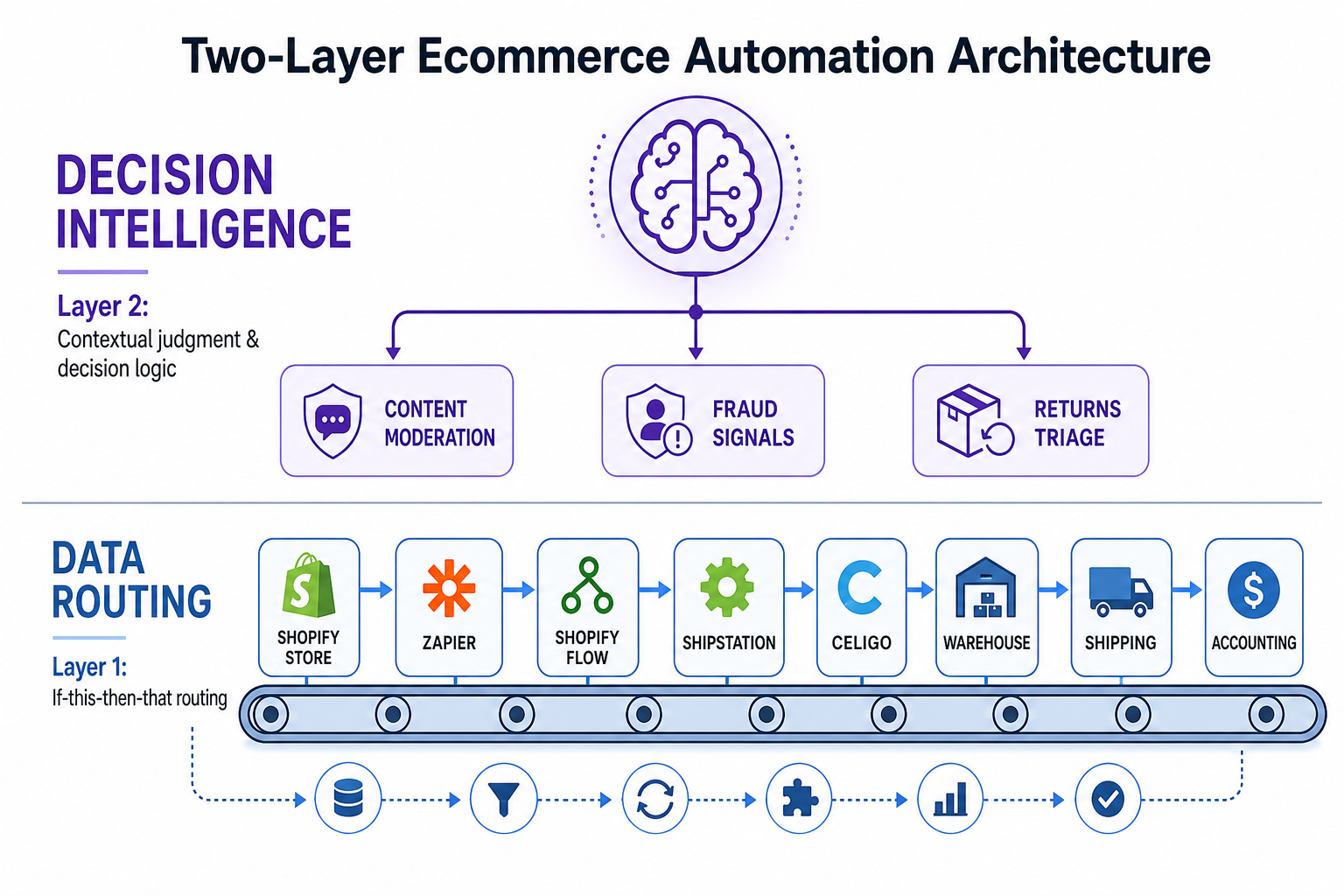
| Layer | Tool | Key Capability | Pricing | Best For |
|---|---|---|---|---|
| Data routing | Zapier | 8,000+ app integrations. Trigger-action workflows. | Free tier (100 tasks/month); paid plans start at $19.99/month. | Small to mid-size ecommerce operations that need broad app connectivity without custom development. |
| Data routing | Shopify Flow | Native Shopify automation: inventory, orders, customers, fulfillment. | Free on standard Shopify plans. Shopify Plus: $2,300/month (three-year term) or $2,500/month (one-year term). | Shopify-native merchants who want zero-configuration automation within the Shopify ecosystem. |
| Data routing | ShipStation | Multi-carrier shipping, order management, batch label printing. | $14.99/month for 50 shipments. | Ecommerce operations that ship high volumes and need carrier rate shopping and label automation. |
| Data routing | Celigo | Pre-built connectors for ecommerce platforms (Shopify, BigCommerce) and ERPs (NetSuite, SAP). | Custom pricing based on transaction volume and connector count. | Mid-market to enterprise ecommerce operations that need deep integration between their ecommerce platform and ERP. |
| Decision intelligence | Logic | Managed-agent platform for content moderation, fraud signals, returns triage. 250,000+ jobs/month, 99.999% uptime. SOC 2 Type II certified. HIPAA available on Enterprise. | Custom pricing. Enterprise tier available. | Ecommerce operations that need to automate contextual decisions (review moderation, return authorization, fraud screening) that if-then rules cannot handle. |
The Garmentory case study illustrates why the decision intelligence layer matters. After switching to Logic, the company scaled from reviewing 1,000 products per day to over 5,000, cut review time from 7 days to 48 seconds, and dropped its error rate from 24% to 2%. These improvements came not from faster data routing but from a platform that could make contextual judgments about product content — a task that would require hundreds of rules in a traditional if-this-then-that system.
The broader market context reinforces the importance of ecommerce automation. According to SellersCommerce and Precedence Research data cited by 2am.tech, 93% of ecommerce businesses view AI shopping agents as a competitive edge. AI-powered ecommerce automation reduces 40–60% of manual operations work in inventory management, order fulfillment, and supplier coordination within the first four weeks, per Duvo research. Retailers using automated inventory and order workflows report up to 65% reduction in stockouts and 50% faster order processing times.
Compliance & Certification Comparison Table
The following table consolidates compliance certifications across all tools discussed in this article. This is the single most important reference for operations leaders who need to verify that a platform meets their regulatory requirements before evaluating features or pricing.
| Tool | HIPAA | PCI-DSS | SOC 2 | SOC 3 | FedRAMP | ISO 27001 | HITRUST | GxP / FDA 21 CFR Part 11 |
|---|---|---|---|---|---|---|---|---|
| Appian | ✓ | ✓ | ✓ | ✓ | ✓ (Moderate & High) | ✓ | ✓ | ✓ |
| ServiceNow FSO | Configurable | — | ✓ | — | — | ✓ | — | — |
| Workato | ✓ (signs BAAs) | — | ✓ | — | — | — | — | — |
| Tray.io | Configurable | — | ✓ | — | — | — | — | — |
| Keragon | ✓ (by design) | — | ✓ (Type II) | — | — | — | — | — |
| Redox | ✓ (by design) | — | — | — | — | — | — | — |
| Rhapsody (Lyniate) | ✓ (by design) | — | — | — | — | — | — | — |
| Power Automate | Configurable | — | — | — | — | — | — | — |
| Microsoft Power Platform | Configurable | — | — | — | — | — | — | — |
| Epicor BPM | — | — | — | — | — | — | — | — |
| Tulip | — | — | — | — | — | — | — | — |
| Plex | — | — | — | — | — | — | — | — |
| Kissflow | — | — | — | — | — | — | — | — |
| ProcessMaker | — | — | — | — | — | — | — | — |
| Zapier | — | — | — | — | — | — | — | — |
| Make | — | — | — | — | — | — | — | — |
| n8n | — | — | — | — | — | — | — | — |
| Shopify Flow | — | — | — | — | — | — | — | — |
| ShipStation | — | — | — | — | — | — | — | — |
| Celigo | — | — | — | — | — | — | — | — |
| Logic | Available on Enterprise | — | ✓ (Type II) | — | — | — | — | — |
Decision Framework: How to Choose Your Vertical BPA Stack
The following framework is designed to help operations leaders narrow their options before evaluating specific platforms. It is organized by the three decision dimensions that matter most in regulated industries: compliance posture, integration requirements, and workflow complexity.
Step 1: Determine Your Compliance Baseline
- If you handle PHI in any workflow, eliminate all tools that do not sign BAAs. This removes Zapier, Make, and n8n from consideration for PHI-touching workflows. Choose between HIPAA by design (Keragon, Redox, Rhapsody) and HIPAA configurable (Workato, Power Automate) based on your in-house compliance expertise.
- If you process payment card data, PCI-DSS certification is non-negotiable. Appian is the only platform in this comparison that holds PCI-DSS certification. Workato and Tray.io may be acceptable if the payment data is handled by a PCI-compliant third-party processor and the BPA platform never stores or transmits cardholder data.
- If you operate under SOX controls, ensure the platform provides immutable audit trails, role-based access control, and data retention policies that match your SOX compliance requirements. Appian and ServiceNow FSO are the strongest candidates here.
- If you serve government clients or operate internationally, FedRAMP, IRAP, or C5 certifications may be required. Appian holds the broadest set of government certifications across the platforms reviewed.
Step 2: Evaluate Integration Depth
- Manufacturing: If you run Dynamics 365, Microsoft Power Platform is the clear choice for native integration. If you run Epicor, Epicor BPM is the path of least resistance. For all other ERPs (SAP, Oracle, JDE), expect to invest in custom integration work regardless of which BPA platform you choose.
- Healthcare: If you need broad EHR interoperability, Redox's single API to 95+ EHR systems is the most efficient path. If you need a proven integration engine for a large hospital network, Rhapsody's 15-year KLAS #1 rating is a strong signal.
- Ecommerce: If you are a Shopify-native merchant, start with Shopify Flow for data routing and add a decision intelligence layer (Logic) if you need contextual judgments. If you run a multi-platform operation (Shopify + BigCommerce + NetSuite), Celigo's pre-built connectors may save months of integration work.
- Finance: If you need a single platform for both financial and cross-departmental workflows, Workato's enterprise iPaaS model is strong. If you need pre-built financial services workflows (card replacements, payment inquiries), ServiceNow FSO is purpose-built for that use case.
Step 3: Assess Workflow Complexity
- If your workflows are primarily data routing (move data from system A to system B, send a notification, update a record), tools like Zapier, Shopify Flow, or Power Automate may be sufficient — provided they meet your compliance requirements.
- If your workflows require contextual decisions (approve or reject based on multiple signals, triage based on risk scoring, moderate content based on policy), you need a decision intelligence platform like Logic or a full BPM suite like Appian that includes business rules and case management.
- If your workflows span multiple departments and require orchestration across people, systems, and AI agents, you need an enterprise BPM platform (Appian, ServiceNow, ProcessMaker) rather than a point automation tool.
Vertical Alignment Beats Feature Count
The central argument of this article is simple but easy to ignore when faced with a vendor demo that shows 500 integrations and a beautiful drag-and-drop interface: the best BPA tool is the one that aligns with your industry's regulatory requirements and workflow patterns, not the one with the longest feature list.
A HIPAA-compliant healthcare stack looks fundamentally different from a PCI-compliant finance deployment. An ERP-integrated manufacturing setup requires a different platform category than a two-layer ecommerce operations stack. The tools that work in one vertical may be compliance liabilities in another — Zapier is excellent for ecommerce data routing but cannot touch patient data; Epicor BPM is ideal for Epicor shops but irrelevant for a hospital network; Appian's compliance breadth is unmatched but its enterprise pricing and complexity are overkill for a small ecommerce brand.
When evaluating BPA platforms for your organization, start with the compliance and integration questions in the decision framework above. If the platform cannot meet your regulatory baseline or integrate with your core systems, the number of features it offers is irrelevant. If it can, then — and only then — evaluate features, pricing, and user experience.