
Why Enterprise BPM Pricing Is So Opaque (and Why That Matters)
If you have ever tried to build a budget for a business process management (BPM) platform, you already know the frustration. Most enterprise vendors do not publish list prices. Their websites offer a "Contact Sales" button and little else. You fill out a form, sit through a demo, and eventually receive a proposal that arrives with a six- or seven-figure price tag and no clear breakdown of what drove the number.
This opacity is not an accident. It is a structural feature of the enterprise software market. Vendors keep pricing close to the vest because every deal is different — and because the gap between the entry-level subscription and the final invoice can be enormous. A platform that looks affordable on a per-user basis can balloon into a multi-million-dollar commitment once implementation services, mandatory upgrades, integration work, and consultant hours are factored in.
The consequences for buyers are real. Without transparent benchmarks, procurement teams cannot compare apples to apples. They end up negotiating blind, often signing contracts that lock them into cost structures they did not fully anticipate. This guide exists to change that. It provides a clear, vendor-by-vendor breakdown of what 10 leading BPM and workflow platforms actually cost in 2026, where the hidden fees live, and how to build a realistic total-cost-of-ownership (TCO) model before you sign anything.
The BPM Market in 2026: A $21.5B Industry Growing Fast
The global BPM market is not small, and it is not slowing down. According to Fortune Business Insights, the market was valued at $21.51 billion in 2024 and is projected to reach $91.87 billion by 2034, growing at a compound annual rate of 17.2%. Grand View Research offers a similar trajectory, estimating the market at $20.38 billion in 2024 and forecasting $61.17 billion by 2030.
That kind of growth attracts vendors — and complexity. The market now spans everything from decades-old on-premise suites to cloud-native low-code platforms that promise deployment in days. The pricing models are just as varied: perpetual licenses, annual subscriptions, per-user fees, consumption-based pricing, and everything in between. For a procurement team, navigating this landscape without a map is expensive.
BPM Pricing Tiers: From Enterprise Suites to Modern Low-Code Platforms
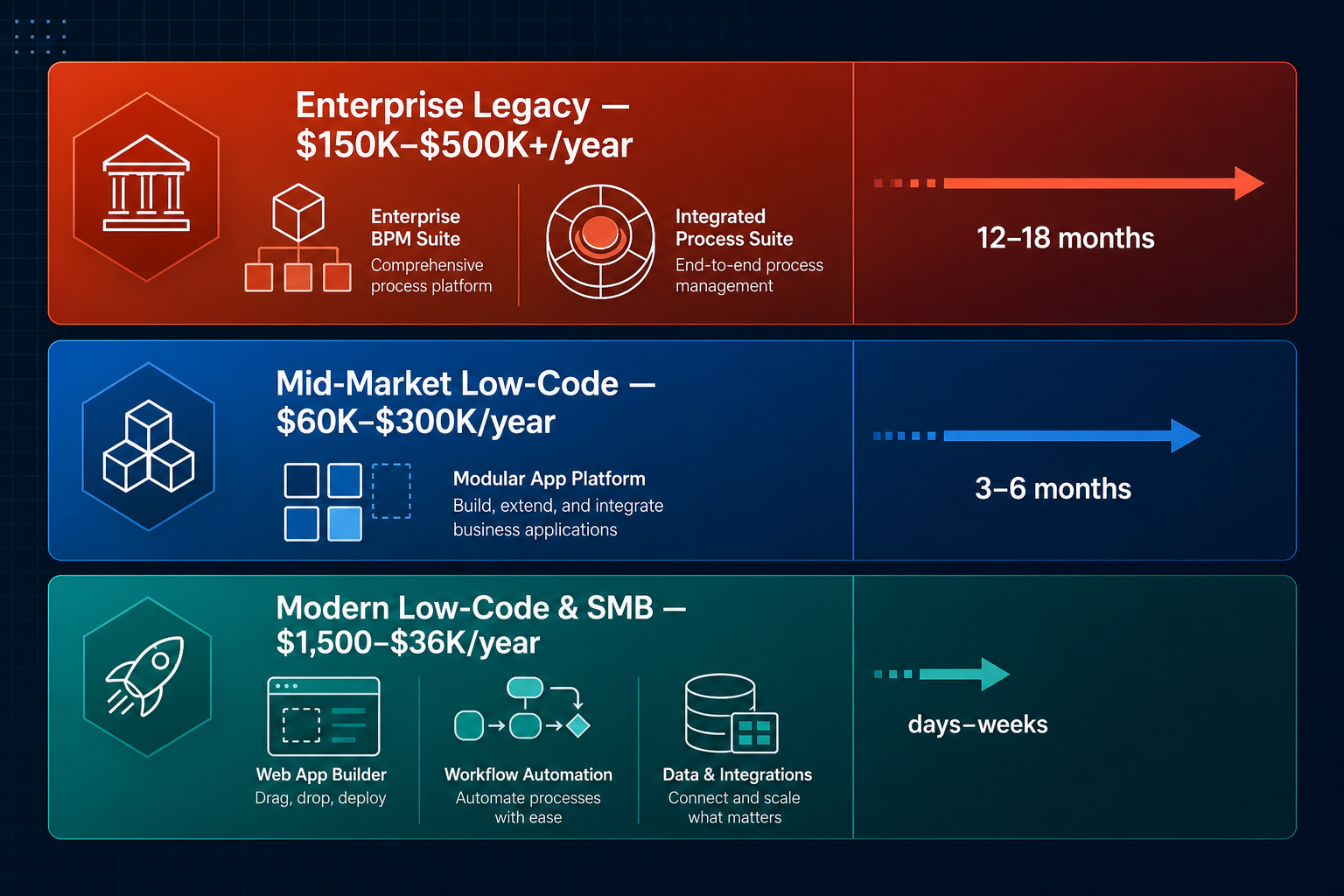
The BPM market breaks into five distinct pricing tiers. Each tier serves a different buyer profile, comes with a different implementation timeline, and carries a different set of hidden-cost risks. Understanding which tier your organization falls into is the first step toward a realistic budget.
Enterprise Legacy Suites (Pega, IBM BAW, SAP Signavio)
These are the heavyweights. Pega licensing typically runs from $150,000 to $500,000 or more per year, and implementation costs can reach several million dollars over multi-year projects. IBM Business Automation Workflow and SAP Signavio operate in a similar range, though neither publishes public pricing. These platforms are built for large, regulated enterprises with complex process requirements and dedicated BPM teams. The sticker price is just the beginning: expect 12 to 18 months of implementation before the system delivers measurable value.
Mid-Market Low-Code (Appian)
Appian positions itself between the legacy suites and the modern low-code platforms. Its annual pricing ranges from $60,000 to $300,000, depending on the number of users and the complexity of the deployment. Appian offers a low-code development environment that accelerates delivery compared to traditional suites, but it still requires significant upfront investment in solution architecture and integration work. Implementation timelines typically run 3 to 6 months.
Developer-Centric Platforms (Camunda)
Camunda takes a different approach. Its open-source core is free, and its cloud platform starts at $1,495 per month. Enterprise plans are priced on usage and support requirements. This model appeals to organizations with in-house development teams who want to embed workflow automation into custom applications. The tradeoff: you need technical staff to build and maintain the workflows, and the total cost can rise quickly as usage scales.
Modern Low-Code Platforms (Kissflow)
Kissflow represents the new generation of BPM platforms designed for business users rather than developers. Its pricing starts at $1,500 per month for up to 50 users, with no setup fees. The platform can be operational in days, not months. This transparent, all-inclusive pricing model eliminates many of the hidden costs that plague legacy deployments. For organizations that do not need the heavy customization of a Pega or Appian, Kissflow offers a dramatically lower TCO.
SMB Workflow Tools (monday.com, Pipefy, Process Street)
At the lowest tier, tools like monday.com, Pipefy, and Process Street offer per-user pricing that starts in the single digits. monday.com's Basic plan is $9 per seat per month (billed annually), and its Pro plan is $19 per seat per month. Pipefy's paid plans start at $24 per user per month. Process Street starts at $100 per month for five members. These tools are excellent for departmental workflows and small teams, but as Moxo notes, per-user pricing that looks affordable at 10 users often becomes a significant line item at 100 users.
10 Leading BPM Platforms: Pricing, Best For, and Key Tradeoffs
The table below summarizes the starting price, pricing model, best-fit use case, typical implementation timeline, and the most significant hidden-cost risk for each of the 10 platforms covered in this guide.
| Platform | Starting Price (Annual) | Pricing Model | Best For | Implementation Timeline | Key Hidden Cost Risk |
|---|---|---|---|---|---|
| Pega | $150,000 – $500,000+ | Annual license + implementation | Large regulated enterprises | 12–18 months | Multi-million-dollar implementation and consulting fees |
| IBM BAW | Enterprise (custom quote) | Perpetual or subscription license | IBM-centric enterprises | 12–18 months | Integration with legacy IBM stack; upgrade costs |
| SAP Signavio | Enterprise (custom quote) | Subscription (module-based) | SAP ecosystem organizations | 6–12 months | Module-specific pricing; integration with SAP |
| Appian | $60,000 – $300,000 | Annual subscription | Mid-market low-code BPM | 3–6 months | Solution architecture and integration services |
| Camunda | $17,940 (cloud, $1,495/mo) | Usage-based / subscription | Developer-led automation | Weeks to months | Scaling costs; requires in-house development team |
| Kissflow | $18,000 (50 users, $1,500/mo) | Flat subscription | Business-user-led BPM | Days to weeks | Minimal — no setup fees, all-inclusive pricing |
| Nintex | Usage-based (custom quote) | Module-based subscription | Process documentation and automation | 4–8 weeks | Module-specific costs; per-document pricing |
| monday.com | $9/seat/month (Basic) | Per-user subscription | Team workflows and project management | Days | Per-user cost at scale; add-on fees for advanced features |
| Pipefy | $24/user/month | Per-user subscription | Departmental process automation | Days to weeks | Per-user cost at scale; limited enterprise features |
| Process Street | $100/month (5 members) | Per-member subscription | Checklist-based workflows | Days | Per-member cost at scale; limited integration depth |
The Hidden Cost Breakdown: What Doubles and Triples Your BPM Bill
The sticker price of a BPM platform is only the tip of the iceberg. Research from Gartner, cited by Kissflow, shows that organizations underestimate the total cost of enterprise software by 30 to 50%. For a platform with a $200,000 annual license, that means an additional $60,000 to $100,000 in costs that were not in the original budget.
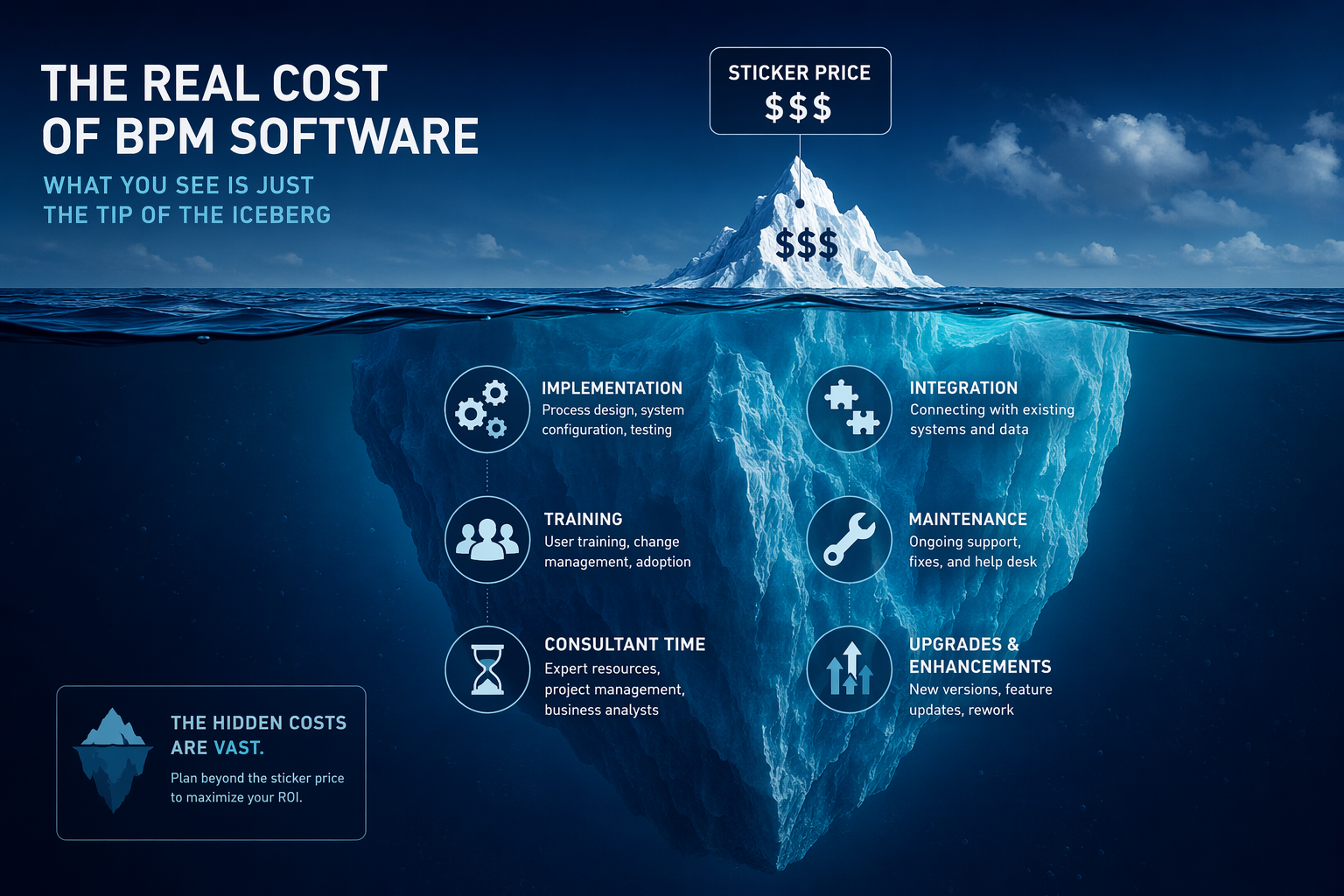
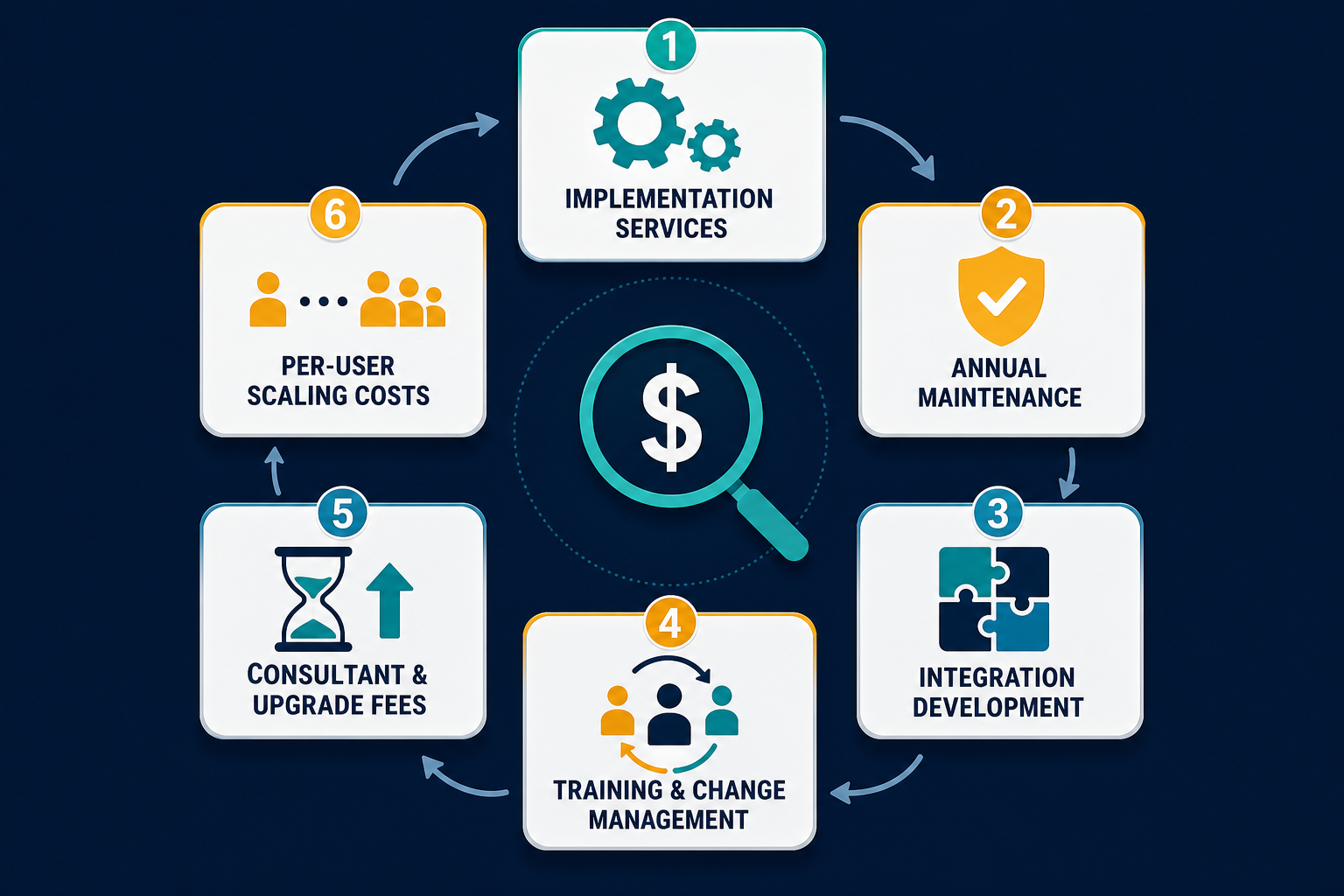
Here are the six major hidden cost categories that can double or triple your BPM bill:
- Implementation services. For legacy platforms like Pega, implementation costs can reach several million dollars over multi-year projects. These costs cover solution architecture, process discovery, configuration, and testing. Even on lower-tier platforms, implementation services from a certified partner can add 50-100% to the first-year license cost.
- Annual maintenance and upgrade fees. Traditional BPM vendors charge 15-22% of the license value annually for maintenance and support. Mandatory upgrade fees — often tied to new feature releases or compliance requirements — add another layer of cost. These fees are non-negotiable for organizations that need vendor support.
- Integration development. BPM platforms rarely exist in isolation. Connecting the platform to your ERP, CRM, HRIS, and other systems requires custom integration work. The complexity of these integrations — and the number of systems involved — directly drives the cost. A single complex integration can cost $20,000 to $50,000 or more.
- Training and change management. Moving from spreadsheets and email-based processes to a structured BPM platform requires significant behavior change. Enterprise-grade training programs — including on-site workshops, e-learning modules, and ongoing coaching — can add $50,000 to $200,000 to the first-year budget.
- Consultant and upgrade fees. Many organizations underestimate the ongoing need for consultant support after go-live. Process optimization, workflow redesign, and platform upgrades often require external expertise. These costs recur annually and are rarely included in the initial contract.
- Per-user scaling costs. As Moxo points out, per-user pricing that looks affordable at 10 users often becomes a significant line item at 100 users. A platform at $24/user/month costs $28,800/year for 100 users — and that is before any add-on fees. Organizations planning to scale from a pilot to enterprise-wide deployment need to model these costs explicitly.
Total Cost of Ownership (TCO) Comparison: Legacy vs. Modern Platforms
To make the cost difference concrete, the table below models the 3-year TCO for a typical 100-user enterprise deployment on two platforms at opposite ends of the spectrum: Pega (enterprise legacy) and Kissflow (modern low-code). The model includes license costs, implementation services, annual maintenance, integration development, training, and consultant fees.
| Cost Category | Pega (100 users, 3 years) | Kissflow (100 users, 3 years) |
|---|---|---|
| License / Subscription | $450,000 – $1,500,000 | $108,000 (100 users at $1,500/mo for 50 users, scaled) |
| Implementation Services | $500,000 – $2,000,000 | $0 – $20,000 (minimal setup) |
| Annual Maintenance (15-22%) | $67,500 – $330,000 | Included in subscription |
| Integration Development | $100,000 – $300,000 | $20,000 – $50,000 |
| Training & Change Management | $100,000 – $200,000 | $10,000 – $30,000 |
| Consultant & Upgrade Fees | $150,000 – $500,000 | $0 – $10,000 |
| Estimated 3-Year TCO | $1.37M – $4.83M | $138,000 – $218,000 |
ROI Timelines: Weeks vs. 12–18 Months
The difference in time-to-value between legacy BPM suites and modern low-code platforms is not incremental — it is structural. A platform like Kissflow can be operational in days, with the first workflow live within a week. The ROI clock starts ticking immediately. Traditional suites like Pega, by contrast, require 12 to 18 months of implementation before they deliver measurable value.
This timeline gap has real financial implications. A platform that takes 18 months to deploy consumes 18 months of license fees, implementation costs, and internal resources before it produces a single dollar of return. A platform that delivers value in weeks can start generating ROI within the same quarter it is purchased. For CIOs under pressure to show results, this is not a minor consideration — it is often the deciding factor.
The ROI advantage of modern platforms is not just about speed. It is also about risk. A 12- to 18-month implementation carries significant execution risk: requirements change, stakeholders lose interest, and the business case can become obsolete before the system goes live. A deployment measured in weeks avoids most of these risks by delivering value incrementally, allowing the organization to adapt and expand as it goes.
Negotiation Tips and an Evaluation Checklist for Enterprise Buyers
Armed with the pricing data and hidden-cost taxonomy above, you can enter vendor negotiations with a clear strategy. The following tactics and checklist will help you build a realistic budget and avoid the most common procurement pitfalls.
Negotiation Tactics
- Ask for implementation costs upfront. Do not let the vendor separate the license discussion from the implementation discussion. Request a single, all-inclusive proposal that covers license, implementation, integration, training, and first-year support.
- Negotiate caps on annual maintenance increases. Standard maintenance contracts allow 4-6% annual increases. Negotiate a fixed cap of 3% or less for the duration of the contract.
- Request a fixed-price integration quote. Integration costs are one of the biggest sources of budget overruns. Ask the vendor or their certified partner to provide a fixed-price quote for the integrations you need, with clear scope boundaries.
- Demand a proof-of-concept timeline. Before signing a multi-year contract, require the vendor to deliver a working proof of concept within 4-6 weeks. This validates both the platform's fit and the vendor's delivery capability.
- Model per-user costs at full scale. If the platform uses per-user pricing, model the cost at your projected user count — not just the pilot group. A platform that looks affordable at 50 users may be prohibitively expensive at 500.
Evaluation Checklist
- What is the total first-year cost, including license, implementation, integration, training, and support?
- What is the estimated 3-year TCO based on our projected user count and process complexity?
- What is the vendor's standard annual maintenance increase, and can it be capped?
- Are there mandatory upgrade fees? If so, how often do they apply?
- What is the typical implementation timeline for an organization of our size and complexity?
- Can the vendor provide references from organizations with similar deployment scope?
- What is the process for scaling from a pilot to enterprise-wide deployment, and what are the associated costs?
- What data portability and exit provisions are in the contract? Can we export our workflows and data if we decide to switch platforms?
Frequently Asked Questions About BPM Pricing
Why is Pega so expensive?
Pega's pricing reflects its position as an enterprise-grade platform designed for large, regulated organizations with complex process requirements. The licensing alone runs $150,000 to $500,000 or more per year, and implementation costs can reach several million dollars over multi-year projects. The platform requires specialized consultants, extensive customization, and significant integration work — all of which drive the total cost.
Can we start with a low-code platform and scale up?
Yes. Modern low-code platforms like Kissflow are designed to scale from departmental pilots to enterprise-wide deployments. The key is to choose a platform that offers enterprise-grade security, governance, and integration capabilities from the start — not a tool that will need to be replaced as your requirements grow. Starting with a low-code platform also allows you to demonstrate ROI quickly, which builds organizational support for broader adoption.
What is the average BPM implementation cost?
There is no single average because the range is so wide. For a legacy suite like Pega, implementation costs can exceed $2 million. For a modern low-code platform like Kissflow, implementation costs are minimal — often zero for straightforward deployments. The best approach is to model your specific TCO using the framework in this guide, then use that model as the basis for vendor negotiations.
How do I calculate TCO for a BPM tool?
Start with the license or subscription cost. Then add: implementation services (typically 50-100% of first-year license for complex deployments), annual maintenance (15-22% of license value), integration development ($20,000-$50,000 per integration), training and change management ($50,000-$200,000 for enterprise deployments), and ongoing consultant fees. Model these costs over a 3-year period to get a realistic TCO. The table in the TCO comparison section above provides a concrete example.