
The Compliance Challenge in Enterprise Automation
For most organizations, robotic process automation (RPA) is a straightforward bet on efficiency: reduce manual effort, eliminate human error, and accelerate throughput. But for banks, insurers, and healthcare providers, automation introduces a second, non-negotiable requirement — compliance. Every automated process in these sectors must withstand scrutiny from regulators, external auditors, and internal risk committees. A bot that processes a mortgage application or handles protected health information cannot simply be fast; it must be provably correct, auditable, and secure.
This is the environment where Blue Prism has built its reputation. While UiPath and Automation Anywhere have raced ahead on attended automation, AI integration, and developer-friendly interfaces, Blue Prism has doubled down on what its core market values most: governance. The platform's architecture was designed from the ground up for environments where a single unlogged bot action or a piece of patient data stored on a local machine constitutes a compliance violation. Understanding why over half of the top 100 financial institutions use Blue Prism requires looking past the feature checklists and examining how the platform handles the fundamental tension between automation speed and regulatory control.
Blue Prism's Governance-by-Design Architecture
The phrase "governance by design" is not marketing language at Blue Prism — it describes a deliberate architectural choice that predates most of the modern RPA market. The platform separates automation logic into two distinct environments: Process Studio, where business analysts define the end-to-end workflow, and Object Studio, where developers build reusable application objects that interact with specific systems. This separation, enforced at the platform level, means that business logic and system integrations are independently versioned, tested, and audited.
The practical consequence for regulated industries is significant. When an auditor asks "who ran this process, on what data, and what exactly happened at each step," Blue Prism's Control Room provides a single source of truth. Every bot action is logged server-side, and critically, no data ever resides on the local machine executing the automation. In a healthcare environment processing protected health information (PHI) under HIPAA, or a bank handling personally identifiable information (PII) under GDPR and SOX, this server-side processing model eliminates an entire class of data exposure risks that platforms with local data caching cannot fully address.
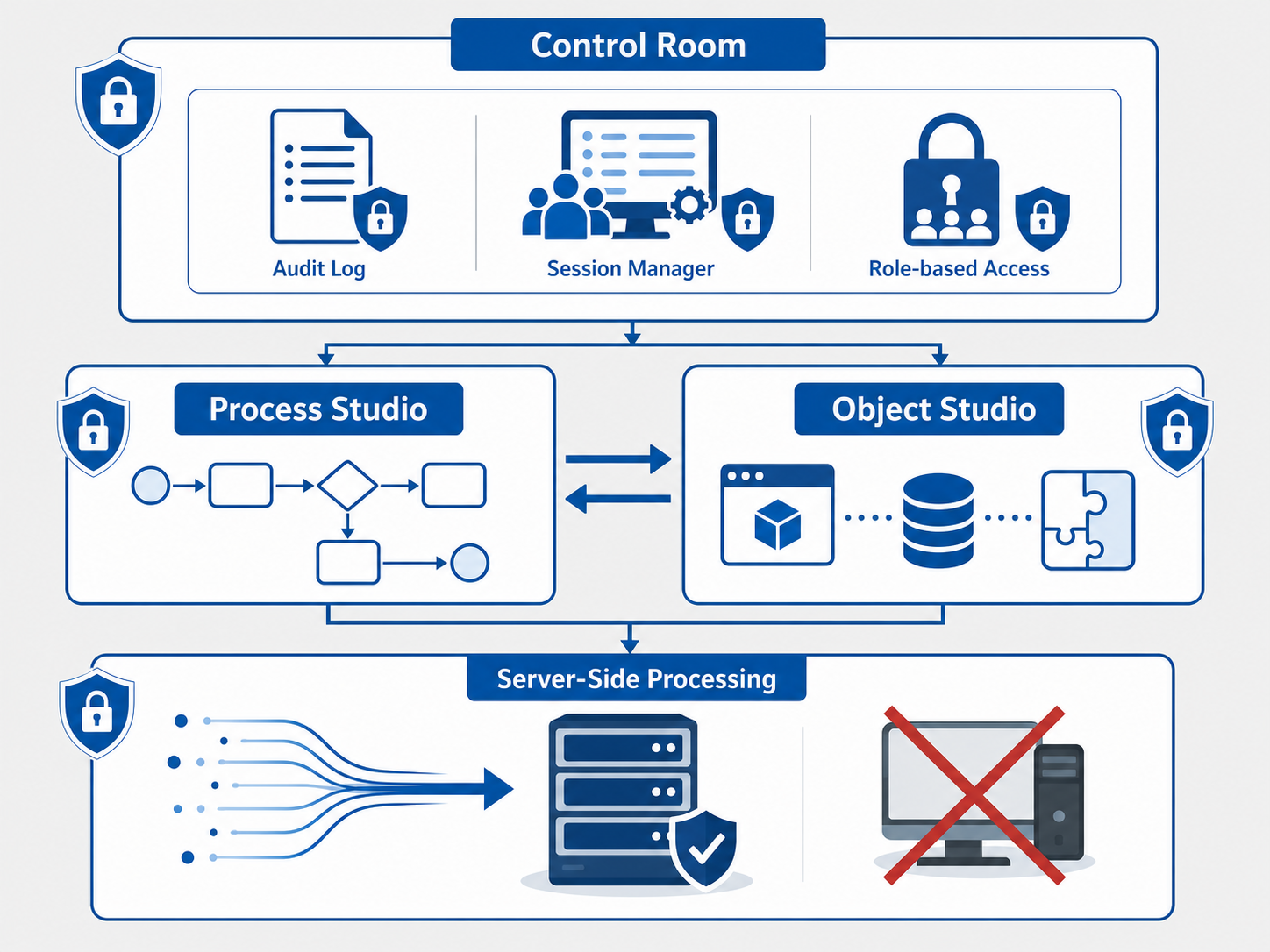
The key architectural features that matter for compliance include:
- Server-side audit logging: Every action a digital worker performs is recorded in the Control Room database. There is no local cache of logs that could be tampered with or lost.
- Role-based access control (RBAC): Permissions are granular and enforced at the environment, process, and object levels. A developer who builds an automation cannot necessarily run it in production.
- Separation of duties: Process Studio and Object Studio enforce organizational boundaries. Business analysts and developers work in their own domains without crossing security perimeters.
- No local data persistence: The runtime resource executing the automation has no persistent storage of the data it processes. This is a fundamental design choice, not a configuration option.
This architecture is not an accident of engineering history. Blue Prism was founded in 2001, years before the term "RPA" was coined, and its original clients were large financial institutions in the UK and Europe. The platform was built to satisfy the audit requirements of those early customers, and that DNA remains visible in every layer of the product today.
Security Certifications and Compliance Credentials
For compliance officers evaluating an RPA platform, security certifications are not optional checkboxes — they are procurement gatekeepers. Blue Prism holds a Veracode Level 5 security certification, the highest rating in the Veracode security review program. This certification indicates that the platform's code has passed rigorous static analysis for vulnerabilities, including SQL injection, cross-site scripting, and buffer overflow risks. In practice, this means that when a bank's procurement team runs its own security review, Blue Prism's codebase starts from a verified baseline that few competitors can match.
How does this map to specific regulatory frameworks? The table below summarizes the alignment between Blue Prism's governance features and the most common compliance standards in regulated industries.
| Regulatory Framework | Key Requirement | Blue Prism Feature That Addresses It |
|---|---|---|
| SOX (Sarbanes-Oxley Act) | Audit trails for financial data processing, segregation of duties | Server-side logging, RBAC, separation of Process Studio and Object Studio |
| HIPAA (Health Insurance Portability and Accountability Act) | Protected health information must not be stored on local devices, access must be logged | No local data persistence, full audit trail in Control Room |
| Basel III / Banking Regulations | Operational risk management, process transparency, data integrity | Version-controlled automation objects, immutable audit logs, role-based access |
| GDPR (General Data Protection Regulation) | Data minimization, right to explanation, processing records | Server-side processing ensures no unnecessary data replication; audit logs provide processing records |