


Why the Sticker Price Doesn't Tell the Story
You find a marketing automation platform that looks perfect. The landing page shows a monthly price that fits your budget. You sign up, import your contacts, and start building workflows. Then the surprises arrive: a mandatory onboarding fee you didn't see coming, a per-user charge that multiplies with every team member you add, or a feature gate that locks essential automation behind a tier that costs three times what you planned.
This is the reality of marketing automation pricing. The sticker price is a starting point, not a final number. The real cost depends on three variables that most comparison articles ignore: your contact volume, the features you actually need, and the hidden fees buried in the fine print.
This guide projects the true total cost of ownership for seven major platforms — ActiveCampaign, HubSpot, Brevo, Klaviyo, Omnisend, Kit, and MailerLite — at three contact tiers: 2,500, 10,000, and 100,000 contacts. We surface the onboarding fees, per-seat charges, overage policies, and feature-gating traps that turn a $39/month plan into a $300/month reality.
If you need a feature-by-feature comparison of workflow builders, read our companion guide: Best Marketing Automation Workflow Tools Compared. This article focuses purely on the real cost — because the cheapest platform at 2,500 contacts is rarely the cheapest at 100,000.
How Marketing Automation Pricing Models Actually Work
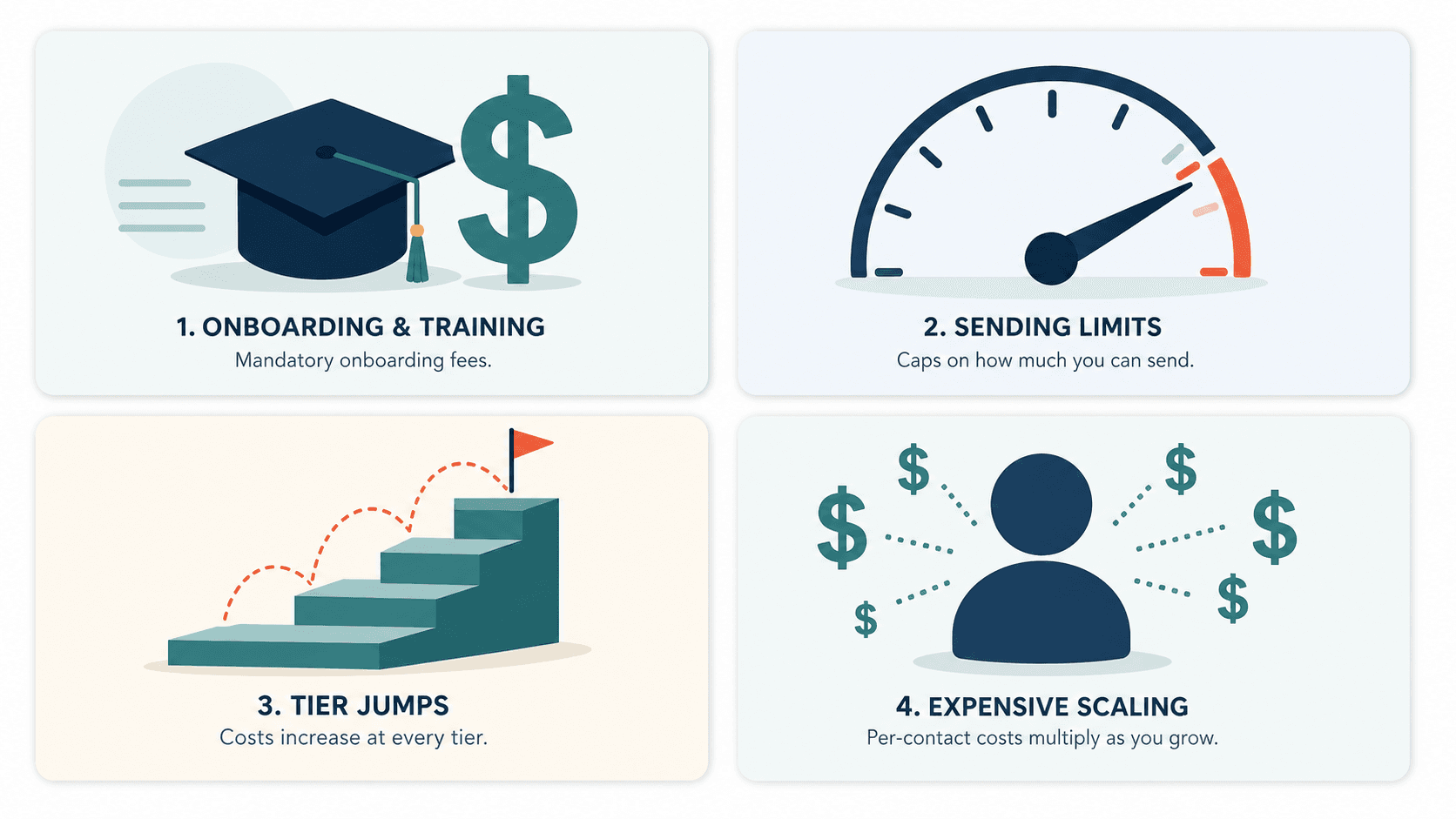
Before we compare specific numbers, it helps to understand the four pricing models that marketing automation platforms use. Most platforms combine two or more of these, which is why direct comparison is impossible without fixing a contact volume first.
- Per-contact pricing: You pay based on the number of contacts in your database. This is the most common model. ActiveCampaign, Brevo, Klaviyo, Omnisend, and MailerLite all use it. The catch: most platforms count all contacts, not just active subscribers, so old lists cost you money.
- Per-seat pricing: You pay per user. monday.com uses this model exclusively, starting at $12/seat/month. This model is great for solo operators but scales poorly for teams.
- Volume-based pricing: You pay based on email volume or API calls, not contact count. Brevo uses this model alongside contact tiers, which is why it offers unlimited contacts on its free plan (capped at 300 emails/day).
- Feature-gated pricing: The base tier gives you basic email sends. Advanced automation, CRM integration, A/B testing, and reporting live behind higher tiers. HubSpot is the most aggressive example: its Marketing Hub Professional plan ($890/month for 2,000 contacts) is where real automation starts, and it comes with a mandatory $3,000–$6,000 onboarding fee.
Understanding these models explains why a $39/month plan can balloon to $300/month as you grow. The platform that looks cheapest at 2,500 contacts may have the steepest price jumps between contact brackets.
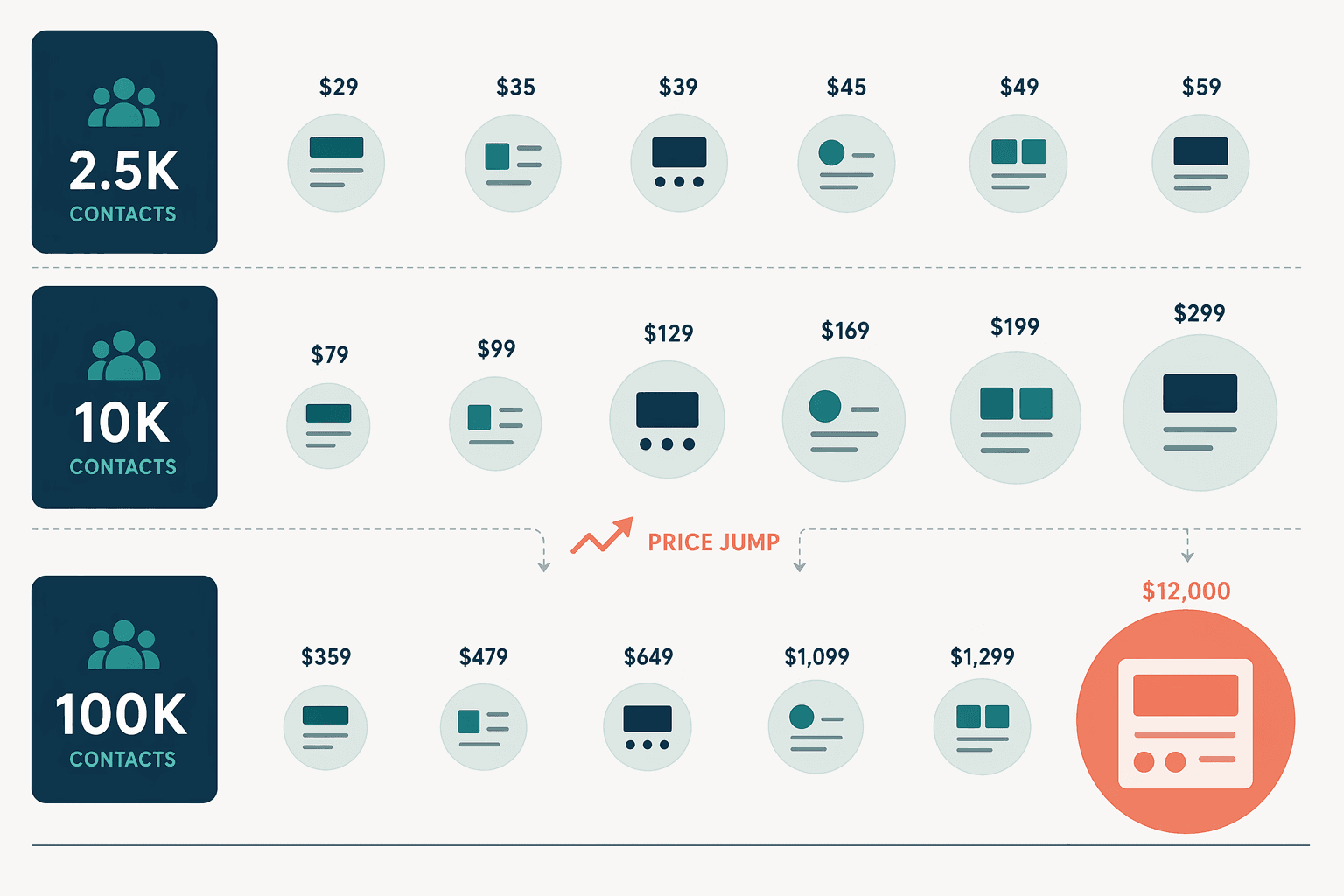
Cost Comparison: What You'll Actually Pay at 2.5K, 10K, and 100K Contacts
The table below shows monthly pricing for each platform at three contact volumes. The 'Hidden Costs' column surfaces mandatory fees that don't appear in the sticker price — onboarding, setup, and required add-ons that make the first-year cost significantly higher.
| Platform | 2,500 Contacts | 10,000 Contacts | 100,000 Contacts | Hidden Costs & Notes |
|---|---|---|---|---|
| ActiveCampaign | $39/mo | $111/mo | $299/mo | Steep tier jumps between contact brackets; CRM add-on costs extra |
| Brevo | $39/mo | $66/mo | $173/mo | Daily sending cap (monthly limit ÷ 30); free tier offers 300 emails/day with unlimited contacts |
| Omnisend | $36/mo | $102/mo | $570/mo | Price spikes dramatically at 100K contacts; e-commerce focused |
| Kit | $49/mo | $119/mo | $679/mo | Flat-fee model becomes expensive at scale; best for creators with small lists |
| Ortto | $149/mo | $249/mo | Not Public | Premium pricing at all tiers; limited transparency at enterprise scale |
| HubSpot | $150/mo | $420/mo | $3,100/mo | Mandatory $3,000–$6,000 onboarding fee for Professional/Enterprise; feature gating behind Pro tier ($890/mo for 2K contacts) |
| MailerLite | $9/mo (est.) | $30/mo (est.) | $150/mo (est.) | Simplest pricing but limited automation features; best for basic email campaigns |
| monday.com | From $12/seat/mo | Per-seat pricing | Per-seat pricing | Does not map to contact tiers; cost depends on number of users, not contacts |
The table reveals a clear pattern: Brevo is the cheapest option at every contact tier, while HubSpot becomes dramatically more expensive as you scale. But monthly price is only part of the story. The hidden costs — onboarding fees, per-user charges, and feature gates — can add thousands to your first-year spend.
Deep Dive: Each Platform's Pricing Gotchas and Hidden Costs
Every platform has its own pricing traps. Here's what to watch for with each tool.
HubSpot: The $3,000 Onboarding Surprise
HubSpot's sticker price at 2,500 contacts ($150/month) is already higher than most competitors. But the real shock comes when you upgrade to Professional, where most automation features live. The Marketing Hub Professional plan costs $890/month for 2,000 contacts — and it comes with a mandatory $3,000–$6,000 onboarding fee. Multiple sources confirm this fee, which is non-negotiable for Pro and Enterprise plans.
On top of that, HubSpot's feature gating means you cannot access advanced automation, A/B testing, or custom reporting without jumping to a higher tier. If you need those features — and most growing businesses do — the $150/month Starter plan is essentially a teaser. The real entry point for serious marketing automation is the Professional plan, which costs $890/month for 2,000 contacts, plus the onboarding fee.
Brevo: The Daily Sending Cap Trap
Brevo's pricing is the most affordable across all three contact tiers — $39/month at 2.5K, $66/month at 10K, and $173/month at 100K. Its free tier (300 emails/day with unlimited contacts) is the best free option for testing automation before scaling.
However, Brevo imposes a daily sending cap. Your monthly email limit is divided by 30, and you cannot exceed that daily limit. If you have a campaign that needs to send 50,000 emails in one day, Brevo's cap may block it. This is a critical consideration for businesses with burst sending patterns — product launches, flash sales, or event promotions.
ActiveCampaign: Steep Tier Jumps Between Contact Brackets
ActiveCampaign starts at $39/month for 2,500 contacts — competitive with Brevo. At 10,000 contacts, it jumps to $111/month, still reasonable. But the pricing structure has steep jumps between contact brackets. Moving from 10K to 25K contacts can double your monthly bill.
ActiveCampaign also charges extra for its CRM add-on ($108/month for 1,000 contacts and 1 user on the Plus plan). If you need both marketing automation and CRM, the combined cost can approach HubSpot's pricing without the same feature depth.
Klaviyo: Expensive Scaling for E-commerce
Klaviyo is built for e-commerce and its pricing reflects that. At 2,500 contacts, it starts around $45/month (for 1,500 profiles on the Email plan). At 10,000 contacts, it jumps to approximately $100–$150/month. At 100,000 contacts, it reaches $570/month — nearly double ActiveCampaign's price at the same volume.
Klaviyo's strength is deep e-commerce integration with Shopify, WooCommerce, and BigCommerce. If you run an online store, the higher price may be justified by the revenue it generates. But for general marketing automation, it is expensive at scale.
Omnisend: The 100K Price Spike
Omnisend is competitive at lower tiers: $36/month at 2,500 contacts and $102/month at 10,000 contacts. But at 100,000 contacts, the price spikes to $570/month — a 460% increase from the 10K tier. This is the steepest percentage jump of any platform in this comparison.
If you expect your contact list to grow past 50,000, Omnisend's pricing becomes difficult to justify. The platform is designed for e-commerce and its feature set is strong, but the scaling cost is punishing.
Kit: Flat-Fee Model That Becomes Expensive at Scale
Kit (formerly ConvertKit) uses a flat-fee model that is great for creators with small lists. At 2,500 contacts, it costs $49/month. At 10,000 contacts, it's $119/month. But at 100,000 contacts, it jumps to $679/month — the second most expensive option after HubSpot.
Kit is optimized for creators, authors, and course builders who need simple automation and landing pages. If you fit that profile and your list stays under 50,000, Kit is a solid choice. But if you plan to scale past 100K, the flat-fee model becomes a liability.
MailerLite: Simple Pricing, Limited Features
MailerLite starts at approximately $9/month for 2,500 contacts and scales to around $150/month at 100,000 contacts. Its pricing is the most transparent and predictable of any platform in this comparison.
The trade-off is feature depth. MailerLite's automation builder is simpler than ActiveCampaign's or HubSpot's. It lacks advanced segmentation, conditional logic, and CRM integration. For basic email campaigns and newsletters, it is excellent. For complex multi-step automation workflows, it will feel limiting.
3-to-5 Year Projection: Which Platform Costs the Least Over Time?
Monthly pricing at a single contact volume is a snapshot. The real question is: what will this platform cost you over 3 to 5 years as your list grows? We modeled three reader personas to find out.
Persona 1: Freelancer Starting at 2.5K Contacts
A freelancer with 2,500 contacts who expects slow growth (reaching 5,000 contacts over 3 years). At this scale, Brevo ($39/month) and ActiveCampaign ($39/month) are the best value. HubSpot ($150/month) and Ortto ($149/month) cost nearly 4x more for similar features. Over 3 years, the difference between Brevo and HubSpot is approximately $4,000 — enough to hire a freelance automation specialist for a month.
| Platform | Year 1 Cost (est.) | 3-Year Cost (est.) | 5-Year Cost (est.) |
|---|---|---|---|
| Brevo | $468 | $1,404 | $2,340 |
| ActiveCampaign | $468 | $1,404 | $2,340 |
| Kit | $588 | $1,764 | $2,940 |
| Omnisend | $432 | $1,296 | $2,160 |
| HubSpot | $1,800 | $5,400 | $9,000 |
| Ortto | $1,788 | $5,364 | $8,940 |
Persona 2: Growing Small Business Reaching 10K Contacts
A small business that starts at 5,000 contacts and grows to 10,000 within 2 years, then to 25,000 by year 5. At 10,000 contacts, Brevo ($66/month) is the cheapest by far. ActiveCampaign ($111/month) is still reasonable. HubSpot jumps to $420/month — and that's before the $3,000 onboarding fee for the Professional plan you will need for automation features.
Over 5 years, the gap widens dramatically. Brevo's total cost is approximately $5,000. ActiveCampaign is around $8,000. HubSpot, including the onboarding fee, exceeds $30,000. That $3,000 onboarding fee alone is more than Brevo's total 5-year cost.
Persona 3: Scaling Startup Hitting 100K Contacts
A startup that grows from 10,000 to 100,000 contacts over 5 years. At 100,000 contacts, Brevo ($173/month) is dramatically cheaper than ActiveCampaign ($299/month) or Klaviyo ($570/month). HubSpot reaches $3,100/month — a price point that forces most startups to reconsider their entire tech stack.
| Platform | Monthly at 100K | 5-Year Cost (est.) | Includes Onboarding? |
|---|---|---|---|
| Brevo | $173 | $10,380 | No |
| ActiveCampaign | $299 | $17,940 | No |
| Klaviyo | $570 | $34,200 | No |
| Omnisend | $570 | $34,200 | No |
| Kit | $679 | $40,740 | No |
| HubSpot | $3,100 | $186,000 | Yes ($3K–$6K) |
The key insight: a cheap starter tier that spikes at 50,000 contacts can cost more long-term than a moderately-priced platform with linear scaling. Brevo's pricing is the most linear of any platform in this comparison, which makes it the safest bet for businesses that expect significant list growth.
Questions to Ask Before You Buy: A Pricing-Call Checklist
Before you sign up for any marketing automation platform, take this checklist to your sales call or use it to compare plans side by side. These questions surface the hidden costs that don't appear on pricing pages.
- Is there a mandatory onboarding or setup fee? HubSpot charges $3,000–$6,000 for Professional and Enterprise plans. Keap charges a setup fee starting at $499. Ask explicitly: 'Is onboarding included, or is it an additional cost?'
- How many users are included in the base price? monday.com charges per seat. HubSpot's Professional plan includes 3 seats. ActiveCampaign's base plan includes 1 user. If you have a team of 5, per-seat charges can double your monthly cost.
- What happens when I exceed my contact limit? Some platforms charge overage fees. Others automatically upgrade you to the next tier. Ask: 'What is the cost per additional 1,000 contacts above my plan limit?'
- Which features are gated behind higher tiers? HubSpot gates automation, A/B testing, and custom reporting behind Professional. ActiveCampaign gates CRM and lead scoring behind Plus. Ask for a feature matrix that shows exactly which features require which tier.
- Is there a daily sending cap? Brevo divides your monthly limit by 30. If you need burst sending for product launches, this can block your campaign. Ask: 'What is the maximum number of emails I can send in a single day?'
- What is the contract length? Monthly plans are usually more expensive than annual. But annual contracts lock you in. Ask: 'Can I switch from monthly to annual mid-cycle? What is the cancellation policy?'
- How much does data migration cost? Moving 100,000 contacts from one platform to another can take hours of manual work. Some platforms offer free migration services; others charge $80–$150/hour for a specialist. Ask: 'Do you offer free migration assistance? What formats can I export my data in?'
- What is the pricing at my expected contact volume in 3 years? Most sales reps will quote you at your current volume. Ask them to project the cost at 2x and 5x your current contact count. This reveals which platforms have linear pricing and which have punishing tier jumps.
For a deeper look at how to build workflows that actually generate revenue once you've chosen a platform, read our guide on 11 Marketing Automation Workflows That Generate Revenue and our practical guide on How to Build Marketing Automation Workflows That Drive Revenue. And if you're already using a platform and wondering why your results are flat, check out 7 Marketing Automation Workflow Mistakes That Kill ROI.
The Bottom Line: Match Your Pricing Model to Your Growth Plan
The cheapest platform at 2,500 contacts is rarely the cheapest at 100,000 contacts. Brevo wins at every tier in this comparison, but its daily sending cap may be a dealbreaker for burst senders. ActiveCampaign offers the best balance of features and price for most small to mid-size businesses. HubSpot is the most expensive option at every tier, and its mandatory onboarding fee makes it difficult to justify unless you need its full CRM and sales suite.
The key takeaway: take a 3-to-5 year perspective when comparing pricing. A platform that costs $39/month today may cost $299/month in 3 years when your list grows. A platform with linear pricing — where the cost per 1,000 contacts stays relatively constant — is almost always a better long-term bet than one with steep tier jumps.
- If you are a freelancer or creator with a small list (under 5K): Brevo's free tier (300 emails/day, unlimited contacts) is the best way to start. Upgrade to the $39/month plan when you need more volume.
- If you are a growing small business (5K–25K contacts): ActiveCampaign at $111/month (10K contacts) offers the best feature-to-price ratio. Brevo at $66/month is cheaper but has fewer automation capabilities.
- If you are a scaling startup (25K–100K+ contacts): Brevo at $173/month (100K contacts) is dramatically cheaper than any competitor. If you need deeper automation, ActiveCampaign at $299/month is still reasonable. Avoid HubSpot unless you have a dedicated marketing budget of $3,000+/month.
- If you run an e-commerce store: Klaviyo and Omnisend are purpose-built for e-commerce. Their higher prices may be justified by better integration and segmentation. But model the cost at your expected 3-year contact volume — Omnisend's 100K price spike ($570/month) can be a nasty surprise.
The global marketing automation market was projected to grow from $3.3 billion in 2019 to $6.4 billion by 2024. With that growth comes more pricing complexity, more feature gating, and more hidden fees. The best defense is a clear understanding of your current and future contact volume, a checklist of must-have features, and a willingness to ask the hard pricing questions before you sign.
For a feature-by-feature comparison of workflow builders, read our companion guide: Best Marketing Automation Workflow Tools Compared. It covers the workflow builder depth, template libraries, and integration ecosystems that this pricing guide intentionally set aside.


Comments
Join the discussion with an anonymous comment.