
From Rule-Based Routing to Intelligence-Driven Approvals
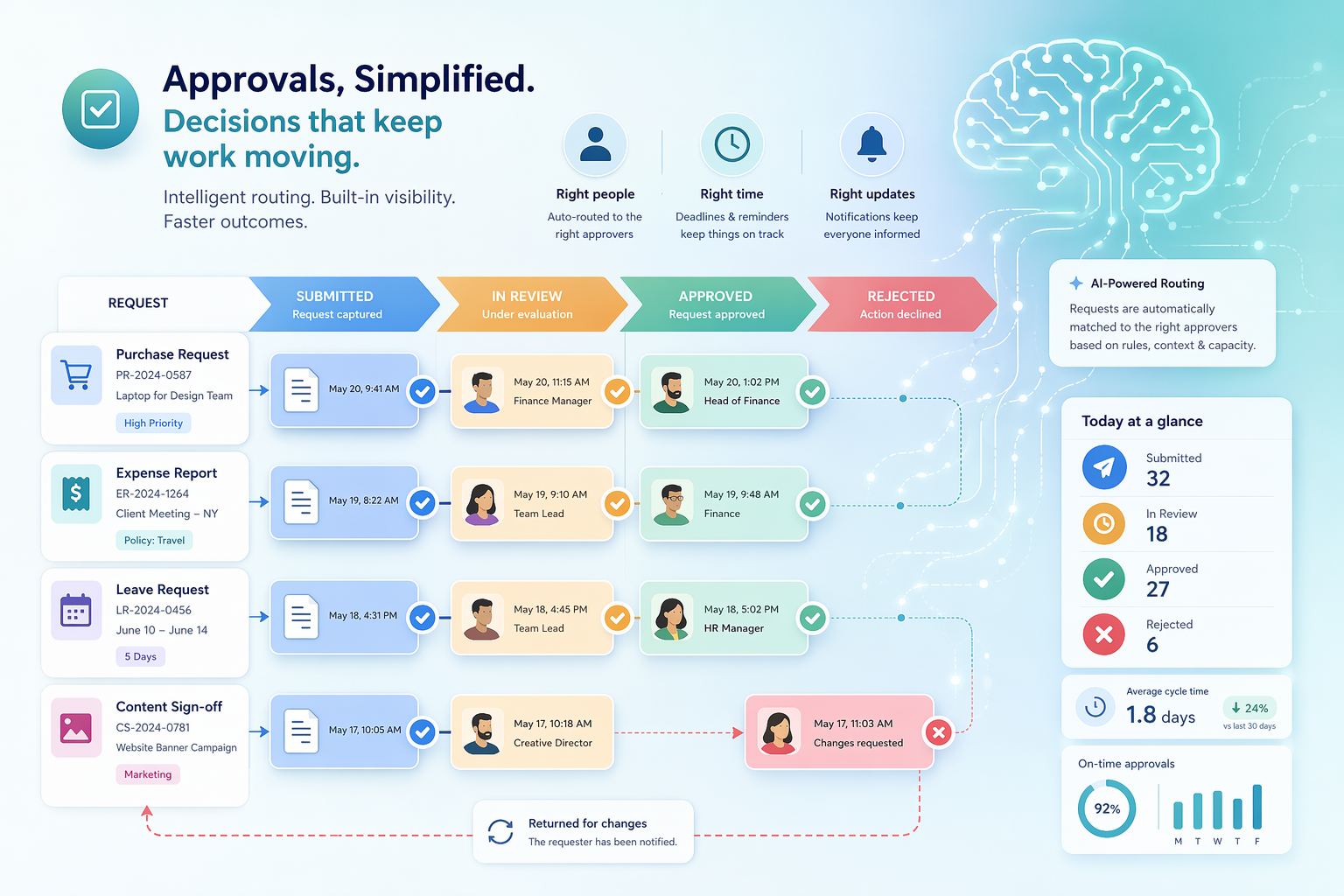
For years, approval workflow software operated on a simple premise: if X happens, send the request to person Y. These rule-based systems served their purpose — they digitized paper forms, enforced basic routing logic, and provided an audit trail. But they also introduced their own set of frustrations. Static routing tables meant that when a manager was out of office, approvals stalled. There was no way to predict a bottleneck before it formed. And building even a moderately complex workflow required dragging dozens of conditional branches onto a canvas.
The shift now underway is more than an incremental feature update. AI is transforming these platforms from passive routing engines into intelligent decision-support systems that can suggest the right approver based on historical patterns, predict which requests will miss their SLA, and even generate an entire workflow from a plain-language description. For tech-forward ops leaders and IT decision-makers, the question is no longer whether to adopt AI-powered approvals, but which capabilities matter most and how to implement them without disrupting existing processes.
This article examines five core AI capabilities that are reshaping how organizations handle approvals, profiles the vendors leading this transformation, and offers practical guidance for teams ready to move beyond rule-based automation.
Five AI Capabilities Reshaping Approval Workflows
The AI features landing in today's approval platforms fall into five distinct categories. Each addresses a specific limitation of traditional rule-based systems, and together they represent a fundamental shift in how approval workflows are designed, executed, and monitored.
1. AI-Suggested Approvers and Next Steps
Traditional approval routing relies on static assignment rules: purchase orders over $5,000 go to the finance director; expense reports from the sales team go to the VP of Sales. These rules work until a person changes roles, goes on leave, or the organizational structure shifts. AI-powered platforms solve this by analyzing historical approval data to learn patterns. The system observes who has approved similar requests in the past, how quickly they responded, and whether they typically approve or reject certain types of submissions.
When a new request arrives, the platform can suggest the most appropriate approver — or even a chain of approvers — based on that learned behavior. If the primary approver is unavailable, the system can recommend a delegate who has handled similar requests before. This capability is particularly valuable in large organizations where routing tables are complex and frequently out of date.
2. Predictive Bottleneck Identification and SLA Enforcement
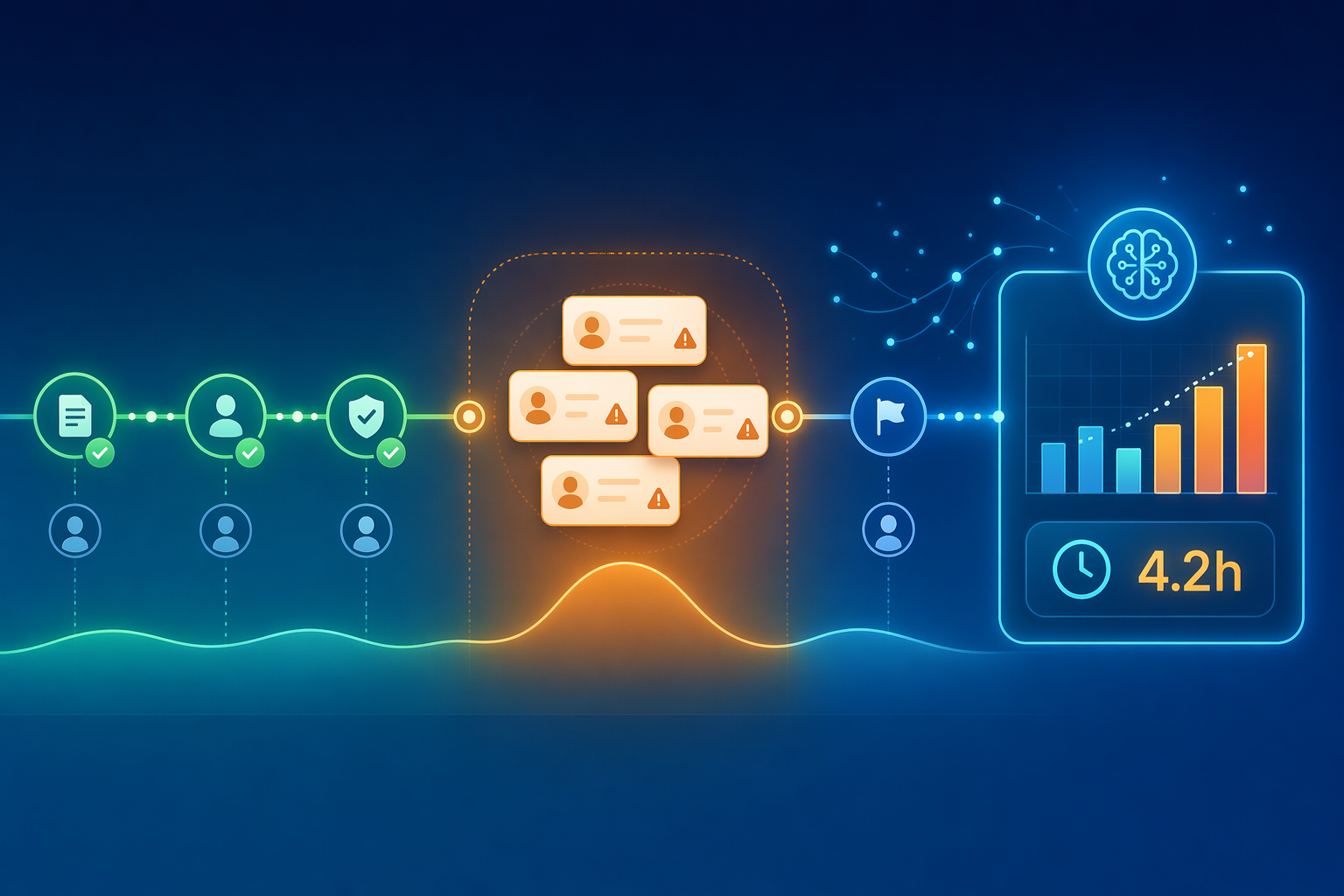
One of the most frustrating aspects of manual approval workflows is the lack of visibility into where delays will occur. A request might sit in a single approver's inbox for days while everyone else in the chain waits. Predictive analytics changes this by analyzing historical cycle times, approver workload, and even calendar data to forecast bottlenecks before they happen.
Modern platforms can flag a request that is likely to miss its SLA based on the current approver's response patterns and workload. Some systems can automatically escalate or reassign the request when a predicted delay crosses a threshold. For cross-departmental workflows — such as a marketing campaign approval that must pass through legal, compliance, and brand teams — this predictive capability prevents the kind of cascading delays that push project timelines.
For a deeper look at how AI identifies bottlenecks in real-world cross-departmental scenarios, see our guide on BPM workflow examples by department.
3. Natural Language Workflow Creation
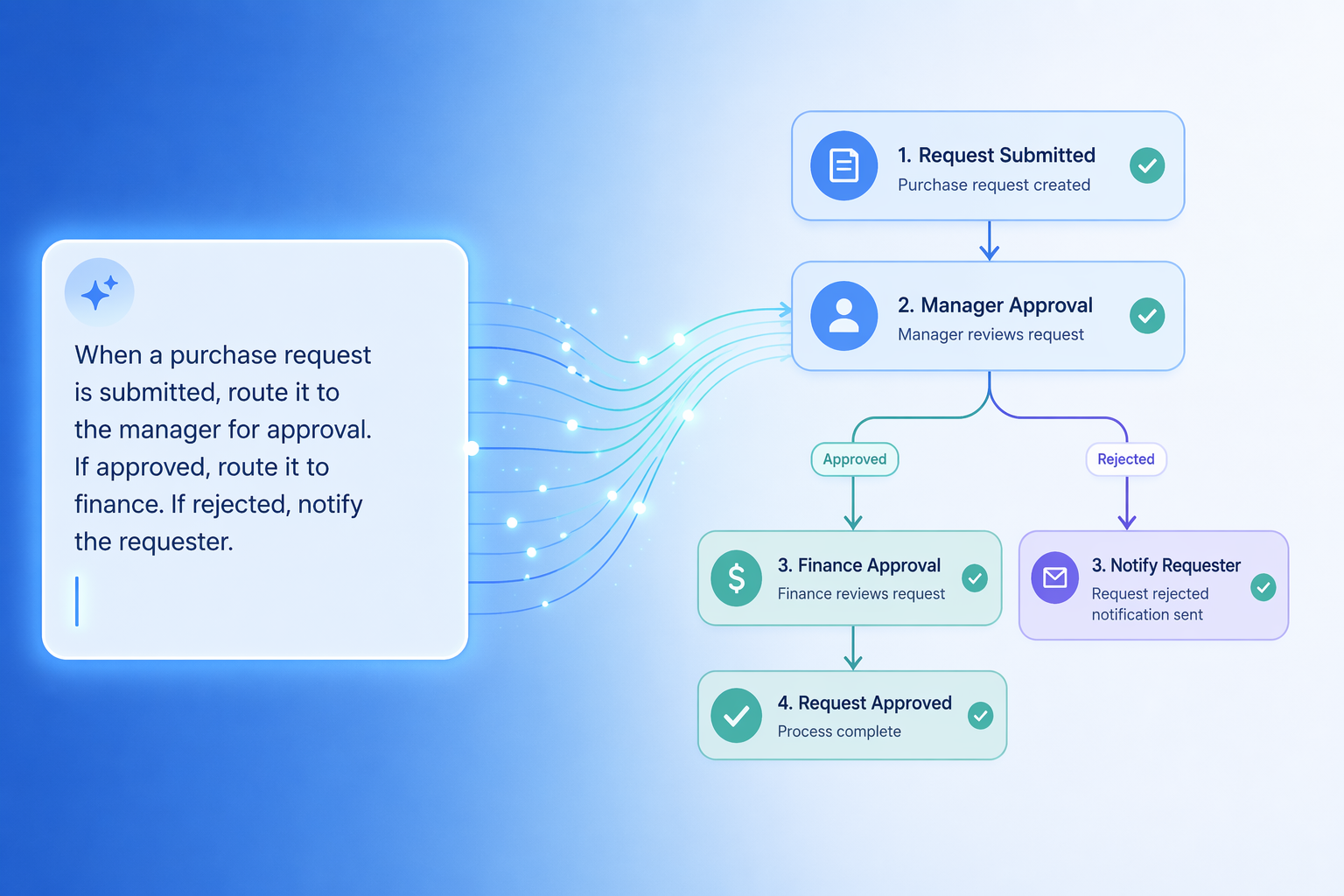
Perhaps the most visible AI capability in the 2026 approval workflow market is natural language workflow creation. Instead of dragging and dropping conditional logic onto a canvas, users describe the process in plain language, and the platform generates the database schema, forms, routing logic, and interface automatically.
Microsoft's Copilot in Power Automate enables this directly within the Microsoft ecosystem, allowing users to type something like "approve expense reports over $1,000 by the department manager and flag anything over $10,000 for finance review" and have the workflow built automatically. Similarly, Zite's conversational builder lets users describe their approval flow in natural language — in testing, it generated a vendor portal with conditional routing (contracts over $10K go to finance, under $10K to department heads) in minutes.
This capability dramatically lowers the barrier to workflow automation. Gartner estimates that 70% of new enterprise applications will be developed using low-code or no-code platforms by 2026, with workflow approval as a top use case. Natural language creation extends that democratization further — users who have never built a workflow can now describe one and have it operational in minutes.
4. Anomaly Detection for Fraud and Compliance
Rule-based systems can flag transactions that exceed a dollar threshold or come from an unapproved vendor. But they cannot detect patterns that suggest fraud or compliance violations — a series of small requests that individually fall under the radar but collectively represent a policy breach, or an approval pattern that deviates from an employee's historical behavior.
AI-powered anomaly detection addresses this by establishing a baseline of normal approval behavior — typical approval times, common approver chains, usual request amounts — and flagging deviations. If a manager who typically approves requests within two hours suddenly starts approving them in thirty seconds, or if a procurement officer begins routing all purchases to a single new vendor, the system can flag the anomaly for review before the request is finalized.
This capability is especially relevant for regulated industries. The BFSI sector held 22.5% of the approval workflow market in 2025, according to Dataintelo, driven by compliance requirements such as SOX and Basel III. Healthcare (17.8%) and government (9.8%, but growing at 13.5% CAGR) follow closely, with HIPAA and GDPR compliance as key drivers.
5. Automated Document Processing with OCR and IDP
Many approval workflows begin with a document — an invoice, a contract, a purchase order, a compliance form. In traditional systems, someone must manually extract key data from that document and enter it into the workflow platform. AI-powered intelligent document processing (IDP) automates this step using optical character recognition (OCR) and machine learning models trained to extract specific fields from structured and semi-structured documents.
When an invoice arrives, the system can automatically extract the vendor name, invoice number, line items, and total amount, populate the approval form, and route it to the correct approver — all without human data entry. If the document contains ambiguous or missing information, the system can flag it for human review rather than rejecting it outright. This capability is closely tied to broader document workflow automation trends that are reshaping how enterprises handle document-heavy processes in 2026.
Vendor Showcase: Who Is Leading the AI Transformation?
The AI shift in approval workflows is not theoretical — it is embedded in the product roadmaps of major vendors and emerging players alike. The following table summarizes the AI capabilities offered by five notable platforms, based on publicly available feature information as of mid-2026.
| Vendor | Key AI Capability | How It Works |
|---|---|---|
| Microsoft Power Automate (Copilot) | Natural language workflow creation | Users describe the approval flow in plain language; Copilot generates the workflow, forms, and routing logic within the Microsoft ecosystem. |
| ServiceNow (Now Assist) | Generative AI across the platform | Now Assist embeds generative AI into ServiceNow workflows, enabling natural language interaction, automated summarization, and intelligent routing suggestions. |
| Appian (+ Google Gemini) | AI-powered process optimization | Appian integrates Google Gemini to provide AI-driven process mining, predictive analytics, and automated decision-making within enterprise BPM workflows. |
| Screendragon (AI Hub) | AI agent management for workflows | Launched in May 2026, Screendragon AI Hub allows users to build and manage AI agents that handle specific approval tasks within marketing and creative workflows. |
| Zite (Conversational Builder) | Natural language app generation | Users describe the approval process in plain language; Zite generates the database, forms, routing logic, and interface, including conditional routing rules. |