
The Steven Bartlett wine controversy became irritating because it was so recognizable. A measurable disturbance appeared on a dashboard, and the dashboard was asked to carry more meaning than it could bear. Bartlett’s widely circulated claim was that three glasses of wine cost him three days of productivity; Inc. framed the episode around that exact claim and the science behind it. [1]
The backlash was not simply anti-health or anti-data. Business Insider, The Independent, and The Drinks Business all treated the moment as a window into optimization culture: the kind of life where a normal evening can be translated into lost recovery, lost output, and a small moral panic before breakfast. [2][3][4] The useful answer to the controversy is split in two: the physiological disruption was not invented, but the claim that it “ruined” days of life was a story placed on top of the measurement.
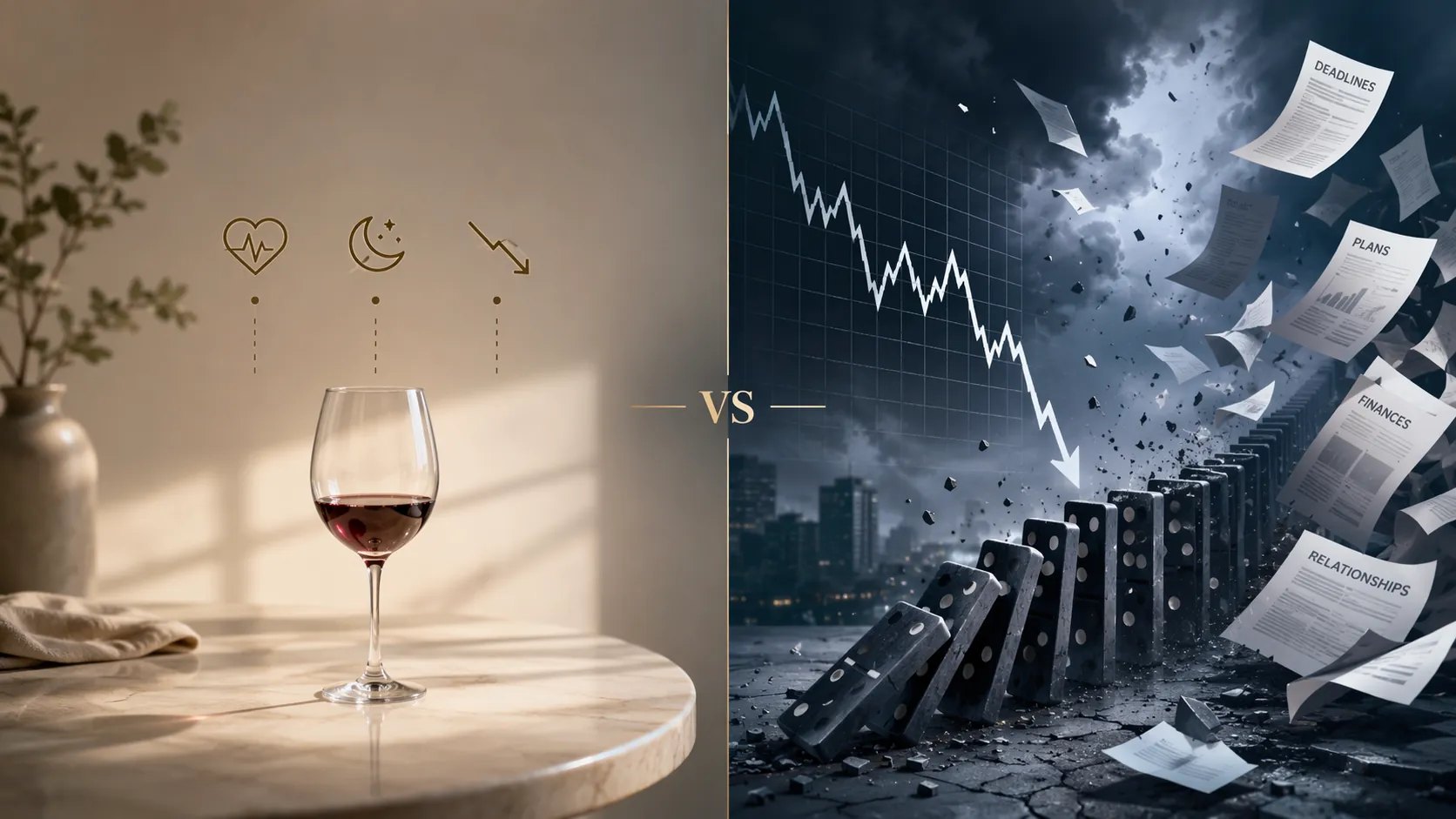
The data can be real without the catastrophe being real
WHOOP’s own press release announced new studies showing that even moderate alcohol can disrupt sleep and recovery. [5] That matters, but the source type matters too: a wearable company has an obvious interest in showing that recovery metrics reveal meaningful signals. The more useful anchor is the peer-reviewed PLOS Digital Health paper on real-world alcohol effects, which reported dose-dependent changes in markers including heart rate, sleep, and physical activity. [6]
That is enough to reject the lazy version of the backlash. It is not serious to say, “Three glasses of wine cannot affect anything.” Sleep and recovery systems do respond to alcohol. Anyone who has woken up after a few drinks with a higher resting heart rate, lighter sleep, or a stale feeling in the morning does not need a wearable to make the point believable.
It is also not enough to accept the dramatic version. A signal is not the same as a life verdict. “My HRV dipped” is information. “I ruined three days” is interpretation. The problem starts when a temporary deviation gets treated as proof that the whole system has failed.
The broader alcohol-health debate should stay outside the frame of this article. A July 2026 Journal of Studies on Alcohol and Drugs item exists, and secondary discussions have repeated specific mortality figures from it, but the original paper requires authentication. Those figures should not be used here as primary conclusions. [7] This article is about a narrower pattern: how optimization culture turns measurable disruption into catastrophic meaning.
Note-app switchers do the same thing with migration risk
The note-app version starts with a practical concern. An Evernote user worries that attachments will not survive export. A OneNote user worries that section structure will flatten into useless folders. A Notion user worries that databases will turn into static Markdown files. An Apple Notes user worries that years of small clippings, scans, and half-remembered links will come out misshapen.
Those are not irrational fears. Attachments do go missing in bad migrations. Links can break. Tags can duplicate. Dates can collapse into plain text. A beautiful nested system can arrive in the new app as a pile of files with technically correct names and no usable working memory attached to them.
The distortion begins one step later. One broken export becomes a lost weekend. A lost weekend becomes a three-week recovery project. A three-week recovery project becomes a permanent productivity collapse. The imagined failure expands faster than the actual failure has been inspected.
This is where the Bartlett comparison is useful. The question is not whether switching note apps causes disruption. It does. The question is whether the disruption is bounded, observable, and recoverable, or whether it has been inflated into a reason to keep living inside a system that already fails you in smaller ways every day.
What can actually break in a migration
Without verified FlowDesk migration test data, it would be dishonest to claim a failure percentage, a recovery time, or a neat “most problems resolve within X hours” promise. The narrower, more useful claim is this: migration problems are usually inspectable as classes of failure. You do not have to wait for disaster to discover them.
| Fear | What to inspect | What the result tells you |
|---|---|---|
| Attachments disappear | Export a representative sample with PDFs, images, scans, and old clipped files | Whether the new app preserves files, paths, filenames, and previews well enough for daily use |
| Hierarchy flattens | Check notebooks, folders, sections, pages, and subpages after import | Whether structure must be rebuilt manually or whether search and links can replace part of it |
| Internal links break | Test notes that link to other notes, embedded documents, and external sources | Whether the old system depends on link behavior the new app cannot reproduce |
| Tags become noise | Compare a small tag-heavy export against the original | Whether tags are a real retrieval layer or just accumulated decoration |
| AI features stop working | List which summaries, searches, automations, or chat features are essential | Whether the workflow depends on a feature that may change outside your control |
A migration test is not a vibe check. It is a small audit. The point is to find the damage while the old system still exists, not to perform a heroic rescue after deleting the source.
This is also where comparison articles often get sloppy. A clean interface screenshot does not prove migration safety. A founder promise does not prove export quality. A Reddit success story does not prove your database-heavy workspace will survive. If you need a concrete example of why “what broke” evidence matters more than app preference, a migration-specific test such as which ChatGPT export method works best for Obsidian Markdown is more useful than a generic productivity ranking.
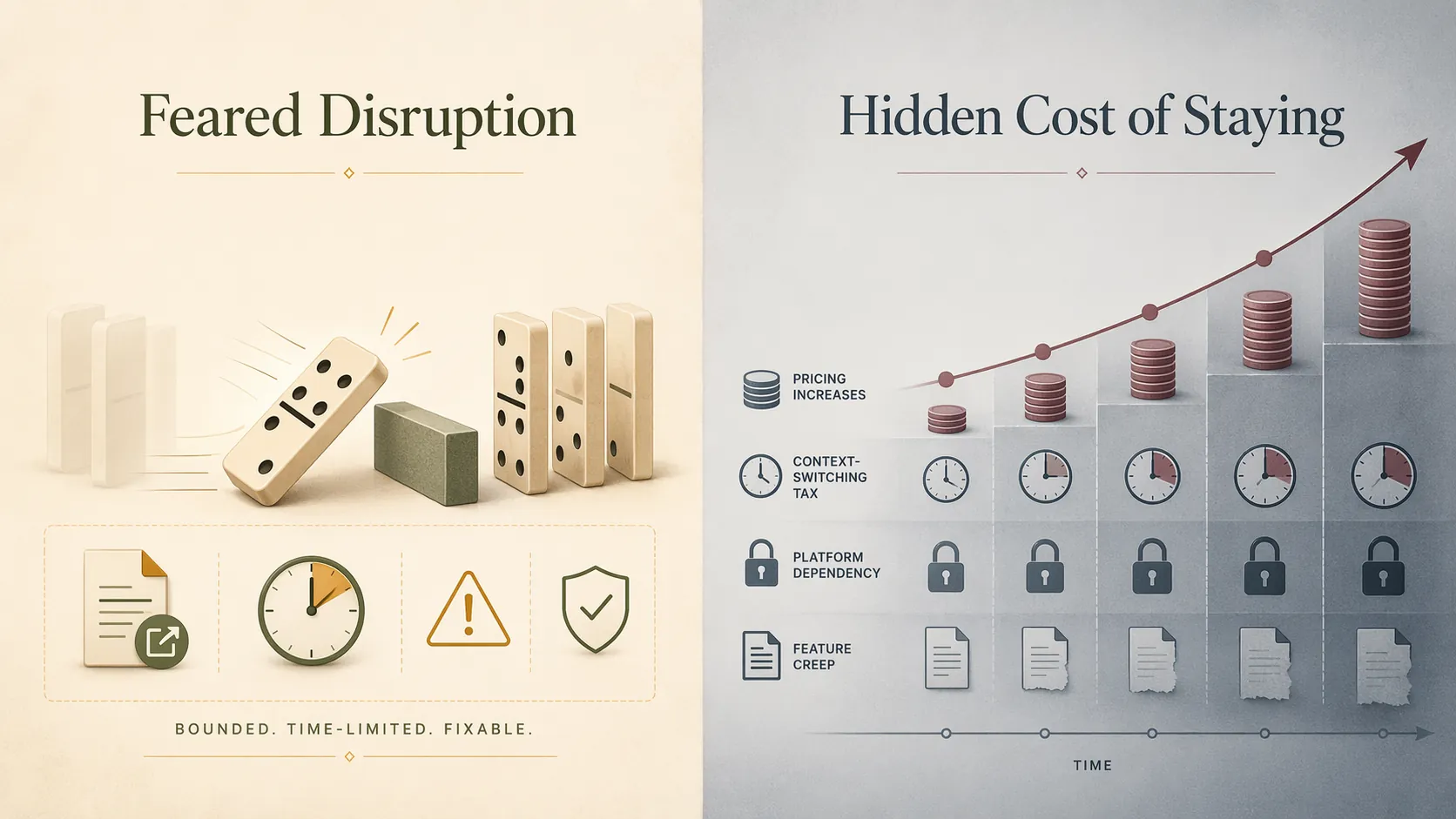
Staying has a cost, but it rarely arrives as an event
Migration fear has an advantage: it is dramatic. You can picture the export folder. You can picture the missing PDFs. You can picture the Monday morning where your notes are split between two apps and search is useless.
The cost of staying is quieter. It shows up as a few extra seconds deciding where to put something. A duplicated note because search failed again. A meeting record trapped in one app while the project plan lives in another. A tag system nobody trusts. A subscription renewal that feels annoying but not quite annoying enough to trigger action.
AI dependency adds another layer. If your note workflow now relies on summarization, semantic search, chat history, or an assistant tied to a platform deal, the risk is not only whether the app works today. It is whether the workflow still works after the vendor changes model access, pricing, limits, privacy posture, or roadmap. That is why a platform-risk comparison such as moving from OneNote to Obsidian after Microsoft AI changes belongs in the same decision calculus as export safety.
A fragile system can look stable because it has not failed in public yet. If your notes depend on a chain of app, cloud account, AI provider, browser extension, automation, and pricing tier, then “I did not switch” is not the same as “nothing changed.” The dependency chain can move while you stand still. For readers already worried about that layer, which note apps work when ChatGPT goes down is a better question than whether a notes app has the most impressive AI demo.
The hidden cost of staying is especially hard to measure because it does not feel like damage. It feels like maintenance. You adjust your naming convention. You tolerate another slow search. You stop saving certain things because the capture flow is too clumsy. You keep a second app “just for now.” Six months later, the system has become harder to leave because you kept feeding the parts that did not fit.
The better comparison is not old app versus new app
Most stuck note-app users compare the wrong things. They compare the current app on its best day with the migration on its worst imagined day. That is not a fair test.
The current app should be evaluated as it actually behaves now: with its clutter, pricing, feature bloat, export anxiety, slow capture, weak retrieval, and dependencies. The migration should be evaluated as a controlled event: sample export, verification pass, broken-item list, fallback copy, and a decision about what is worth rebuilding.
That does not mean switching is always correct. Some systems are ugly but dependable. Some migrations reveal that the old app was doing more structural work than the user realized. Some workflows depend on features that the preferred new app simply does not have. In those cases, the test has done its job: it has replaced dread with evidence.
What the test should not do is inherit the Bartlett-style drama where a measurable dip becomes a personal defeat. A flattened folder tree is a problem. It is not proof that the migration was reckless. A week of unfamiliar shortcuts is friction. It is not proof that the old app was better. A failed import sample is information, and information is much cheaper before the full move than after years more accumulation.
A decision frame before you switch
Before turning this into a full migration project, ask a smaller set of questions:
- What exactly am I afraid will break: attachments, links, hierarchy, tags, dates, search, automations, AI features, or daily capture?
- Can I test that fear with a representative export instead of imagining the entire archive failing at once?
- Which failures would be unacceptable, and which would merely require cleanup?
- What is the current system already costing me each week in friction, avoidance, duplicate storage, or lost trust?
- Which risks are outside my control if I stay: pricing, AI access, export limits, platform strategy, or vendor funding pressure?
That last question matters more in 2026 than it did when note apps were mostly storage and search. Funding pressure, AI positioning, and platform partnerships can change what an app is trying to become. If that is the part making your current setup feel unstable, how AI funding drives note-taking app migration waves is part of the comparison, not a separate industry footnote.
Bartlett’s data may have been real. “Ruined” was the optional part. Note-app migration risk is real too: files can misbehave, structures can flatten, and familiar routines can slow down for a while. But “too dangerous to attempt” is often the same kind of story, especially when the alternative is staying inside a system whose cost is spread thin enough to ignore.
Do not ask whether switching causes disruption. It does. Ask whether that disruption can be bounded, observed, tested, and recovered from, compared with the unmeasured cost of continuing to build your work inside a system that no longer fits.
References
- Steven Bartlett Claims 3 Glasses of Wine Cost Him 3 Days of Productivity. Here's What the Science Says — Inc.
- Steven Bartlett and the 3 glasses of wine — Business Insider.
- Is there anything more miserable-looking than Steven Bartlett's perfectly optimised life? — The Independent.
- Steven Bartlett had three glasses of wine. The rest of us had a Thursday — The Drinks Business, June 2026.
- New WHOOP Studies Show Even Moderate Alcohol Disrupts Sleep and Recovery — WHOOP, April 2026.
- Real-world effects of alcohol on heart rate, sleep, and physical activity — PLOS Digital Health, April 2026.
- Alcohol Intake and Health Study: No Protective Effect at Low Levels — Journal of Studies on Alcohol and Drugs, July 2026.





Comments
Join the discussion with an anonymous comment.