
The familiar failure mode is not dramatic. Your second brain looks competent. Notes are clipped, summarized, tagged, linked, maybe even routed through a PARA setup or a Zettelkasten-style vault. The graph is dense enough to feel alive. Then, when a project actually asks for the knowledge, you reach for it and find the outline but not the thought.
The usual suspects are easy to blame: weak reviews, messy folders, too many inboxes, a template that captures more than it clarifies. Those are real problems. FlowDesk already treats them as system-design issues in why most PKM systems fail and in its guide to 12 reasons your PKM system is not working. But cannabis, REM sleep, and productivity belong on the same troubleshooting map, because a second-brain system does not end at capture. The biological step after capture is consolidation, and that step happens largely while you are offline.
That is where evening cannabis can create a false accounting problem. Sleep may feel heavier, deeper, and more welcome. For adults using cannabis to come down, manage pain, or make bedtime less hostile, that subjective benefit should not be dismissed. The issue is narrower and more mechanical: the part of sleep that feels restorative is not the same as the part most relevant to turning yesterday's inputs into tomorrow's usable memory.
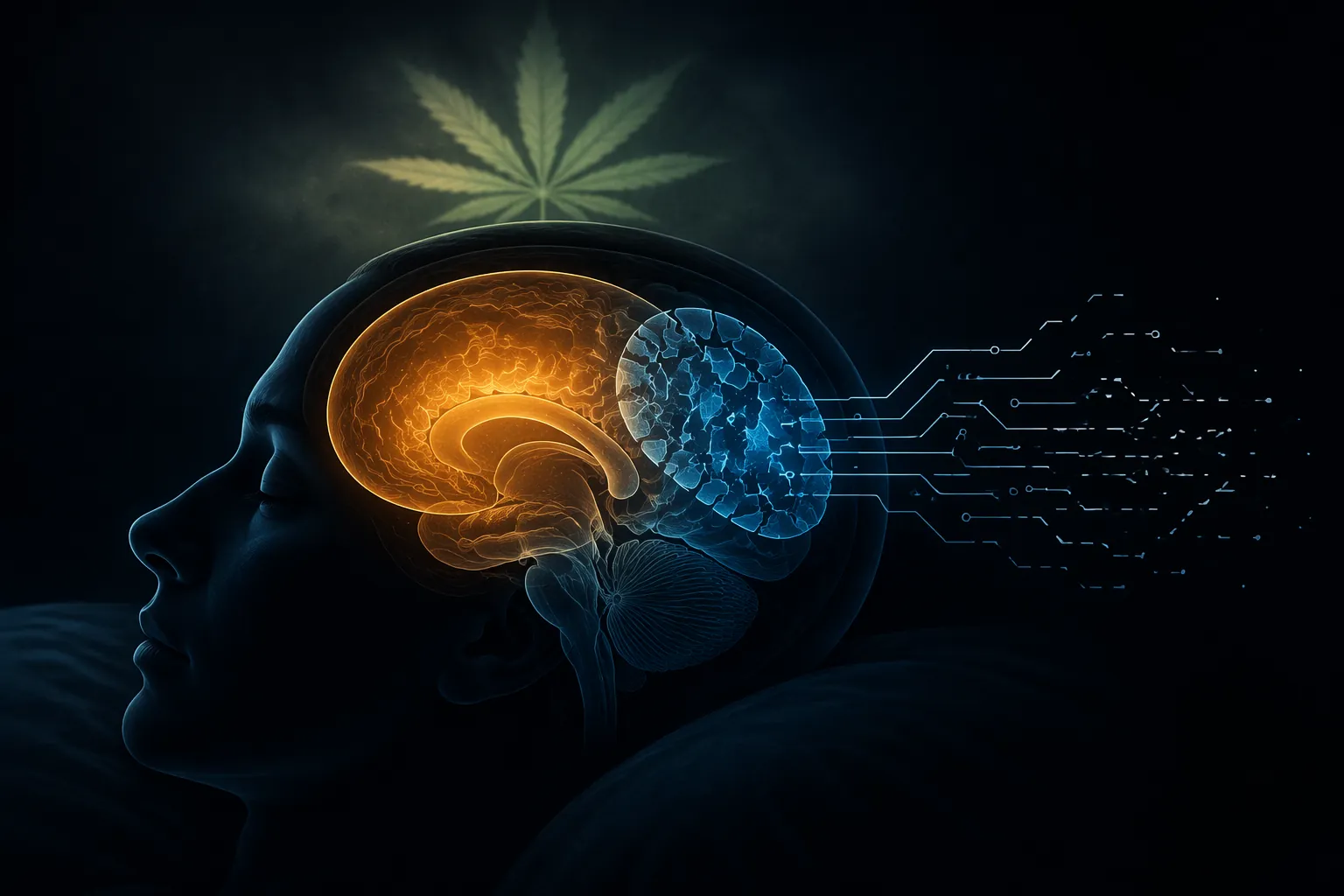
The Sleep Tradeoff Hidden Inside a Better Night
A 2025 BrainHealth and University of Texas at Dallas EEG study of adults with chronic pain tracked 339 nights of sleep and found a tradeoff that matters for knowledge workers: cannabis use was associated with increased slow-wave sleep and decreased REM sleep. In plain terms, the night can tilt toward more deep sleep while giving up some REM, so the user may wake with a reasonable story that cannabis improved sleep even as one memory-relevant sleep phase was reduced.[1]
That finding sits inside a broader literature rather than standing alone. A 2021 review of cannabinoids and sleep reported that THC reduces REM sleep duration and REM density, while noting that cannabinoid effects vary by compound, dose, timing, disorder, and user history.[2] That caveat matters. The evidence does not support a clean universal rule such as one evening dose always causing the same next-day cognitive cost for every person.
Still, for second-brain users, the tradeoff is unusually relevant. The vault is not just a storage location. It is a bet that the brain will later recognize patterns, recover context, notice relationships, and reuse fragments. If REM is being compressed after capture, the system may still look busy while the person using it gets less integration from the same inputs.
A Second Brain Needs More Than a Capture Layer
Most second-brain frameworks describe the visible flow: capture, organize, distill, express. The PKM stack is useful because it makes that information flow explicit. But there is an unglamorous layer under the stack: the nervous system has to stabilize and recombine what the tools collected.
That is why the argument is not PARA versus Zettelkasten, Notion versus Obsidian, or manual backlinks versus AI search. Those choices change the external arrangement of knowledge. They do not remove the need for the brain to consolidate memory. A well-matched system, whether chosen through a PKM framework comparison or tuned to a preferred thinking style, can reduce friction. It cannot substitute for the sleep-dependent work that makes retrieved knowledge feel familiar, connected, and usable.
This is the small private shame many vault builders know too well: the tool contains the material, but the mind does not seem to own it. The reflex is to rename the folders again, rebuild the dashboard, add properties, install another plugin, or switch from one second-brain approach to another. Sometimes that helps. Sometimes it is just tooling effort piled on top of a biological bottleneck.
The Memory Evidence Points Through Sleep
The most useful evidence here is not merely that cannabis users perform differently on memory tasks. It is the finding that sleep disruption helps explain the memory difference. In a 2024 UT Dallas and Center for BrainHealth study of 141 participants with cannabis use disorder, researchers reported that sleep disruption, rather than cannabis use directly, mediated memory deficits. They also found spatial and visual memory more affected than verbal memory.[3]
For a second-brain user, spatial and visual memory are not abstract lab categories. They are how you remember that a project note sits near a source note, that a cluster in a graph view used to mean something, that a Notion page layout had a particular path through evidence, or that a visual map gave a cue you could follow without searching. A vault is full of external memory aids, but using it fluently still depends on internal cues.
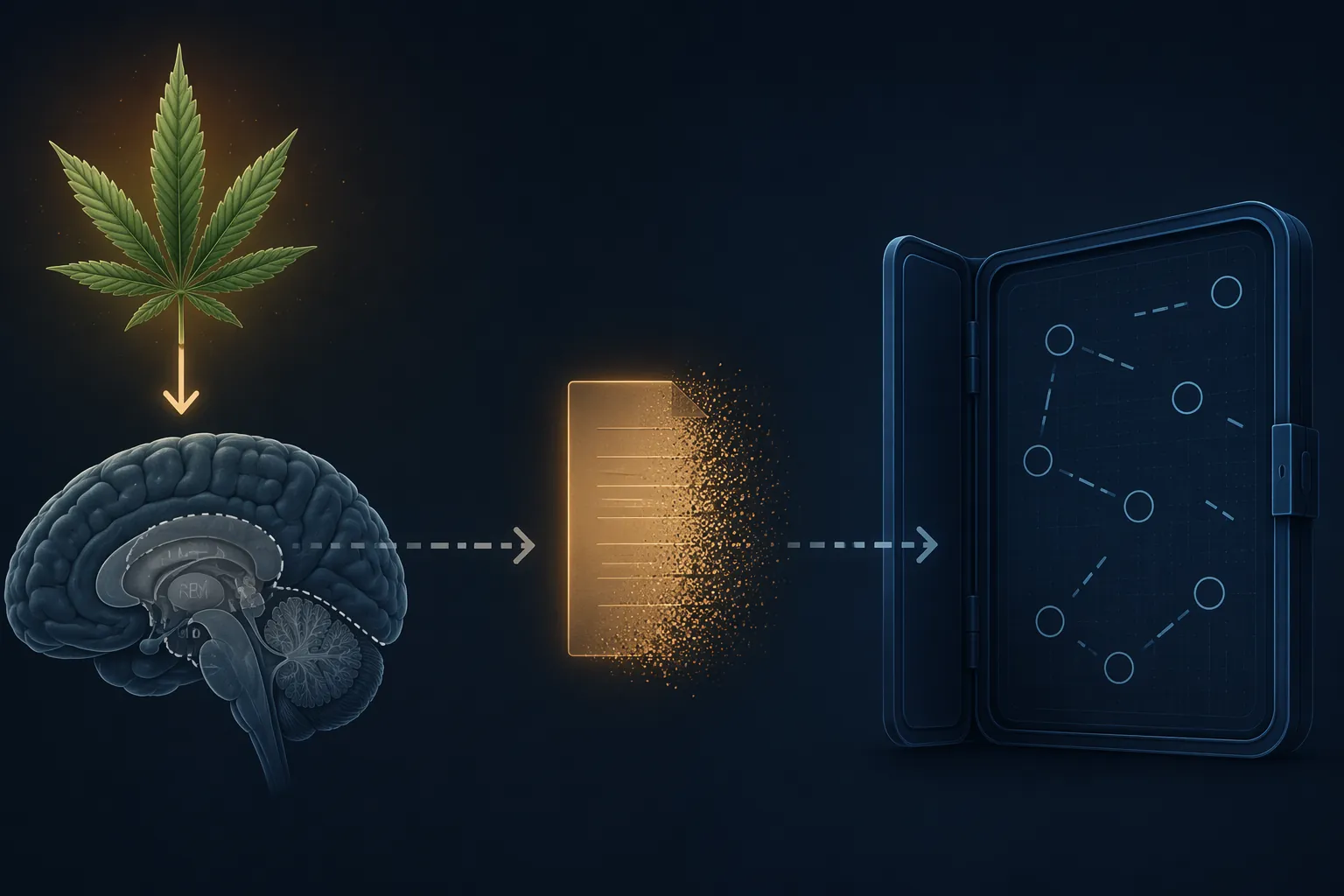
That makes the UT Dallas result unusually practical. If the weaker link is spatial and visual memory, the failure may show up as friction inside the very interfaces that second-brain users trust: graph navigation, canvas boards, linked databases, visual dashboards, and note layouts. The user does not necessarily forget that a note exists. They lose the felt route back to why it mattered.
Next-Morning Deficits Are Easy to Mislabel as Workflow Problems
The next-day piece matters because second-brain work is often delayed work. You read at night and synthesize in the morning. You clip during a research session and write two days later. You collect weak signals for a future project. If the cost appears after intoxication has passed, it is easy to mislabel it as procrastination, shallow processing, or a bad review cadence.
A 2025 CU Anschutz report on a JAMA Network Open study of more than 1,000 participants found that 63% of heavy cannabis users showed reduced brain activity during a working-memory task, including in regions such as the dorsolateral prefrontal cortex.[4] That does not mean every cannabis user will experience the same impairment, and it does not prove that one person's evening use caused one bad workday. It does make working memory a poor place to assume immunity.
The 2026 CAMH study is even closer to the morning-after problem. In adults who used cannabis frequently, smoking infused joints with a mean THC concentration of 30% produced a large-effect-size deficit in verbal delayed recall the next morning, with Cohen's d reported at 0.84.[5] Verbal delayed recall is not identical to writing a literature note or reconstructing an argument from a vault, but the overlap is obvious enough to take seriously.
This is where modern potency changes the practical risk. The same CAMH paper notes that average cannabis flower THC rose from 8.9% in 2008 to about 30% in 2025.[5] Dose control was never perfectly simple, because route of administration, tolerance, metabolism, product labeling, and timing all matter. Higher average potency makes the old intuition of “a normal amount” less reliable.
Why the User Keeps Blaming the Vault
The cruel part is that the person affected may not feel affected. Productivity culture loves problems that can be solved by discipline because discipline keeps the blame inside the user. PKM culture has its own version: if the note did not become insight, perhaps the title was wrong, the tags were lazy, the folder boundary was ambiguous, or the review interval was too long.
Cannabis adds another reason self-diagnosis can fail: impairment may outlast the feeling of being high. A professional-oriented synthesis from Tryfloral describes spatial working-memory deficits persisting up to 22 hours after subjective intoxication and also discusses cannabis-related metacognition impairment, meaning users may be poor judges of their own performance while they are trying to decide what went wrong.[6] Because this is a secondary synthesis rather than the strongest primary evidence in the article, it should be treated as a caution about self-assessment, not as a personal threshold.
That metacognitive blind spot is enough to explain a lot of wasted redesign. The person does not experience the missing REM as an event. They experience a morning in which the idea is harder to re-enter, the article outline feels flatter, the graph looks decorative, and the note that seemed brilliant last night now requires rereading from scratch. The interface is visible, so it gets blamed. Sleep architecture is invisible, so it escapes review.
What This Changes in a Second-Brain Troubleshooting Session
A useful troubleshooting session should separate three failures that often feel the same.
| What seems broken | What may actually be happening | What to inspect |
|---|---|---|
| Notes feel hard to reuse | Capture is working, but consolidation is weak | Timing of cannabis use relative to sleep and next-day synthesis |
| Graph view looks impressive but unhelpful | Spatial and visual cues are not becoming reliable retrieval paths | Whether navigation depends on recognition you no longer get automatically |
| Morning writing feels blank despite heavy evening reading | Delayed recall or working memory may be reduced after sleep | Whether the problem clusters after cannabis-assisted nights |
| You keep rebuilding the system | Metacognition may be poor enough that the tool gets blamed first | Whether redesigns actually improve retrieval, not just aesthetics |
This is not a medical instruction to use cannabis differently or stop using it. People use cannabis for different reasons, including pain and sleep, and the research base still includes observational and cross-sectional evidence alongside more controlled work. Randomized evidence for cannabinoid sleep benefits is also mixed by condition and compound, so confident universal advice would outrun the data.[2]
It is, however, a reason to stop treating second-brain failure as purely architectural. If you are comparing Notion, Obsidian, and AI-native research systems, the comparison is still worth doing. If you are implementing the PARA Method in Notion, structure still matters. The correction is simply to add a missing layer to the audit: what happens between the night you capture information and the day you expect it to be available?
The Clean Accounting
The honest version is not “cannabis ruins productivity” and not “better tools solve everything.” The more precise claim is that evening THC can reduce REM sleep, REM reduction is tied to memory consolidation concerns, and recent studies connect cannabis-related sleep disruption with measurable memory deficits. For someone whose productivity system depends on remembering, navigating, recombining, and reusing knowledge, that pathway is directly relevant.
No backlink strategy can consolidate a memory for you. No dashboard can restore a retrieval cue that never stabilized. No AI search result can fully replace the internal familiarity that lets you recognize why a note belongs in the argument you are building. If a meticulous second-brain system is not sticking, evening cannabis belongs on the troubleshooting checklist alongside vault structure, capture habits, review cadence, and the rest of the workflow.
References
- New BrainHealth Research Reveals Tradeoffs on Sleep with Cannabis Use for Chronic Pain — Center for BrainHealth, Dec. 2025.
- Effects of Cannabinoids on Sleep and their Therapeutic Potential for Sleep Disorders — PMC, 2021.
- Cannabis's Effects on Memory Might Be Related to Sleep Disruption — University of Texas at Dallas, 2024.
- Largest study ever done on cannabis and brain function finds impact on working memory — CU Anschutz, Jan. 2025.
- Cognitive performance and subjective effects the morning after last use of smoked cannabis by adults who use cannabis frequently — PMC, 2026.
- How THC Affects Productivity: A Professional's Guide — Tryfloral.





Comments
Join the discussion with an anonymous comment.