
Last verified: August 2, 2026.
The live question is no longer whether students use ChatGPT around schoolwork. In a Pew Research Center survey of 1,391 U.S. teens conducted from September to October 2024, 26% said they had used ChatGPT for schoolwork, double the 13% share reported in 2023. The more interesting split is what teens think it is acceptable for: 54% said using ChatGPT to research new topics is acceptable, while only 18% said the same for writing essays.[1]
That puts research and note-taking in the gray zone students actually occupy. They may not be asking it to write the final essay. They may be asking it to explain a source, summarize a passage, pull out key points, or turn scattered reading into tidy notes. The danger is quieter than cheating: the work looks organized before the learner has done the selecting, rephrasing, and connecting that makes notes useful later.
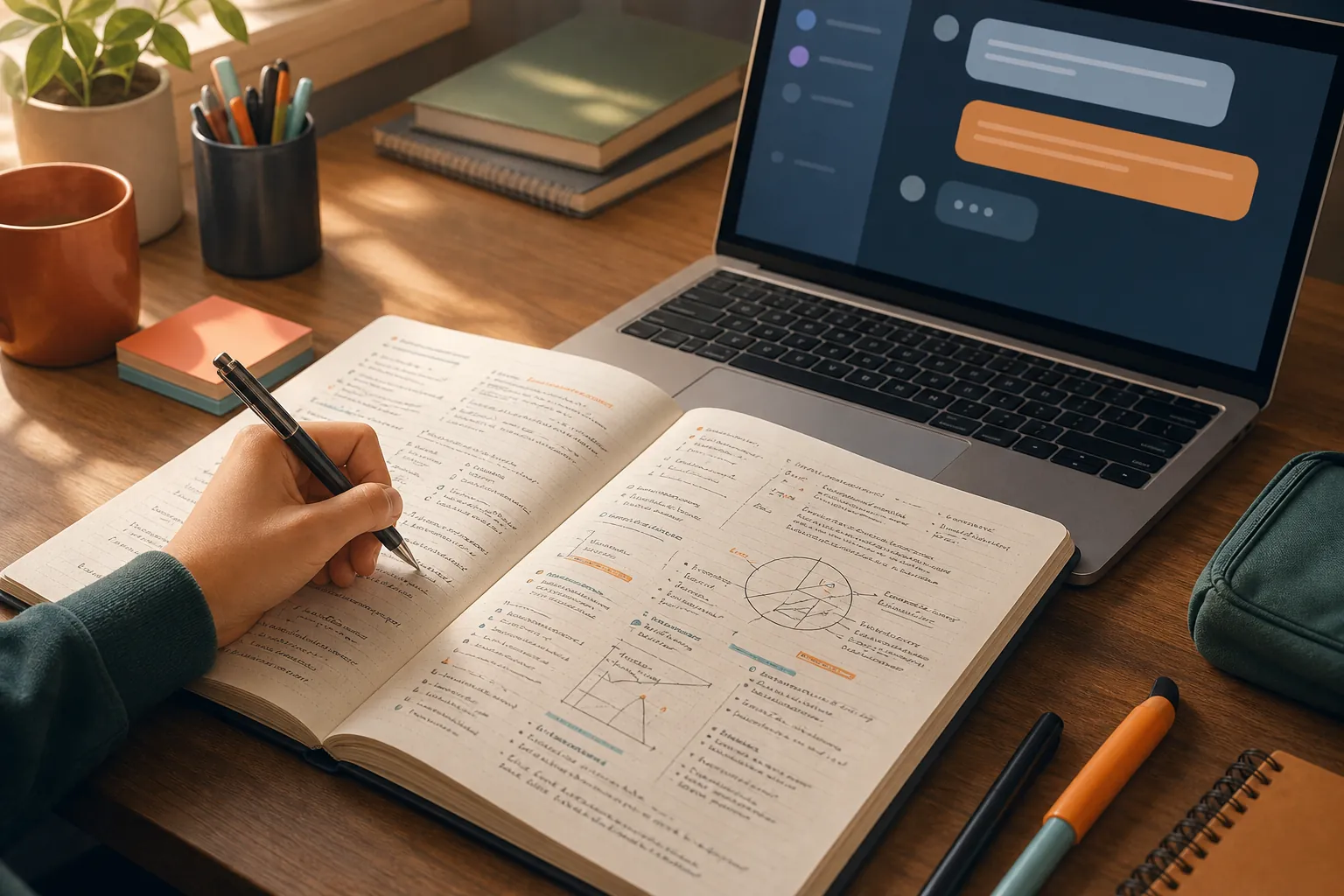
The Strongest 2025 Signal: Own Notes Beat LLM Notes
The most directly relevant study in the current evidence set is the 2025 Kreijkes et al. study in Computers & Education, summarized by The Economy of Meaning. It involved more than 300 fifteen-year-olds in the United Kingdom and compared learning from students’ own notes with learning from notes produced by a large language model. The disclosure matters: the study authors were affiliated with Microsoft and Cambridge University Press and Assessment, so this should not be presented as independent research.[2]
Even with that caveat, the pattern is hard to ignore. Students learned more from their own notes than from LLM-generated notes. A combined condition, where students had LLM support plus notes, produced only a small additional gain over using the LLM alone. At the same time, students found the LLM route more enjoyable and easier, and they invested less effort when using it.[2]
That combination is the whole problem in miniature. The weaker learning path felt smoother. The stronger learning path asked for more effort. If a learner judges the study session by how clean the output looks or how quickly it was produced, ChatGPT appears to win. If the learner has to recall, explain, or use the material later, the study points the other way.
The detail worth slowing down for is copy-paste behavior. In the combined condition, many students copied literal fragments from the LLM output. That is not a cosmetic issue. The useful part of note-taking is often the annoying middle step: deciding what matters, changing the wording, compressing the idea, and placing it next to what you already know. Copying a fluent fragment skips exactly that work.[2]
The study does not prove that all AI use harms learning. It is narrower than that. It says that, for this task and this adolescent sample, learners who took their own notes learned more than learners who relied on LLM notes, even though the LLM felt easier. That is enough to change the sequence: notes first, AI second.
A Smaller MIT Study Points In The Same Direction
A second 2025 signal comes from an MIT Media Lab EEG study covered by TIME. This one should be handled cautiously: it was pre-peer-review and involved 54 subjects aged 18 to 39. Participants wrote essays under different conditions, while EEG activity was measured across 32 brain regions.[3]
Within those limits, the findings rhyme with the note-taking study. ChatGPT users showed the lowest brain engagement and, in the study’s phrasing, “consistently underperformed at neural, linguistic, and behavioral levels.” The TIME report also describes copy-paste increasing across successive essays and weak recall of participants’ own work.[3]
These two studies are not identical. One is a larger study of U.K. fifteen-year-olds and note-based learning. The other is a small, pre-peer-review adult essay-writing study with neural measures. They should not be collapsed into one grand claim about AI and the brain. The convergence is more modest and more useful: when ChatGPT takes over the first-pass production work, learners may feel less friction while doing less of the work that supports later recall.
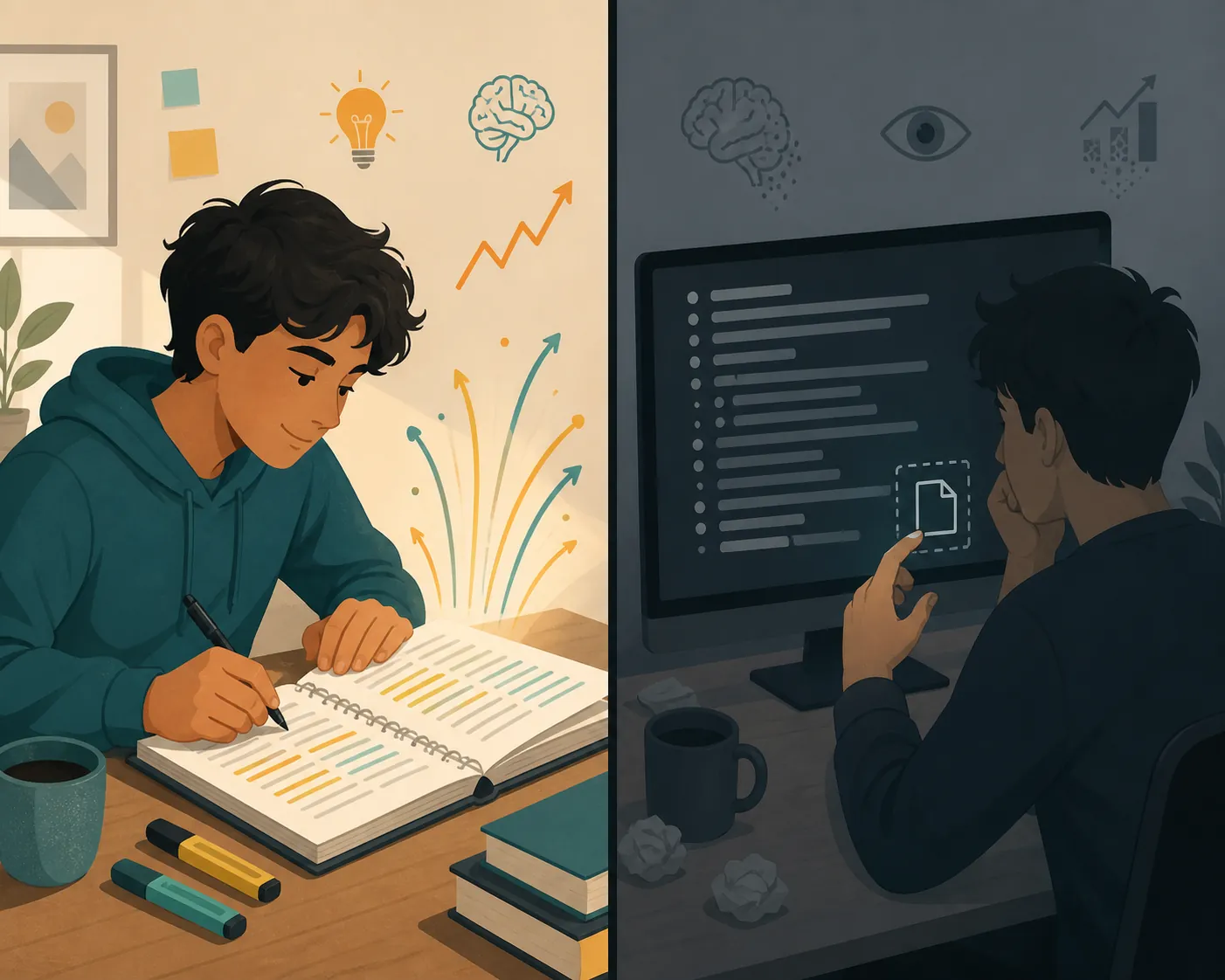
Where The Saved Effort Goes
“It saves time” is too blunt a standard for learning tools. A dishwasher saves time because the goal is clean dishes. Notes are different. The goal is not just a tidy page; it is a changed learner. If ChatGPT saves time by removing transcription drudgery after the learner has already selected and processed the material, that can be useful. If it saves time by doing the selection and rephrasing before the learner has engaged, the saved effort may be the learning step itself.
This is why the copy-paste finding matters more than the visual quality of the notes. A polished bullet list can hide low ownership. A messy page of student notes can contain decisions, confusions, arrows, abbreviations, and half-formed distinctions that become retrieval hooks later. The cleanest artifact is not automatically the strongest study record.
There is also an emotional reason students reach for the tool. A long reading, a vague assignment, or a subject that already feels slippery can make ChatGPT feel like a way back into control. That relief is real. The practical mistake is letting relief arrive before contact with the material. A better use is to let ChatGPT reduce confusion after the learner has made an honest first pass.
The Notes-First Pattern
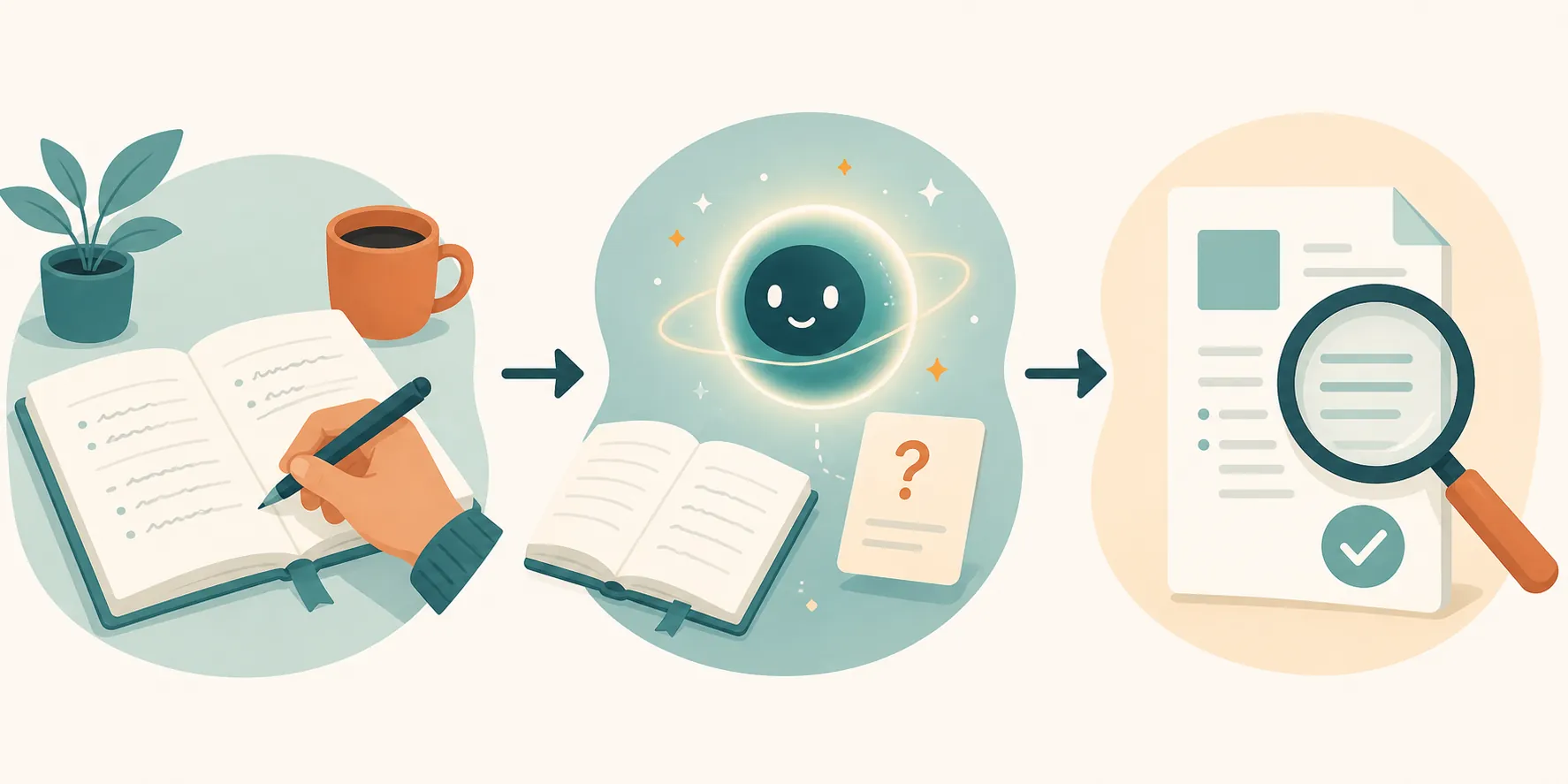
A defensible workflow is simple enough to remember and strict enough to matter: take your own notes first, use ChatGPT to coach and synthesize second, then verify anything factual before it enters your trusted notes.
| Stage | What the learner does | What ChatGPT can do |
|---|---|---|
| First pass | Read, select, paraphrase, mark confusion, write rough notes | Nothing, or only clarify instructions if needed |
| Second pass | Ask for gaps, quizzes, alternative explanations, and structure | Coach, question, compare, reorganize |
| Verification | Check claims, citations, dates, definitions, and source links | Generate a checklist of things to verify, not the final authority |
AVID Open Access gives a useful boundary for the first step of focused note-taking: AI should “notice or suggest, not explain or choose,” and the student should do the heavy lifting.[5] That wording is better than a ban because it separates assistance from replacement. ChatGPT can point out that your notes do not define a term. It should not decide, before you have tried, which ideas deserve to be in your notes.
Dr. Philippa Hardman’s guidance on turning notes into a personalized learning experience takes the same post-note direction. Her learning-science-based prompts use ChatGPT after notes exist: to generate questions, diagnose weak understanding, produce practice, and help the learner revisit material more deliberately.[6] That is a different act from asking the model to produce the original notes.
Useful Prompts After You Have Notes
- “Here are my rough notes. Ask me five questions that would reveal whether I understand the main ideas. Do not answer them yet.”
- “Compare these notes with the assignment question. What have I not addressed? Mark gaps, but do not fill them in for me.”
- “Turn my notes into a study plan with retrieval practice first, then review. Keep the original wording where my phrasing shows uncertainty.”
- “Give me two alternative explanations of the hardest concept, then ask me to explain it back in my own words.”
- “List every factual claim in this draft that needs verification against the original source.”
The pattern also fits a normal note-app setup. Keep the primary record in the place you already review: GoodNotes, Notability, Obsidian, Apple Notes, or whatever system you trust. ChatGPT sits beside that system as a coach or synthesizer, not as the source of record. If you keep research conversations inside ChatGPT anyway, FlowDesk’s ChatGPT-to-Obsidian export guide is the more practical next question: how do you get material out before it becomes a stranded study archive?
Research Help Needs A Verification Wall
For research tasks, the problem is not only effort. It is trust. Scott H. Young describes LLMs as a “calculator for words” and warns that they routinely invent facts and citations. In one documented example, ChatGPT falsely described Mayer’s review as a meta-analysis.[4]
That makes ChatGPT useful for questions, not final evidence. It can help you generate search terms, compare possible explanations, produce counterarguments, or turn your own rough notes into a source-checking list. But a citation that appears in a ChatGPT answer is not a citation you have. A quotation is not a quotation you can use. A date, statistic, or institutional conclusion remains unverified until you have checked the original source.
A good research workflow therefore has two separate documents: working notes and verified notes. Working notes can include questions, model-generated explanations, and tentative summaries. Verified notes contain only claims you have traced back to a source you can open, read, and cite. The separation prevents fluency from laundering uncertainty into fact.
What This Does Not Prove
The evidence does not say which note app is best. It does not prove that adult professionals will show the same pattern as fifteen-year-old students. It does not prove that every ChatGPT study session is worse than a non-AI study session. It also does not settle every new feature that OpenAI, Anthropic, Google, or note-app vendors may release after this article’s verification date.
If your next decision is tool behavior rather than learning design, use a comparison layer instead of stretching these studies past their scope. FlowDesk has separate tests for Claude versus ChatGPT for note-taking and a broader Claude vs. ChatGPT note-taking comparison. Those pieces are better places to ask how the tools behave in capture, formatting, and review.
There is also a stack-risk question. If ChatGPT becomes part of your study workflow, access matters. FlowDesk’s note-apps and ChatGPT outage comparison is the relevant detour for dependency risk, not evidence about learning outcomes.
Who This Is And Is Not For
This guidance is for students, self-directed learners, and educators who want ChatGPT in the workflow without handing it the learning step. It is also for people already keeping handwritten or app-based notes who want AI to help them review, quiz, reorganize, and inspect their own understanding.
It is not for you if the main thing you want is a tool that writes your notes for you. ChatGPT can do that. The current evidence gives a good reason not to treat that output as equivalent to having learned the material.
A companion way to read this is FlowDesk’s Claude note-taking profile, which is more practitioner experience than controlled evidence. Treat it as a separate perspective rather than another study.
The Lesson To Keep
The best supported lesson is narrow, which makes it stronger. In the available 2025 evidence, learners who wrote their own notes learned and recalled more than learners who relied on ChatGPT or LLM-generated notes, even though the AI-supported route felt easier. The sensible response is not to avoid ChatGPT. It is to protect the learning step: take notes yourself, use ChatGPT as coach and synthesizer, and verify every factual claim before it earns a place in your trusted notes.
References
- About a quarter of U.S. teens have used ChatGPT for schoolwork – double the share in 2023, Pew Research Center, January 15, 2025, link
- ChatGPT feels easier, but taking notes works better for learning, The Economy of Meaning, December 8, 2025; summary of Kreijkes et al., Computers & Education, DOI 10.1016/j.compedu.2025.105514; author affiliations include Microsoft and Cambridge University Press and Assessment, link
- AI Chatbots Are Hurting Students’ Learning, Study Finds, TIME; coverage of MIT Media Lab pre-peer-review arXiv 2506.08872 study with 54 subjects, link
- 10 Ways You Can Use ChatGPT to Learn Better, Scott H. Young, May 2, 2023, link
- AI in Focused Note-Taking, Step 1: Taking Notes, AVID Open Access, link
- How to Turn Your Notes into a Personalised Learning Experience, using ChatGPT, Dr Philippa Hardman, link