

A note app says the import is complete. The user’s work is often just beginning: inspect the attachments that did not transfer, find the notes whose formatting changed, rebuild organization rules, reconnect routines, and decide whether unfamiliar results are defects or merely differences. The progress bar records what the provider processed. It does not record what the user must now understand, verify, and repair.
Annie Lowrey’s definition of a time tax fits that gap unusually well: “a levy of paperwork, aggravation, and mental effort imposed on citizens in exchange for benefits.” Her 2021 Atlantic essay, published as “The Time Tax” and displayed online under the headline “How Government Learned to Waste Your Time,” examines the administrative work governments impose on people seeking services or meeting obligations.[1]
Applying that idea to note-app migration is an analogy, not a finding made by Lowrey or administrative-burden researchers. Still, it is a productive analogy. A provider can make the user learn the rules, absorb the uncertainty, and perform the transfer while describing only the automated portion as the migration.
The verdict on Lowrey’s time-tax argument
The Atlantic essay and Lowrey’s 2026 book, The Time Tax: How the Government Wastes Our Time—And How to Fix It, offer a descriptively persuasive and practically useful thesis: procedural friction consumes real resources, falls unevenly, and can be reduced when institutions redesign processes around the person completing them.
The strongest evidence is local and observable. A form becomes shorter. Completion takes less time. Fewer eligible people disappear at a renewal point. An agency performs work that it previously demanded from each applicant. Those changes identify who is doing the work and whether redesign moves it.
The argument is less secure when it becomes one national total for hours lost. Lowrey acknowledges the underlying data shortage, and published estimates vary substantially. That does not undo the documented examples, but it limits what the headline number can establish. For migration decisions, the framework is therefore more useful as an audit than as a calculator.
Three costs hidden inside “Import complete”
Pamela Herd and Donald Moynihan divide administrative burden into learning costs, psychological costs, and compliance costs.[2] The categories help separate work that migration instructions tend to collapse into one reassuring verb: switch.

Learning costs: discovering the real rules
Before moving anything, a user has to discover what each product means by export and import. That includes export caps, available formats, attachment handling, supported note types, account requirements, and the destination’s interpretation of folders, tags, links, drawings, metadata, and embedded files.
This work is easy to omit from a migration estimate because it happens before the visible transfer. It may involve searching documentation, comparing contradictory instructions, running a sample export, or learning only after an error that the chosen format discarded something important. FlowDesk’s account of why a daily routine breaks after a note-app switch tracks this wider result: data can technically arrive while the working system around it no longer behaves as expected.
A vendor’s happy path typically begins after these questions have been answered. The user’s migration begins when they first have to answer them.
Psychological costs: deciding what loss is acceptable
Migration also charges for uncertainty. The user has to decide whether a partial-looking export is safe, whether an irreversible-feeling command should be run, and whether a changed note is merely displayed differently or has actually lost information. A student protecting handwritten material and a long-time Evernote user with years of attachments do not experience that uncertainty as a minor interface inconvenience.
Available attention changes the burden. Research on poverty-related preoccupation found performance effects comparable to a 13-point reduction in IQ or losing a night’s sleep; it supports the narrower conclusion that cognitive load can leave fewer resources for other demanding tasks.[3] It does not prove an equivalent effect in app migration. It does help explain why the same ambiguous warning or verification queue may be manageable for one person and enough to stop another.
That distinction matters for anyone evaluating a switch during an already overloaded period. FlowDesk’s guide for sleep-deprived new parents choosing note apps treats attention as a constrained resource rather than assuming every user can compensate for unclear systems with more research and vigilance.
Compliance costs: performing and proving the move
Compliance costs are the visible labor: exporting, downloading, unzipping, converting, importing, waiting, retrying, checking, repairing, and reconfiguring. Verification belongs in this category too. Counting notes, opening representative attachments, testing internal links, comparing handwriting, and checking dates are not optional if silent loss would matter.
Policy research shows how a procedural checkpoint can produce abandonment even when underlying eligibility has not necessarily changed. Families are six times more likely to leave SNAP in the month when they must recertify their eligibility.[1] Lowrey’s later Louisiana reporting describes a 26-page, 8,350-word SNAP form and records that 21,893 children were disenrolled in 2019 for “failure to comply with procedures”; it also cites waits of 32 months for housing vouchers in the state.[4] These are policy examples, and the Louisiana figures should not be generalized into national rates.
Nor do they prove how often people abandon note migrations. Their relevance is explanatory: an additional checkpoint can filter out people who still want the underlying benefit. In a migration, the equivalent outcome may be a user remaining with an unsuitable app, accepting an incomplete transfer, or postponing verification indefinitely. Those outcomes should be investigated directly rather than inferred from SNAP data.
Better systems keep more of the work
Lowrey’s most useful examples do more than show that bureaucracy is unpleasant. They show that friction can be measured and removed. Michigan’s Project Re:form reduced a benefits application from 42 pages and 18,000 words, cut reported completion time from 40 minutes to 16 minutes, and increased completion from 72% to 94%.[1]
Those figures measure a specific redesigned process, not every interaction with government. Their force comes from that specificity. The institution changed the application, then observed changes in time and completion. It did not ask applicants to become more organized or more patient.
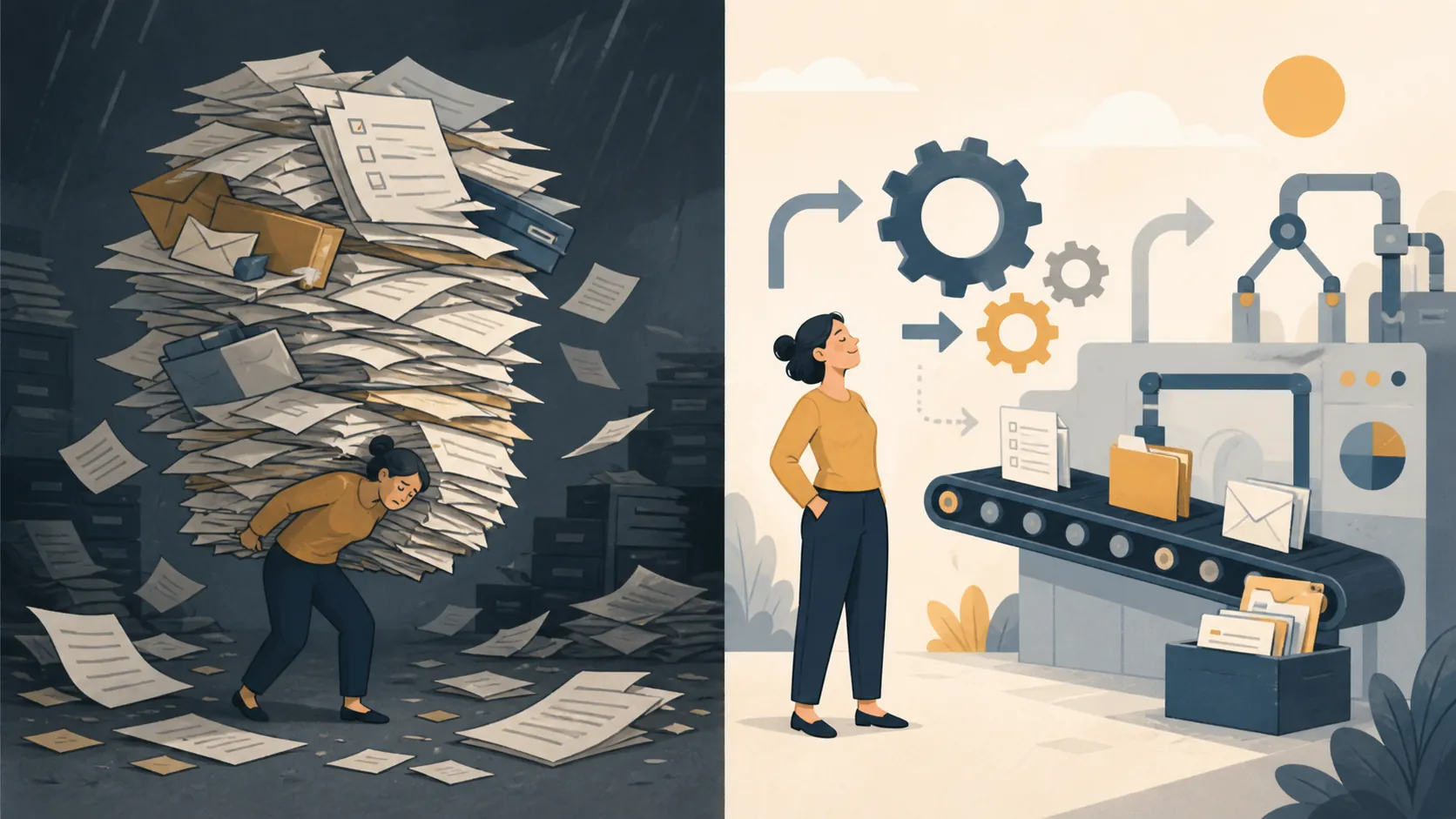
Social Security provides a different standard. Its near-universal take-up is associated with an administrative model in which the agency tracks earnings and eligibility, leaving relatively little for the citizen to initiate or prove.[2] Steven Teles likewise identifies Social Security as an unusually simple exception within a broader system of institutional complexity.[5]
For migration design, the lesson is about burden placement. A destination app can require every user to interpret an export, identify omissions, and rebuild structures manually. Or it can recognize source formats, preserve more relationships, disclose unsupported content before import, produce an exception report, and make rollback possible. Both products may advertise an importer; they do not assume the same amount of responsibility.
This also changes how a destination should be selected. Decide what the tool must do before paying the switching cost. An aging Evernote user can begin with the workflow questions in the Evernote AI study-notes profile; anyone moving primarily for retrieval features should first compare AI search and summaries with conventional note apps. Otherwise, the user may pay the migration tax before discovering that the destination cannot support the intended routine.
Where the argument needs restraint
The national totals are less dependable than the process-level evidence. Lowrey relays a 2016 Tax Foundation estimate of 8.9 billion hours and $409 billion spent on federal tax compliance.[1] Teles cites an earlier National Taxpayer Advocate estimate of 6.1 billion hours and $163 billion.[5] These estimates concern different years and should not be blended into a single stable measure. Lowrey’s acknowledgment that “there just is not a lot of data out there” is the appropriate warning.[1]
Intentionality also varies. In 2020, Florida Governor Ron DeSantis said the state’s unemployment system had been designed with “pointless roadblocks” so fewer people would receive benefits; the office of former governor Rick Scott denied that characterization.[6] That is meaningful evidence about one contested case, not proof that every complicated procedure was deliberately made hostile. Teles’s account instead emphasizes “kludgeocracy”: complexity produced through layered, indirect, and bipartisan institutional choices.[5]
The same restraint improves criticism of software. A damaged attachment does not by itself prove that a vendor intended lock-in, and an imperfect importer may reflect difficult format differences. The practical question remains who detects the problem, who resolves it, and whose time disappears when the system cannot.
The 2026 book is too recent to justify pretending that a settled reception already exists. The essay therefore carries more weight here than early reactions to the book. Its administrative-burden framework can already be tested against concrete processes without inflating a thin review record into a consensus.
Audit the time tax before switching
A useful migration estimate starts with the complete work expected from the user, not the duration of the import job. Before committing, record the answers to these questions:
- What are the real steps from the first export to a verified, usable destination? Include research, preparation, downloads, conversions, retries, inspection, repair, and workflow setup.
- Do export caps divide the move into batches, require repeated requests, or force a subscription renewal before all data can be removed?
- Which formats preserve attachments, handwriting, tags, internal links, dates, tables, and other material that matters to this collection?
- What can fail silently? Look for unsupported content and changed relationships, not only files that generate explicit errors.
- How will completeness be verified? Specify representative notes, counts, attachment types, dates, links, and any high-value material that requires direct inspection.
- What work does the destination perform? Prefer clear compatibility disclosures, exception reports, resumable imports, and rollback over a bare success message.
- What must the destination tool do after migration? Test the intended retrieval, writing, study, handwriting, collaboration, or automation workflow before moving the full archive.
- Who has to absorb unresolved work, and how much attention do they realistically have now? A plan that succeeds only through hours of careful remediation is not low-friction for a low-slack user.
Only after those answers are visible does the advertised migration time become meaningful. If the destination passes that audit, the subsequent note-vault context-engineering setup can address how the new system should work. It should not be used to disguise transfer repair as ordinary setup.
That is the durable time-management takeaway from Lowrey’s argument. “Time tax” does not provide a defensible universal estimate for how many hours a note-app switch will consume. It provides a disciplined way to expose work that a provider has transferred beyond the progress bar.
References
- How Government Learned to Waste Your Time, The Atlantic, July 27, 2021
- Administrative Burden: Policymaking by Other Means, Russell Sage Foundation
- Poor concentration: Poverty reduces brainpower needed for navigating other areas of life, Princeton University, August 29, 2013
- $100 Million to Cut the Time Tax, The Atlantic, April 2022
- Kludgeocracy in America, National Affairs
- Gov. Says Florida's Unemployment System Was Designed To Create 'Pointless Roadblocks', NPR, August 6, 2020