
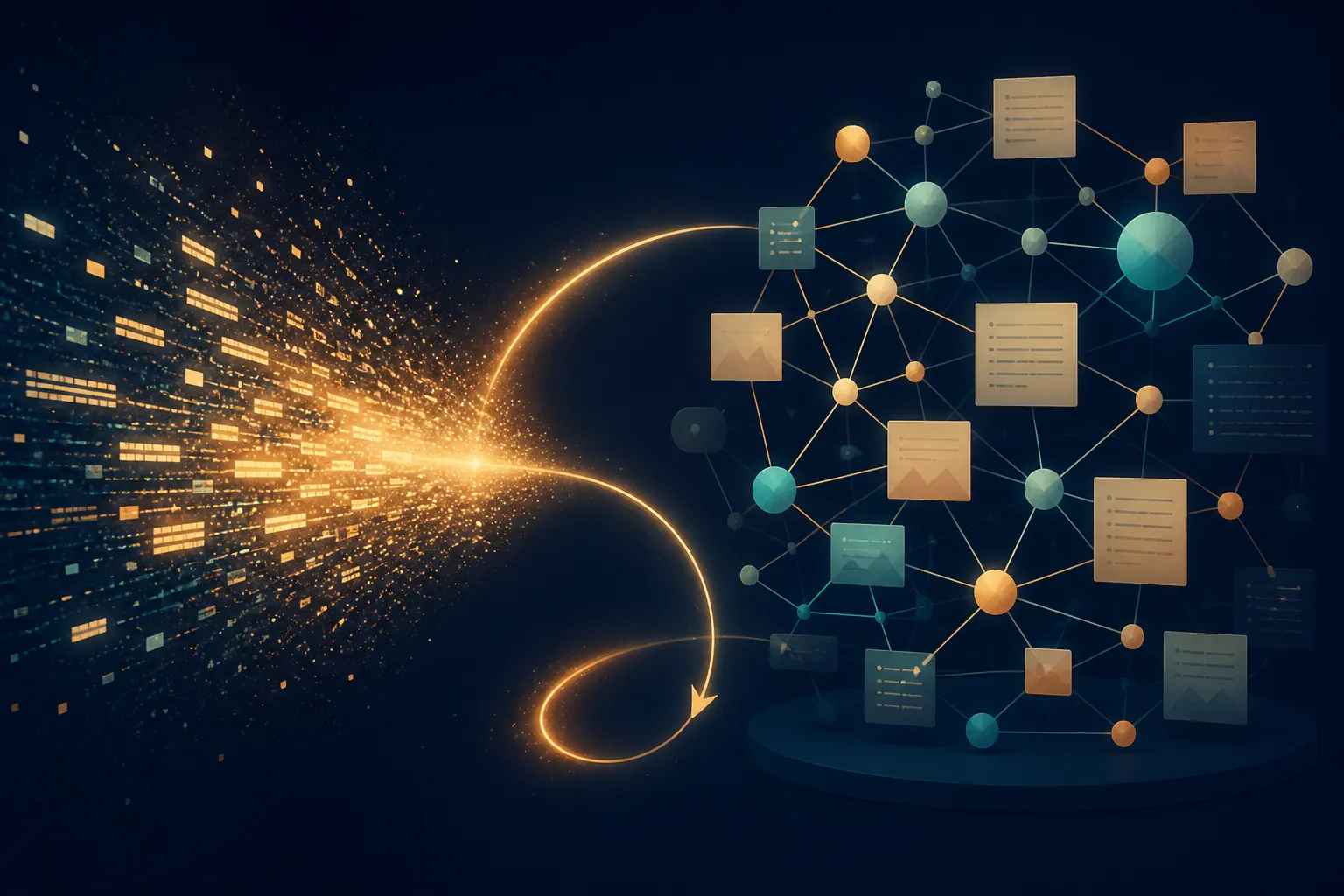
If an AI search summary can answer a research question in seconds, maintaining a note-taking app can feel like duplicate work. It is not—unless the answer has no value beyond the current session.
AI search summaries can replace much of the search step: finding sources, scanning a topic, comparing explanations, and suggesting avenues to investigate. A notes system does a different job. It preserves selected evidence, records why it mattered, connects it to previous work, and makes it available when a later project approaches the subject from another direction.
| Research task | Better default |
|---|---|
| Get oriented in an unfamiliar topic | AI search |
| Generate competing explanations or follow-up questions | AI search |
| Locate possible sources and terminology | AI search, followed by source checking |
| Preserve a claim with its provenance and limitations | Note-taking app or reference manager |
| Connect a finding to earlier projects | Note-taking app |
| Recover useful context months later | Note-taking app |
| Synthesize accumulated personal research | Notes first; AI can assist when given the right context |
The practical workflow is therefore: ask, distill, link, resurface. The AI answer begins the loop; it is not the final research artifact.
Search is changing faster than research memory
The temptation to abandon notes is understandable. In February 2024, Gartner forecast that traditional search-engine volume would fall 25% by 2026 because of AI chatbots and other virtual agents.[1] That figure was a prediction, not a measured decline. As of August 27, 2026, the material available here does not provide a comparable market-volume result that would establish whether the forecast materialized.
There is clearer evidence that research activity is moving into agentic tools. In a Perplexity and Harvard Business School analysis of 100,000 queries, “Research and Analysis” was the largest task category at 25.8%. For matched tasks, agent sessions involved about 26 minutes of estimated machine execution, compared with roughly 33 seconds for search.[2] Those numbers measure system execution under the study’s assumptions, not independent research quality or time saved by every user. The sample also reflected early adopters, which limits how confidently it can be generalized.
The ask–distill–link–resurface loop
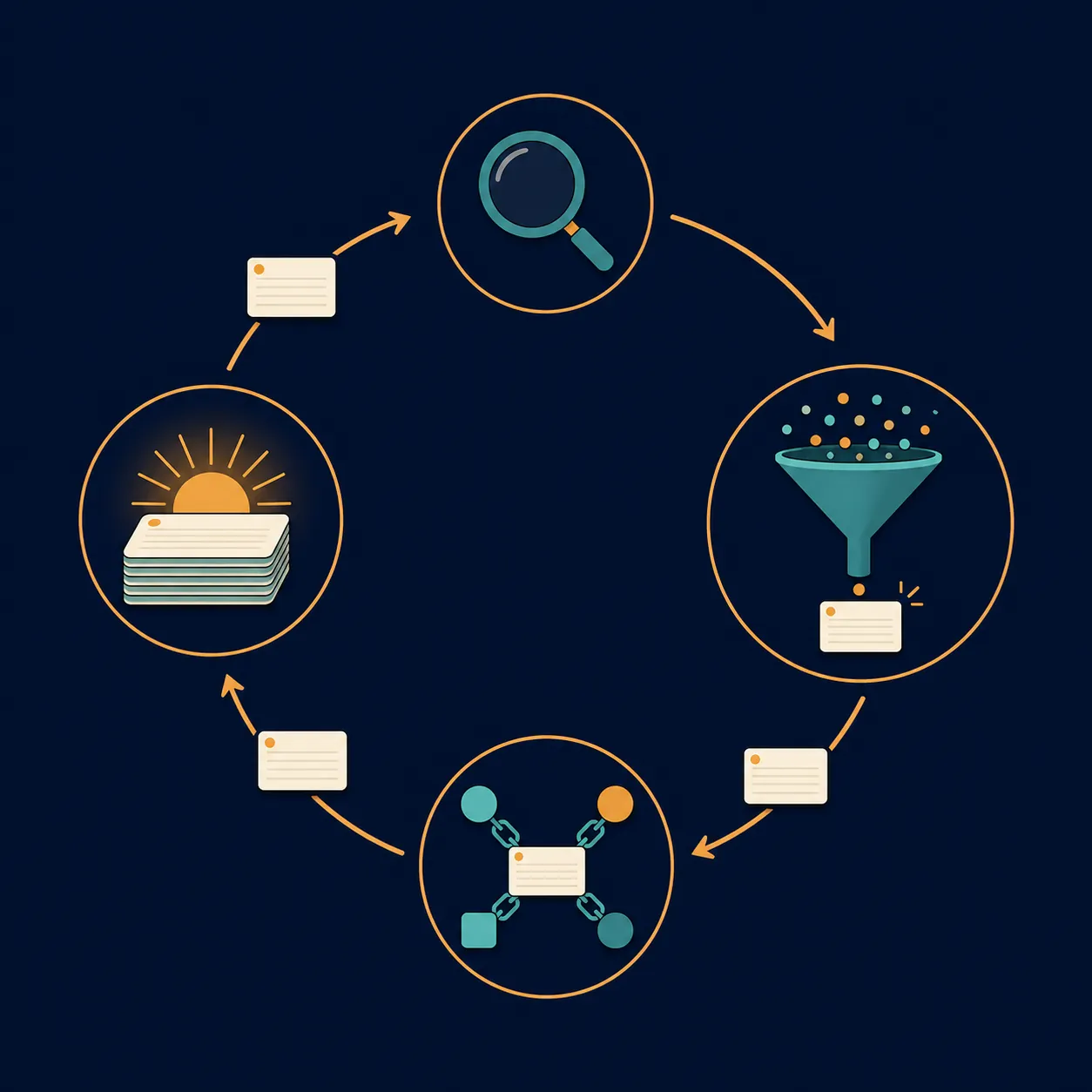
This loop avoids two bad extremes: researching everything manually as if AI search did not exist, or pasting every generated report into a vault and calling the result knowledge management. Each handoff has a specific purpose.
Ask for a map, not an unquestioned answer
AI search is most valuable at the beginning of an investigation, when the vocabulary, major disagreements, and likely sources are still unclear. A useful prompt can ask for competing explanations, the strongest evidence for each, relevant primary sources, and unresolved points. The output becomes a research map that would otherwise require many searches and open tabs.
Its citations are leads to inspect, not a transfer of responsibility. OpenAI says its deep-research outputs can “sometimes hallucinate facts” or make incorrect inferences, can struggle to distinguish authoritative information from rumors, and may not convey uncertainty accurately.[3] Google similarly warns that AI responses may include mistakes and tells users to check important information in more than one place.[4]
These are first-party disclosures from the vendors, not independent accuracy measurements. They nevertheless establish an important boundary: even the companies providing the summaries do not describe them as a sufficient verification layer.
For consequential claims, open the cited material and confirm that it supports the wording, scope, and date of the answer. Prefer the original paper, official documentation, dataset, court filing, or institutional report over another summary of it. If provenance is central to the project, a reference manager such as Zotero can hold the publication record and source file while the notes app holds your interpretation and connections.[5]
Distill the answer into something worth finding again
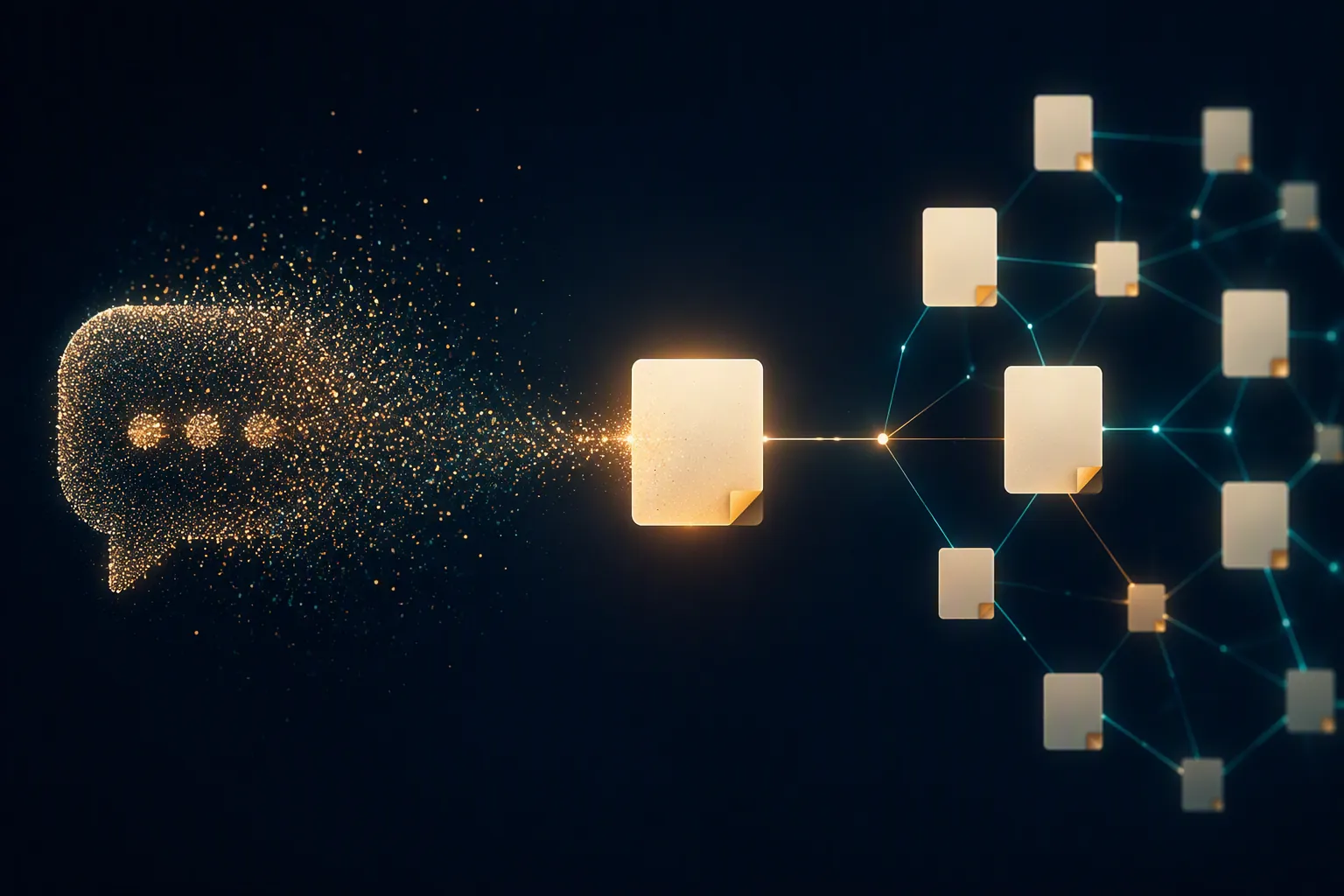
The decisive step happens after the answer arrives. Copying the full AI response into a note preserves text, but it also preserves unsupported transitions, duplicated background, and claims you may never have checked. A long transcript is usually easier to store than to reuse.
Distillation means deciding which ideas deserve to survive the session. A durable research note should normally record:
- The claim or insight in your own words.
- Why it matters to the question or project.
- The original source, including a stable link or bibliographic record where possible.
- The evidence location, such as a relevant section, page, table, or quoted passage.
- Scope conditions, uncertainty, disagreement, or other limitations.
- Links to existing notes and any question the finding creates.
Not every question warrants this treatment. A quick definition, disposable recommendation, or one-time troubleshooting answer may never need to enter the vault. The filter is future value: would losing the answer force you to repeat meaningful work, or make an earlier decision impossible to reconstruct?
Andy Matuschak’s evergreen-notes approach treats notes as evolving units of thought rather than containers for source excerpts.[6] His broader argument that knowledge work should accrete explains why the distinction matters: when intermediate insights remain available for later projects, research can build on prior work instead of repeatedly starting from zero.[7]
This also improves future AI use. A vault containing concise claims, provenance, scope, and explicit relationships provides better context than a folder of unedited transcripts. FlowDesk’s AI context-engineering guide covers how to structure that context so an assistant can work with it without turning the vault into model-generated sludge.
Link for the question you have not asked yet
A note becomes more useful when it has a stable identity and explicit relationships. The Zettelkasten method formalizes this through fixed, unique addresses and references between notes, making an idea retrievable independently of the project that first produced it.[8] You do not need to adopt a full Zettelkasten to use the mechanism. A stable title or identifier, a few meaningful links, and clear source metadata can provide much of the benefit.
Link by intellectual relationship rather than superficial topic. A note about AI-generated citations might connect to notes on evidence standards, retrieval systems, source authority, or a decision made during an earlier project. Briefly label the relationship when it is not obvious: supports, contradicts, qualifies, applies to, or raises a question about.
The right structure depends on the kind of work being preserved. Project-oriented material, atomic conceptual notes, and resource libraries do not need identical organization. The PKM method and tool-pairing guide compares approaches such as PARA, Zettelkasten, and Building a Second Brain without assuming one system fits every research practice.
Resurface before repeating the research
Storage alone does not complete the loop. The note must appear when it can change later work. That may happen through search, backlinks, an index note, a project dashboard, a saved query, periodic review, or an AI assistant operating over a deliberately selected part of the vault.
Suppose a later project asks about trust in automated research rather than citation quality specifically. A well-linked note can resurface the earlier findings about source authority, uncertainty, and verification even though the wording of the new question is different. A previous AI conversation may still exist somewhere in a history panel, but recovering it generally depends on remembering the original prompt, tool, or phrasing. The durable note was written for retrieval after those details faded.
Resurfacing also creates the conditions for personal synthesis. Several notes created months apart can reveal a recurring mechanism, a contradiction between sources, or a missing piece of evidence. AI can help compare those notes, but only after the relevant material has been retained and supplied as context.
Where NotebookLM-style tools fit
Source-scoped tools occupy a useful middle position. When given a defined collection of documents, they can summarize, compare passages, identify themes, and answer questions within that collection. This narrower context can make them more suitable for interrogating a reading packet than an open-web answer engine.
That role still differs from a permanent, cross-project knowledge base. A third-party comparison of NotebookLM, Notion, and Obsidian characterizes NotebookLM as a source-scoped research analyst, while describing the other tools as workspace or knowledge-archive layers; it also identifies gaps around permanent accumulation and queries across notebooks.[9] Because this is a third-party assessment rather than official product documentation, it is best treated as a role comparison, not a definitive statement about every current feature.
A source-scoped notebook can therefore sit inside the loop: load the materials, ask questions, inspect the supporting passages, and distill the conclusions that should remain available beyond that collection.
Built-in AI does not erase the task boundary
Note-taking products are adding search, summarization, and assistant features, while AI services are adding longer research processes and access to personal sources. The interfaces are converging, but the important questions remain operational: Where does the checked result live? Can it be linked to earlier work? Is its source recoverable? Can it move to another system? Will it still be available after the current project ends?
Those questions matter more than whether the assistant appears inside Notion, Obsidian, Logseq, Apple Notes, Evernote, or a separate browser tab. Readers comparing the implementations can use FlowDesk’s 2026 note-taking software comparison and its deeper comparison of AI, portability, and offline access. The replace-or-complement decision should be made at the workflow level before comparing feature lists.
When an AI summary is enough
| Situation | What to keep |
|---|---|
| Low-stakes question with no expected reuse | Nothing, or the answer thread temporarily |
| Early exploration of a new subject | Promising terminology, questions, and source leads |
| Decision that may need to be defended later | A distilled note with checked evidence and rationale |
| Long-running or recurring research topic | Linked notes with stable provenance |
| Academic or evidence-heavy project | Source records in a reference manager plus synthesis notes |
| Source-bounded document analysis | Use a scoped AI tool, then retain conclusions that have cross-project value |
| Sensitive or ownership-critical material | A system whose storage, export, access, and model-sharing terms meet the requirement |
No elaborate second brain is required for every answer. Keep the notes system wherever durable retrieval, linking, ownership, provenance, or future synthesis matters. Use AI search for rapid orientation. The deciding question is what must still be available after the answer window closes.
References
- Gartner Predicts Search Engine Volume Will Drop 25% by 2026 Due to AI Chatbots and Other Virtual Agents, Gartner, February 19, 2024
- How AI Agents Reshape Knowledge Work, Perplexity
- Introducing deep research, OpenAI, February 2, 2025; updated through February 10, 2026
- AI Overviews and more in Search, Google Search Help
- Zotero, Zotero
- Evergreen notes, Andy Matuschak
- Knowledge work should accrete, Andy Matuschak
- Introduction to the Zettelkasten Method, Zettelkasten.de
- NotebookLM vs Notion vs Obsidian, Sourclip