

Why Most PKM Systems Fail Before They Start
The typical journey into personal knowledge management begins with a tool. You hear about Obsidian, sign up for Notion, or download Logseq. You spend a weekend setting up folders, tags, and templates. Two weeks later, the system feels like a burden. Notes pile up unorganized. You start looking at the next app.
This pattern is so common that it has a name: tool-hopping. And it is expensive. According to research cited by GoLinks, knowledge workers waste an average of 9.3 hours each week searching for information, and nearly 20% of every workweek disappears into hunting for internal information. A structured PKM system directly recovers that time — but only if the method fits how you actually work.
The core thesis of this guide is simple: method before tool. You cannot evaluate whether Obsidian is "better" than Notion until you know which methodology you are trying to implement. PARA, Zettelkasten, and Building a Second Brain (BASB) are three proven frameworks, each designed for a different kind of output. Pick the method that matches your work style first. Then choose the tool that supports it.
The Three Proven Methods: PARA, Zettelkasten, and BASB
Each of these three methods has a track record. None is universally "best." The right one depends on whether your primary output is completing projects, synthesizing ideas, or processing large volumes of content.
PARA: For Project-Driven Action
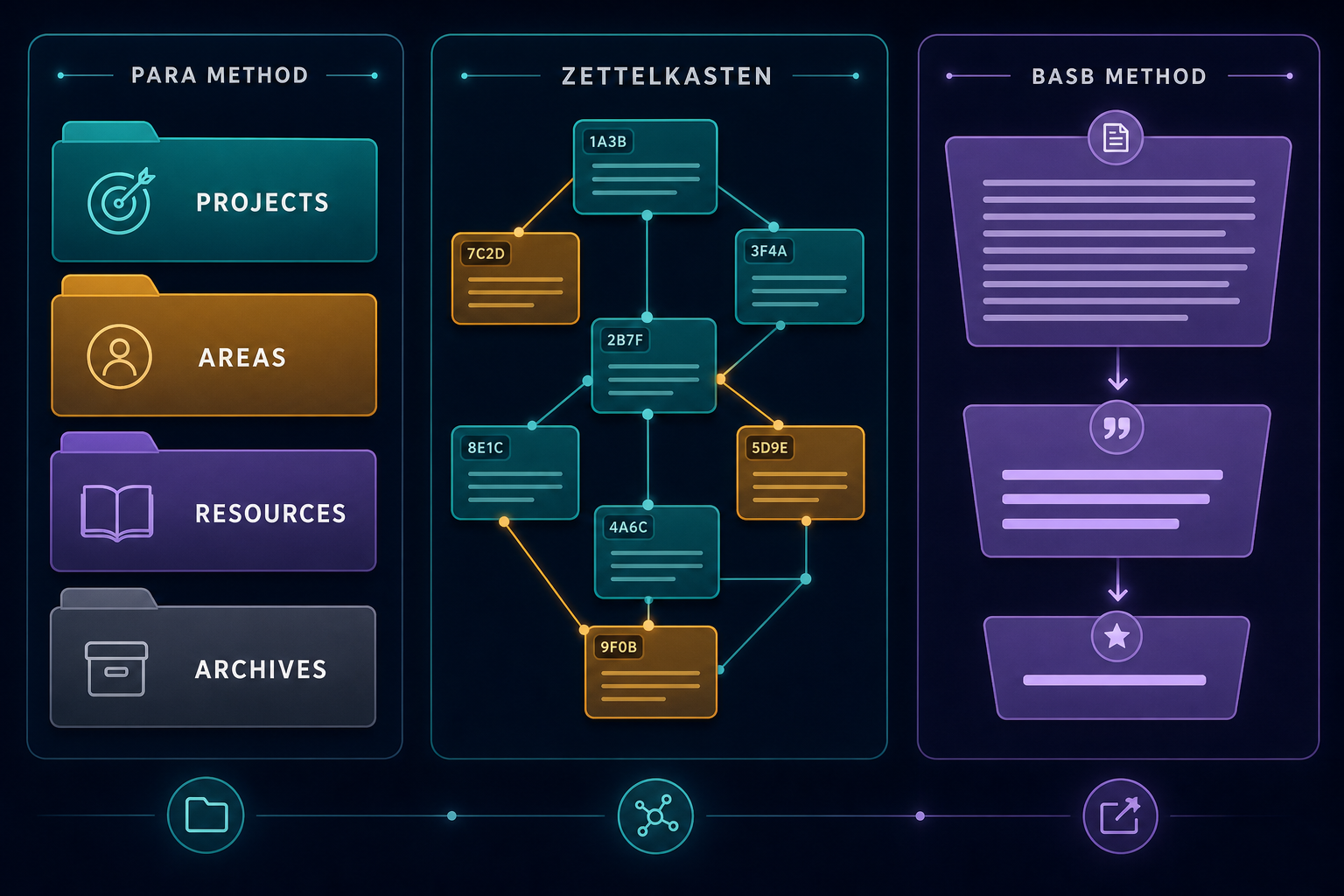
PARA stands for Projects, Areas, Resources, and Archives. It was developed by Tiago Forte as part of the Building a Second Brain methodology, but it works as a standalone filing system. The entire structure has exactly four top-level buckets. Projects are short-term outcomes with deadlines. Areas are long-term responsibilities without a finish line. Resources are topics of ongoing interest. Archives are inactive items from the other three categories.
PARA is the safest starting point for action-oriented knowledge workers. It survives busy quarters better than any other method because the filing rules are minimal: if something does not belong to an active project or area, it goes into Resources or Archives. There is no tagging taxonomy to maintain, no link graph to curate. The Atlas guide to PKM describes PARA as the method that "prioritizes actionability over completeness," which is exactly what a project manager, consultant, or operations lead needs.
Zettelkasten: For Idea Synthesis and Research
Zettelkasten (German for "slip box") is the oldest and most intellectually demanding method on this list. Developed by the sociologist Niklas Luhmann, it is built on atomic notes — each note contains a single idea, written in your own words, and linked to other notes through explicit connections. Luhmann used this system to produce more than 70 books and 400 academic articles from roughly 90,000 handwritten notes over 30 years.
Zettelkasten has the highest ceiling for original thinking, but it also has the highest upfront cost. You cannot dump highlights or clipped articles into a Zettelkasten and expect it to work. Every note requires reformulation and linking. The payoff is a knowledge base that generates insights you did not explicitly put into it — connections emerge from the link structure rather than from manual categorization.
Building a Second Brain (BASB): For Capture-to-Output Flow
Tiago Forte's Building a Second Brain framework is the most popular PKM methodology for a reason: it is designed for knowledge workers who consume large volumes of content and need to turn that consumption into tangible output. The core practice is progressive summarization — a five-layer technique that distills a captured piece of content from the full original down to a single actionable sentence.
BASB is not a filing system in the way PARA is. It is a workflow: capture, organize, distill, express. The "organize" step uses PARA as its default structure, which means BASB and PARA are complementary rather than competing. If you are a writer, marketer, or researcher who needs to turn a stream of articles, podcasts, and meeting notes into regular output, BASB's progressive summarization is the load-bearing practice.
| Dimension | PARA | Zettelkasten | BASB |
|---|---|---|---|
| Core principle | Actionability through minimal filing | Emergent insight through atomic linking | Capture-to-output through progressive distillation |
| Best-fit audience | Project managers, operators, consultants | Researchers, academics, long-form writers | Content consumers, marketers, knowledge workers |
| Learning curve | Beginner — 4 buckets, no tagging required | Advanced — requires reformulation discipline | Intermediate — workflow is simple, distillation takes practice |
| Upfront setup time | 30 minutes to organize current projects | 2–4 weeks to build a meaningful note base | 1–2 hours to set up capture and review routines |
| Risk of abandonment | Low — easy to restart after a gap | High — broken link chains discourage return | Medium — capture without distillation leads to pile-up |
If you are still unsure which work style fits you, the thinking-style guide to PKM tools offers an alternative lens that may validate your choice from a different angle.
The Decision Matrix: Mapping Method to Your Work Style
The three methods map to three distinct work-style profiles. Most knowledge workers are a blend, but one profile usually dominates. Use the self-assessment below to identify your primary pattern.
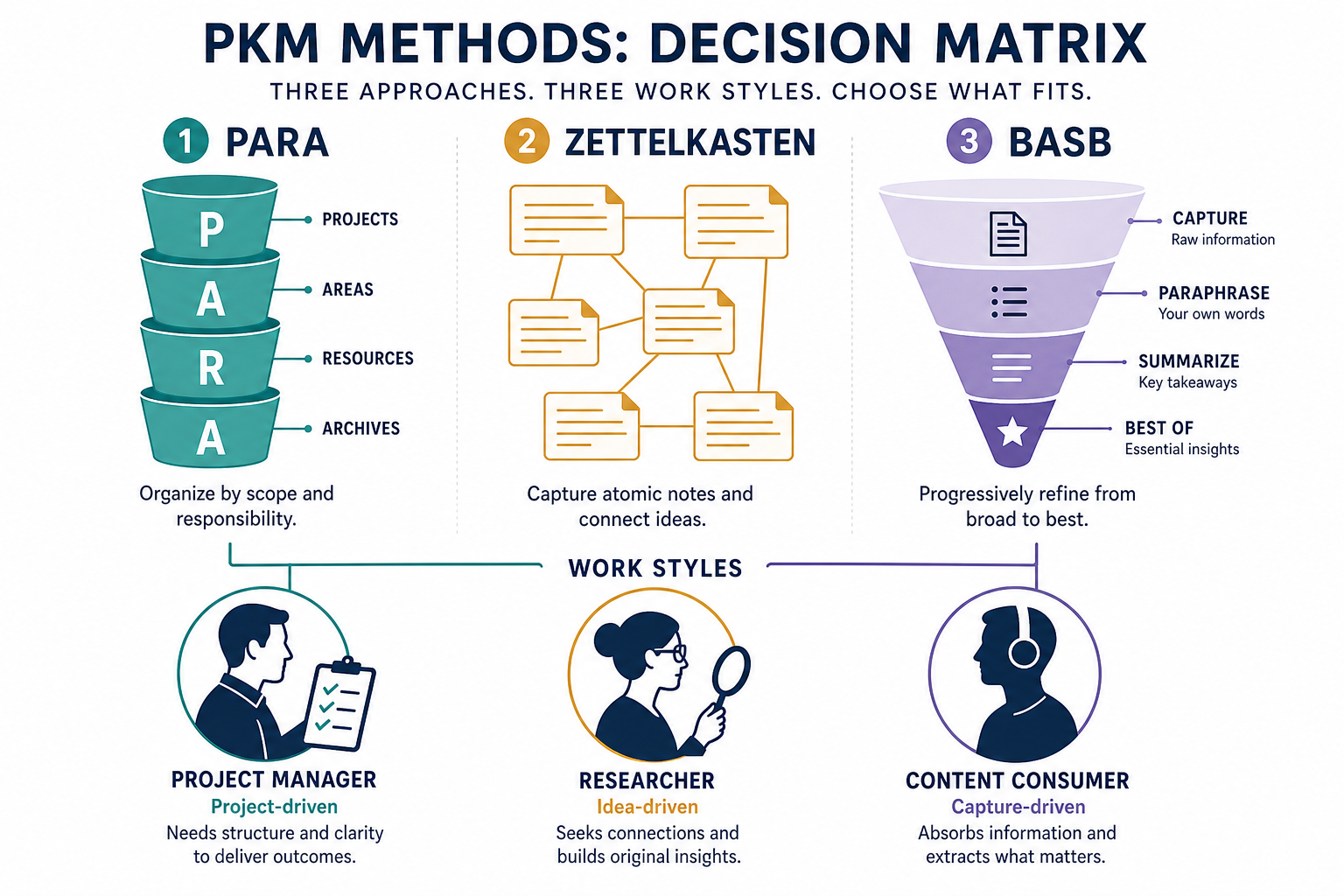
| Work-style profile | Primary output | Best-fit method | Why |
|---|---|---|---|
| Project-driven | Completed deliverables, managed deadlines | PARA | PARA's four-bucket structure keeps active work visible and archives everything else without friction |
| Idea-driven | Original arguments, research papers, books | Zettelkasten | Atomic linking generates novel connections that structured folders cannot produce |
| Capture-driven | Regular content output, synthesized research | BASB | Progressive summarization turns a high-volume capture stream into distilled, actionable material |
Self-Assessment Checklist
Read the three statements below. Pick the one that describes your typical week most accurately.
- "I manage multiple active projects with deadlines. I need to find the latest version of a document or decision fast, and I need old work to stay out of my way." → PARA
- "I read widely across disciplines and want to develop original ideas. I am willing to invest time in linking notes if it means I discover connections I would otherwise miss." → Zettelkasten
- "I consume a high volume of articles, reports, and meeting notes. My job requires me to turn that material into regular output — posts, presentations, or recommendations." → BASB
Top Tools for Each Method in 2026
Once you have chosen your method, the tool decision becomes straightforward. Each of the following tools has a natural affinity with one or more of the three frameworks. Pricing was last verified in mid-2026.
| Tool | Best for method | Pricing (mid-2026) | Key strength |
|---|---|---|---|
| Obsidian | Zettelkasten, PARA | Free; $50/yr Sync; $10/mo Publish | 1,500+ community plugins make it the most extensible PKM tool |
| Notion | PARA, BASB | Free; $10/mo Plus; $15/mo Business | All-in-one workspace with databases, wikis, and project management |
| Logseq | Zettelkasten | Free, open-source | Outliner-first design with bidirectional linking built into the core |
| Atlas | BASB | Free; $20/mo Pro | Purpose-built for progressive summarization and capture-to-output flow |
| Apple Notes | PARA | Free (Apple ecosystem) | Zero-friction capture with reliable sync across Apple devices |
Obsidian's plugin ecosystem is both its greatest strength and its biggest risk. The Atlas guide notes that Obsidian's flexibility creates setup overhead that causes many users to abandon it within weeks. If you choose Obsidian for Zettelkasten, commit to a minimal plugin set for the first 90 days — core plugins only — and resist the urge to optimize your setup before you have a working practice.
For readers who want to compare a wider range of tools before committing, the best note-taking software comparison for 2026 covers 12 tools across a decision matrix organized by use case.
Four Traps That Kill PKM Systems
Even with the right method and tool, most PKM systems fail within the first three months. The Atlas guide to PKM identifies five common traps. The four most relevant to method selection are listed below, along with how to avoid each one.
- Tool-hopping: Switching apps every few weeks because the current tool feels limiting. The fix is to commit to one method for 90 days before evaluating the tool. Most perceived tool limitations are actually method mismatches.
- Over-tagging: Creating dozens of tags that overlap and contradict each other. PARA solves this by eliminating tags entirely — four folders replace any tagging taxonomy. Zettelkasten replaces tags with links. If you are tagging more than 10 categories, you are over-tagging.
- Capture without distill: Saving articles, highlights, and screenshots without ever processing them. This creates a digital pile that is harder to search than the open web. BASB's progressive summarization is the direct antidote: every captured item must go through at least one distillation pass within 48 hours.
- Public-system bias: Building a system that looks impressive in screenshots but is impractical for daily use. A PARA system with four folders does not look impressive. A Zettelkasten with 200 notes and 50 links does not look like a finished product. The goal is a system that works when you are tired and busy, not one that wins aesthetic approval.
For a broader analysis of PKM failure modes, the 12 reasons your PKM system isn't working article covers eight additional traps with specific fixes for each.
Your 30-Day Starter Plan: Pick, Commit, and Build Momentum
This plan is not about building perfect habits. It is about method selection and commitment. The Atlas 30-day starter workflow provides the progression; the emphasis here is on choosing one method and sticking with it.
- Days 1–2: Pick your method. Use the decision matrix and self-assessment checklist above. Choose PARA, Zettelkasten, or BASB. Do not mix methods. Do not customize the framework. Follow it as written for the next 90 days.
- Days 3–7: Capture 30–50 notes. Use your chosen method's capture rules. For PARA, file each note into one of the four buckets. For Zettelkasten, write each note in your own words and link it to at least one existing note. For BASB, apply the first layer of progressive summarization (bold the most important sentence).
- Days 8–14: Organize using the method's core structure. Review your 30–50 notes. PARA users: move any note that does not belong to an active project into Areas, Resources, or Archives. Zettelkasten users: add at least one new link per note. BASB users: apply the second layer of summarization (highlight the most important phrase) to your 10 most valuable captures.
- Days 15–21: Daily capture of 3 things. Three captures per day, every day. This is the minimum viable habit. If you miss a day, do not double up the next day — just resume at three.
- Days 22–30: Weekly 30-minute review. Each week, spend 30 minutes reviewing what you captured. PARA users: close completed projects by moving them to Archives. Zettelkasten users: identify orphan notes (notes with zero links) and either link them or archive them. BASB users: identify captures that never received a second summarization pass and either process them or delete them.
For a more detailed habit-building progression that goes beyond method selection, the 30-day starter workflow for building a PKM system from scratch covers daily capture targets, review routines, and troubleshooting for each week of the first month.
Your Next Step After 90 Days
After 90 days with one method, you will know whether it fits. If it does, the next question is how your system will evolve as your knowledge base grows. No single method scales indefinitely. PARA becomes unwieldy when you have hundreds of archived projects. Zettelkasten requires periodic restructuring as your thinking matures. BASB's capture pipeline needs pruning as your output focus shifts.
The three levels of PKM maturity — from digital filing cabinet to model revision system — provides a roadmap for that evolution. It describes how a PARA system can grow into a thinking environment, how a Zettelkasten can transition from note-taking to theory-building, and how a BASB workflow can shift from capture-heavy to synthesis-heavy as your expertise deepens.
For now, the only step that matters is the first one: pick a method, commit for 90 days, and let the tool be a consequence of that decision — not the cause of it.
Comments
Join the discussion with an anonymous comment.