

The Trap of the Perfectly Organized but Unused Knowledge Base
You have a system. It is well-organized — folders, tags, bidirectional links, maybe even a graph view that looks like a constellation. You capture reliably. You review periodically. You have accumulated hundreds or thousands of notes. And yet, when someone asks you a question that requires synthesizing what you know, or when you sit down to write, or when you need to make a real decision informed by your research, the system goes quiet.
This is not a tool problem. It is not a method problem. It is a maturity problem.
Most PKM practitioners build a system that is excellent at two things: storing information and generating internal insights. They stall at the third thing — using that knowledge to change how they act in the real world. The system becomes a beautiful, self-contained universe that never touches the ground.
The model identifies three distinct levels of PKM maturity:
- Level 1: Storage — a digital filing cabinet optimized for retrieval.
- Level 2: Thinking Partner — a linked network of ideas that surfaces unexpected connections.
- Level 3: Model Revision — a system that ships output to the real world and updates its mental models based on external feedback.
Each level is a legitimate stage. The problem is not being at L1 or L2 — it is believing you have finished building your system when you have only built a sophisticated archive.
Level 1: Storage — The Digital Filing Cabinet
Level 1 is the foundation. It treats your PKM system as a personal search engine — a place where you store information so you can find it later. The primary design goal is retrieval speed and reliability.
At L1, your system is organized around:
- Folders, notebooks, or PARA-style Areas for top-level categorization.
- Tags or labels for cross-cutting metadata.
- Full-text search as the primary retrieval mechanism.
- A reliable capture habit — clipping articles, saving bookmarks, jotting quick notes.
The success metric for L1 is simple: you can find almost anything you have stored in under 60 seconds. If you can do that, your L1 is working.
The common failure mode at L1 is digital hoarding — collecting without processing. The capture habit outpaces the review habit. Notes pile up unread. The system becomes a graveyard of good intentions. The Ebbinghaus Forgetting Curve ensures that anything not reviewed within a few days is effectively lost, even if it sits in a perfectly labeled folder.
L1 is necessary. Without it, you cannot build the higher levels. But if your system stops at L1, you are running a personal archive, not a knowledge management system.
Level 2: Thinking Partner — The Linked Network of Ideas
Level 2 is where most intermediate PKM practitioners live. At this level, your system does not just store information — it helps you think. You have added bidirectional links, atomic notes, and regular connection-making practices inspired by Zettelkasten or the Second Brain methodology.
At L2, your system is designed for:
- Atomic, self-contained notes that each capture a single idea.
- Bidirectional links that connect related ideas across domains.
- Graph views or link maps that reveal clusters and gaps.
- Regular connection reviews — sessions where you browse links, merge duplicates, and surface orphan notes.
The success metric for L2 is serendipity: unexpected insights surface regularly. You open a note about cognitive biases and find a link to a project note you wrote six months ago, and the combination sparks a new idea. The system feels alive.
This is the level that most PKM content on the internet teaches you to build. It is also the level where most practitioners stall — permanently.
If you recognize this pattern — beautiful system, no output — you are not failing at PKM. You are succeeding at L2. The problem is that you have not built the bridge to L3.
For readers who want a deeper comparison of the methods that power L2 systems — Zettelkasten, PARA, CODE, and Seek-Sense-Share — the site has a dedicated framework comparison article that covers each method's strengths and ideal use cases.
Level 3: Model Revision — Reality-Tested Output That Changes How You Think
Level 3 is where knowledge earns its name. At this level, your PKM system does not just store and connect — it changes how you act, decide, and think. The system ships output to the real world, and the real world pushes back.
Volkov defines knowledge at L3 as deeply integrated information that changes decisions, behavior, or actions. This aligns with the scientific definition of knowledge — it is not what you have stored, but what you can act on.
At L3, your system is designed for:
- Regular output — writing, teaching, building, or deciding based on what the system surfaces.
- External feedback loops — publishing work, getting critique, observing outcomes, measuring results.
- Mental model updates — when reality contradicts your stored assumptions, you revise the note, not the reality.
- Behavior change — the system's value is measured by what you do differently, not by how many notes you have.
The canonical L3 practitioner is Niklas Luhmann, the German sociologist who produced 70 books and over 400 academic articles from a slip box of roughly 90,000 handwritten notes over 30 years. Luhmann did not have a beautiful graph view. He had a publishing deadline.
The success metric for L3 is behavioral: you can point to a decision you made differently, a project you completed, or an argument you changed your mind about — directly because of what your system surfaced.
How to Diagnose Your Current Level and Level Up
The first step is honest self-diagnosis. Ask yourself what your system actually produces — not what it contains.
| Diagnostic Question | L1 Answer | L2 Answer | L3 Answer |
|---|---|---|---|
| What happens when I need a specific fact? | I find it in under 60 seconds. | I find it and see related ideas. | I find it, connect it to my current project, and adjust my plan. |
| What does my weekly review produce? | A cleaned-up inbox and updated tags. | New links and connection insights. | A draft, a decision, or a revised project plan. |
| When was the last time my system changed my mind about something? | I don't track that. | I had an insight from linked notes. | I published something, got feedback, and updated my position. |
| What would I lose if my system disappeared tomorrow? | My personal archive. | My network of ideas. | My ability to produce work at my current quality level. |
If you recognize yourself mostly in the L1 column, your path forward is to add linking and connection-making practices. Start with daily linking — every time you capture a new note, link it to at least two existing notes. This is the bridge from L1 to L2.
If you recognize yourself in the L2 column — and most intermediate readers will — your path forward is not more system optimization. It is output commitment. You need a regular cadence of shipping work to the real world: a weekly public note, a monthly essay, a quarterly project with external feedback. The system is ready. You are not using it.
For readers who recognize their own failure modes in the L2 stall — tinkering instead of producing, optimizing system aesthetics instead of shipping output — the PKM anti-patterns article explores twelve common traps and how to escape them.
Why AI Automates L1 and L2 but Cannot Replace L3
The rise of AI-native PKM tools — semantic search, auto-tagging, AI-powered graph analysis, automated connection suggestions — is changing the landscape. These tools dramatically lower the cost of operating at L1 and L2.
Consider what AI can do today:
- Semantic search finds relevant notes even when you do not remember the exact keywords — L1 retrieval, automated.
- Auto-tagging and summarization organize incoming information without manual effort — L1 categorization, automated.
- AI link suggestions surface connections between notes you might have missed — L2 pattern-spotting, accelerated.
- Graph analysis identifies clusters, gaps, and emerging themes across your entire knowledge base — L2 insight generation, scaled.
These are real capabilities, and they make L1 and L2 more accessible than ever. But they do not touch L3.
This is the key insight for practitioners evaluating AI tools in 2026: AI can make your system faster and smarter at L1 and L2, but it also makes it easier to stall at L2. If the tool handles retrieval and connection automatically, you have even less friction preventing you from staying in the comfortable loop of collecting and linking without ever shipping output.
The solution is not to avoid AI tools — it is to recognize that they solve the lower-level problems so you can focus your energy on L3. Use AI to handle the filing and the pattern-spotting. Use your freed-up time to write, build, teach, and decide.
A 90-Day Progression Path from L1 to L3
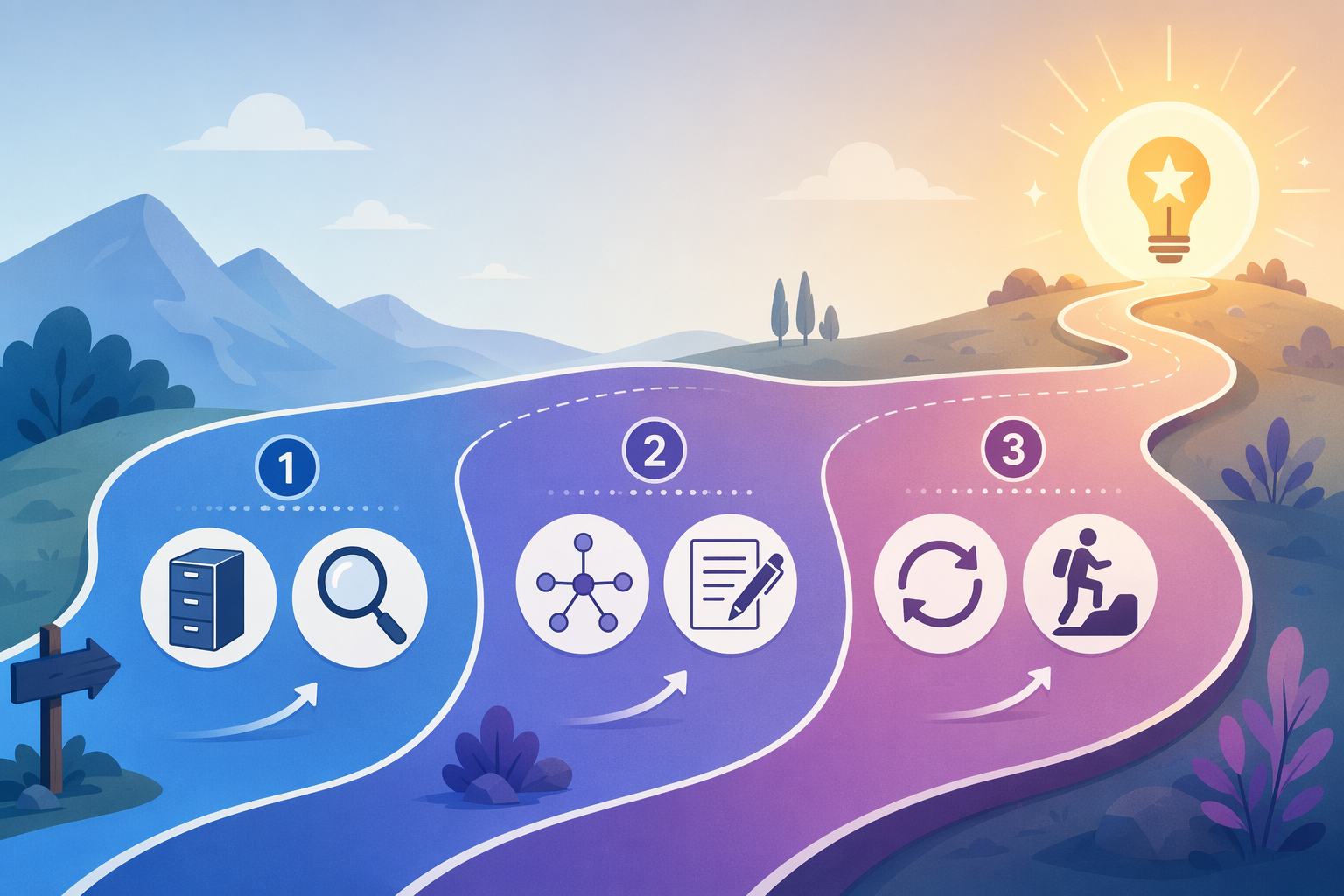
The following roadmap is designed for readers who have an existing system and want to push through the L2 stall into L3. It assumes you already have a capture habit and a basic organizational structure — you are not starting from zero.
| Phase | Days | Focus | Daily Practice | Weekly Deliverable |
|---|---|---|---|---|
| L1 Foundation | 1–30 | Reliable capture and retrieval | Capture at least one note per day. Tag or file it within 24 hours. | A clean inbox with zero unprocessed items. |
| L2 Thinking | 31–60 | Linking and connection-making | Link every new note to at least two existing notes. Review one cluster of linked notes per day. | An insight journal entry — one unexpected connection discovered. |
| L3 Output | 61–90 | Shipping and feedback | Spend 30 minutes per day turning a note cluster into a draft, decision, or plan. | One piece of public output — a published note, a shared decision memo, or a completed project milestone. |
The critical transition is Day 61. Before that, you are building infrastructure. After that, you are building a habit of reality engagement. The goal is not to finish the system — it is to establish a rhythm where output and feedback are as automatic as capture and linking.
The DIKW Cycle: Why Knowledge Is Not a Pyramid
The traditional DIKW pyramid — Data, Information, Knowledge, Wisdom — suggests a linear progression. Collect enough data, organize it into information, synthesize it into knowledge, and eventually you reach wisdom. This model is intuitive, widely taught, and misleading.
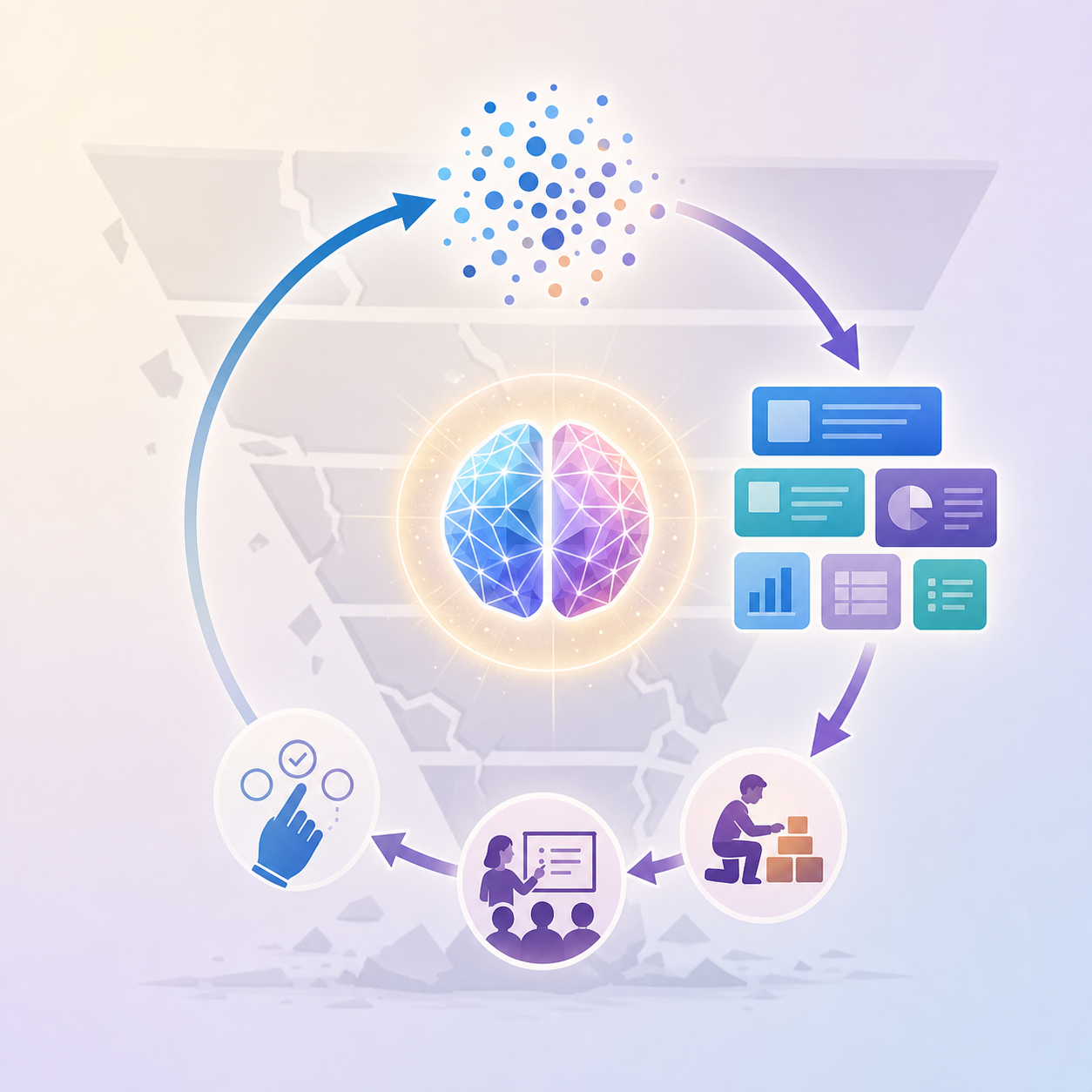
Volkov argues that the DIKW pyramid is misleading because knowledge is actually a cycle, not a linear progression. Data does not automatically become information. Information does not automatically become knowledge. The transformation happens through action and feedback.
In practice:
- You collect data (a statistic, a quote, an observation).
- You organize it into information (a note with context and source).
- You connect it to other information and generate an insight (L2).
- You act on that insight — write, decide, teach, build (L3).
- Reality pushes back. The outcome contradicts your expectation, or reveals a gap in your understanding.
- You update your mental model. The note changes. The link changes. Your next collection is guided by a better question.
This is the DIKW cycle — not a pyramid. The feedback arrow from action back to data is what turns information into knowledge. Without that arrow, you have an archive. With it, you have a learning system.
This reframing supports the L3 thesis directly: more notes does not equal more knowledge. More output, more feedback, and more model revision does.
Comments
Join the discussion with an anonymous comment.