
The first problem with asking whether “Doubao Work membership” is worth its price is that this is not a documented standalone subscription name in the available evidence. The verified ¥68, ¥200, and ¥500 monthly prices belong to Doubao Pro, launched on June 24, 2026.[1] Doubao Work was released separately on August 25, with work-oriented capabilities and deep Feishu integration, but no standalone Doubao Work membership price was located in the source set.[2][3]
Last verified: August 27, 2026. The comparison here therefore uses the Doubao Pro subscription prices alongside the work and office features available around Doubao Work; it does not treat “Pro” and “Work” as officially interchangeable product labels. The distinction matters because Doubao Work had been public for only two days, while the subscription and its quota structure predated it.
The short answer is role-specific. Editorial recommendation: the ¥68 Standard tier is mainly defensible for research-heavy knowledge workers who regularly exhaust free quotas for research, document, meeting, or data work. The ¥200 and ¥500 tiers are aimed at people operating automation-heavy Office Tasks workflows. Someone who primarily captures, organizes, and retrieves notes will usually be paying for substantial duplication.
What the three prices actually buy
| Doubao Pro tier | Verified price | Quota position | Likely role fit |
|---|---|---|---|
| Standard | ¥68/month or ¥688/year; student Standard ¥38/month | 5× the free quotas | Research-heavy individual regularly reaching free work-feature limits |
| Enhanced | ¥200/month or ¥2,048/year | 4× the Standard quotas | Frequent Office Tasks operator with recurring automated workflows |
| Professional | ¥500/month or ¥5,088/year | 10× the Standard quotas | High-volume operator whose usage and time savings can justify professional-tool pricing |
These multipliers measure access, not effectiveness. Five times as many runs do not establish that a generated research report is reliable, that meeting minutes require no correction, or that an automated task removes more work than it creates. A tier becomes valuable only when the additional allowance applies to a recurring bottleneck and the output survives review.
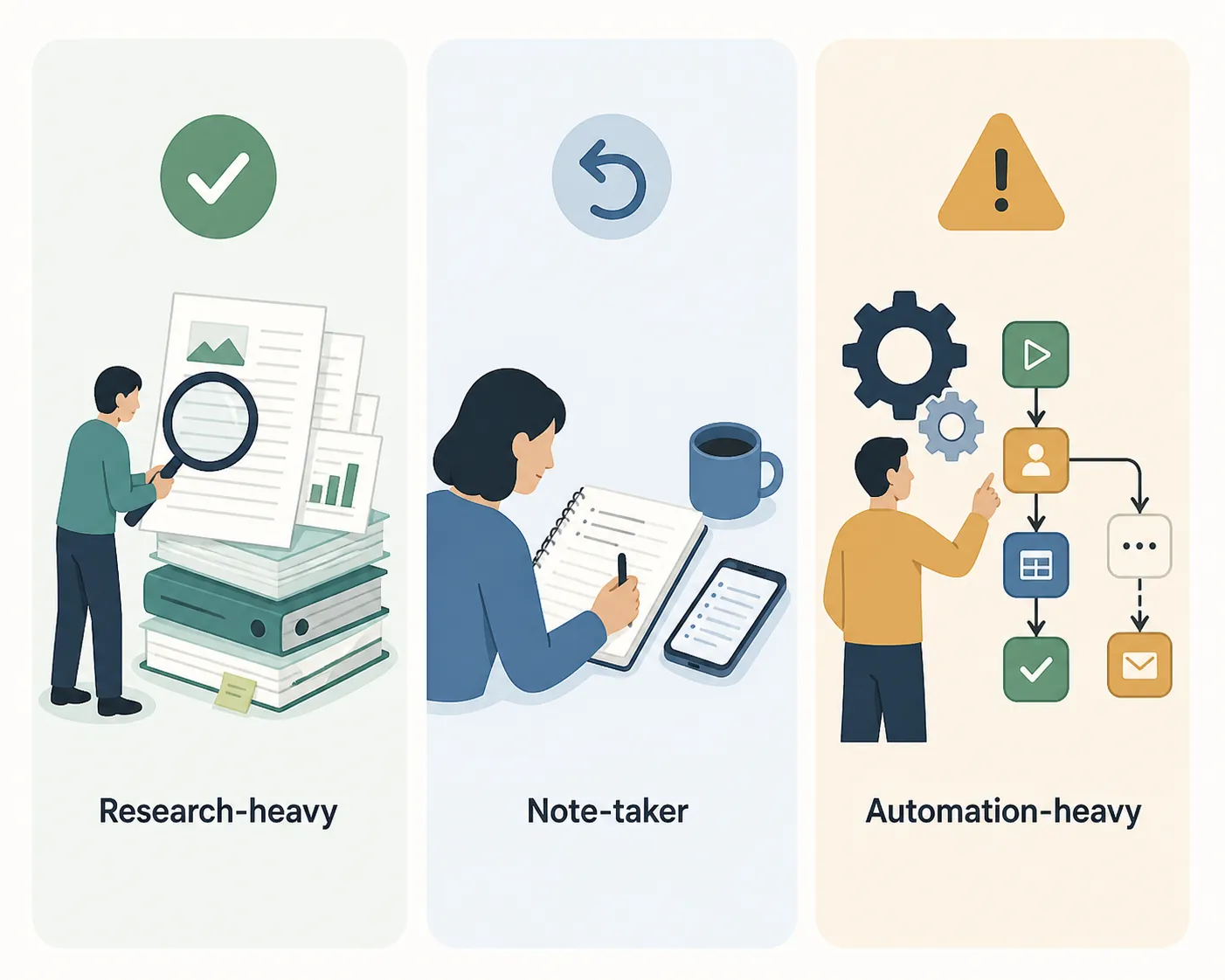
The ¥68 case starts with synthesis, not note-taking
For a research-heavy student or knowledge worker, the expensive part of the workflow is often what happens after capture. Reports, papers, meeting records, and spreadsheets must be read together; claims must be traced back to source material; and the resulting synthesis must be turned into something that can be revised or shared. That is a different workload from writing a note and finding it later. The distinction between capture and synthesis also underlies FlowDesk’s comparison of using two AI note-taking tools.
Doubao’s In-depth Research feature entered free testing in 2025 and can produce report documents and visual webpages. Its broader work feature set includes meeting minutes, data analysis, and an AI Cloud Drive that can preview as many as 42 office file formats.[2] Those capabilities can replace some of the handoffs between a note app, a general AI assistant, meeting material, and office files.
Consider a hypothetical researcher who keeps permanent notes in Obsidian or Notion but repeatedly sends batches of source documents to an external assistant, copies the synthesis back, cleans its structure, and links it to the source notes. Doubao may reduce the upload, conversion, and report-production portion of that loop. It does not remove the need to inspect unsupported claims, preserve source context, or decide which output deserves a place in the long-term knowledge base.
That is where the ¥68 tier has a credible purchasing case. If the free allowance is already sufficient, the paid multiplier has no practical value. If research and document jobs repeatedly stop at the quota boundary—and those jobs are important enough that waiting or moving them elsewhere is disruptive—Standard buys continuity. The relevant evidence is not the size of the quota in isolation but the amount of recurring synthesis work that the extra quota can carry.
- Likely favorable: recurring multi-document research, frequent report production, meeting-heavy work, or regular analysis of office files.
- Borderline: occasional coursework or monthly projects that fit within the free allowance.
- Likely unfavorable: mostly short notes, web clipping, journaling, task capture, and retrieval.
File-format coverage deserves similar restraint. Previewing up to 42 formats can remove friction when material arrives in mixed office files, but coverage says nothing by itself about extraction quality, table fidelity, or the accuracy of a resulting summary. Meeting-minutes availability likewise establishes that a function exists, not that every speaker, decision, or follow-up action will be recorded correctly.
For ordinary notes, compare the whole stack—not one feature
A plain note-taker usually needs dependable capture, organization, retrieval, and editing. If Notion, Obsidian, Evernote, or Apple Notes already handles those jobs, and a separately available AI assistant covers occasional summarization or rewriting, Doubao must replace enough of that combined workflow to justify another account, another archive, and another bill. A list of overlapping AI features is not sufficient.
The duplication baseline is also higher than it first appears because note apps increasingly bundle their own AI functions. FlowDesk’s overview of the AI boom inside note-taking apps is the appropriate comparison point: the purchase decision concerns the capability already available across the stack, not whether Doubao can summarize a document in isolation.
There is also maintenance work. Generated summaries must be checked, useful material must be moved or linked into the durable note system, and duplicated files eventually need an owner. A tool that saves time during generation can return part of that cost during cleanup. This is especially relevant when the note app remains the system of record and Doubao is added as a processing layer rather than replacing it.
For users who deliberately keep notes local, the comparison extends beyond feature overlap. Uploading working material to an AI service can change where copies exist and which service becomes involved in retrieval. The practical questions in AI note tools versus local notes and a personal AI policy for note apps should be settled before convenience is counted as a net saving.
¥200 and ¥500 are Office Tasks prices
The Enhanced and Professional tiers are difficult to justify as upgrades for writing or storing notes. Their economic case depends on Office Tasks: recurring work in which Doubao operates on documents, files, or office processes often enough for the higher allowance to prevent interruptions. The reader paying these prices should be able to identify which repeated handoffs are being removed and who otherwise performs them.
An automation-heavy operator might repeatedly prepare editable files, process batches of office material, or run standardized document workflows. For that user, Enhanced or Professional can be compared with labor time and with specialized professional software. FlowDesk’s separate explanation of Doubao Work’s feature behavior covers the editable-file side in more detail. A note-taker who invokes those operations only occasionally has no equivalent workload against which to recover ¥200 or ¥500 each month.
The difference between Standard, Enhanced, and Professional therefore should not be interpreted as light, medium, and serious note-taking. It is closer to occasional paid research capacity versus progressively higher-volume office operation. The 4× and 10× multipliers are relevant only after Standard is demonstrably constraining a productive workflow.[1]
The discontinued agent weakens the automation case
Doubao discontinued its intelligent-agent feature on July 15, 2026. The documented timeline says affected user data can be viewed and saved only until October 15, 2026.[2] This does not establish that Office Tasks as a whole has been discontinued, but it is a material warning for anyone pricing the subscription around automation continuity.
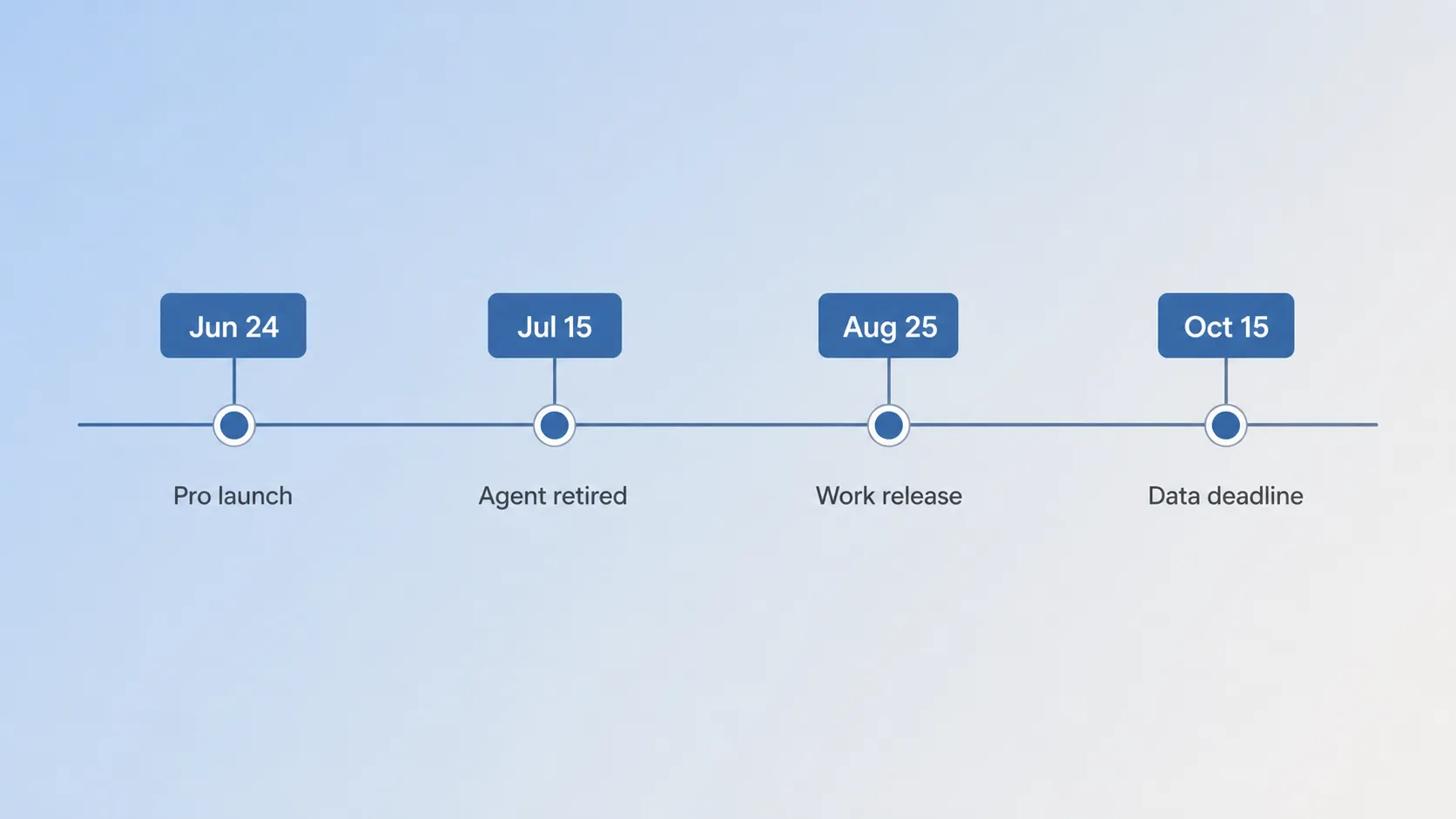
The timing is unusually compressed: Pro launched on June 24, the agent was retired on July 15, and Doubao Work arrived on August 25.[1][2] An automation-dependent buyer is consequently evaluating both quota economics and product continuity. Any workflow that relied on the retired feature also has an immediate preservation task before the October deadline.
At ¥200 or ¥500, that continuity risk matters more than it does for an occasional research user. Automation creates dependencies: templates, review procedures, file locations, and expectations about what the tool will do next. Rebuilding those arrangements is part of the subscription’s potential cost, even if it never appears on the pricing page.
A new product label is not proof of a stable purchase
Baidu Baike’s product timeline relays an Aicpb estimate that Doubao’s monthly active users fell by 6.1 million in May 2026, and it records commentary questioning whether the ¥200 and ¥500 tiers are approaching professional-tool pricing.[2] A one-month audience decline does not predict an individual user’s results, and pricing similarity does not establish feature equivalence. Both facts are better read as reasons not to confuse popularity, quota size, or launch attention with workflow value.
This is an editorial purchase judgment based on cited sources, not a first-hand product test. No available evidence establishes how accurately Doubao will handle a particular reader’s meetings, research corpus, spreadsheets, or mixed-format documents. The recently released Work interface and its relationship with Pro may change after the last-verified date.
Readers who need the broader, non-role-specific buying framework can use FlowDesk’s general Doubao Work value comparison. For note-takers, the boundary is narrower: Standard becomes defensible when research, meeting, document, or data workloads regularly exceed the free allowance. Enhanced and Professional require recurring Office Tasks automation with observable time savings. If the existing note app and AI assistant already cover the actual workload, keeping that stack is usually the less expensive and less fragile choice.
References
- Doubao Officially Launches “Pro Version” Just Now — 36Kr, June 24, 2026
- Doubao — Baidu Baike
- 豆包工作 — Doubao, August 25, 2026