
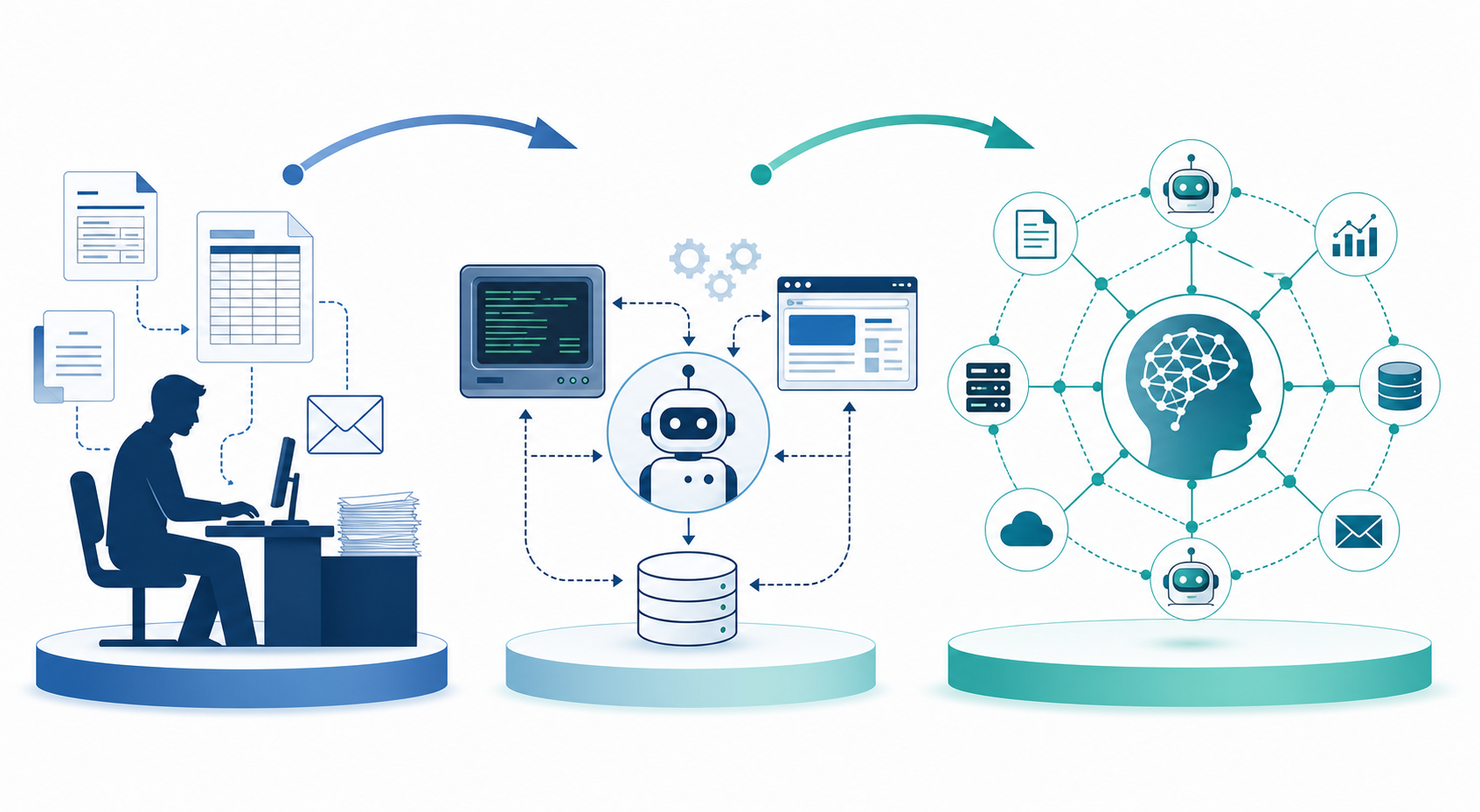
From RPA Startup to Agentic AI Platform: The Blue Prism Evolution Timeline
Blue Prism began as a pure-play robotic process automation vendor in 2001, long before "AI agent" entered the enterprise lexicon. For nearly two decades, its value proposition was straightforward: deploy software robots that mimic human keystrokes and clicks to automate repetitive, rules-based tasks. The platform earned a reputation for enterprise-grade security, auditability, and compliance — qualities that made it a staple in banking, insurance, and healthcare. By 2022, Blue Prism had been acquired by SS&C Technologies, a financial services software giant with $5.6 billion in annual revenue, in a deal valued at approximately $1.6 billion.
The SS&C acquisition marked a turning point. Rather than operating Blue Prism as a standalone RPA unit, SS&C began integrating it into a broader intelligent automation strategy. The result, by early 2026, is a platform that looks fundamentally different from the Blue Prism of 2022. The company now reports 3,571 production automated agents — up from 2,301 in 2024 — and 35 AI agents that have collectively processed over 500,000 transactions. The number of automated processes running on the platform has grown from 2,144 to 3,477 in the same period.
This is not merely incremental growth. The introduction of the WorkHQ platform, the AI Gateway, and the Chorus orchestration layer represents a deliberate pivot from "digital workers" that follow rigid scripts to "AI agents" that can reason, adapt, and collaborate. For enterprise architects evaluating the platform in 2026, the central question is no longer "does Blue Prism work for RPA?" but rather "can an incumbent with a legacy architecture evolve fast enough to compete with AI-native challengers?"
The New Product Stack: WorkHQ, AI Gateway, Chorus, and Decipher IDP
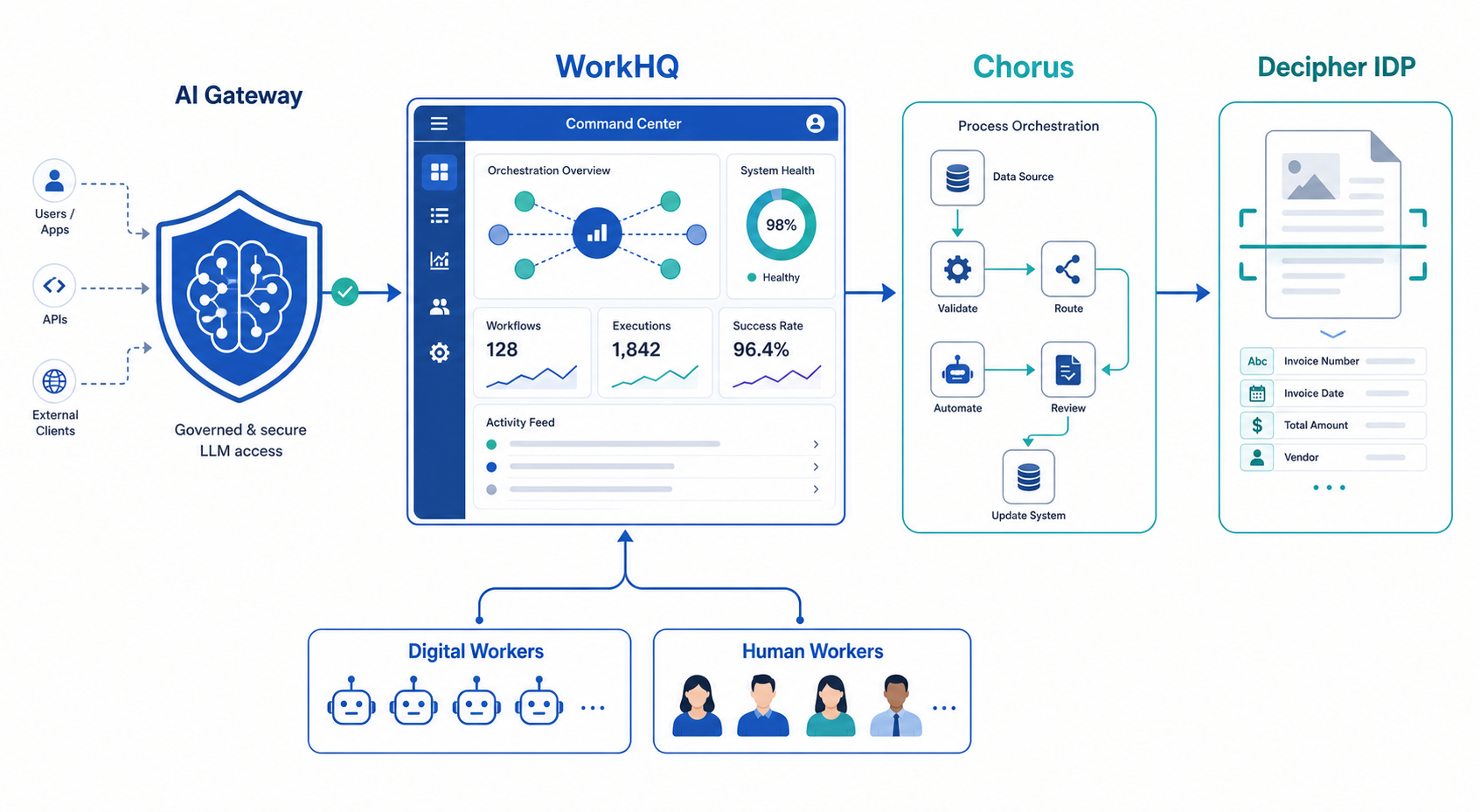
Blue Prism's current architecture is built on four interconnected components that together form what the company calls the "agentic automation platform." Understanding how these pieces fit together is essential for anyone evaluating the platform's ability to deliver on its AI agent promise.
WorkHQ: The Unified Control Plane
WorkHQ is the central orchestration layer that unifies human workers, digital workers (traditional RPA bots), and AI agents under a single interface. Rather than managing bots through one console and AI agents through another, WorkHQ provides a single pane of glass for assigning tasks, monitoring performance, and managing exceptions. This is a significant departure from the fragmented tooling that characterized earlier RPA deployments, where IT teams often juggled separate dashboards for bot management, document processing, and workflow monitoring.
For knowledge workers evaluating workflow automation vs. process automation vs. RPA, WorkHQ's convergence of these three worker types under one roof is unusual in the market. Most platforms still treat human-in-the-loop workflows, automated processes, and AI-driven tasks as separate capabilities.
AI Gateway: Governed Access to Large Language Models
The AI Gateway is arguably the most strategically important component of the new stack. It provides a governed interface through which Blue Prism's bots and agents can access large language models (LLMs) — whether from OpenAI, Anthropic, or other providers — without exposing the organization to the security and compliance risks of direct API access. The Gateway enforces role-based access control (RBAC), maintains full audit trails of every LLM interaction, and provides real-time risk notifications when a model's output falls outside acceptable parameters.
For regulated industries — banking, insurance, healthcare — this governance layer is the primary reason to stay with Blue Prism rather than switching to a lighter-weight AI-native tool. The platform's 4.5-star rating on both Gartner Peer Insights and G2 reflects this strength, as does its seventh consecutive year as a Leader in the Gartner Magic Quadrant for RPA.
Chorus: Process Orchestration and Decipher IDP: Document Intelligence
Chorus is Blue Prism's process orchestration layer, responsible for managing end-to-end workflows that span multiple systems, departments, and worker types. It handles task routing, exception management, and SLA tracking. Decipher IDP (Intelligent Document Processing) adds the ability to extract, classify, and validate data from unstructured documents — invoices, contracts, forms — using machine learning rather than fixed templates.
Together, these four components create a platform that can handle the full lifecycle of an automated process: from document ingestion (Decipher) through orchestration (Chorus) and AI-powered decision-making (AI Gateway) to execution by human workers, digital workers, or AI agents (WorkHQ). The integration is tighter than what most organizations could achieve by stitching together point solutions from different vendors, but it comes at a cost — both in licensing fees and in the complexity of maintaining a platform that spans so many capabilities.
Concrete Metrics: 3,571 Production Agents and 35 AI Agents in the Field
Numbers matter more than promises when evaluating a platform's transformation. Blue Prism's own metrics, published on its plans and pricing page, provide a snapshot of where the platform stands in early 2026:
- 3,571 production automated agents deployed (up from 2,301 in 2024)
- 35 AI agents processing over 500,000 transactions
- 3,477 automated processes running on the platform (up from 2,144 in 2024)
The growth in production agents — a 55% increase over two years — suggests that existing customers are expanding their deployments, not abandoning the platform. The 35 AI agents, while still a small fraction of the total, represent a meaningful proof point that the platform can support AI-driven automation in production, not just in pilot projects.
The ratio of 35 AI agents to 3,571 traditional bots is revealing. It indicates that Blue Prism's AI agent capability is real but early-stage. Organizations deploying AI agents through the platform are likely doing so in controlled, well-defined use cases rather than at scale. This is consistent with the broader market pattern: most enterprises are still in the experimentation phase with agentic AI, even as vendors race to announce new capabilities.
Customer Case Studies: Real-World Value from Kimberly-Clark, Banorte, ABANCA, and SS&C Internal
Blue Prism's customer case studies offer concrete examples of the value the platform has delivered, though it is important to note that these are vendor-supplied success stories and may not represent typical outcomes.
| Customer | Industry | Key Metric | Reported Impact |
|---|---|---|---|
| Kimberly-Clark | Consumer Goods | $140M+ cumulative business value | 1.6 million manual hours saved |
| Banorte | Banking | 60% faster credit application processing | 30% capacity increase |
| ABANCA | Banking | 60% faster customer inquiries | 150,000 digital worker days completed |
| SS&C Internal | Financial Services | 95% faster credit contract data processing | AI and automation combined |
Kimberly-Clark's results stand out. The $140 million in cumulative business value and 1.6 million manual hours saved represent a scale of impact that few RPA deployments achieve. These figures suggest a mature, enterprise-wide automation program rather than a departmental pilot. For organizations considering Blue Prism, the Kimberly-Clark case study provides a reference point for what is possible with sustained investment and organizational commitment.
The banking case studies — Banorte and ABANCA — both report approximately 60% faster processing times, which is consistent with what well-executed RPA programs typically deliver in financial services. The SS&C internal case study, showing 95% faster credit contract data processing, is particularly relevant because it demonstrates the platform's ability to automate complex, document-heavy workflows that combine traditional RPA with AI capabilities.
The Cost Challenge: AI-Native Alternatives Claim 80% Lower TCO
Blue Prism's most significant vulnerability in 2026 is not a feature gap — it is cost. The platform's pricing model, which is sales-led and not publicly published, is estimated by third-party analysts at approximately $13,000 to $20,000 per bot per year. Cloud Launch Packs start at roughly £25,000 to £50,000 per year for a basic package, and the Process Intelligence add-on costs approximately £78,000 or more per year.
The total cost of ownership (TCO) for Blue Prism is typically 2 to 3 times the license fee, with implementation services accounting for approximately 70% of total RPA spend versus 30% on software. This means a single bot that costs $15,000 in licensing could easily carry a total first-year cost of $30,000 to $45,000 when implementation, training, and ongoing maintenance are factored in.
Against this backdrop, AI-native platforms such as Autonoly (priced at approximately $49 per user per month), O-mega, and Duvo are claiming 80% lower TCO. Their argument is straightforward: by using self-healing AI agents that adapt to interface changes automatically, they eliminate the maintenance overhead that drives up the cost of traditional RPA. When a website or application updates its UI, a traditional Blue Prism bot breaks and requires manual repair. An AI-native agent, in theory, adapts on its own.
The cost gap is compounded by a failure rate that Ernst & Young's global RPA practice estimates at 30-50% for initial implementations. When nearly half of all RPA projects fail to achieve their goals, the total cost of failed experiments — including sunk implementation costs — becomes a significant barrier to scaling. AI-native vendors argue that their platforms reduce this risk by enabling faster deployment and easier iteration.
However, the comparison is not apples-to-apples. Blue Prism's pricing includes enterprise-grade governance, audit trails, and compliance features that AI-native tools may not offer at the same level. For organizations in regulated industries, the cost of compliance failure — fines, reputational damage, legal liability — can far exceed any savings from a lower-priced platform. The governance premium that banks, insurers, and healthcare organizations pay for Blue Prism is real, and it may be worth the cost.
The AI Gateway Approach: Governed, Auditable, Enterprise-Safe AI
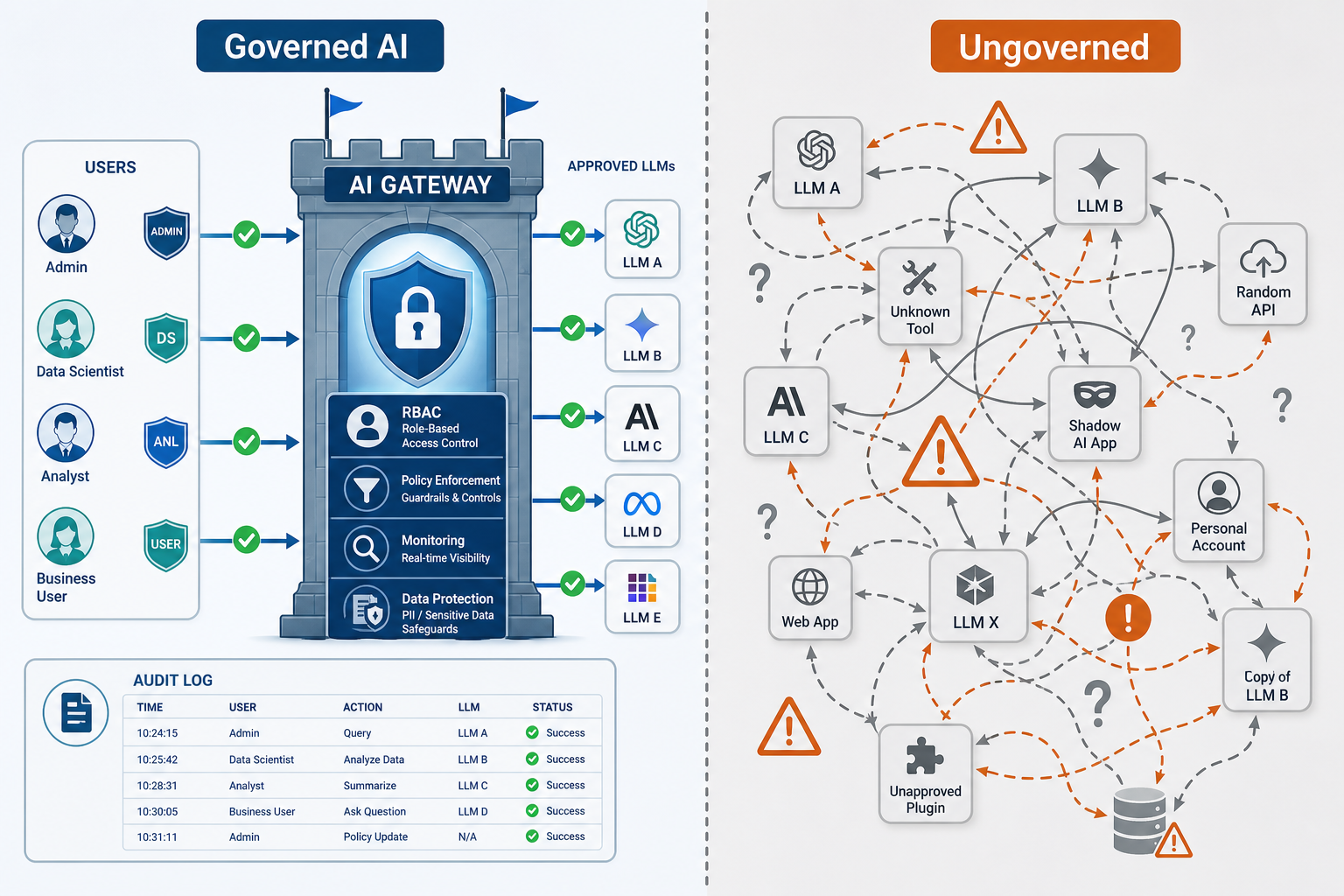
Blue Prism's AI Gateway is the company's answer to the fundamental tension in enterprise AI adoption: how to give employees and automated systems access to powerful LLMs without exposing the organization to data leakage, compliance violations, or reputational risk. The Gateway sits between the organization's internal systems and external LLM providers, enforcing policies at every step.
Key capabilities of the AI Gateway include:
- Role-based access control (RBAC) that determines which users, bots, and agents can access which LLMs and with what level of autonomy
- Full audit trails of every LLM interaction, including input prompts, model responses, and timestamps
- Real-time risk notifications when model outputs contain sensitive data, policy violations, or anomalous patterns
- Support for multiple LLM providers through a single governed interface, avoiding vendor lock-in
For organizations in regulated industries, this governance layer is not optional — it is a compliance requirement. A bank that allows an AI agent to process customer loan applications cannot afford to have that agent sending sensitive financial data to an ungoverned LLM endpoint. The AI Gateway ensures that every AI interaction is logged, reviewable, and compliant with internal policies and external regulations.
This is where the distinction between AI process automation and traditional RPA becomes critical. Traditional RPA operates in a deterministic world: if X happens, do Y. AI agents operate in a probabilistic world: given context Z, the model generates a response that is likely correct but not guaranteed. The governance requirements for probabilistic systems are fundamentally different, and Blue Prism's AI Gateway is designed to address that difference.
Future Outlook: Outcome-Based Pricing, Citizen-Developer AI Agents, and Market Consolidation
The automation market is moving toward three trends that will shape Blue Prism's trajectory over the next two to three years.
Outcome-Based Pricing
Blue Prism's current per-bot pricing model is increasingly out of step with the market. AI-native platforms charge per user or per outcome, not per bot. As organizations deploy more AI agents that can handle multiple tasks simultaneously, the per-bot model becomes both expensive and difficult to justify. A shift toward outcome-based pricing — where customers pay based on the business value delivered rather than the number of bots deployed — would align Blue Prism's cost structure with the value its platform generates. SS&C has not announced such a shift publicly, but the pressure from AI-native competitors makes it likely within the next 12 to 18 months.
Citizen-Developer AI Agents
One of the most significant shifts in the automation market is the rise of citizen-developer AI agents — tools that allow business users to create and deploy AI-powered automations without writing code or understanding RPA architecture. Blue Prism has traditionally been a developer-centric platform, requiring specialized training to build and maintain automations. The WorkHQ platform begins to address this by providing a more intuitive interface, but the platform still carries a learning curve that limits its appeal to non-technical users. If Blue Prism can make AI agent creation accessible to business analysts and operations managers, it could open a much larger addressable market.
Market Consolidation
The automation market is consolidating rapidly. SS&C's acquisition of Blue Prism was part of a broader wave of consolidation that has seen major enterprise software companies absorb RPA and automation capabilities. The convergence of RPA, AI agents, and workflow automation into unified platforms means that standalone RPA vendors — whether incumbents or AI-native startups — face pressure to either become comprehensive platforms or be acquired. For buyers evaluating AI automation platforms in 2026, the long-term viability of any vendor depends on its ability to offer a complete stack, not just a single capability.
Buyer's Checklist: When to Stick with Blue Prism and When to Explore AI-Native Alternatives
For enterprise architects and automation strategists, the decision to invest further in Blue Prism or explore AI-native alternatives depends on a set of concrete factors. The following checklist is designed to help organizations assess their own position.
Stick with Blue Prism if:
- Your organization operates in a regulated industry (banking, insurance, healthcare) where audit trails, RBAC, and compliance reporting are non-negotiable requirements
- You already have a significant investment in Blue Prism — existing bots, trained staff, and integrated workflows — and the cost of migration would outweigh the potential savings
- Your automation use cases are predominantly rules-based, high-volume, and stable, with low tolerance for the probabilistic variability of AI-generated outputs
- You need a single platform that can handle the full lifecycle from document processing through orchestration to execution, and you prefer an integrated stack over stitching together point solutions
Explore AI-native alternatives if:
- Your automation program is still in early stages and you want to avoid the high upfront costs and implementation complexity of traditional RPA
- Your use cases involve unstructured data, natural language understanding, or dynamic decision-making where rule-based bots struggle
- You need to scale automation quickly across multiple departments without a large central RPA team
- Your organization is comfortable with a higher degree of vendor risk in exchange for significantly lower TCO and faster time-to-value
The decision ultimately comes down to a single question: does your organization need the governance and compliance capabilities that Blue Prism offers, or can it accept the risks of a lighter-weight AI-native platform in exchange for lower cost and faster deployment? There is no universally correct answer — only the answer that fits your specific regulatory environment, existing investments, and risk tolerance.