
You can do a surprising amount “right” and still end up with a personal knowledge management system that feels inert. You captured the article. You clipped the quote. You wrote the meeting note. You made the PARA folders, or the Zettelkasten notes, or both. For a while, you even tagged carefully.
Then a real task appears: a client question, a class assignment, a product decision, an essay draft, a hiring plan. You know you have useful material somewhere. You remember reading something adjacent. You can almost feel the note sitting in the archive. But the system does not volunteer it. You search three terms, browse two folders, open a few notes that are not quite relevant, and eventually move on without the archive.
That is usually not a sign that you chose the wrong method. It is a sign that the system is missing a retrieval layer.
In 2026, the useful question is less “Should I use PARA or Zettelkasten?” and more “Which layer of the stack is failing?” Capture, File, Think, and Retrieve are different jobs. When they collapse into one app, one folder scheme, or one heroic tagging routine, the archive often looks responsible while behaving like storage.
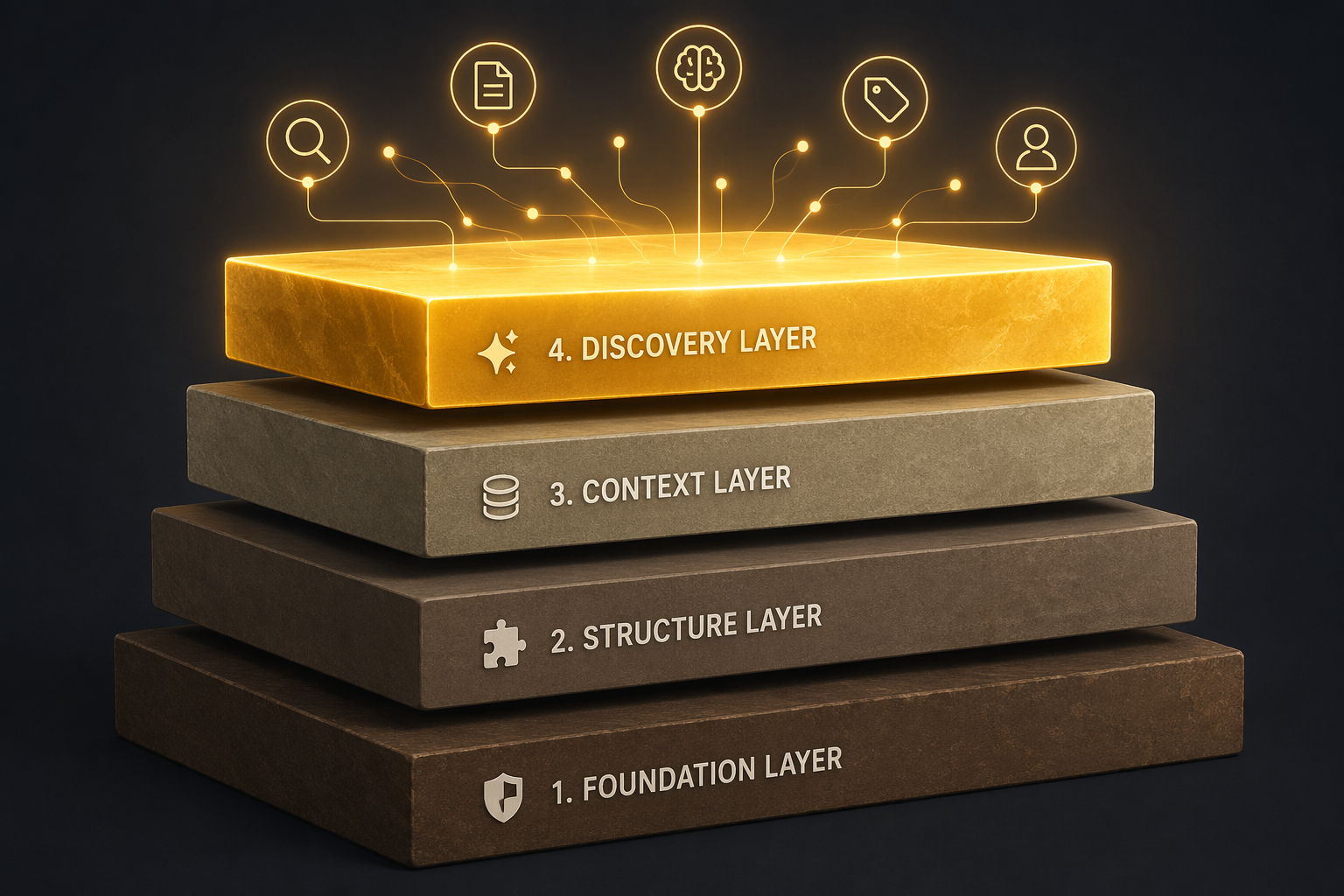
The four jobs your PKM system has to do
A mature personal knowledge management system is easier to diagnose when it is treated as a stack, not a philosophy. The layers are simple:
| Layer | Job | Typical methods or tools | Failure pattern |
|---|---|---|---|
| Capture | Get material into the system with low friction | Inbox notes, web clippers, voice notes, meeting notes, read-it-later tools | Important material never enters, or enters too slowly |
| File | Put active material where it can support action | PARA, project folders, databases, task-linked notes | Everything is stored, but current work cannot find its supporting material |
| Think | Turn collected material into interpreted ideas | Atomic notes, Zettelkasten links, progressive summarization, output pipelines | Notes remain excerpts, highlights, and transcripts rather than usable thought |
| Retrieve | Surface relevant notes, relationships, and patterns at the moment of need | Semantic search, AI assistants, graph-based retrieval, GraphRAG | The archive contains value, but you cannot reliably re-enter it |
The stack is a practical synthesis, not a doctrine handed down by one method. InfraNodus makes the retrieval shift unusually explicit: AI changes the bottleneck in personal knowledge management from organization to retrieval, especially when graph-based analysis is used to show relationships across a knowledge base rather than merely store documents in better places.[1]
That diagnosis matters because many intermediate users respond to retrieval failure by reorganizing. They rename areas. They split resources into subfolders. They add tags. They migrate from one app to another. Some of that may help, but it often addresses the wrong layer. If the system cannot bring prior thinking back into view when a live question appears, finer filing will only postpone the frustration.
Capture is the inlet, not the system
Most people who have stayed with PKM for more than a few months understand capture reasonably well. The problem is not that they refuse to save useful material. If anything, they have proved they can save too much.
The capture layer should be boring. It needs a fast way to record a thought before it evaporates, save a source before the tab disappears, and preserve a meeting decision before the team rewrites history in Slack. It does not need to decide the final meaning of the material at the moment of intake.
A good capture layer has three qualities: low friction, predictable inboxes, and a review habit. The inbox can be messy for a while. It cannot be imaginary. If captured material never gets reviewed, then capture is only a private landfill with better typography.
This is why capture tools rarely solve the intermediate-stage problem by themselves. Better clipping creates more inventory. Better transcription creates more text. Better mobile input creates more fragments. Those are useful only if later layers can sort, interpret, and retrieve them.
File gives current work a spine
Filing is where PARA earns its keep. Projects, Areas, Resources, and Archives are not trying to become a theory of knowledge. They are trying to answer a more immediate question: “Where does this belong in relation to my current responsibilities?”
That is a valuable job. Active projects need a home. Recurring responsibilities need a stable place. Reference material needs somewhere to live without pretending it is urgent. Completed work needs to leave the active workspace without being destroyed. For Notion users, a database-driven setup can make that project spine easier to maintain; the mechanics are covered more directly in this PARA setup guide.
But filing is often overburdened. A project folder can tell you where the notes for the redesign live. It cannot, by itself, tell you that a quote from a customer interview six months ago connects to a pricing objection, a churn pattern, and a half-written strategy memo. Folder structure is good at custody. It is weaker at recombination.
This is the point where many people start doubting their whole setup. They look at their folders and conclude the taxonomy must be wrong. Sometimes it is. More often, the filing layer is being asked to perform thinking and retrieval work it was never built to perform.
A useful filing layer should make active work easier to navigate. It should not require every note to have a perfect permanent address before it can be useful. If you are spending more time debating where a note belongs than using it, the layer has become too expensive.
Thinking happens when notes stop being containers
The thinking layer is where Zettelkasten-style practice still matters, even in an AI-heavy environment. Manual linking is not sacred because it is manual. It is valuable because it forces interpretation.
When you break a source note into an atomic idea, give it a title, write it in your own words, and connect it to another note, you are making a judgment. You are saying: this claim matters because of that problem; this observation complicates that assumption; this example belongs near that pattern. The link is a trace of thought, not just a navigation feature.
The classic benchmark is Niklas Luhmann’s Zettelkasten: about 90,000 notes, associated with more than 70 books and more than 400 articles over roughly 30 years.[2] That is impressive, but the wrong lesson is to imitate the romance of the cabinet. The useful lesson is that disciplined note-making created a retrieval and recombination environment. The system was not merely an archive of what Luhmann had read; it became a place where prior thinking could be encountered again in new combinations.
Zettelkasten.de’s discussion of Building a Second Brain and Zettelkasten is helpful here because it treats the methods as complementary rather than mutually exclusive. BASB-style organization can provide the action-oriented spine, while Zettelkasten-style notes support idea development and conceptual linking.[2]
That hybrid is closer to how working systems survive. Project material often starts inside the filing layer because a deadline needs it. Some of it later deserves promotion into the thinking layer because it contains an idea that will outlive the project. A user research quote, for example, may belong first in a client project. Later, the pattern it reveals might become a permanent note about onboarding friction, decision avoidance, or the difference between stated preferences and actual behavior.
This is also where an output pipeline becomes useful. Output exposes whether the thinking layer is real. If a note cannot help you draft a section, make a decision, frame a question, or explain a tradeoff, it may still be a good record. It is just not yet a thinking asset.
AI does not remove this need. In some cases, it makes the distinction more important. If an assistant summarizes everything before you have decided what matters, you may get cleaner prose and weaker thinking. The act of selecting, naming, and linking is part of how the material becomes yours.
Retrieval is the layer most intermediate systems never built
Retrieval is not the same as search. Search asks you to know the word you used before. Retrieval helps you re-enter the knowledge base from the question you have now.
This difference becomes painful once the archive grows past casual browsing. A few dozen notes can be remembered. A few hundred notes already strain memory, naming consistency, and folder discipline. At that point, the system may contain useful relationships that no folder view will show and no exact keyword search will catch.

This is why the retrieval layer is the 2026 differentiator. InfraNodus argues for graph-based personal knowledge management because graph structures can reveal topical clusters, gaps, and relationships across notes, while AI can then help query and navigate that structure.[1] The practical point is not that every individual needs a visually impressive graph. The point is that relationships become first-class retrieval material.
Ordinary keyword search is brittle when the wording changes. Vector search is better at semantic similarity, but it can still return plausible chunks without showing the larger shape of the knowledge base. GraphRAG approaches try to combine retrieval with a relationship map, which can be especially useful for overview questions: “What themes keep recurring in my notes on onboarding?” “Which objections appear across sales calls and support tickets?” “Where do my notes on attention, delegation, and decision fatigue overlap?” InfraNodus frames this as an advantage of GraphRAG over vector-only retrieval for relationship-heavy and overview-level questions.[1]
That does not make GraphRAG a magic phrase. It changes the kind of question your system can answer. A search box is often good for “find the note.” A retrieval layer should help with “show me what I have been circling around,” “surface neglected connections,” and “bring related prior thinking into this current draft.”
The cost of poor retrieval is not abstract. McKinsey’s work on the social economy is widely cited for the estimate that knowledge workers spend 9.3 hours per week searching for information.[3] Even if a personal archive accounts for only a fraction of that waste, the pattern is familiar: time disappears not because the knowledge was never captured, but because it cannot be found at the moment it would change the work.
For a working PKM stack, retrieval should support at least four behaviors:
- Semantic recall: finding notes that are conceptually relevant even when they use different wording.
- Relationship surfacing: showing links, clusters, contradictions, and recurring themes across notes.
- Context assembly: pulling together source notes, project notes, and permanent notes around a current question.
- Traceability: letting you inspect where an answer came from instead of accepting an AI-generated synthesis on trust.
That last behavior is not optional. A retrieval layer that produces confident summaries without reliable paths back to the underlying notes is convenient, but it weakens the system’s working memory. The more AI participates, the more important it becomes to preserve source visibility, note boundaries, and the difference between your own claims and generated synthesis. For a deeper treatment of those tradeoffs, see the GraphRAG and truth-layer discussion.
AI changes the method debate by lowering the penalty for imperfect filing
Before AI retrieval became practical, filing carried too much pressure. If you put a note in the wrong place, failed to tag it, or used inconsistent wording, you might never see it again. The system rewarded people who could maintain a taxonomy with unusual discipline.
AI retrieval changes that priority order. It does not make structure irrelevant. It makes structure less responsible for every future act of discovery.
PARA can remain the action spine. Zettelkasten can remain the thinking layer. Tags can remain useful when they mark workflow status, source type, or review needs. But none of them has to carry the full burden of resurfacing every possible connection. That is the retrieval layer’s job.
This is a relief if you maintain the system yourself. It means you do not need to rebuild the whole archive because one category scheme aged badly. You need to ask which layer is weak.
| Symptom | Likely weak layer | Better first move |
|---|---|---|
| You keep losing fleeting ideas before they are written down | Capture | Improve quick capture and create one trusted inbox |
| You cannot see what belongs to current projects | File | Repair project and area structure before adding more AI |
| Your notes are mostly quotes, highlights, and copied passages | Think | Write more atomic notes in your own words and connect them deliberately |
| You know relevant material exists but cannot resurface it under pressure | Retrieve | Add semantic or graph-based retrieval before reorganizing everything |
| AI gives polished answers but you cannot verify where they came from | Retrieve | Prioritize tools and workflows with source traceability |
This audit prevents the most common waste pattern: replacing a whole personal knowledge management system when only one layer needed attention. If the capture layer is working and the filing layer is adequate, do not migrate apps just because retrieval feels weak. Add or improve retrieval. If the thinking layer is thin, do not expect an AI assistant to manufacture durable insight from unprocessed clippings. Strengthen the notes.
What to keep manual, and what to let AI handle
The cleanest division is not “humans think, AI retrieves.” Real systems are messier than that. But some responsibilities should stay close to the person using the archive.
Keep manual control over the claims you want to stand behind. Name important notes yourself. Write durable ideas in your own words. Create deliberate links when the relationship matters to your work. Decide whether a note is merely a source, an active project artifact, or a reusable idea.
Let AI help with the work that benefits from breadth and patience: finding semantically related notes, suggesting overlooked connections, clustering a large set of fragments, comparing notes across projects, and generating first-pass maps of what a collection appears to contain. Treat those outputs as invitations back into the archive, not as replacements for the archive.
A simple rule helps: if the action changes your understanding, do it deliberately; if the action scans more material than you can reasonably inspect by hand, ask the retrieval layer to help.
How to layer tools without churning your setup
Tool decisions become calmer when each tool is matched to a layer. One app can cover multiple layers, but it should not be judged as if it must be perfect at all of them.
- If your current app captures reliably, keep it for capture.
- If your project structure is stable, keep it as the filing layer.
- If your thinking happens best in plain text, backlinks, or a local-first notebook, protect that environment.
- If retrieval is weak, evaluate AI search, semantic retrieval, or graph-based tools against the archive you already have.
The evaluation question is not “Which app is the best PKM tool?” It is “Which layer is this tool improving, and what maintenance cost does it add?” An AI-native workspace may be worth exploring if retrieval and synthesis are the missing pieces. A local graph-based system may be better if you care more about inspectable links and source control. A project database may be enough if your real pain is active work management. Readers comparing options can use a tool-level PKM system comparison after the layer diagnosis is clear.
For people still deciding between base methods, a framework-first comparison of PARA, Zettelkasten, and BASB is a better starting point than another migration. For people specifically watching AI-native tools, AI-native PKM system profiles are most useful once you know whether you are buying capture, filing, thinking support, retrieval, or some combination.
A practical rebuild-free sequence
The safest way to improve an existing system is to avoid a grand redesign. Work through the stack in order, but spend the most attention where the evidence points.
- Pick one live project or question. Do not audit the entire archive in the abstract.
- Trace the project backward through the stack. What did you capture? Where was it filed? Which notes became interpreted ideas? What could you retrieve when you needed it?
- Name the weak layer. Resist the temptation to fix all four at once.
- Make one layer-specific change. Add a capture inbox, simplify filing, write atomic notes from the best source material, or test retrieval across a bounded set of notes.
- Run the same project question again. The test is whether the system reduces friction and brings prior thinking back into the work.
A bounded test is important. If you connect an AI retrieval tool to a chaotic archive and ask it to become a thinking partner overnight, disappointment is likely. Try it first on a project folder, a set of research notes, or a few hundred mature notes. Ask real questions, not demo questions. Look for whether it surfaces something you would otherwise have missed and whether you can verify the source quickly.
The same restraint applies to templates. A template pack can accelerate implementation if you already know which layer you are building; it becomes decorative overhead if you are avoiding the diagnosis. Use templates to stabilize repeated work, not to hide uncertainty. If you need implementation scaffolding after the audit, the complete PKM template pack can serve that role.
The system is working when old notes change current work
A personal knowledge management system does not become mature when it has a beautiful graph, a pure method, or a complete folder taxonomy. It becomes mature when captured material can move into action, be transformed into thought, and return when it can alter the decision, draft, conversation, or question in front of you.
The retrieval layer is what many intermediate systems are missing, but it should be added with respect for the layers already doing useful work. Keep the project spine if it helps you act. Keep deliberate notes and manual links where they sharpen your thinking. Add AI retrieval where memory, browsing, and keyword search have reached their limits.
The goal is not to own the fanciest app or practice the purest method. The goal is to build a stack you can still maintain six months from now, where the work you have already done is easier to find, easier to trust, and more likely to matter when the next real question arrives.
References
- Personal Knowledge Management, InfraNodus
- Building a Second Brain and Zettelkasten, Zettelkasten.de
- The social economy: Unlocking value and productivity through social technologies, McKinsey & Company
Comments
Join the discussion with an anonymous comment.