
The Monday workout usually fails before the first rep. The alarm goes off, the shoes are somewhere under a chair, the shirt you planned to wear is still in the laundry, and the plan in your head is vague enough to negotiate with. By 8:15 a.m., “I’ll start the week with energy and focus” has become “maybe after work.”
A useful Monday motivation workout for energy and focus has to survive that exact moment. The default should be modest, pre-decided, and specific: a moderate-intensity session that combines aerobic movement and simple resistance work, wrapped in a warm-up and cooldown. It does not need a gym, a heroic wake-up time, or a personality transplant.
The best starting version is 20 to 30 minutes. If that is too much for the current week, the fallback is not “skip it.” The fallback is “do the 10-minute version and stop cleanly.” That distinction matters because Monday routines are judged less by how impressive they look once and more by whether they are still possible when sleep, meetings, weather, or school deadlines are not cooperating.

The evidence-backed default: moderate effort plus resistance
For energy and focus, the workout dose matters more than the motivational tone around it. A 2022 meta-analysis by Wender and colleagues reviewed 81 randomized controlled trials with 7,050 participants and found that chronic exercise improved feelings of energy and reduced fatigue. The clearest signal was moderate-intensity exercise: it improved energy with an effect size of g=0.415 and reduced fatigue with an effect size of g=-0.374.[1]
That does not mean every person will feel a dramatic surge after every workout. The effects were small to moderate, and the analysis reported high heterogeneity, which is the research way of saying the results varied across studies and people.[1] Still, for a Monday routine meant to be repeated by ordinary desk-bound humans, moderate intensity is a better default than “go as hard as possible.” Hard workouts create more recovery cost, more dread, and more reasons to bargain with the alarm.
The same meta-analysis also answers a practical design question: should this be cardio only? Not if energy is the goal. Combined aerobic and resistance training had a stronger association with feelings of energy than aerobic training alone. In the Wender analysis, combined training showed an energy effect size of g=0.636, resistance training alone showed g=0.569, and aerobic training alone showed g=0.210.[1]
That is enough to change the workout. A Monday session should not be only a jog, only a walk, or only time on a bike unless that is the only version the person will actually do. The stronger default is a hybrid: raise the heart rate, then add a small amount of muscle work. Resistance does not have to mean barbells or a gym floor. Squats to a chair, wall push-ups, step-backs, glute bridges, rows with a band, or farmer carries with two household objects all count as resistance work if they make the muscles do more than coast.
Morning is useful because it is schedulable, not because it is magic
A Monday morning workout has one obvious advantage: it happens before the day fills up. That is a logistics advantage, not proof that 6 a.m. is biologically superior for everyone. Time-of-day research is not clean enough to turn morning exercise into a moral ranking.
Maeneja and colleagues studied cognitive benefits of exercise by time of day in 56 participants and found no attention difference between morning and afternoon exercise in a study without a control group.[2] That does not make morning exercise useless. It makes the honest claim narrower: morning is a strong default when it protects the session from later interruptions, not a universal brain-performance law.
There is also some support for same-day attention after morning movement, though it should stay in its lane. Healthline summarizes a 2019 British Journal of Sports Medicine study in which a 30-minute morning walk improved attention, visual learning, and decision-making across an 8-hour sitting day, especially when paired with regular breaks.[3] Useful, yes. Proof that one Monday walk fixes an entire workweek, no.
A smaller acute-exercise study gives a compact template. Fischetti and colleagues tested 10-minute physical activity breaks in 27 healthcare workers and used a three-phase structure: 2 minutes of warm-up, 6 minutes of main activity, and 2 minutes of cooldown. The study found improvements in attention and executive-function measures after the short activity breaks, but it measured immediate effects, not long-term productivity or cognition.[4]
For a Monday setup, that three-phase structure is more useful than another list of inspirational benefits. It gives the session a beginning, a middle, and an exit. That reduces one of the quiet sources of friction: not knowing when the workout is “done.”
The Monday workout flow
Use this as the default plan. It is written for a living room, dorm room, apartment hallway, driveway, or quiet corner of a gym. The equipment is optional: a mat, a pair of light dumbbells, a resistance band, or nothing.
| Phase | Time | What to do | How it should feel |
|---|---|---|---|
| Warm-up | 5 minutes | Easy marching, gentle step-touches, shoulder rolls, hip hinges, bodyweight squats to a comfortable depth | Breathing gets slightly warmer; no strain |
| Main aerobic-resistance block | 12–20 minutes | Alternate simple cardio intervals with resistance moves such as squats, wall push-ups, glute bridges, band rows, or step-backs | Moderate effort; you can speak in short sentences |
| Cooldown | 3–5 minutes | Slow walking or marching, then calf, chest, hip-flexor, and back stretches; finish with slower breathing | Heart rate comes down before the workday starts |
| Fallback version | 10 minutes | Do 2 minutes warm-up, 6 minutes alternating easy cardio and one resistance move, 2 minutes cooldown | Enough to keep the commitment alive |
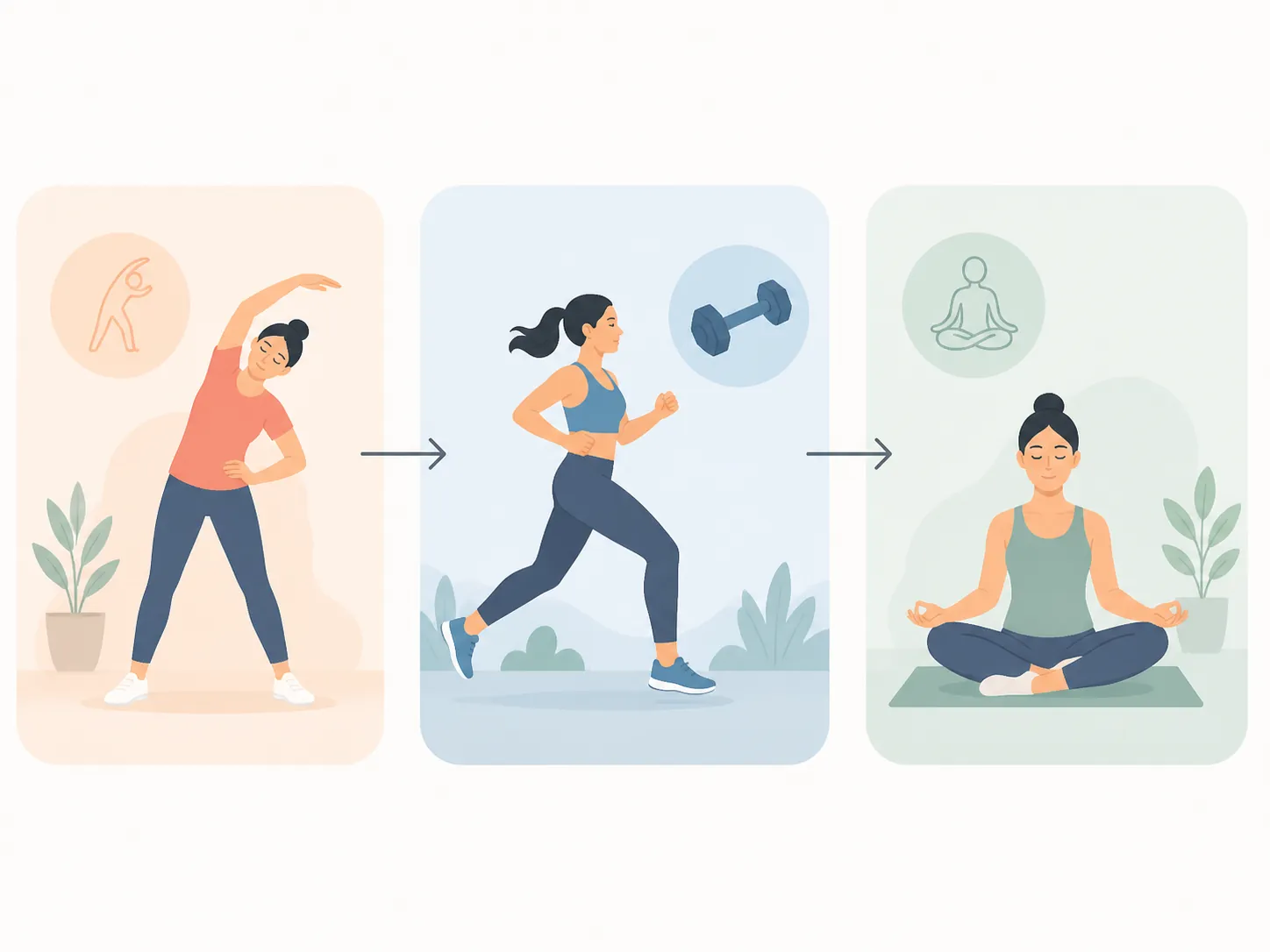
Warm up for the workout you are actually doing
The warm-up is not a ceremonial preface. It is the first success of the session. Keep it simple enough that you can begin half-awake: march in place, circle the shoulders, hinge at the hips, do a few slow squats to a chair, and take a short walk around the room or block. If the main set includes push-ups or rows, add a few gentle arm swings or wall presses. If it includes lunges or step-backs, add ankle circles and slow step-touches.
On low-sleep Mondays, the warm-up is also the decision point. Start it before deciding whether to do the full session. If after 10 minutes you still feel flat, stop after the cooldown and count it. Healthline’s motivation guide includes a “3 x 10” approach and small-increment tactics, including using a short warm-up-sized commitment instead of waiting for full motivation.[5] The point is not to trick yourself into doing a long workout every time. The point is to preserve the routine without turning Monday into a courtroom.
Make the main set moderate, not punitive
Moderate intensity is the lane. A practical test is whether you can speak in short phrases but would not want to hold a long conversation. If you are gasping, the session has probably drifted into a harder category than this Monday routine needs.
One simple main block is four rounds of this sequence:
- One minute of brisk walking, marching, low-impact jumping jacks, easy cycling, or stair stepping.
- Eight to twelve squats to a chair, or sit-to-stands if squats are not comfortable.
- One minute of brisk movement again.
- Eight to twelve wall push-ups, counter push-ups, or floor push-ups.
- One minute of brisk movement again.
- Eight to twelve glute bridges, band rows, or light dumbbell rows.
If counting reps is annoying, use time instead: 45 seconds of movement, 15 seconds to transition, then repeat. The specific exercises can change, but the pattern should stay boringly clear: cardio, resistance, cardio, resistance. That is the design implication from the energy evidence, not a decoration added for variety.
For a joint-friendly version, keep every cardio choice low impact: brisk walking, step-touches, gentle stairs, cycling, or marching. For a gym version, use a treadmill or bike for the aerobic intervals and machines or dumbbells for the resistance moves. For a dorm or apartment version, choose quiet moves: marching, slow squats, wall push-ups, glute bridges, dead bugs, and band rows.
Cooldown before the day starts making demands
A cooldown is partly physical and partly administrative. Walk slowly or march lightly until breathing settles. Stretch the calves, chest, hip flexors, and upper back for a few easy breaths each. Then end the session on purpose: water, shower, breakfast, commute, class, or first work block. The workout should not leak into the morning as an unfinished task.
If Monday focus is already fragile because of a schedule disruption, protect the first work block the same way you protect the workout: decide it before the morning starts. The same setup logic applies to calendar shocks like daylight saving time; a pre-decided first block is less fragile than a good intention. FlowDesk’s guide to daylight saving time productivity tips is useful when the Monday slump is more about clock friction than exercise choice.
Night-before setup is part of the workout
The Monday session begins Sunday night. Not spiritually. Logistically.

Prepare the clothes or kit where you will see them. Put shoes near the door or mat. Fill the water bottle. Choose the workout version before bed: full 20–30 minutes or fallback 10 minutes. Calm’s morning workout guide includes the same practical mechanics: prepare workout clothes the night before, move wake time earlier gradually in 15-minute increments, use accountability, and track the commitment.[6]
The wake time deserves more respect than it usually gets. If you normally wake at 7:15, deciding on Sunday that you are now a 5:45 person is not a plan; it is a provocation. Move the alarm earlier only as much as the workout actually requires. If the 10-minute fallback is the honest version this week, wake 15 minutes earlier, not 90.
A consistent morning schedule may also support adherence. Healthline’s morning workout guide cites American College of Sports Medicine guidance that consistent exercise timing can help people maintain the habit.[3] That is another reason morning works well for some people: fewer calendar negotiations. It still does not mean morning is mandatory. If an afternoon slot is the one you can repeat, the evidence does not require you to abandon it for a colder, darker, more theatrical version of discipline.
Track only the commitment you want to reinforce. For this routine, the cleanest checkbox is “started the warm-up.” A second checkbox can mark “completed full session,” but the first one matters more for repeatability. If the tracker only rewards the perfect version, it will quietly teach you that a disrupted Monday equals failure.
Accountability is useful only if it removes friction. A text to a friend saying “I’ll send a done message by 7:30” can help. A group chat that turns every missed session into a public confession may simply add dread. The same filter applies to playlists, apps, wearables, and streaks: keep what lowers the start cost; remove what makes the morning heavier.
Adjust the plan when sleep is the real bottleneck
Some Mondays do not need a tougher workout. They need a smaller one because sleep was bad. If you slept poorly, keep the session low impact and moderate, use the 10-minute version if needed, and do not turn fatigue into evidence of weak character. A hard workout on top of poor sleep may be less useful than a short movement session that gets blood moving without adding more stress.
This is especially relevant during hot nights, travel, caregiving interruptions, or seasonal sleep disruption. If heat is cutting into sleep quality and the next-day energy problem keeps repeating, the workout is only one part of the setup. FlowDesk’s piece on heat-disrupted sleep and productivity science is the better place to troubleshoot that constraint.
What to expect on day one, week six, and month six
Day one can produce a real lift, but the claim should stay modest. A single short activity session has been shown to improve attention and executive-function measures immediately in the Fischetti study, and morning walking research summarized by Healthline suggests attention and decision-making benefits during a sitting-heavy day.[4][3] That supports trying the routine before a demanding Monday. It does not support promising an all-day transformation.
Across weeks, energy and mood are more plausible targets than measurable cognitive change. The Wender meta-analysis supports exercise improving energy and reducing fatigue across chronic training studies, especially with moderate-intensity and resistance-containing programs.[1] Brookings, discussing a University of Georgia randomized controlled trial, reports that participants who did low-intensity or moderate-intensity exercise three times per week experienced energy gains within six weeks compared with a control group.[7]
For cognition, the timeline is longer. Harvard Health advises aiming for a standard exercise target of about 150 minutes per week and notes that cognitive benefits may take about six months to appear.[8] The CDC also frames physical activity as brain-supportive, including benefits for thinking, learning, problem-solving, emotional balance, and sleep, but the public-health message is about regular activity rather than a single perfect Monday session.[9]

So the honest timeline looks like this: after one session, you may feel more alert and settled for the start of the day; after several weeks, energy and fatigue may begin to shift if the routine repeats; after months near the broader weekly activity target, cognitive benefits become a more reasonable expectation. The Monday workout is the entry point, not the whole dose.
For next Monday, set out the shoes, choose the wake time, write down the full and fallback versions, and track the warm-up. Then judge the routine by the right standard: not whether it felt dramatic, but whether it was easy enough to start again.
References
- The Effect of Chronic Exercise on Energy and Fatigue States — PubMed Central, 2022
- Cognitive Benefits of Exercise: Is There a Time-of-Day Effect? — PubMed Central, 2022
- Working Out in the Morning: 13 Benefits, Research, Tips, and More — Healthline
- Ten-Minute Physical Activity Breaks Improve Attention and Executive Functions in Healthcare Workers — PubMed Central, 2024
- 32 Ways to Motivate Yourself to Work Out — Healthline
- Working out in the morning: benefits and 14 tips to get started — Calm
- Exercise Increases Productivity — Brookings
- Exercise can boost your memory and thinking skills — Harvard Health
- Physical Activity Boosts Brain Health — CDC






Comments
Join the discussion with an anonymous comment.