
The spring daylight saving time shift is small on the clock and larger on the workday. After the clocks move forward, people average about 40 to 60 minutes of sleep debt per night, and that shortfall can last up to a week.[1] On the Monday after spring-forward, workplace injuries rise 5.7%, and lost workdays rise 67.6% in a 20-year mining study.[2] In software work, the early damage can last longer: hourly GitHub activity from 174,505 users shows depressed productivity between 8 a.m. and 10 a.m. for up to two weeks after the transition.[3]
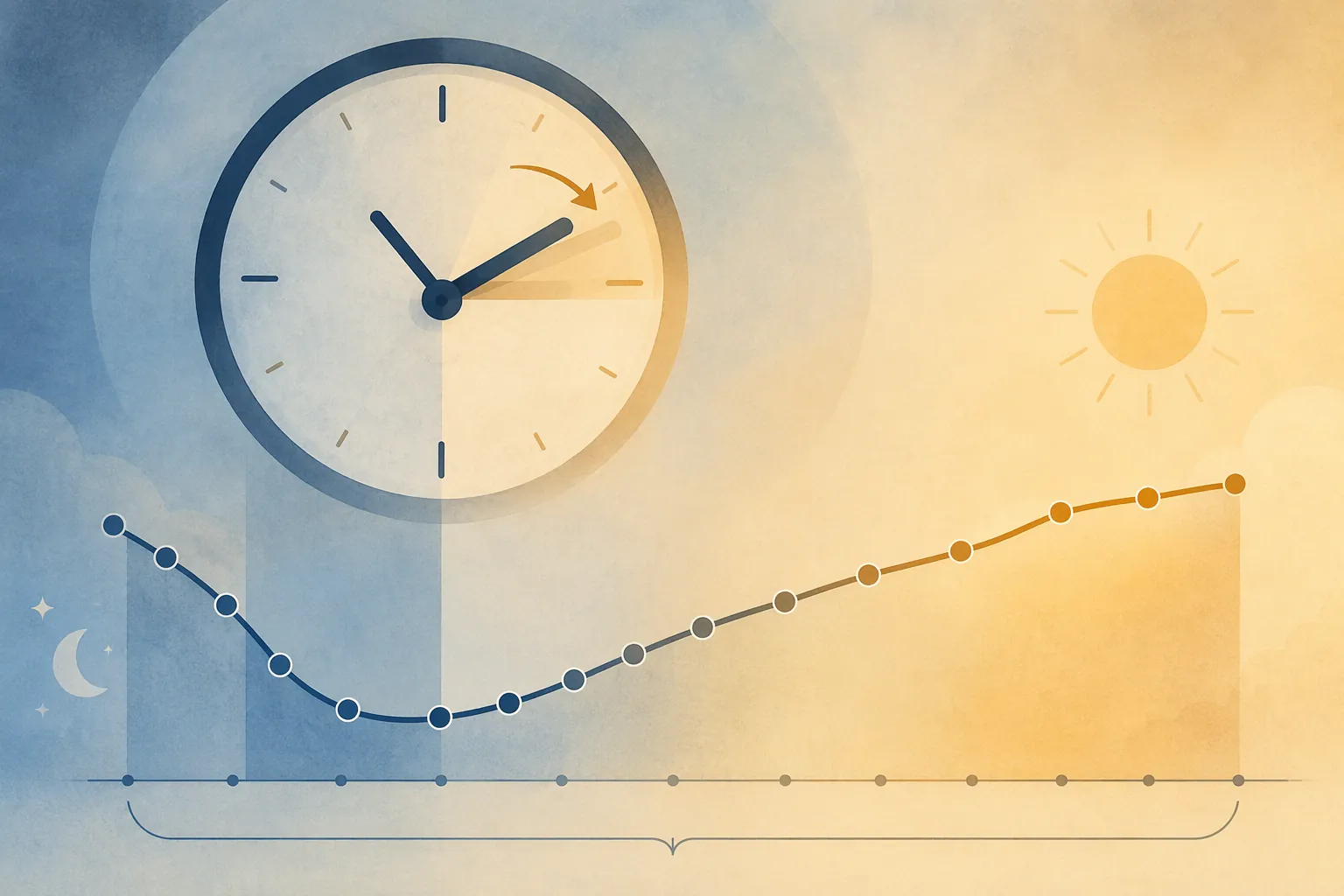
That is the real problem behind daylight saving time productivity tips. The issue is not whether someone feels a little groggy. It is that predictable sleep loss shows up in measurable behavior: fewer early-morning work actions, more avoidable errors, more distraction, and a Monday that many calendars still treat like any other Monday.
The GitHub finding deserves special weight for software-heavy workplaces, but it should not be stretched into proof for every job. GitHub activity is a useful trace for developers and engineers; it is not a universal productivity meter for nurses, warehouse teams, teachers, service workers, or managers whose output is less visible in commits and pull requests. Still, for remote teams that run on code review, tickets, chat, and early standups, the finding lands uncomfortably close to the actual shape of the workday.
What Actually Drops After Spring-Forward
The most useful detail in the GitHub study is the timing. The productivity dip is concentrated in the early work hours, especially 8 a.m. to 10 a.m., and it remains detectable for up to two weeks after the spring transition.[3] That matters because many teams put the most synchronization-heavy work exactly there: standups, status calls, sprint planning, incident reviews, code review handoffs, and the first pass at the day’s hardest task.
A one-hour clock change becomes an operational problem when it collides with a full morning calendar. The engineer reviewing a security-sensitive pull request at 8:30 a.m. is not merely sleepy; they are working during the window where the available evidence suggests output is more likely to be depressed. The manager who keeps the usual Monday morning meeting stack is not neutral. They are deciding where the team spends its lowest-margin attention.
Distraction rises too. Research cited by Forbes found that entertainment web browsing, or cyberloafing, increased 3.1% on the Monday after daylight saving time compared with the prior Monday.[1] That number is not a moral failure hiding in a browser tab. It is a signal that attention regulation gets worse when sleep and circadian timing are disturbed.
The injury data widens the stakes beyond desk work. In the 20-year mining study reported by PBS, the Monday after spring-forward brought a 5.7% rise in workplace injuries and a 67.6% rise in lost workdays.[2] Mining is not a stand-in for remote software work, and injury patterns from physically hazardous workplaces should not be lazily mapped onto every office. But the direction is hard to ignore: when people lose sleep at the same time, organizations see consequences.
| Finding | What it measures | Best workplace reading |
|---|---|---|
| 40–60 minutes of sleep debt per night for up to a week | Average sleep loss after spring DST | Do not expect Monday to be the only affected day |
| Depressed 8 a.m.–10 a.m. GitHub activity for up to two weeks | Hourly developer activity among 174,505 GitHub users | Move high-stakes engineering work out of the earliest hours when possible |
| 3.1% increase in cyberloafing on the Monday after DST | Entertainment browsing compared with the prior Monday | Treat distraction as a predictable load issue, not just individual discipline |
| 5.7% more injuries and 67.6% more lost workdays | Workplace injury outcomes in a 20-year mining study | Reduce time pressure and avoidable risk on the first Monday |
Two or Three Days Before: Move the Body Clock Before the Clock Moves
The cheapest DST productivity move happens before Sunday. Shift bedtime earlier by about 15 minutes per night for two to three days before the transition, and pair that with consistent wake time, morning sunlight, and short naps only when needed.[4] This is not glamorous advice, which is part of its value. It removes some of the shock before the workweek starts.
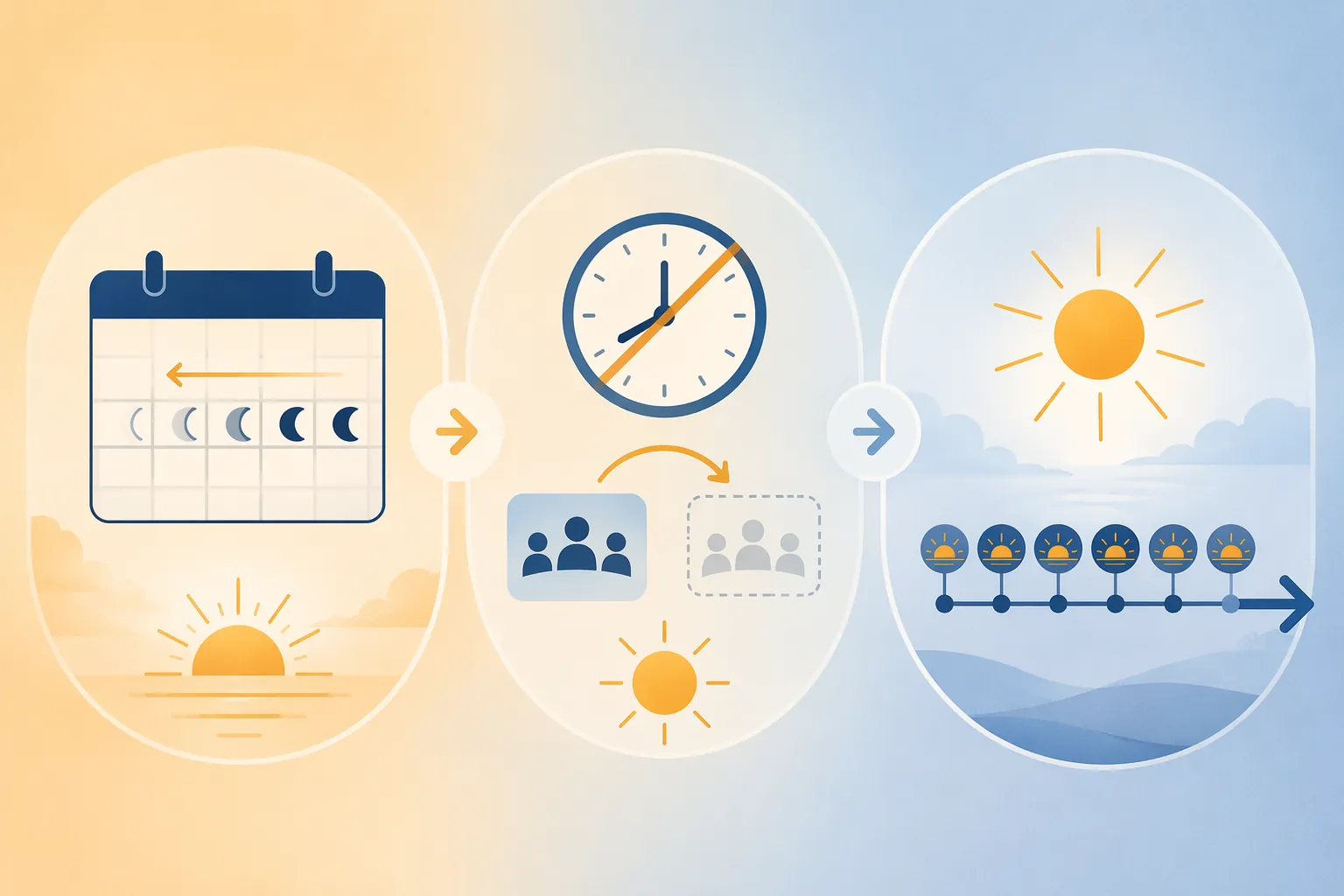
A realistic prep sequence looks like this: if the clock changes on Sunday, go to bed 15 minutes earlier on Thursday, another 15 minutes earlier on Friday, and another 15 minutes earlier on Saturday. Wake time should move with the same restraint if your schedule allows. The point is not to become a perfect sleeper in one weekend; it is to avoid asking your brain to absorb the entire hour at once.
Morning light does part of the work because the DST problem is not only sleep quantity. It is timing. Your clock time says one thing; your circadian system is still negotiating. Sleep Foundation recommends getting morning sunlight as part of preparing for daylight saving time.[4] If you can take a walk shortly after waking, do that before opening email. If you cannot, sit near bright outdoor light, step outside for a few minutes, or take the first call of the day while walking.
The more specific light-exposure numbers come from a 2024 Nature Scientific Reports modeling study, not a human trial. In that model, a 30-minute morning walk at about 10,000 lux on the four days after spring-forward reduced full circadian adjustment from about 10 days to about 6.5 days.[5] That is a modeled estimate from 200 simulated participants, so it should not be sold as a guaranteed outcome. It is still directionally useful: bright morning light is one of the few interventions that is practical, free, and tied directly to circadian timing.
Evening light matters in the opposite direction. The same Nature modeling paper estimated that reducing evening light from 50 lux to 10 lux between 7 p.m. and sleep, with 200 lux daytime light, shortened adjustment from 15.4 days to 9.8 days.[5] In ordinary terms: dim the room, stop treating late-night screens as harmless background, and make the last hour of the evening less bright than the workday. If screen habits are the hard part, a practical next read is how to limit screen time for better focus.
Naps can help, but they should be treated like a precision tool rather than a second sleep period. Keep them under 20 minutes, and avoid late-day naps that make the next night harder.[4] A short nap after lunch can rescue the afternoon; a long nap at 5 p.m. can push the problem into Tuesday.
Monday and Tuesday: Protect the Hours Most Likely to Break
The first workday after spring-forward should not be planned as a character test. It should be planned as a known performance dip. Forbes, citing work on DST and productivity, points to flexible start times, avoiding 9 a.m. meetings, and work-from-home options on the Monday after the transition as organizational mitigations.[1]
For a remote or hybrid team, the simplest intervention is to remove the 9 a.m. status meeting. Move it to late morning, make it asynchronous, or cancel it if it exists mainly to prove the week has started. A Monday morning status call often creates the worst possible chain: people wake short on sleep, rush into a meeting, defer actual work, then begin deep tasks after they have already spent their cleanest attention on coordination.
Deep work should move later than usual on Monday and, for many teams, Tuesday. The GitHub evidence points to a depressed early window rather than a whole-day collapse.[3] That suggests a practical scheduling rule: put low-risk coordination, inbox triage, planning, and routine maintenance early; reserve code review, architecture decisions, security-sensitive work, financial review, and hard writing for late morning or early afternoon.
- Cancel or move 8 a.m. and 9 a.m. meetings on the first Monday.
- Make the first standup asynchronous if the team can operate without live coordination.
- Delay high-consequence reviews until late morning or early afternoon.
- Allow flexible start times, especially for workers with school drop-offs, long commutes, or sleep disruption at home.
- Keep Monday deadlines narrow: fewer launches, fewer approvals, fewer avoidable handoffs.
This is where individual tactics and team policy either reinforce each other or cancel each other out. A worker can shift bedtime, get morning light, and keep caffeine sensible, but those efforts lose power if the calendar starts with back-to-back early calls. A manager does not need a wellness program to help. They can move three meetings and lower the number of decisions required before 10 a.m.
Caffeine can support the plan, but it should not carry the plan. A coffee immediately after waking may feel necessary, yet poorly timed caffeine can also make the next night worse. If you rely on it heavily during DST week, use a timing approach rather than escalating dose; this guide to timing and dosing coffee for maximum productivity is the more useful place to handle that.
Wearable sleep data can be useful if you already track it, mainly to keep you honest about bedtime, wake time, and whether the slump is fading. It should stay optional. DST week does not require buying a device, changing platforms, or turning recovery into another dashboard. For readers already comparing devices, Garmin Cirqa or WHOOP for focus and energy management is a better place to think through whether tracking adds value.
The Rest of the Week: Do Not Pretend It Ended on Monday
The common planning mistake is to protect Monday and then go back to normal on Tuesday morning. The sleep debt evidence points to effects lasting up to a week, and the GitHub study found depressed early-morning activity for up to two weeks.[1][3] That does not mean everyone is impaired for 14 days. It means the early schedule deserves skepticism beyond the first workday.
Keep the morning-light cue consistent through the week. If the 30-minute walk is realistic, use it. If not, choose the version you can repeat: outdoor coffee, walking the dog earlier, school drop-off without sunglasses if safe and comfortable, or a short loop before the first meeting. Consistency matters more than making one perfect Monday effort and abandoning it by Wednesday.
Keep evening light lower too. The modeled Nature estimates make the direction clear even if the exact day counts should be treated cautiously: brighter mornings and dimmer evenings help the body clock move in the desired direction.[5] This is the week to make the living room darker, stop working under bright overhead lights at night, and avoid turning the last hour before bed into another work session.
For managers, the two-week GitHub horizon argues for a softer early-morning standard. That does not require two weeks of low expectations. It means the riskiest work should not be repeatedly assigned to the earliest slot just because that is where the calendar has room. If a production launch, code freeze decision, budget approval, or incident review can move from 8:30 a.m. to 11 a.m., move it.
A Simple DST Work Plan
| Timing | Individual action | Team action |
|---|---|---|
| 2–3 days before | Move bedtime earlier by about 15 minutes per night; get morning light; reduce evening brightness | Warn the team early; move or cancel first-Monday morning meetings |
| Sunday | Keep wake time steady; avoid long naps; prepare Monday tasks before evening | Do not send late-night planning requests unless urgent |
| Monday | Use bright morning light; keep caffeine deliberate; do low-risk work first | Avoid 8–9 a.m. meetings; shift deep work and high-stakes reviews later |
| Tuesday | Repeat the light routine; use a short nap only if needed | Keep flexibility; do not overload the morning because Monday was protected |
| Rest of week | Stay consistent with morning light and dimmer evenings | Keep early-morning expectations realistic, especially for cognitively heavy work |
If you are already past the transition and trying to recover rather than prepare, use this more focused guide on how to recover your work productivity after daylight saving time. The recovery problem is different from the prevention problem: you are no longer softening the clock change, only reducing the number of bad mornings it creates.
What About Fall-Back?
The fall transition is not simply spring-forward in reverse. The research base is smaller, and the extra clock hour can still disrupt sleep continuity even when total sleep time looks better. It deserves a lighter protocol, not a second full emergency plan.
The same Nature modeling study suggests that fall adjustment can be influenced with light timing as well, including a 30-minute evening walk or a morning sunglasses strategy.[5] Those are modeled estimates, not a universal prescription. The practical point is to avoid blasting the body with the wrong light cue at the wrong time when the clock shifts backward.
Students face a different version of the scheduling problem because school start times, homework, sports, and family routines change the available levers. For that audience, see how daylight saving time affects student productivity.
Spring DST costs real output, especially in early work hours, but it is not a mysterious productivity curse. Prepare before the clock change, protect Monday and Tuesday from avoidable cognitive load, keep light cues consistent afterward, and if you manage the calendar, change the schedule instead of asking everyone to push through.
References
- How To Prevent Lost Productivity When Daylight Saving Time Starts, Forbes, 2025-03-07.
- Daylight saving time causes lower productivity and higher health care costs, studies say, PBS.
- Daylight saving time linked to lost worker productivity, University of Oregon.
- How to Prepare for Daylight Saving Time, Sleep Foundation.
- Light exposure behaviors predict mood, memory and sleep quality, Nature Scientific Reports, 2024.
Comments
Join the discussion with an anonymous comment.