
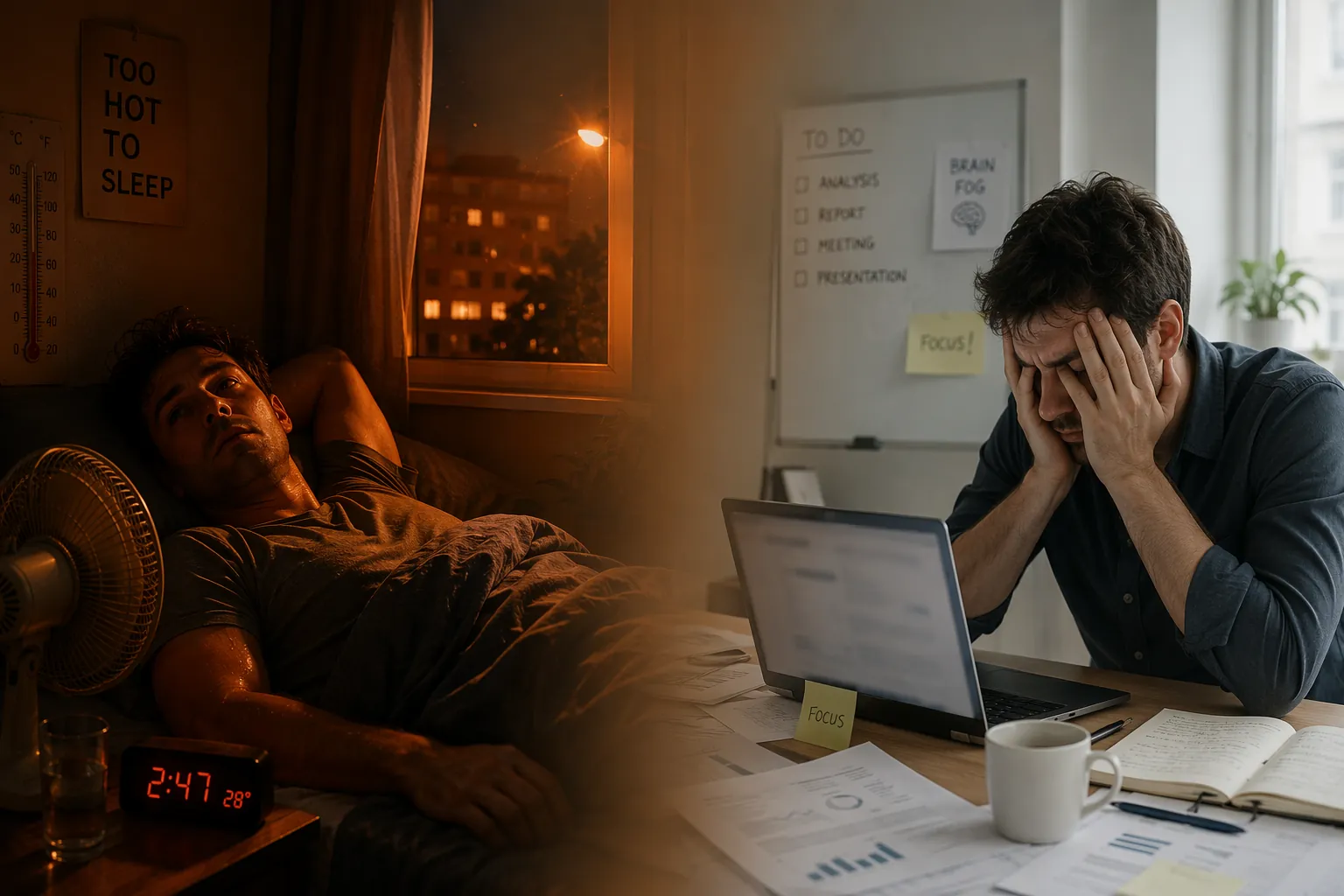
The morning after a hot night has a particular texture: the inbox looks ordinary, the calendar looks ordinary, and the work is still asking for the same level of recall, patience, and judgment. But attention slips. A simple comparison takes longer than it should. A decision that would normally feel obvious now needs rereading, checking, and one more cup of coffee.
The chain linking heat-disrupted sleep to productivity is not mysterious, but it is often skipped. Nighttime heat interferes with the body’s cooling process. That disrupted sleep then reduces the slow-wave and REM sleep needed for attention, working memory, and decision-making. The next day’s poorer performance is not just a mood or motivation problem; in several settings, it shows up as slower responses, fewer correct answers, weaker academic performance, and less rational economic choice.
The first loss happens before work starts
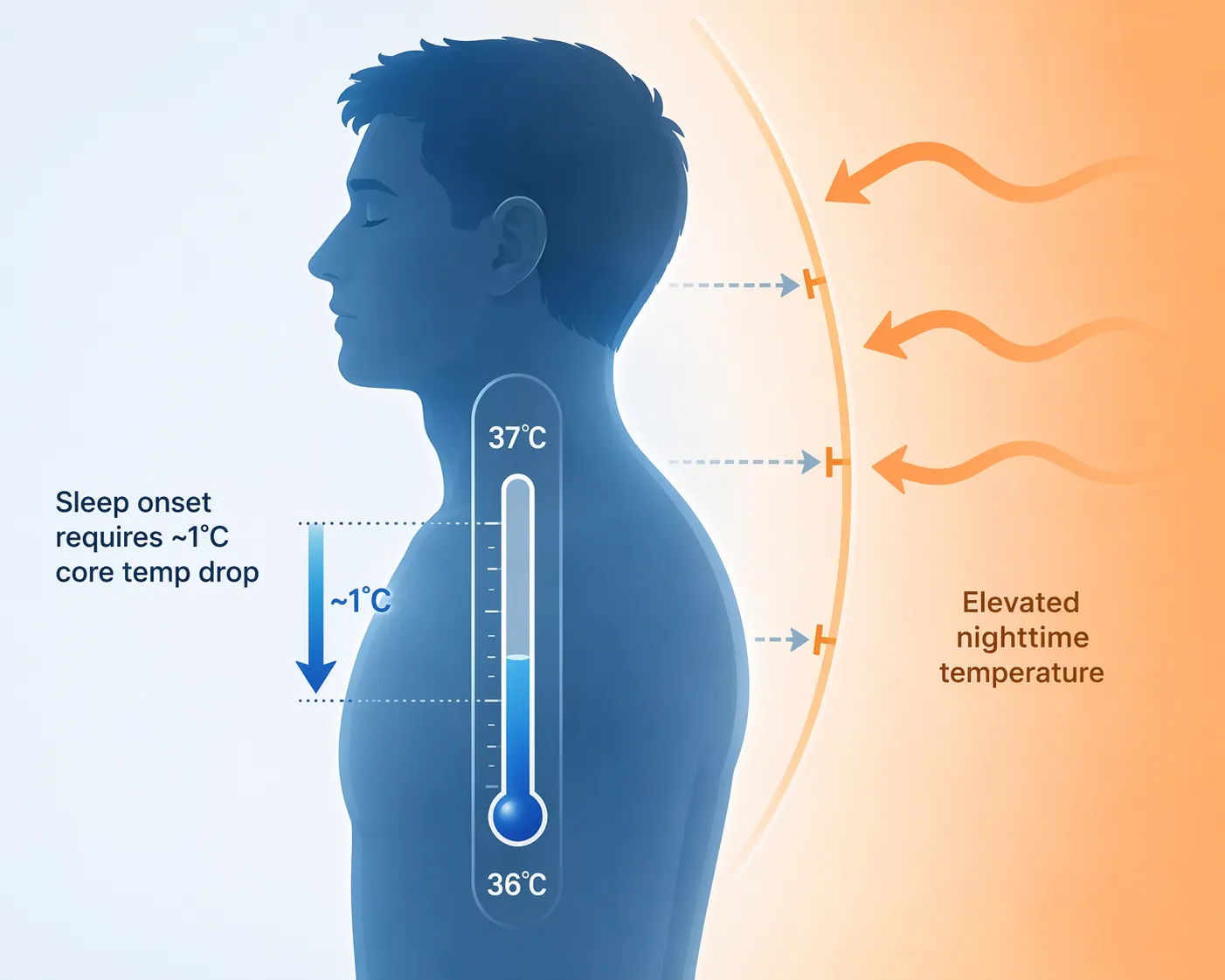
Sleep onset depends on thermoregulation. Under ordinary conditions, the body sheds heat and core body temperature falls as sleep begins. A review by Okamoto-Mizuno and Mizuno describes this drop as roughly 1°C and explains why warm, humid environments make sleep more fragile: if the body cannot lose heat effectively, sleep onset, sleep depth, and sleep continuity are disturbed.[1]
That mechanism matters because it moves the discussion away from discipline. A worker lying awake in a hot room is not simply failing to relax. The body is trying to complete a cooling task that the room is making harder.
Large sleep datasets make the same point in minutes rather than impressions. Minor et al. analyzed sleep data across 68 countries and found that each 1°C increase in nighttime temperature reduced sleep by 5 to 14 minutes. Nights above 30°C cut sleep by about 14 minutes, with a 95% confidence interval from −17.6 to −10.6 minutes, and increased the probability of sleeping less than seven hours by 3.5 percentage points.[2]
A single short night is survivable. The workplace problem appears when heat creates repeated partial sleep loss while the next day’s expectations remain unchanged. The person who lost sleep is still expected to join the planning call, catch the edge case in the spreadsheet, remember the dependency from last week, and make the same judgment under the same deadline.
The global result is not standing alone. A 2025 Nature Communications study using 23 million sleep records from China reported similar per-degree sleep losses, and a December 2025 USC Keck School of Medicine report found the same broad pattern in U.S. adults: hotter nights were linked to reduced sleep.[3][4]
Those replications do not remove every limitation. Many large sleep studies rely on wearable accelerometer data rather than polysomnography, so they may miss brief awakenings and overestimate total sleep. Wearable-based samples also tend to skew toward people who can buy and regularly wear tracking devices; in the global datasets described in the research literature, that often means more male, middle-aged, and higher-income participants. If anything, that makes it risky to assume the measured burden captures the most exposed workers.
Lost sleep becomes slower thinking
The next question is the one team leads actually have to manage: does the sleep loss change performance enough to matter? The Harvard heatwave dorm study is useful because it sits close to the kind of cognition many knowledge workers recognize. Researchers followed young adults during a Boston heatwave in the summer of 2016, comparing students in air-conditioned buildings with students in non-air-conditioned buildings. The non-air-conditioned group had 13.4% slower reaction times and gave 13.3% fewer correct answers on cognitive tests.[5]
That is not a complete model of office work. The participants were young adults, the setting was one city, and dorm life is not the same as managing a production incident, writing a legal memo, reviewing a budget, or debugging code after a broken night. Still, the measured losses are not vague. They are the kinds of deficits that turn into missed details, slower handoffs, weaker meeting participation, and more rework.
Reaction time deserves more respect in knowledge work than it usually gets. In a factory or transport setting, slower reaction time is obviously operational. In desk work, it can hide inside pauses: a longer time to notice a contradiction, a slower shift between tasks, a delayed recognition that a client request conflicts with the contract, or an extra round of rereading before a decision. The cost is real even when it arrives as friction instead of a visible accident.
Accuracy matters even more. A 13.3% reduction in correct answers does not mean every worker becomes 13.3% worse at every job after a hot night. The Harvard study cannot support that claim. It does support a narrower and more useful one: heat exposure in real buildings was associated with measurable cognitive performance loss in tasks requiring speed and correctness.[5]
Decision quality is part of the productivity cost
Productivity is often treated as output volume: tickets closed, documents finished, calls handled, slides delivered. Heat-disrupted sleep also threatens the quieter layer underneath that output: whether the choice was good.
A national study from Indonesia linked hotter nights to lower math performance and more irrational economic decisions. Escobar et al. found that each 1°C increase in nighttime temperature was associated with a 1.1% to 3.2% standard-deviation decline in math scores and a 1.1 percentage-point increase in irrational economic decisions.[6]
This evidence needs careful handling. The Indonesia study is not a randomized experiment that assigns people to hotter and cooler nights. It uses quasi-random variation and fixed-effects methods, which strengthen causal inference, but the result remains observational. The responsible reading is not that every hot night mechanically causes a specific amount of poor decision-making in every worker. It is that hotter nights are associated with measurable losses in cognitive and economic outcomes at national scale, in a pattern consistent with the sleep-disruption mechanism.
For workplaces, that distinction is enough to matter. Many important errors are not caused by total incapacity. They come from a small reduction in working memory, a slightly weaker tolerance for ambiguity, a slower check of assumptions, or a worse choice under time pressure. Heat-disrupted sleep pushes on exactly those functions.
The workplace evidence is broader than one bad morning
Once the sleep and cognition evidence is in view, the productivity studies become easier to place. They are not the whole argument; they are scale evidence showing that heat-related performance loss appears in labor outcomes too.
Research summarized by the Federal Reserve Bank of San Francisco reports Jisung Park’s finding of roughly a 2% output decline per 1°C above room temperature. The same Economic Letter cites the International Labour Organization’s projection that heat stress could reduce global work hours by 2.2% by 2030, equivalent to 80 million full-time jobs.[7]
Those figures include work far beyond laptops and calendars. Outdoor labor, manufacturing, and other heat-exposed jobs carry direct physical risks that knowledge work does not always share. But the knowledge-work version should not be dismissed just because it is less visible. A missed architectural flaw, an avoidable escalation, a poor hiring decision, or a rushed financial approval can be a productivity loss even when no one is sweating on a construction site.
A 2026 systematic review by Raja et al. synthesized evidence on heat and sleep across worker populations, reinforcing the broader point that heat exposure affects sleep in ways relevant to occupational performance.[8] The practical lesson is not that every workplace needs the same rule. It is that sleep disruption belongs in the evidence file when teams discuss heat, output, and next-day cognitive demands.
The heat does not always end when the forecast changes
One common management mistake is to treat heat as a daytime weather event. The sleep evidence points in the opposite direction. Nighttime temperature is central because it affects whether the body can cool enough to sleep well. A cooler morning does not automatically mean the worker recovered.
Indoor heat can linger after outdoor temperatures drop. Apartments, dorms, and poorly cooled home offices may hold heat into the night, especially during multi-day heatwaves. Cognitive recovery can also lag because the worker is not recovering from discomfort alone; they are recovering from reduced sleep duration, fragmented sleep, and lost sleep stages.
That matters for scheduling. A team may see lower temperatures on Tuesday and assume Monday night’s problem is gone. The person who slept through a hot room may still be carrying the performance cost into Tuesday’s review meeting, incident analysis, negotiation, or planning session.
What the evidence can support at work
The evidence does not justify a universal rule that all cognitive work must stop after every warm night. It does justify treating severe hot nights as a legitimate operational constraint. When sleep is likely to be shortened or fragmented, the next day’s work plan should not pretend that attention, memory, and judgment are untouched.
For a knowledge worker, the most defensible requests are specific. Move high-stakes decisions away from the morning after a severe hot night. Shift deadline-sensitive work into asynchronous windows. Add review time for tasks where correctness matters. Provide cooling support for home offices where the employer expects remote work to happen. Reduce the number of live meetings that require rapid context switching after known heat-disrupted sleep.
| Workplace adjustment | Evidence-based reason |
|---|---|
| Delay high-stakes decisions after severe hot nights | Heat-disrupted sleep is linked to weaker attention, accuracy, and decision quality. |
| Use asynchronous deadlines where possible | Workers can place demanding tasks in the part of the day when they are most cognitively reliable. |
| Add review or pairing for precision work | Accuracy losses are easier to catch when a second check is built into the workflow. |
| Support cooling for remote workspaces | The relevant exposure is often the bedroom or home office, not the employer’s main building. |
The burden should not sit only with the worker to explain why their brain is not performing normally. The measured chain is strong enough for managers to plan around: elevated nighttime heat makes sleep harder, shortened or fragmented sleep impairs cognitive function, and those impairments can reduce output and decision quality the next day.
That is a practical evidentiary judgment, not a climate slogan. When a hot night is severe enough to disrupt sleep, schedule flexibility, cooling interventions, and fewer critical cognitive decisions the next day are not special favors. They are ordinary risk management.
References
- The effects of thermal environment on sleep and circadian rhythm, Journal of Physiological Anthropology, 2012.
- Rising temperatures erode human sleep globally, One Earth, 2022.
- Rising nighttime temperature reduces human sleep duration in China, Nature Communications, 2025.
- Study links rising temperatures to reduced sleep in U.S. adults, Keck School of Medicine of USC, December 2025.
- Reduced cognitive function during a heat wave among residents of non-air-conditioned buildings: An observational study of young adults in the summer of 2016, PLOS Medicine, 2018.
- Hotter nights are disrupting sleep and hurting economic decisions, VoxDev, January 2025.
- The Impact of U.S. Labor Productivity Losses from Extreme Heat, Federal Reserve Bank of San Francisco, May 2024.
- Heat exposure and sleep among worker populations: a systematic review, 2026.
Comments
Join the discussion with an anonymous comment.