
A school year 2026 calendar planning checklist cannot begin with a national date table. For the 2026-27 year, the dates you can trust are the ones confirmed by your school district for the correct group of students or staff. General calendars can help you identify what to look for, but they cannot establish when your school opens, closes, takes winter break, or uses a makeup day.
The practical goal is not to fill every calendar slot immediately. It is to give every entered date a source and a status, while leaving unresolved dates visibly unfinished until the district answers them.
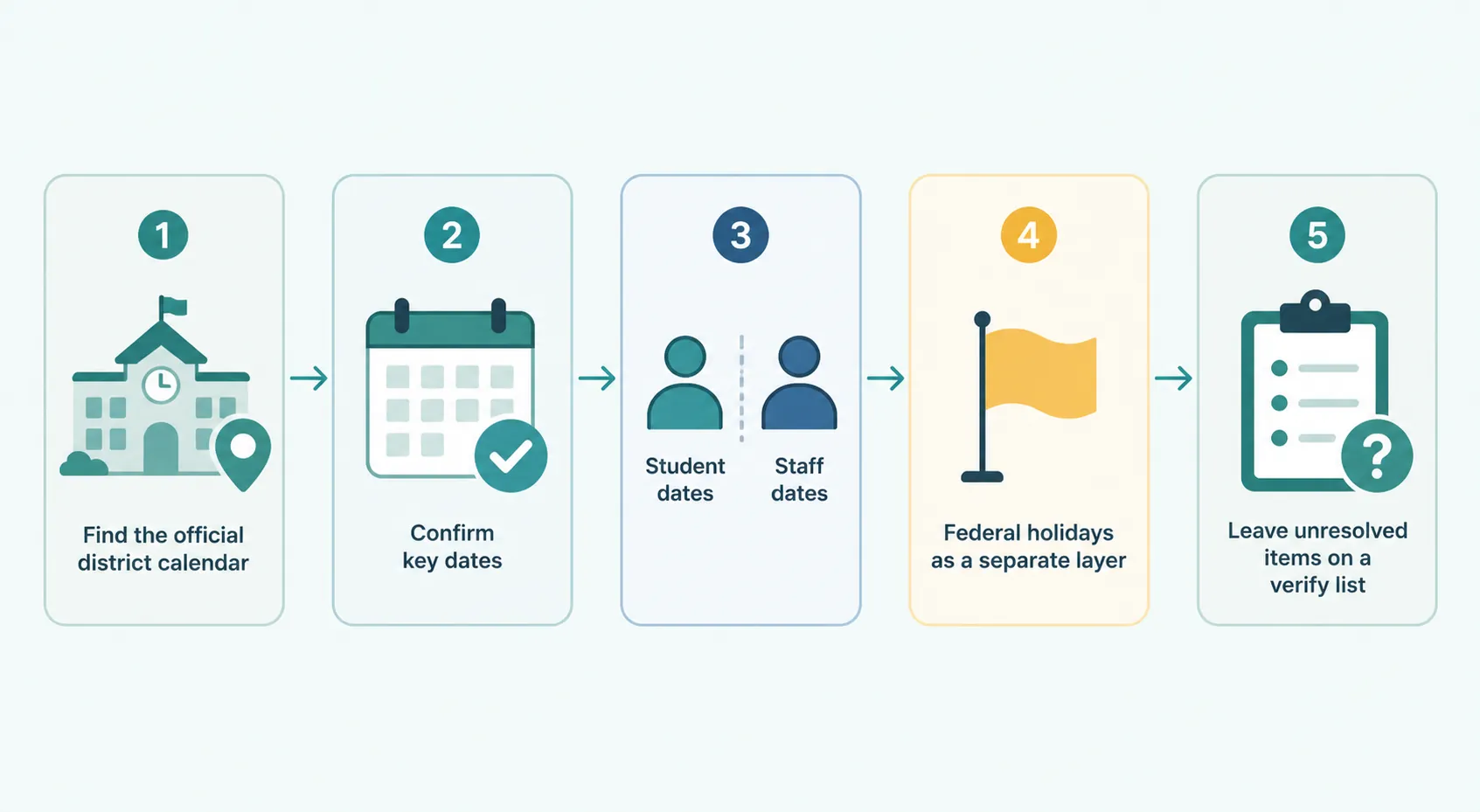
The district-first verification flow
- Locate the official district calendar or a district-hosted page for the 2026-27 school year.
- Confirm the first day, major breaks, last day, and any designated makeup days.
- Record which audience each date covers: all students, a particular grade group, teachers, other staff, or the entire district.
- Add federal or state holiday dates as a separate reference layer unless the district calendar explicitly identifies them as school closures.
- Place every unsupported date—including an unconfirmed winter break—on a verify-with-the-district list rather than guessing.
For each entry, save more than the date itself. A useful calendar record includes the event name, start and end dates, affected audience, source link, date checked, and one of three statuses: confirmed, tentative, or needs verification. If the district later revises its calendar, this small amount of provenance makes reconciliation much easier.
| Checklist field | What to record |
|---|---|
| Event | The district’s wording, such as “First day of school, grades 1–12” |
| Date or range | The exact district-published date, including the year |
| Audience | Students, specific grades, teachers, staff, or districtwide |
| Status | Confirmed, tentative, or needs verification |
| Source | Official district page or district-hosted document |
| Checked | The date you last reviewed the source |
| Notes | Conditions such as makeup-day use or a different kindergarten start |
Worked example: Seattle Public Schools
Seattle Public Schools provides a useful example because its official 2026-27 page confirms several important dates while also showing why one district’s calendar cannot be reused elsewhere. The dated entries below were verified against that district page on August 30, 2026.
| Checklist item | Verified Seattle date | How to enter it |
|---|---|---|
| First day, grades 1–12 | September 2, 2026 [1] | Confirmed; audience: grades 1–12 |
| First day, preschool and kindergarten | September 8, 2026 [1] | Confirmed; keep separate from the grades 1–12 entry |
| Spring break | April 12–16, 2027 [1] | Confirmed district break |
| Memorial Day | May 31, 2027 [1] | Confirmed as listed by the district |
| Juneteenth | June 18, 2027 [1] | Confirmed as listed by the district |
| Last day of school | June 21, 2027 [1] | Confirmed district anchor date |
| Makeup days | June 22–23, 2027 [1] | Record separately and label as makeup days |
| Winter break | Not established by the available verified material | Leave blank and add to the district-verification list |
The two first-day entries deserve separate calendar records. A household with an older student and a kindergartner would otherwise see one generic “school starts” event even though the children begin on different dates. The audience field prevents that error without requiring two completely different calendars.
The makeup dates also should not be merged into the last-day event. Keep June 21 as the published last day and June 22–23 as separately labeled makeup days. That preserves the distinction between the planned anchor date and dates reserved for a different operational purpose.
Winter break remains intentionally blank here. An attractive two-week range copied from another calendar would make the checklist look complete, but it would not make it reliable. Add an unresolved item such as “Winter break 2026-27—confirm dates on district calendar,” then replace it only when an official source supplies the range.
Why Seattle’s dates do not travel
Seattle explains that its collective bargaining agreement sets the first day for grades 1–12 as the first Wednesday in September. In 2026, that produces the September 2 start shown on the official page.[1] The formula is valuable evidence for Seattle; it is also the reason a family in another district should not copy the result. The other district may operate under a different agreement, approval process, or calendar rule.
A broad statement that schools tend to begin in August or early September can provide seasonal orientation. It cannot tell you which morning transportation starts, when attendance is required, or whether kindergarten follows the same schedule as the higher grades. Those consequences require a local source.
Separate student dates from teacher and staff dates
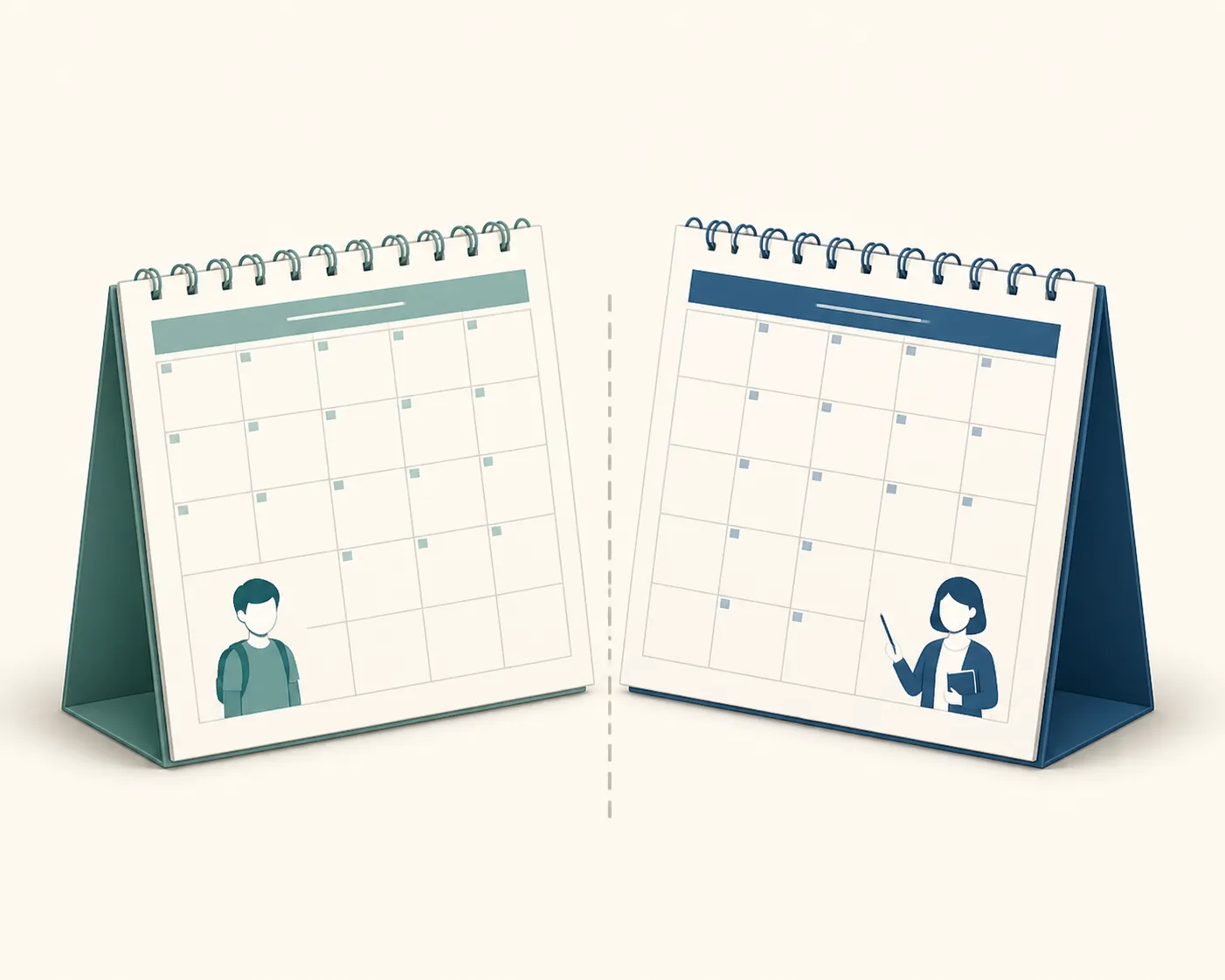
A page labeled “school calendar” may contain events for several audiences. Teacher workdays, professional-development days, student release days, and district closures should retain their original labels instead of being flattened into a single list.
For example, the Anchorage School District calendar identifies June 1, 2027 as the last day for teachers.[2] That is a teacher-specific date; it does not establish the last day for students. Without a separately verified student date, the correct checklist action is to record the teacher event for the teacher audience and leave the student field unresolved.
Audience labels are especially important when one person maintains a shared household calendar. A teacher’s last workday may affect child care or travel even when the children have already finished school, but the events still need distinct names. “Last day—teachers” is more useful than a generic “school ends” entry whose meaning must be reconstructed later.
Treat holiday dates as a secondary layer
A federal holiday date is not, by itself, evidence that your school is closed. When an official district source lists a closure—as Seattle does for Memorial Day and Juneteenth—you can treat it as a confirmed district entry. Otherwise, add the holiday to a reference layer and wait for district confirmation before changing its status.
A non-official, Connecticut-specific school-calendar guide lists Labor Day on September 7, Columbus Day on October 12, Veterans Day on November 11, Thanksgiving on November 26, Christmas on December 25, New Year’s Day on January 1, and Martin Luther King Jr. Day on January 18 for the 2026-27 period.[3] These dates may serve as prompts for a Connecticut verification list. They do not prove that a particular Connecticut district—or a district in another state—uses the same closure schedule.
Keep this layer visually distinct in your note app. A field such as “Reference only—district closure unconfirmed” is better than relying on color alone, especially when events are later exported, printed, or viewed by someone unfamiliar with the system.
Build the unresolved-date list alongside the calendar
The verification list is part of the finished setup, not a pile of notes to hide. It should hold any item that could affect attendance, travel, child care, or work planning but lacks an official district date.
- Winter break start and end dates
- Teacher workdays and student no-school days
- Early-release dates
- Makeup-day conditions or calendar-extension rules
- Different start dates for preschool, kindergarten, or transition grades
- District treatment of federal and state holidays
Give each unresolved item an owner and a next action. “Check later” tends to disappear; “Parent—review district calendar page after its next revision” or “Call school office to confirm whether the staff day affects students” makes the remaining work explicit. When an answer arrives, update the status and retain the source rather than deleting the verification history.
Put the verified dates into your note app
Enter confirmed district anchors first: the applicable first day, verified breaks, the last day, and separately identified makeup days. Add role-specific events next. Holiday references and unresolved items should remain filtered or labeled so they cannot be mistaken for confirmed school closures.
If the checklist will live in Notion, use the structure in Build Your Own Back-to-School Checklist Template in Notion to create the verification fields and unresolved-items view. Before choosing where the dated records should live, compare the options in Notion Calendar App vs. Database Calendar Templates: Which Should You Use?.
Once dates are confirmed, convert only the events that require preparation into calendar holds—for example, a travel-planning block before spring break rather than another duplicate of the break itself. The hold structure demonstrated in Plan a Sacramento Weekend with Calendar in Notion/Obsidian can be reused for those planning blocks. Keep the underlying school dates tied to their district sources, and leave every unsupported slot marked for verification.
References
- News : 2026-27 School Year Dates — Seattle Public Schools, August 10, 2026
- Calendar — Anchorage School District
- Here's the CT Public School Calendar for 2026-2027 — Mommy Poppins

Comments
Join the discussion with an anonymous comment.