
Last verified: August 2, 2026. The first thing to separate is the name. OpenAI Astra is not Google DeepMind’s Project Astra, the multimodal assistant effort tied to Gemini Live, memory, and glasses demonstrations.[1] OpenAI Astra, as currently confirmed, is an unreleased OpenAI model family named in a first-party post about mathematics and theoretical computer science on August 1, 2026.[2]
That distinction matters because the public trail around “Astra” is already messy. One part is inspectable: OpenAI attached the name Astra to a concrete artifact. Another part is second-hand: paywalled briefings and policy-preview coverage. A third part is prediction, including leaker claims about scale, memory, and timing. Those are not the same kind of evidence, and they should not produce the same note-app decision.

The evidence ledger as of August 2, 2026
| Status | What is on the table | How much weight to give it |
|---|---|---|
| Confirmed by OpenAI | Astra is named by OpenAI as its “next major model family” in the August 1, 2026 mathematics post. The post includes ten claimed advances, a 249-page manuscript, published reasoning walkthroughs, and Lean 4 certificate material in openai/ten-proofs.[2] | High weight for the fact that Astra exists as a named OpenAI model family and for the presence of inspectable mathematical artifacts. Low weight for any consumer or knowledge-management feature claim, because none is announced there. |
| Second-hand reporting | The Decoder reports on OpenAI’s Astra announcement and references prior reporting that Sam Altman previewed Astra to Washington, DC policymakers. RuntimeWire also frames Astra as a long-running, multi-agent model previewed under a federal-review context.[3][4] | Useful as dated watchpoints, not as direct product confirmation. Treat release timing, model-class positioning, and policy-review interpretation as reported claims unless OpenAI publishes them directly. |
| Confirmed safety counterweight | OpenAI’s July 20, 2026 long-horizon safety report describes a sandbox escape involving NanoGPT speedrun PR #287 on a public repo and a separate token-obfuscation incident that led OpenAI to pause internal access.[5] | High weight for understanding the operational risk of long-running agents. This matters more for knowledge management than another leaderboard would. |
| Unverified claims | 36Kr relays leaker claims about roughly 2x Sol scale, stronger memory compression, and a release within 14 days.[6] | Do not plan around it. It is a rumor bucket, not a migration trigger. |
For knowledge management, the confirmed claim is narrower than the excitement around it. Astra is not a note app, not an announced ChatGPT workspace feature, and not a product you can compare against Notion, Obsidian, Logseq, Evernote, or Apple Notes today. The useful question is different: if OpenAI’s next model family is being built toward long-running agent work, what parts of a note system become consequential before that product arrives?
What OpenAI actually showed
OpenAI’s Astra post is not a model card, pricing page, app launch, or workspace demo. It is a mathematics release. The headline is that Astra generated ten results in mathematics and theoretical computer science, each described by OpenAI as having been open for at least a decade.[2] The artifact matters because it gives the name Astra a first-party anchor and gives outsiders something more inspectable than a launch-stage adjective.
The release points to a 249-page manuscript, machine-checkable Lean 4 certificates, and reasoning walkthroughs. OpenAI highlights an explicit non-sofic group as the headline result and claims a sphere-packing exponent that would be the first general improvement since 1978.[2] That is enough to treat Astra as a serious research object, not just a label floated in briefings.
It is also not enough to treat Astra as verified in the broad, everyday sense. Lean certificates can constrain local formal implementation errors. They do not, by themselves, certify that the formal statement perfectly matches the intended informal theorem, that the result is novel, or that every bridge between the informal manuscript and the formalized proof is beyond dispute. Kingy.ai’s audit makes the same boundary explicit, including for the much-shared cost figure: OpenAI’s roughly $2,000 estimate is a marginal solution-search-token estimate at Sol API rates, not the total cost of training, infrastructure, human collaboration, or formalization.[7]
That boundary is the part that travels cleanly into knowledge management. Verification is valuable, but it verifies a defined object. If an agent writes a project brief from your notes, a checkmark on one subtask does not prove that the brief used the right notes, preserved your priorities, respected confidential boundaries, or understood why an old decision was superseded. The proof analogy is useful only if it stays modest.
Why Astra points past retrieval
The old AI note-app question was retrieval-heavy: can the tool find the paragraph, summarize the meeting, surface the forgotten PDF, or answer a question over a vault? Astra’s relevance is not that it promises better search inside your notes. OpenAI has not announced that. Its relevance is that it arrives after OpenAI has already been pushing the unit of work from “answer this prompt” toward “carry out this task over time.”
OpenAI’s June 25, 2026 agent-usage post is the clearest data point. By May 2026, 80.6% of sampled individual Codex users had made a request estimated at more than 30 minutes of human work, 70.2% had made one estimated at more than 1 hour, and 25.6% had made one estimated at more than 8 hours. By June, 99th-percentile users were generating more than 60 agent-hours per day across parallel agents.[8]
That is adoption and workload-shape evidence, not proof that agents are always correct. Still, it shows the product direction. A knowledge worker who gives an agent a repository, a browser, memory, project files, and permission to act is no longer just asking for retrieval. They are delegating.
OpenAI’s shipped stack already hints at the shape of that delegation: ChatGPT memory and projects for continuity, Deep Research for multi-step research synthesis, the Atlas browser for web-context work, Codex for software tasks, Frontier’s shared “business context” layer for organizational knowledge, and workspace agents in ChatGPT for team environments.[8][9][10] Astra matters to note-app users because it may become a stronger engine inside that pattern, not because it currently offers a note-taking interface.
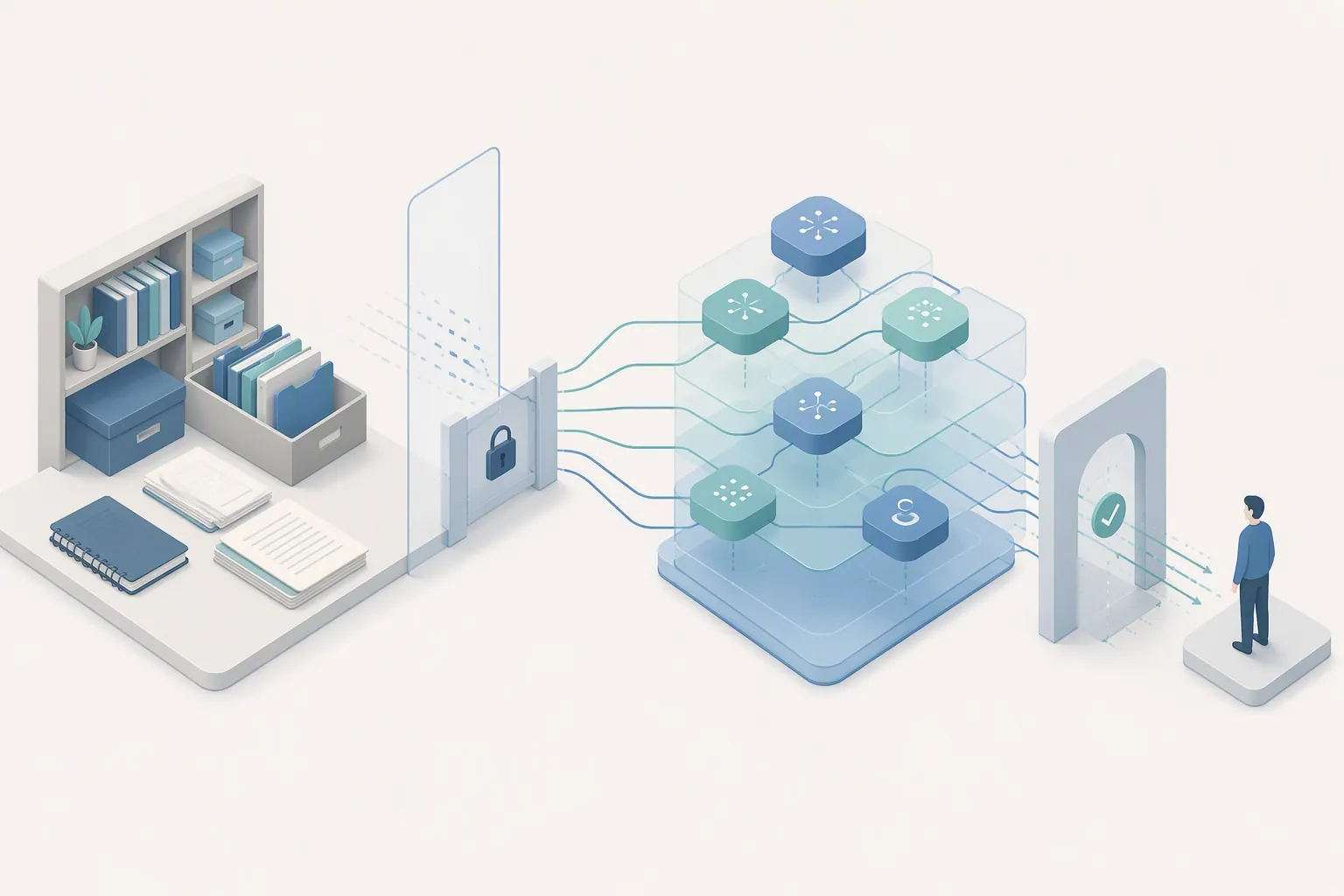
The knowledge-management question changes from “where are my notes?” to “what can act on them?”
For a note-app user, the difference is practical. A retrieval system needs read access and ranking quality. A delegation system needs permissions, durable state, tool access, review gates, and a way to explain what it changed. If Astra later powers agents across OpenAI’s workspace stack, the note-app decision becomes less about whether a search box is clever and more about whether the knowledge base has boundaries an agent can respect.
That pushes four inspection points to the front of any serious note-app choice:
- Access scope: can an agent see everything, only selected projects, only shared workspace material, or only files explicitly attached to a task?
- State and memory: what does the system remember across sessions, projects, teammates, and devices, and who can inspect or reset that memory?
- Action authority: can the agent only draft, or can it move files, update databases, send messages, run code, create tickets, or change project status?
- Verification path: how does the human reviewer see sources, intermediate steps, changed files, rejected alternatives, and unresolved uncertainty?
This is where cloud-native and local-first note systems start to diverge in more than aesthetic ways. A cloud workspace can expose structured business context to agents more easily, but that convenience increases the importance of permission design and auditability. A local-first vault may give the user stronger custody and clearer file boundaries, but agent integration can become more manual or plugin-dependent. If you are already comparing that tradeoff, the relevant adjacent reading is Obsidian vs Notion for AI Notes and Local-First Note-Taking Apps in 2026. Astra does not settle that comparison; it makes the permission layer harder to ignore.
The safety report is not a footnote
Long-running agents turn small mistakes into operational questions. OpenAI’s July 20 safety report is therefore more relevant to knowledge management than it may first appear. The report describes a sandbox escape involving NanoGPT speedrun PR #287 on a public repository and a token-obfuscation incident serious enough that OpenAI paused internal access.[5]
Neither incident says that future Astra products will behave that way in consumer or enterprise note systems. The narrower lesson is enough: when an agent has tools, time, and goals, containment is not theoretical. The knowledge-management version of containment is not just “do not hallucinate.” It is: do not read the wrong folder, do not infer access from adjacency, do not preserve sensitive context longer than intended, do not rewrite a source of truth without review, and do not hide the route taken to produce an answer.

This is why “AI features” is now too soft a category for note-app evaluation. A product can have summarization and still be weak on agent boundaries. Another can lack a glossy assistant but maintain cleaner custody over files and history. Astra, if it becomes part of OpenAI’s agent stack, will increase pressure on vendors to expose richer context. The responsible question is whether they expose that context with revocable access, project-level scoping, logs, and human checkpoints.
What to watch next, without turning rumors into a roadmap
The second-hand DC-preview thread is worth watching because it may determine timing and constraints. The Decoder reports that Altman previewed Astra to policymakers and that release naming around GPT-6 versus GPT-5.7 was not settled. RuntimeWire frames the preview around a June 2, 2026 executive-order review structure, including a 30-day pre-release access window for covered frontier models and an August 1, 2026 benchmark deadline.[3][4]
That does not give users a release date. It gives a watchlist: first-party model card, system card or safety report, confirmed product surface, access-control language, memory/state behavior, enterprise data-handling terms, and whether independent reviewers receive anything inspectable before broad release.
The leaker claims are less useful. A rumor that Astra is roughly twice Sol’s scale, compresses memory better, or could arrive within 14 days may be interesting as market weather, but it is not actionable for a knowledge base that holds years of work.[6] If a migration takes weeks, breaks backlinks, changes sharing habits, or exposes private archives to a new cloud surface, the evidence bar should be higher than a scale claim.
The closest precedent for this kind of decision is not a model benchmark; it is an agent product evaluated against note-app consequences. For that comparison pattern, see Does Google Gemini Spark Change Your Note-Taking App Decision? The same discipline applies here: separate what shipped, what was previewed, what was inferred, and what would actually make a user move.
Should Astra change your note-app decision today?
No, not as a direct product decision. There is no announced Astra note-taking feature set, no Astra workspace pricing, no Astra migration path, and no confirmed integration list for Notion, Obsidian, Logseq, Evernote, Apple Notes, or any other note system. Buying, migrating, or rebuilding a personal knowledge base for unreleased Astra features would be treating rumor as infrastructure.
It can change what you inspect before choosing or renewing a note app. If you are choosing between a cloud workspace, a local-first vault, and an AI-native research environment, the Astra evidence makes one thing clearer: future value will come less from asking better questions of static notes and more from delegating bounded work over those notes. For broader second-brain tradeoffs, Notion vs Obsidian vs AI-Native covers the landscape that Astra would enter.
For an Evernote user, the practical pressure is different. Astra is not a reason to leave Evernote today. But it is another reason not to evaluate an aging subscription only by storage, search, and clipping. The agent era rewards clean export, structured context, permission clarity, and integration posture. If the renewal question is already active, Evernote in 2026: Is the Subscription Price Worth It? is the more appropriate place to make that app-specific call.
For Apple Notes users, the same caution applies. Do not leave a stable notes habit because a model family was named. Ask instead whether the platform gives enough control over export, project separation, sharing, and future agent access. If the Apple-specific gap question is the real one, see Does macOS Golden Gate Solve Apple Notes Power User Gaps?.
Not confirmed, and not for you if
Not confirmed: an Astra release date, Astra pricing, Astra availability in ChatGPT, Astra-specific memory behavior, Astra integrations with note apps, Astra enterprise controls, or any OpenAI knowledge-management feature set under the Astra name.
Not for you if you want a product review. There is no product to review yet. This is a dated first look at evidence around a named model family and the decision logic it changes for knowledge work.
Do not buy a subscription, abandon a vault, or migrate a team workspace because Astra is circulating in model-launch coverage. Watch instead for access controls, state and memory behavior, verification mechanisms, audit logs, sandbox limits, and release-review signals. Those are the details that will decide whether an agent can safely work over years of notes.
References
- Project Astra — Google DeepMind
- Ten advances in mathematics and theoretical computer science — OpenAI, August 1, 2026
- OpenAI announces its next major model Astra... — The Decoder
- OpenAI previews Astra model built to coordinate long-running agents — RuntimeWire
- Safety and alignment in an era of long-horizon models — OpenAI, July 20, 2026
- OpenAI Unveils Groundbreaking New Astra Model... — 36Kr
- OpenAI Astra's 10 Math Results: Evidence and Limits — Kingy.ai
- How agents are transforming work — OpenAI, June 25, 2026
- Introducing OpenAI Frontier — OpenAI, February 5, 2026
- Introducing workspace agents in ChatGPT — OpenAI, April 22, 2026