
People searching for “bryan johnson daily routine habits for productivity” usually get pulled into the wrong exhibit. The supplements, blood tests, devices, and anti-aging claims are louder than the workflow. But the more useful question is smaller and less theatrical: which parts of Bryan Johnson’s routine behave like productivity infrastructure?
In his current 2026 material, the useful clue is not that the morning is extreme. It is that the morning is protected. Johnson’s April 22, 2026 morning-routine page lays out a 4h46m sequence before work begins at 10:00 am, which makes the workday look less like a heroic sprint and more like the final handoff from a long pre-work operating system.[1]
This is Bryan Johnson, the Blueprint entrepreneur, not Bryan R. Johnson, the LinkedIn productivity author. The distinction matters because the useful material here comes from Johnson’s own 2026 Blueprint protocol and morning routine pages, read less as longevity proof and more as a workflow specification.

The routine is a protective wrapper around work
Copying the whole 4h46m morning would be a bad reading of the document. A normal knowledge worker does not have Johnson’s budget, staff, measurement stack, or medical oversight. The transferable part is the architecture: make sleep less negotiable, put focused work before incoming demands, reduce daily bargaining, and use small physical rules to keep attention and recovery from drifting.
| Routine element | Productivity job it performs | Normal-worker translation |
|---|---|---|
| 4h46m morning before a 10:00 am work start | Creates a large buffer between waking and external demands | Do not copy the length; copy the idea of a protected runway before reactive work |
| Sleep treated as the base layer | Moves performance upstream to the night before | Set a fixed sleep window before optimizing apps, calendars, or task lists |
| No messages or social media until after focused work | Prevents other people’s priorities from setting the first context of the day | Block the first work interval from inboxes, feeds, and chat |
| Rules such as “None is easier than some” | Removes repeated decisions at predictable failure points | Use stricter defaults where partial permission keeps turning into negotiation |
| Movement breaks, post-meal walks, caffeine cutoff, screen cutoff | Protects energy and sleep with low-drama guardrails | Use cheap physical constraints before buying measurement gear |
That distinction keeps the routine from becoming either cosplay or dismissal. The expensive layer is real. So is the operational neatness.
Sleep is where the productivity system starts
Johnson’s protocol puts sleep before work tactics. In the January 23, 2026 version of “Bryan Johnson’s Protocol,” he describes an 8-hour sleep target, a consistent bedtime, a final meal more than 4 hours before bed, and resting heart rate as a key lever, with his resting heart rate presented around 39–44 bpm.[2]
Those are Johnson’s self-reported measurements and design priorities, not independent proof that the same routine will produce the same results for someone else. His claim of “eight months of 100% perfect sleep” belongs in the same category: useful as a signal of what he is optimizing for, not as a universal benchmark.[2]

For productivity, the important move is the placement of responsibility. A bad morning is not treated as a motivation failure at 9:00 am. It is treated as a scheduling failure the previous evening: food too late, screens too late, caffeine too late, bedtime too flexible. That is a more mechanical diagnosis, and it is easier to act on.
The final-meal rule is a good example. You do not need to eat on Johnson’s schedule to borrow the job the rule performs. The job is to stop digestion, stimulation, and evening drift from competing with sleep. If you are experimenting with that boundary, a simple tracking approach is more useful than imitating his exact meal timing; FlowDesk’s guide to a time-restricted eating cognitive tracker is closer to the transferable mechanic than a celebrity meal copy.
The same is true of readiness data. Johnson’s numbers may not be your numbers, and some of his apparatus sits outside ordinary life. But the principle of using yesterday’s recovery to shape today’s work is portable. If a wearable helps you notice that heavy work consistently fails after short sleep, the device is doing a useful job. If it only gives you another dashboard to obey, it has become part of the drag. That line is also the practical question in FlowDesk’s comparison of Garmin, Cirqa, and Whoop for productivity.
Deep work comes before inputs
The cleanest productivity rule in Johnson’s protocol is also one of the cheapest: no messages or social media until after the first hour of focused work.[2] The rule does not require a lab. It requires the morning to begin with output before intake.

The value is not purity. It is sequencing. Once messages enter the system, the workday inherits other people’s urgency, unresolved questions, small emotional hooks, and tasks that look quick enough to handle immediately. Even if you resist, you have already paid the context-switching cost.
A protected first hour changes the order of authority. The document, model, analysis, codebase, proposal, or design problem gets first claim on attention. Chat gets a later slot. Email gets a later slot. Social media does not get to define the emotional weather before the most valuable work has started.
This is where a normal worker can copy the job without copying Johnson’s life. The first hour does not have to start at dawn. It can start when childcare handoff ends, when the train ride begins, when the office door closes, or when the calendar first allows silence. The constraint is simple: no inbox, no feed, no team chat, no notification cleanup until one real work interval is done.
The weak point is usually not discipline. It is device defaults. If the phone is allowed to light up, the laptop badge is allowed to count, and the chat app is allowed to launch on startup, the rule has to be re-decided every morning. That is an avoidable failure point. Start with the boring infrastructure: notification permissions, home-screen placement, app launch settings, and physical distance. For a practical version of that cleanup, see FlowDesk’s guide to fixing Samsung notification spam.
Decision elimination is the part people underestimate
The routine’s austerity is not just about health. It is about removing small votes from the day. Johnson’s protocol uses the line “None is easier than some,” a rule that matters because “some” keeps the negotiation open.[2]
That rule has obvious applications outside food. No messages before deep work is easier than checking only the important ones. No phone in the bedroom is easier than “I’ll just charge it on the nightstand and not touch it.” No meetings before a writing block is easier than “one quick sync if it matters.” Partial permission sounds moderate, but it often leaves the tired version of you in charge of interpretation.
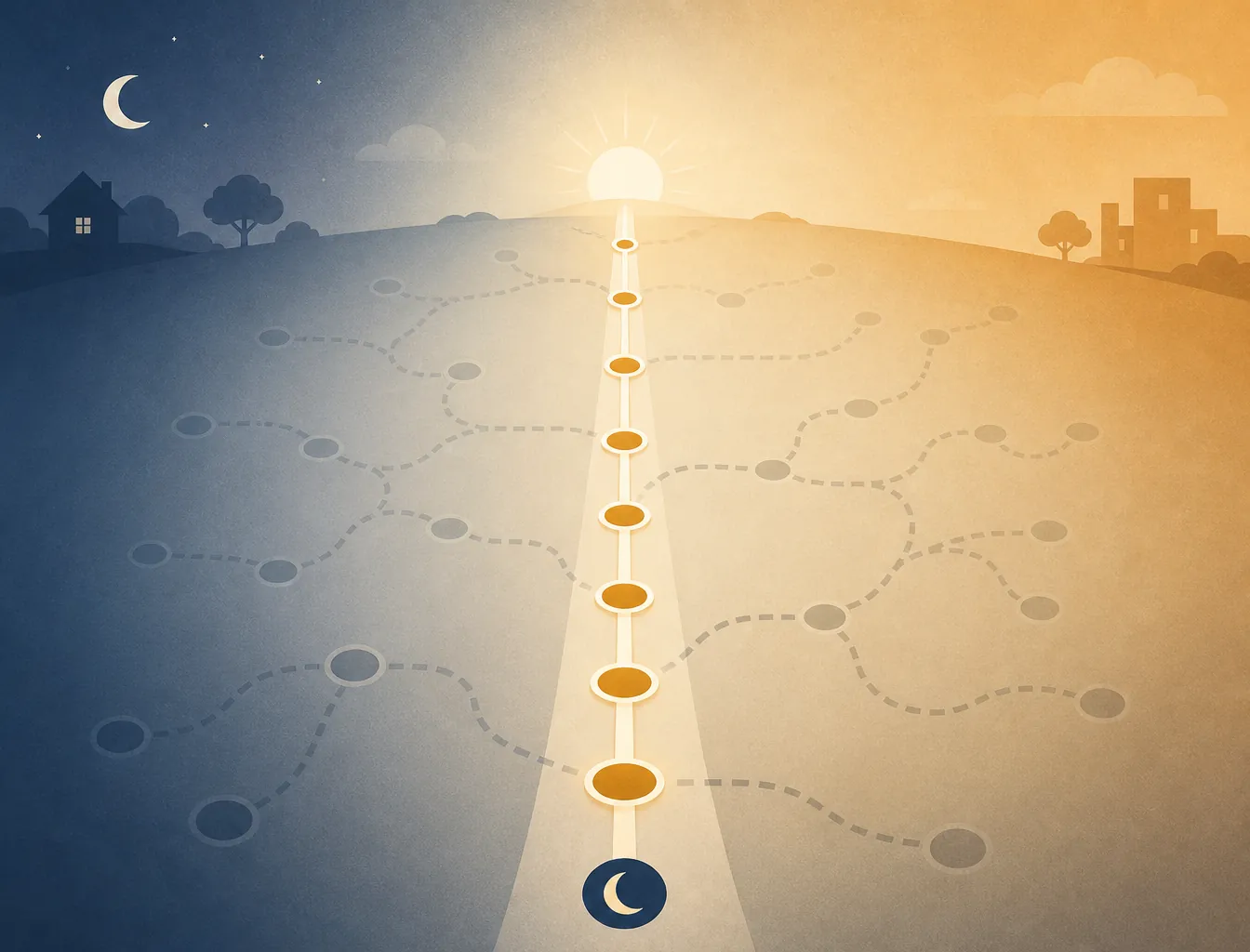
Johnson explains this as a question of who gets authority. On The Knowledge Project, he says “an algorithm takes better care of me than I can myself” and frames the routine around deciding “who’s in charge,” with the goal of having “zero decisions of doing things I don’t really want to do.”[3] The useful translation is not that everyone needs an algorithm. It is that predictable failure points should not be left to the weakest hour of the day.
Men’s Health captured the same idea in a more memorable form: “Evening Bryan” loses authority because, as Johnson describes it, “if he gets one bite, it turns into 100 bites.”[4] That line is easy to mock until you replace the bite with one late Slack reply, one episode, one scroll, one extra drink, or one “quick” email check that turns tomorrow’s first hour into recovery from last night’s drift.
This is the strongest reason to take the routine seriously without worshiping it. Johnson has built a system in which the present self has less room to improvise against the future self. For knowledge work, that is often the whole game: protect the person who has to think clearly tomorrow.
The smaller rules are maintenance, not decoration
Johnson’s protocol also includes movement breaks every 30 minutes, 10-minute walks after meals, no caffeine after noon, and a screen cutoff around 7:30 pm.[2] None of these rules is as dramatic as the full Blueprint apparatus. That is why they are easier to miss.
The movement rules do not need to be turned into a fitness identity. Their productivity job is simpler: interrupt long static blocks before the body becomes another source of friction. A 30-minute break rhythm can be too frequent for some deep work, but the broader mechanic is sound enough to test: insert movement before discomfort, stiffness, or post-meal heaviness becomes the thing deciding the afternoon.
The caffeine and screen rules point back to sleep. No caffeine after noon is not an aesthetic. It is a cutoff that protects the night from the afternoon. A digital sunset around 7:30 pm does the same for attention: fewer inputs at the hour when tomorrow’s sleep is being negotiated.[2]
Again, the copyable version is not Johnson’s exact clock. It is the existence of a clock. If 7:30 pm is impossible, choose the latest defensible boundary and make it physical: the phone charges outside the bedroom, the laptop closes, the TV remote lives elsewhere, or the router schedule does the enforcing. FlowDesk’s guide to phone distraction limits is useful here because the rule only works if the environment stops inviting exceptions.
What to copy, and what to leave alone
The copyable version of Bryan Johnson’s daily routine is much plainer than the public spectacle around it.
- Copy the sleep-first priority: fixed sleep window, earlier final meal if it helps, and evening rules that protect the next morning.
- Copy the first-hour input block: do one focused work interval before messages, feeds, or chat.
- Copy stricter defaults where partial permission keeps failing: none may be easier than some.
- Copy movement breaks and post-meal walks if they reduce afternoon drag.
- Copy a real evening shutdown: caffeine cutoff, screen cutoff, and fewer late decisions.
- Do not copy the full 4h46m morning as a status performance.
- Do not treat Johnson’s self-reported sleep, heart-rate, or protocol claims as verified science for your body.
- Do not copy medically adjacent or expensive interventions without the relevant professional oversight.
A cleaner version for a normal weekday might be almost embarrassingly simple: sleep and wake within a consistent range, stop eating early enough that sleep is not competing with dinner, keep the phone out of the first work block, move after meals, stop caffeine at a chosen cutoff, and make the evening less interesting to your devices.
That is not the glamorous version of the Bryan Johnson routine. It is the useful one. The routine works best as productivity engineering when you extract the free architecture and leave the self-reported science, expensive apparatus, and full 4h46m performance where they belong.
References
- My Morning Routine (2026), Blueprint, 04.22.2026
- Bryan Johnson's Protocol, Blueprint, 01.23.2026
- Bryan Johnson: Five Habits for Longer Living, The Knowledge Project
- Biohacker Bryan Johnson's 4-Hour Rule for 30% Better Sleep, Men's Health