
It is 10:37 AM, the calendar still says “write draft” or “review architecture,” and the day has already drifted. Sleep was worse than expected, the first meeting ran long, coffee helped for twenty minutes, and now the question is not whether you are a productive person. The question is whether this is still the right hour to start the hard thing.
That is the useful way to frame Garmin Cirqa vs Whoop: which fitness band boosts productivity best for someone scheduling deep work? Not which band has the stronger athletic identity, and not which app looks more motivational in the morning. The more practical question is whether the device gives you usable information at the moment the work decision changes.
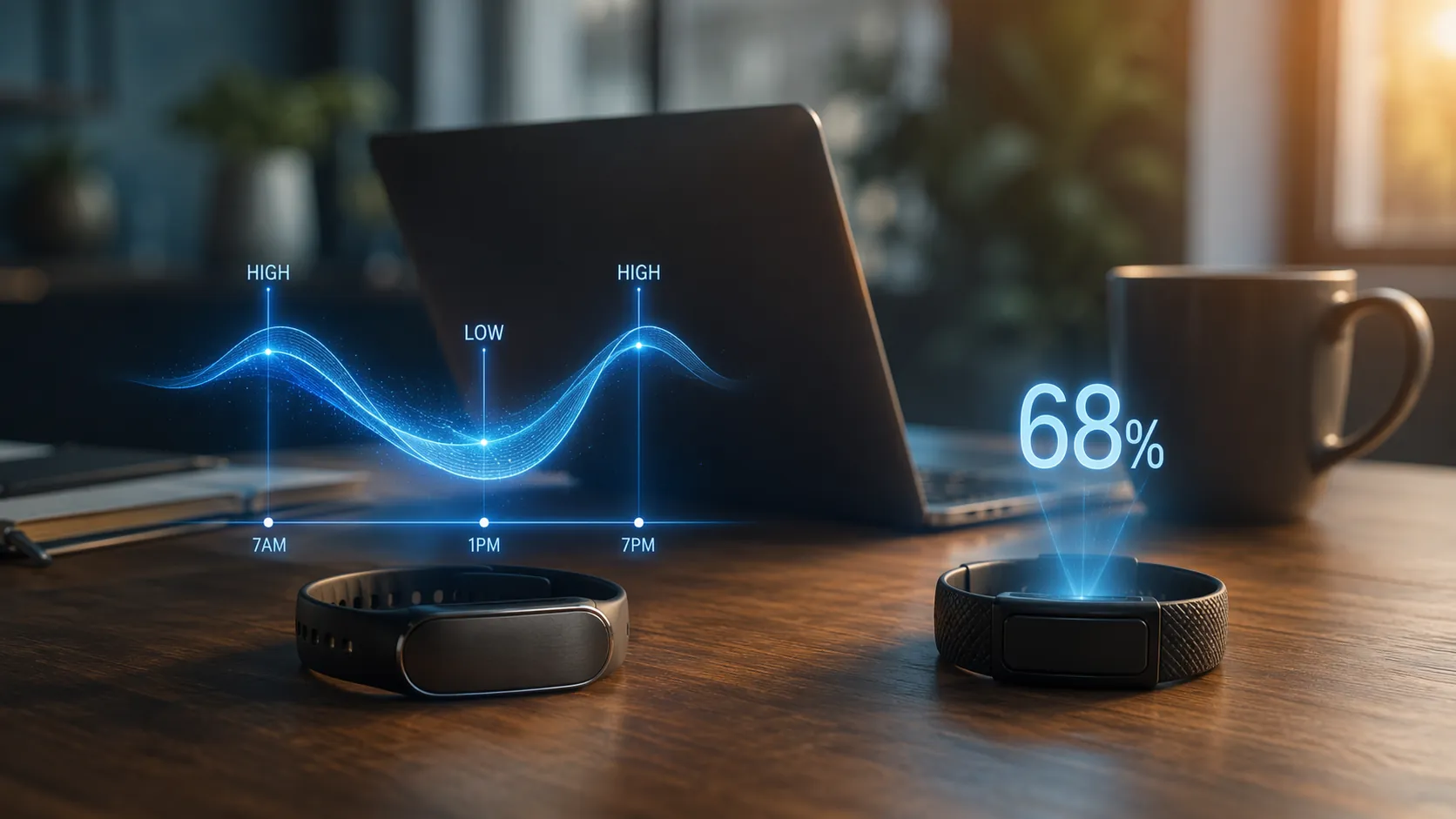
On that axis, Garmin Cirqa has the structural advantage. Cirqa’s Training Readiness and Body Battery-style energy signals are built around data that can change throughout the day. Whoop’s Recovery score, by contrast, is a morning percentage. It can be useful context, especially for learning from habits over time, but it does not answer the same midmorning or midafternoon scheduling question.
The Decisive Difference Is Data Freshness
A morning recovery score is clean. It gives you one number before the day starts, which fits neatly into a planning ritual. The problem is that knowledge work rarely respects the first plan. A heavy meeting, a commute, a workout, a conflict, a long code review, or a poor lunch can change the state you are actually working from.
That is why DC Rainmaker’s first-look Cirqa test matters more for productivity than most spec-sheet differences. During his test day, Cirqa’s Training Readiness moved from 73 to 50 after a run and then back to 73 later in the day. He also noted that Cirqa launched on July 24, 2026, and flagged software bugs, so this is early evidence rather than a settled long-term verdict.[1]
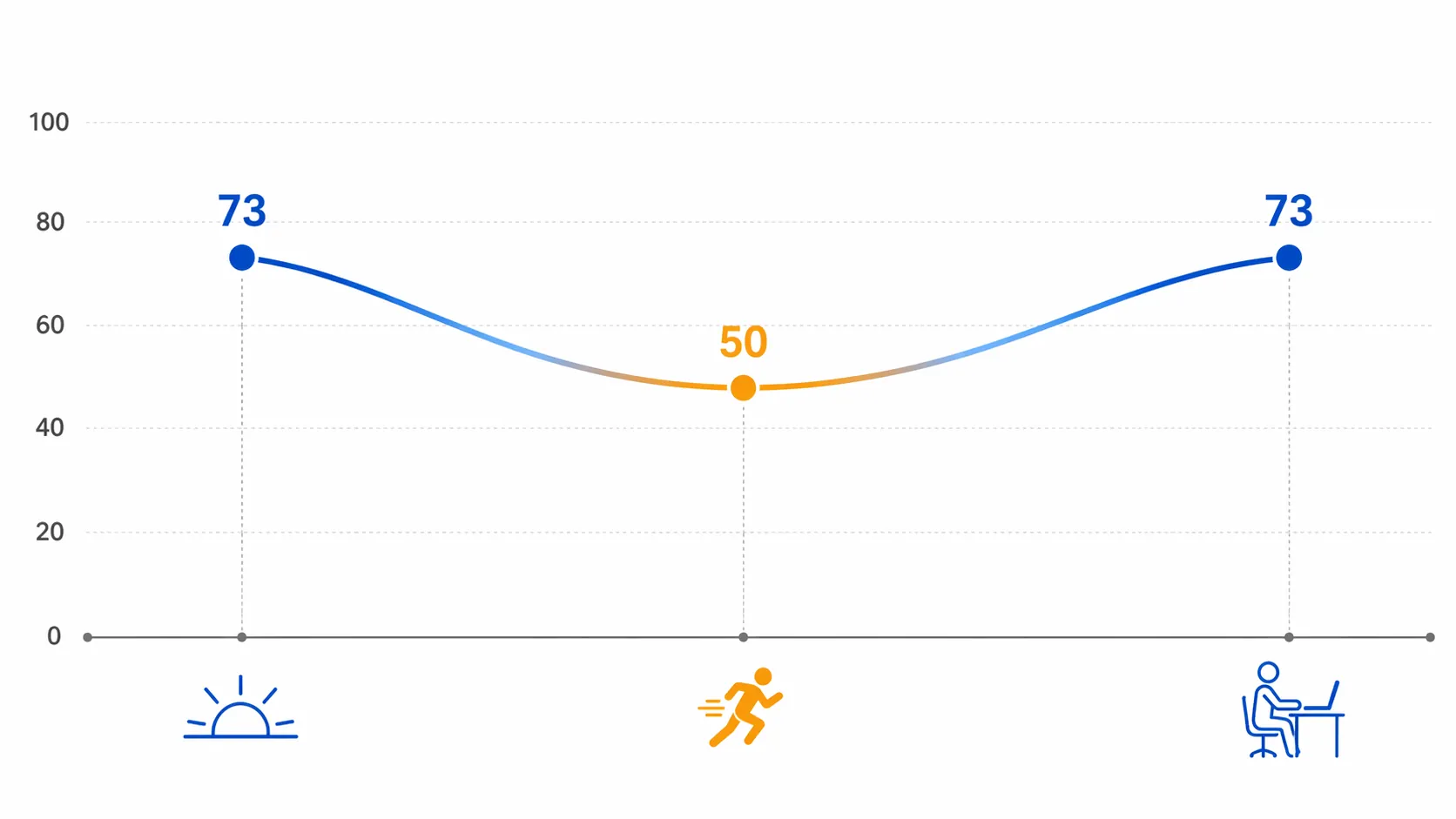
For a runner, that 73→50→73 movement is recovery feedback. For a knowledge worker, it is scheduling information. It means the band can notice that the body state available for demanding work at 8 AM is not necessarily the same body state available after exercise, after lunch, or before a late afternoon focus block.
Whoop’s Recovery score does something different. It tells you how recovered you are when you wake up. That can shape the initial plan: take the hard task early, avoid stacking meetings, or lower the day’s ambition. But if the day changes sharply, the Recovery number does not refresh into a new answer. Whoop does have other metrics, including strain and sleep-related data, so it is not blind after breakfast. The narrower point is that its central Recovery score is not an intraday readiness dial.
How Each Band Fits a Real Workday
A productivity wearable has to survive three moments: the morning plan, the midday revision, and the protected focus block. Many tools look useful at the first moment. Fewer help with the second. Almost none matter at the third unless they change the decision in front of you.
| Workday moment | What you need to decide | Garmin Cirqa fit | Whoop fit |
|---|---|---|---|
| Morning planning | How ambitious should today’s plan be? | Useful: readiness and energy context support the first calendar draft. | Useful: Recovery is built for this kind of morning interpretation. |
| Midday revision | Should the hard task move, shrink, or stay? | Stronger: readiness can update as conditions change. | Weaker: Recovery remains the morning snapshot, though other Whoop data may still add context. |
| Before deep work | Can I start a cognitively demanding block now? | Stronger: current energy trend is closer to the decision. | Less direct: better for explaining patterns than for timing this specific block. |
| Weekly reflection | Which habits seem to help or hurt readiness? | Useful: trend dashboards can show longer patterns. | Strong: journaling and Recovery Impacts are built around behavior links. |
The table is not a claim that Cirqa knows when you will write a great paragraph or solve a stubborn bug. Physiological readiness and cognitive readiness overlap imperfectly. A low-energy reading can coexist with a clear mind, and a high readiness score can coexist with distraction, anxiety, or a badly defined task. The useful claim is narrower: when the workday changes, Cirqa’s main productivity-relevant signals are better shaped for revising the plan.
Cirqa Is Better for Deciding When to Start the Hard Thing
The most productive use of Cirqa is not treating Training Readiness as a command. It is using the score as a friction check before spending your best remaining attention.
If readiness is high and Body Battery-style energy is holding, that supports starting the deep block rather than filling the next hour with low-value admin. If the signal has dropped after exercise or a tense meeting, it supports reducing the scope: outline instead of draft, review instead of design, fix one known bug instead of opening the hardest architectural problem. If the signal recovers later, the calendar can recover with it.
This is where a continuously updating band earns its place in a knowledge-work system. It does not need to predict genius. It only needs to reduce one kind of guesswork: whether the next demanding block is being placed against the current state of the day or against a stale morning assumption.
Garmin’s Body Battery framing supports this kind of use. Garmin describes Body Battery as an energy-monitoring feature that estimates available energy based on inputs such as stress, rest, sleep, and activity, and presents it as a way to manage when to push and when to rest.[2][3] That does not make it a validated writing-performance meter. It does make it closer to the way a time-blocked worker thinks: energy is a resource that changes, not a fixed trait assigned at wake-up.
Whoop’s Strongest Case Is Habit Learning, Not Intraday Scheduling
Whoop should not be dismissed as merely static. Its stronger productivity argument is slower and more prescriptive: journaling, behavior tracking, and Recovery Impacts can help someone learn which routines appear to improve recovery over weeks. For a person experimenting with caffeine timing, alcohol avoidance, late meals, screen use, bedtime consistency, or training load, that feedback loop may be more useful than another dashboard to inspect before a writing block.
That matters because many knowledge workers do not only have a scheduling problem. They have a systems problem. Their deep work fails because sleep debt accumulates, recovery is treated as optional, and the calendar keeps pretending every weekday has the same cognitive budget. Whoop’s habit-linking model is well suited to that longer experiment.
The tradeoff is immediacy. A behavior-linked recovery system can teach you that a habit tends to correlate with better mornings. It is less useful when the open question is whether to begin a hard task at 2:15 PM after the day has already deviated from plan. For that moment, Cirqa’s changing readiness model is the better shape of information.
Accuracy Matters, but Only Up to the Workflow Threshold
For productivity, the sensor question is not whether Cirqa replaces a chest strap. It is whether the signal is credible enough to detect meaningful energy trends. TechRadar’s HIIT comparison found Cirqa’s average heart rate within 2 bpm of a Polar H10 chest strap, at 153 bpm versus 155 bpm.[4] That is not a full validation of every readiness algorithm, but it is enough to make the heart-rate foundation harder to dismiss as decorative.
The caution is that a productivity conclusion cannot be imported directly from heart-rate accuracy. No cited test here compares Cirqa and Whoop in a controlled writing, coding, or management-work study. The available evidence supports a workflow judgment about data freshness and usability, not a measured claim that one band increases output by a specific amount.
The Burnout Angle Favors Garmin, With a Caveat
A single day is not the whole problem. The knowledge worker who keeps pushing through low-energy afternoons eventually needs trend visibility: is this just today, or has the baseline been sliding for weeks?
Lifestack’s review of Cirqa points to Garmin Health Status trends across 7-, 28-, and 90-day windows, which is the kind of view that can surface gradual changes rather than one-off bad mornings.[5] For burnout monitoring, that matters. A day-level readiness score helps with scheduling; a trend dashboard helps with noticing that the schedule itself has become unrealistic.
Still, trend visibility is not diagnosis. If the dashboard shows a persistent decline, the practical move is to treat it as a prompt to examine workload, sleep, stress, training, and health—not as proof of a single cause.
Pricing Changes the Productivity-Tool Calculation
Subscription cost matters differently when a band is being bought as a productivity tool rather than a training platform. If the main job is helping you place deep-work blocks, the cost has to compete with software, coaching, note apps, calendars, and all the other tools that promise better workdays.
Cirqa’s pricing is simpler: DC Rainmaker reports a $199 one-time cost with no required subscription, and notes that Garmin Connect+ is genuinely optional for the core experience.[1] Whoop’s model is different: the research brief’s cited pricing range is $199 to $359 per year, and Gear Patrol describes Whoop bands as “useless” without a paid subscription.[6]
That does not automatically make Whoop poor value. If its coaching, journal, and behavior analysis become part of how you manage sleep and recovery, a subscription can be justified. But for someone who wants a band mainly as an energy-aware scheduling input, Garmin’s no-required-subscription model lowers the risk. If you stop training for a month but still want to check energy before a demanding work block, Cirqa is less likely to become a sunk-cost reminder on your wrist.
What Cirqa Still Has to Prove
The Garmin case is strong structurally, but it is early. The most relevant independent analysis available here is a first look, not a long-term review.[1] Bugs at launch are not a small footnote if the product’s value depends on trust. A readiness score that updates during the day is only useful if the user believes the movement is meaningful enough to act on.
There is also a category problem. Wearables measure physiological signals, then apps translate those signals into simplified readiness language. Knowledge work depends on more than physiology: task clarity, emotional load, interruption risk, skill, motivation, and deadline pressure all change whether a deep-work block succeeds. A band can inform the decision. It should not own the decision.
The best use is modest: let the wearable update the calendar, not replace judgment. If the signal says your energy is low but the deadline is immovable, you may still start. You might just change the block: shorter duration, clearer endpoint, fewer context switches, or a recovery break immediately after.
Which One Should You Buy for Productivity?
Choose Garmin Cirqa if your main productivity problem is deciding when to do demanding work today. Its advantage is not that it proves you will focus better. Its advantage is that Training Readiness and energy signals can change as the workday changes, which makes them more useful for revising time blocks after the morning plan goes stale.
Choose Whoop if you care more about long-term habit experiments than intraday scheduling. If you want a more prescriptive system for connecting behaviors to recovery, and you are comfortable paying an ongoing subscription, Whoop’s journaling and Recovery Impacts may be the better fit.
Wait if launch bugs, first-look evidence, or the lack of productivity-specific testing would bother you. Cirqa is the better-shaped tool for energy-aware deep-work scheduling, but it is not yet proven to make writers write more, developers solve more, or managers think more clearly. The buying decision comes down to which uncertainty you would rather live with: Garmin’s early-product uncertainty, or Whoop’s less timely Recovery signal and recurring cost.
References
- Garmin Cirqa: Everything You Need To Know — DC Rainmaker, July 2026
- Body Battery Energy Monitoring — Garmin
- Body Battery: Thrive — Garmin
- Is Garmin Cirqa good... — TechRadar
- Garmin Cirqa — Lifestack
- Garmin Cirqa Smartband Explained, Revealed — Gear Patrol
Comments
Join the discussion with an anonymous comment.