
A cognitive-performance routine built around time-restricted eating should start with a slightly uncomfortable fact: the research does not hand you a universal eating window. A systematic review on intermittent fasting and cognition concluded that there was “no clear evidence of a positive short-term effect of IF on cognition in healthy subjects,” which is exactly the wrong foundation for a confident productivity prescription and a good foundation for a careful tracker.[1]
The more useful clue is not simply how long the fasting period lasts. A 2024 systematic review of time-restricted eating and intermittent fasting in older adults found that cognitive outcomes appear to depend on the temporal placement of the eating window, not only on fasting duration.[2] That one sentence changes the tracking design. If timing matters, a log that only records “16:8” is too blunt. You need start time, end time, and a timing label you can query later.
There are encouraging signals, but they are not interchangeable with proof for a healthy knowledge worker’s Tuesday morning writing block. A Rutgers pilot reported in July 2026 found that women aged 50–79 using a 9-hour eating window from 10 a.m. to 6 p.m., with a 4-hour pre-bed fast, performed better on spatial planning and problem-solving tests than those eating across 12 hours, while both groups lost about 7 kg; the lead researcher described the effects as modest, and the work was reported from a conference presentation rather than a peer-reviewed paper.[3] A 3-year cohort of 99 older adults with mild cognitive impairment found improved cognitive function among regular intermittent fasting practitioners, with mediation through lower CRP, higher SOD activity, and lower DNA damage.[4] Another study found that early time-restricted feeding affected BDNF expression and autophagy-related genes.[5]
Those are reasons to log thoughtfully, not reasons to declare a schedule. Li et al. found that time-restricted feeding was associated with poorer performance in orientation to place and attention/calculation among older Chinese adults.[6] The Italian study included in the 2024 review points the other way: a 10-hour time-restricted eating pattern was associated with lower likelihood of cognitive impairment, with an odds ratio of 0.28 and a 95% confidence interval of 0.07–0.90.[2] Different populations, different protocols, different cognitive domains. A personal tracker exists because this evidence landscape is too mixed for a template schedule to be honest.
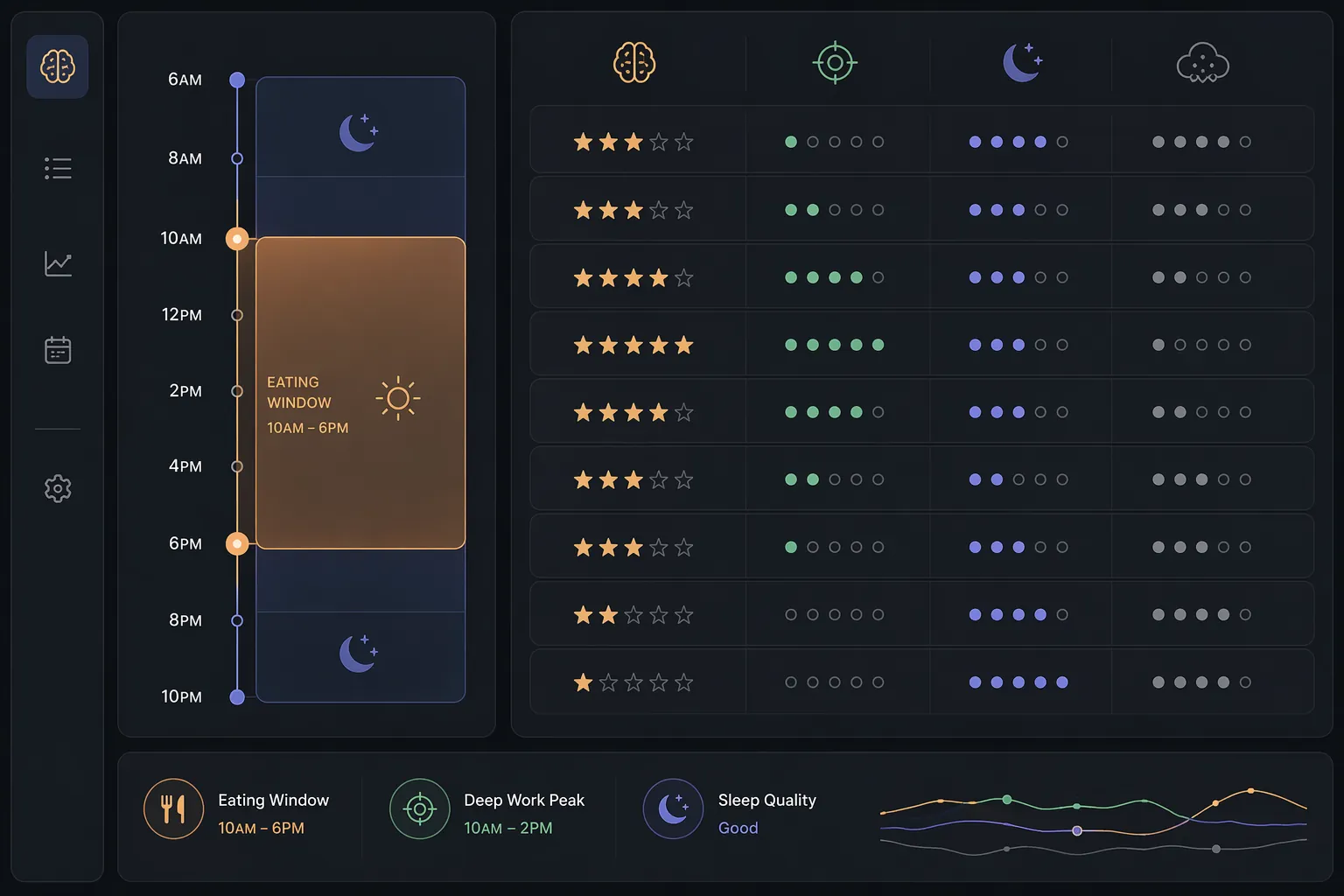
Define the experiment before you open Obsidian, Notion, or Logseq
The tracker has one job: make it harder to tell yourself a clean story from messy days. If you felt sharp after an early eating window, the log should also show whether you slept well, had fewer meetings, did less reactive work, or simply protected a long block of deep work. If you felt foggy after a later window, the log should show whether dinner ran late, sleep was poor, or the day was already overloaded.
Keep the experiment narrow enough to survive normal work. Pick the cognitive output you actually care about: writing, coding, analysis, strategy work, research synthesis, or another task where mental clarity matters. Then choose the eating-window variants you want to compare. The comparison can be early versus mid-day, mid-day versus later, shorter versus longer, or weekday consistency versus social flexibility. Do not change every variable at once if you expect the weekly review to mean anything.
- Choose one primary work outcome: deep work hours, completed focus blocks, or a daily cognitive rating.
- Choose one timing comparison: early, mid-day, or later eating windows.
- Keep meal composition, caffeine habits, and work schedule as stable as realistically possible.
- Mark confounders instead of deleting imperfect days.
- Review by week, not by emotional memory of one excellent or terrible day.
The smallest useful tracking schema
A good daily log should take less than a minute to complete. The schema below is deliberately plain. It avoids nutrition theater and captures the variables most likely to explain why a cognitive-performance day looked better or worse.
| Field | Type | Why it exists |
|---|---|---|
| eating_start | Time | Records the first caloric intake so timing can be queried, not guessed. |
| eating_end | Time | Records the last caloric intake and allows duration to be calculated. |
| window_duration | Calculated number | Separates duration from timing; two people can both fast for the same length but eat at different times. |
| window_label | Select | Groups days into early, mid-day, later, irregular, travel, or social windows. |
| cog_rating | Number 1–5 | Captures your subjective cognitive state in a queryable format. |
| deep_work_hours | Number | Tracks output capacity rather than only how focused you felt. |
| sleep_quality | Number 1–5 | Keeps sleep from silently taking credit or blame for the eating window. |
| brain_fog | Text or checkbox plus note | Captures episodes, timing, and likely causes without over-structuring them. |
| confounders | Multi-select or short text | Flags heavy meetings, illness, alcohol, travel, unusual stress, late caffeine, or disrupted sleep. |
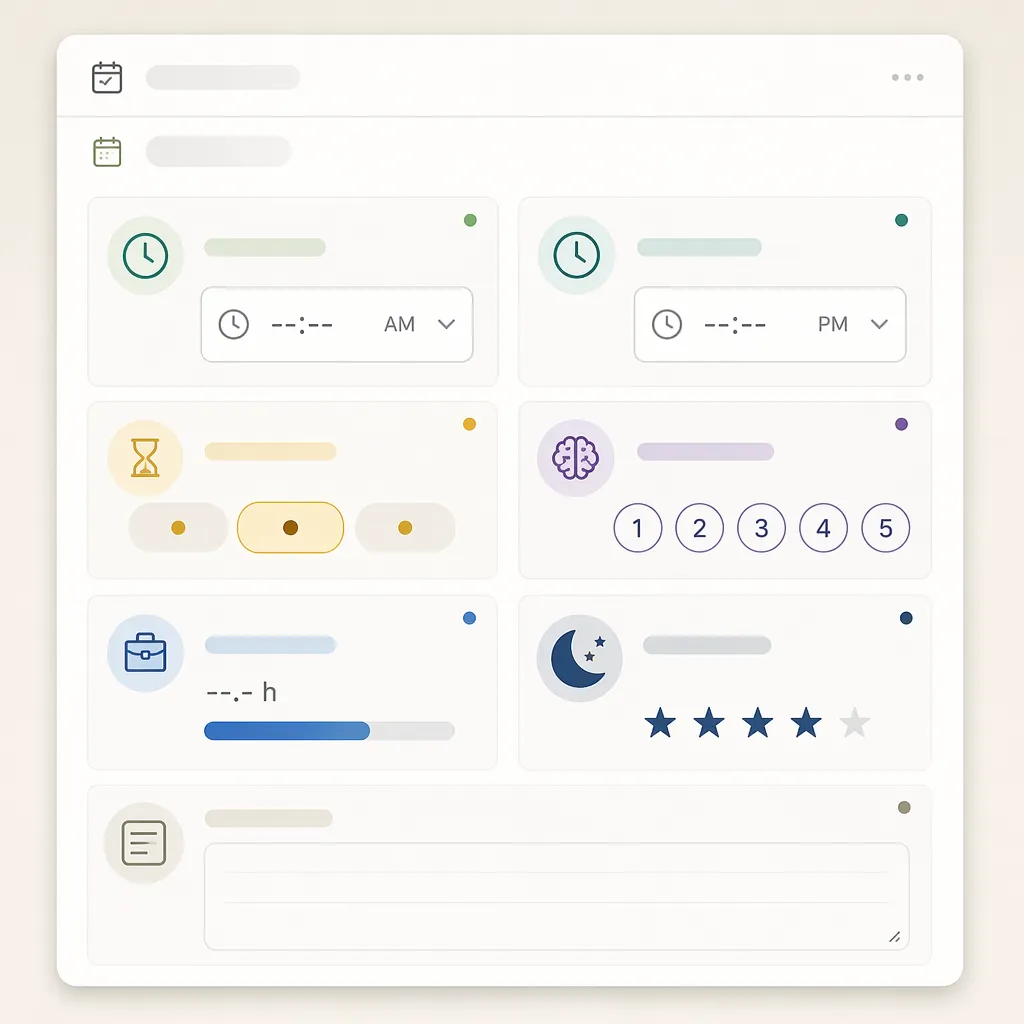
Eating start and end time
These are the fields most people under-specify. “I did TRE today” is not queryable. “Started 10:05, ended 18:20” is. Exact times let you distinguish a stable 10 a.m.–6 p.m. pattern from an eating window that slides by two hours depending on workload. That distinction matters because the review evidence suggests cognitive outcomes may depend on when the window sits in the day, not only how long the fast lasts.[2]
Do not force false precision if you forgot. Use your best estimate and mark the day as estimated. A slightly imperfect log that survives is more useful than a perfect schema abandoned after four days.
Window label
The label is what makes review fast. Use broad categories that match the experiment, such as early, mid-day, later, irregular, travel, or social. The label should not replace start and end times. It gives you a quick grouping layer; the times preserve the real record.
| Label | Use it when |
|---|---|
| early | Your eating window starts and ends earlier than your usual pattern. |
| mid-day | Your eating window sits around the middle of your active workday. |
| later | Your first meal or last meal shifts later than usual. |
| irregular | The day does not fit the planned comparison but should remain in the record. |
| social | The window was shaped by dinner, events, family, or travel rather than the experiment. |
Cognitive rating from 1–5
A 1–5 rating is crude on purpose. More granular scales usually feel scientific while adding hesitation. Define the scale once and reuse it exactly.
| Rating | Meaning |
|---|---|
| 1 | Foggy, distractible, hard to start meaningful work. |
| 2 | Functional but sluggish; focus required unusual effort. |
| 3 | Normal working clarity; no strong signal either way. |
| 4 | Clear and steady; focus blocks felt easier than usual. |
| 5 | Unusually sharp; complex work felt fluent for a meaningful part of the day. |
Rate the day near shutdown, not during a single peak or crash. If your system supports reminders, write the scale into the daily-note template so you do not reinterpret it every week.
Deep work hours
Subjective clarity and actual output can diverge. Deep work hours give the review a behavioral measure: how much protected, cognitively demanding work happened. Count only blocks where you were doing the primary work type you defined at the beginning. Email triage, meetings, chat, and admin may be necessary, but they should not inflate this field.
Sleep quality and brain-fog notes
Sleep quality is not a decorative wellness field. It protects the interpretation. A later eating window followed by a poor cognitive rating may be less interesting if sleep was already a 1. A mid-day window followed by an excellent writing day may be less convincing if it also happened after your best sleep of the week.
Brain-fog notes should be short and situational: “foggy 14:00–15:30 after long meeting block,” “clear morning, crash after late lunch,” “fine cognitively, low motivation.” Avoid turning this into a diary. You are preserving context for review, not building a second workday.
Implement the same system in your note-taking app
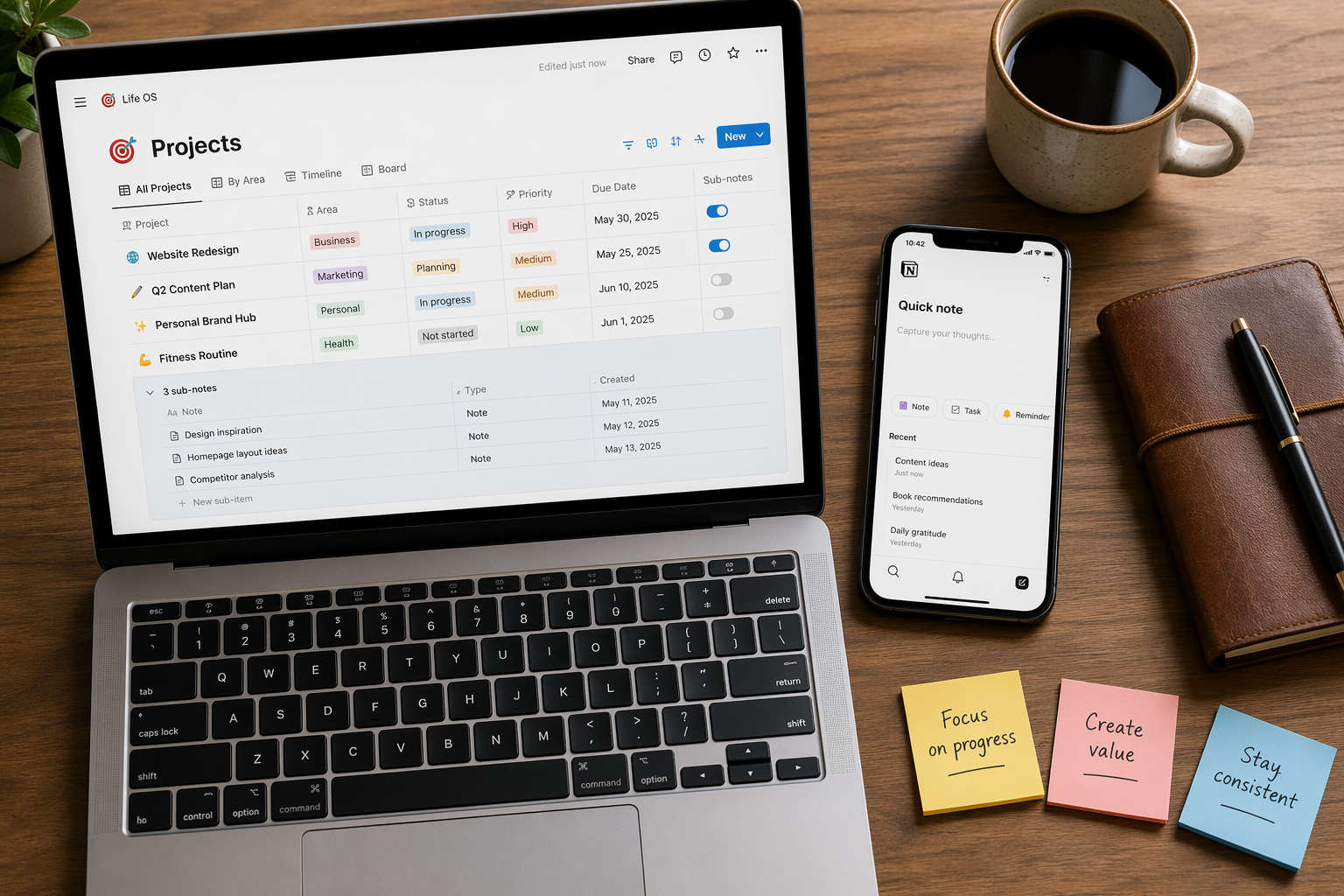
The tool matters less than the schema. Obsidian, Notion, and Logseq all need the same bones: structured daily entries, consistent field names, and one weekly review surface that groups days by window timing.
Obsidian: daily note properties plus Dataview
In Obsidian, put the structured fields in the daily note frontmatter and keep the human note below it. The daily note remains readable, but the experiment data stays queryable.
---
date: 2026-07-28
eating_start: "10:05"
eating_end: "18:20"
window_label: mid-day
cog_rating: 4
deep_work_hours: 3.5
sleep_quality: 4
brain_fog: "brief dip after meetings"
confounders: [heavy-meetings]
---

## TRE + cognition note
- Main work: drafted analysis memo
- Fog context: 14:30 after back-to-back calls
- Anything unusual: later caffeine than normal
A basic Dataview table is enough for the first review. Do not build a dashboard before you have data worth reviewing.
TABLE
  eating_start AS "Start",
  eating_end AS "End",
  window_label AS "Window",
  cog_rating AS "Cog",
  deep_work_hours AS "Deep Work",
  sleep_quality AS "Sleep",
  brain_fog AS "Brain Fog",
  confounders AS "Confounders"
FROM "Daily"
WHERE eating_start
SORT file.day DESC
For a weekly review note, filter to the week you are reviewing and group mentally by window label. If you already use DataviewJS, you can calculate averages by label later, but the first version should privilege completion over cleverness.
Notion: one database, two useful views
In Notion, create a database called something plain like TRE Cognitive Log. Each row is one day. Resist the urge to create separate databases for meals, symptoms, tasks, and sleep unless you already maintain those systems. For this experiment, a single daily row is usually the correct level of detail.
| Notion property | Property type |
|---|---|
| Date | Date |
| Eating Start | Text or Date with time |
| Eating End | Text or Date with time |
| Window Label | Select |
| Cognitive Rating | Number |
| Deep Work Hours | Number |
| Sleep Quality | Number |
| Brain Fog | Text |
| Confounders | Multi-select |
| Week | Formula or select |
Use a table view for entry and a board or grouped table for review. Group by Window Label. Add visible columns for Cognitive Rating, Deep Work Hours, Sleep Quality, Brain Fog, and Confounders. If a formula for duration becomes annoying, skip it at first. Duration is useful, but consistent start and end times are the non-negotiable fields.
Logseq: properties on journal pages
Logseq works well when the entry lives at the top of the journal page as page properties, with a few bullets underneath for context. Keep property names stable. Queries become fragile when one day says “cog_rating” and another says “focus_score.”
eating_start:: 10:05
eating_end:: 18:20
window_label:: mid-day
cog_rating:: 4
deep_work_hours:: 3.5
sleep_quality:: 4
brain_fog:: brief dip after meetings
confounders:: heavy-meetings

- Main work: drafted analysis memo
- Fog context: 14:30 after back-to-back calls
- Anything unusual: later caffeine than normal
A simple query can pull journal pages where the eating-start property exists. From there, the review can happen in a query result, a manually maintained weekly page, or a linked reference workflow if that is already how you work.
Build the weekly review around timing, not fasting identity
The weekly review is where the tracker earns its keep. The goal is not to announce that TRE worked or failed. The goal is to ask whether certain timing patterns repeatedly coincide with better cognitive days after obvious confounders are visible.
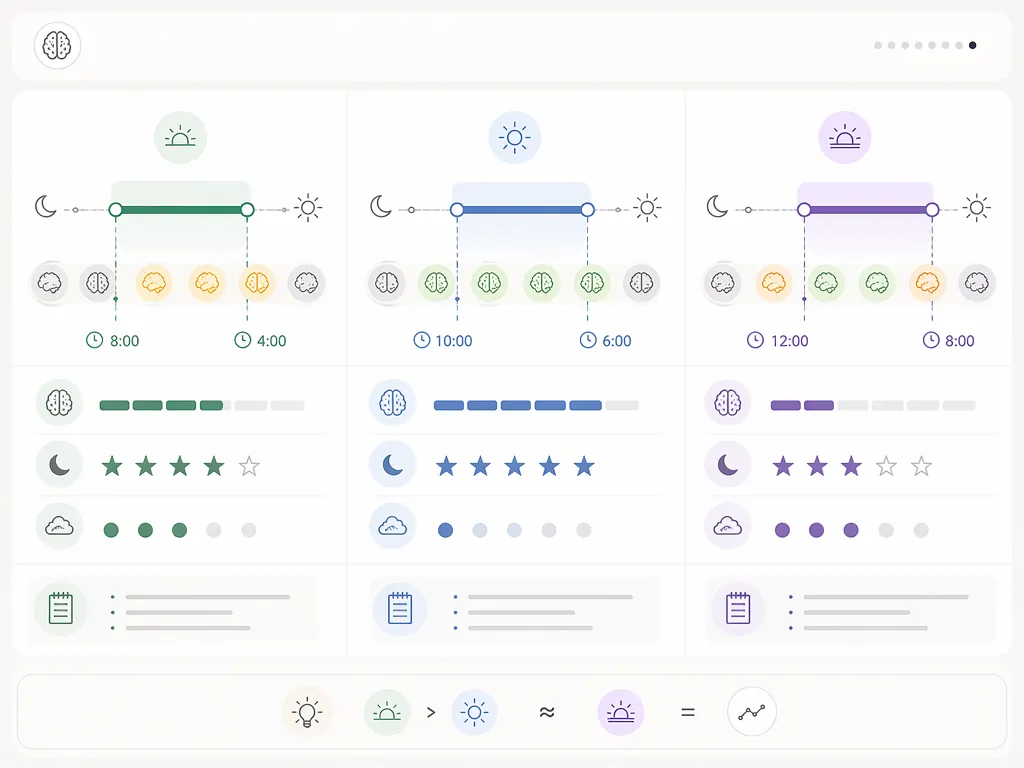
Review in this order: timing first, cognitive rating second, output third, sleep and confounders fourth. That order keeps the question aligned with the evidence. If timing placement may matter, then “mid-day windows averaged higher cognitive ratings than later windows” is more useful than “fasting longer felt better.”
| Review question | What to look for | What not to conclude |
|---|---|---|
| Which timing label had the strongest cognitive ratings? | Repeated 4s and 5s under the same timing label, especially on ordinary workdays. | That the timing caused the improvement. |
| Which timing label supported the most deep work? | Higher deep work hours on days with comparable workload and meetings. | That a low-output day means the eating window failed. |
| Did sleep quality move with the result? | High ratings only on high-sleep days, or poor ratings clustered after poor sleep. | That TRE explains what sleep already explains. |
| Did brain fog appear at predictable times? | Repeated fog before first meal, after first meal, late afternoon, or after long meeting blocks. | That every fog episode is metabolic. |
| Did irregular or social days dominate the week? | Too many confounded days to compare timing variants cleanly. | That the experiment is useless; it may just need a steadier block. |
A useful weekly note can be short. Write three bullets: the best-supported timing pattern, the largest confounder, and what you will hold steady next week. If the mid-day window looked promising but all mid-day days also had excellent sleep, the next week’s job is not to celebrate the window. It is to see whether the signal remains when sleep is less perfect.
A practical review template
## TRE cognitive review: Week of ____

### Window comparison
- Early windows:
  - Cognitive ratings:
  - Deep work hours:
  - Sleep pattern:
  - Brain-fog notes:

- Mid-day windows:
  - Cognitive ratings:
  - Deep work hours:
  - Sleep pattern:
  - Brain-fog notes:

- Later windows:
  - Cognitive ratings:
  - Deep work hours:
  - Sleep pattern:
  - Brain-fog notes:

### Confounders that matter
- Meetings / workload:
- Sleep disruption:
- Travel / social meals:
- Illness / stress / caffeine:

### Next adjustment
- Keep stable:
- Change:
- Do not interpret yet:
How to compare variants without fooling yourself
The cleanest comparison is not the most ambitious one. If you compare early windows, later windows, shorter duration, longer duration, different meal composition, different caffeine timing, and a new workout schedule in the same week, the review will become retrospective fiction with numbers attached.
Compare one dimension at a time. If the question is timing, keep the duration roughly similar and compare early versus mid-day or mid-day versus later. If the question is duration, keep the placement roughly similar and compare shorter versus longer windows. The research signal that timing placement may matter does not make duration irrelevant; it means your tracker should avoid collapsing both into one vague field.[2]
Use confounders as a visibility layer, not a reason to hide days. A day with a late client dinner, poor sleep, and a cognitive rating of 2 should stay in the database as an irregular or social day. Removing it makes the system prettier and less honest. Keeping it lets the weekly review say, “This week did not test the planned pattern very well,” which is often the correct conclusion.
When a pattern appears, downgrade your language. “The mid-day window is better for my attention” is too strong after a few good days. “Mid-day windows have coincided with better cognitive ratings and more deep work on relatively normal sleep days” is clunky but more accurate. That phrasing leaves room for the next work crunch, the next poor night of sleep, and the next social week.
Where biomarkers belong in this tracker
Biomarker findings are interesting, but they should not take over a cognitive-performance tracker. Ooi et al. linked cognitive improvements in older adults with mild cognitive impairment to inflammatory and oxidative-stress markers such as CRP, SOD activity, and DNA damage.[4] Jamshed et al. found changes in BDNF expression and autophagy-related genes under early time-restricted feeding.[5] Those findings may help explain possible mechanisms, but they do not tell you whether your 10 a.m. writing block was clearer.
If you already track lab work with a clinician, keep it in a separate health record and link it only as context. Do not let a mechanism proxy replace the work outcome. The daily system here is built around eating-window timing, cognitive rating, deep work hours, sleep quality, and brain-fog episodes because those are the variables you can maintain and review without turning the experiment into a medical dashboard.
A durable rule for interpreting your log
Treat TRE as a personal cognitive-performance experiment only when the log can answer three questions: when you ate, how the workday felt, and what else could plausibly explain the result. If one of those is missing, the conclusion should stay weak.
- If cognitive ratings improve but deep work does not, you may be feeling better without producing more focused work.
- If deep work improves but sleep also improves, keep testing before crediting the eating window.
- If brain fog clusters around a specific timing pattern, preserve the pattern and look for repetition.
- If social, travel, illness, or workload confounders dominate, pause interpretation rather than forcing a verdict.
- If the tracker takes more than a minute per day, remove fields before you remove the habit.
The most useful result may be modest: a window that seems to support clearer mornings, a later pattern that repeatedly damages sleep, or no reliable cognitive change at all. Any of those outcomes is better than adopting someone else’s eating schedule because it sounded disciplined. Your note-taking system should leave you with a record that can be reviewed without drama: start time, end time, timing label, cognitive rating, deep work hours, sleep quality, brain fog, and the context that kept the day human.
References
- “The Effects of Intermittent Fasting on Brain and Cognitive Function” — PMC, 2021.
- “Effect of time-restricted eating and intermittent fasting on cognitive function and mental health in older adults: A systematic review” — PMC, 2024.
- “Restricted eating hours may reduce cognitive decline in older age, researchers find” — The Guardian, July 26, 2026.
- “Intermittent Fasting Enhanced the Cognitive Function in Older Adults with Mild Cognitive Impairment” — PMC, 2020.
- “Early Time-Restricted Feeding Improves 24-Hour Glucose Levels and Affects Markers of the Circadian Clock, Aging, and Autophagy in Humans” — PMC, 2019.
- “Time-Restricted Feeding Is Associated with Poor Performance in Specific Cognitive Domains of Suburb-Dwelling Older Chinese” — Nature, 2023.




Comments
Join the discussion with an anonymous comment.