
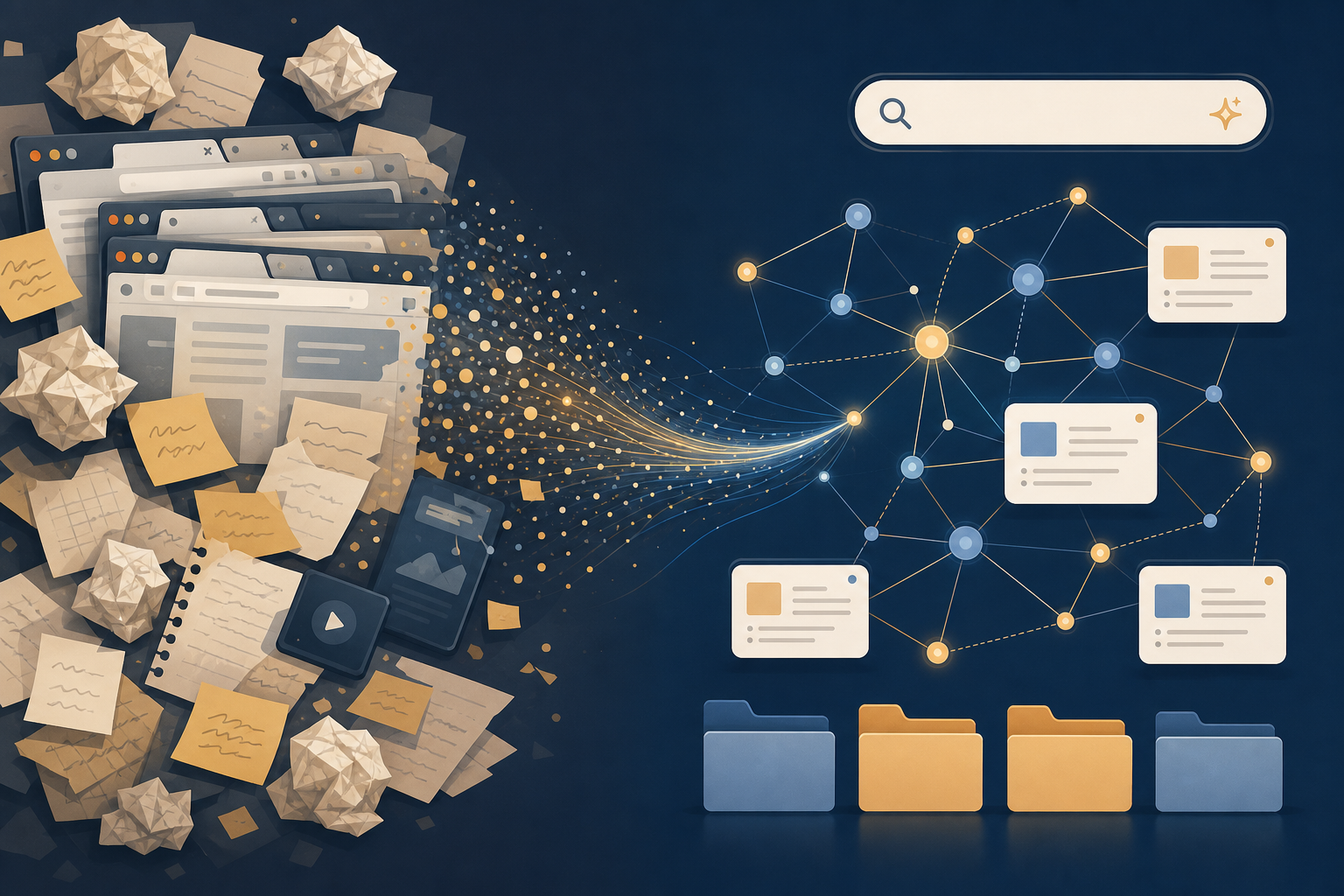
How Traditional PKM Works: The Cognitive Effort of Linking Is Part of the Value
For the past decade, the dominant paradigm in personal knowledge management has been built on a simple premise: you capture information, then you organize it so you can find it again. That organization layer — tagging, filing into folders, creating bidirectional links between notes — is the engine that turns a collection of clippings into a usable knowledge base. Frameworks like PARA (Projects, Areas, Resources, Archives) and Zettelkasten are the two most refined expressions of this manual-linking philosophy, and they achieve their results through very different mechanisms.
PARA, popularized by Tiago Forte, is a project-oriented system that uses four top-level folders to reduce the friction of deciding where a note belongs. Its strength is speed of capture and retrieval for active work — you don't need to think about taxonomy, only about whether something belongs to a current project, a broader area of responsibility, a resource you might use later, or an archive. Zettelkasten, the method Niklas Luhmann used to produce over 70 books and 400 academic articles from roughly 90,000 index cards, takes the opposite approach: it demands that every note be atomic, self-contained, and manually linked to existing notes through explicit connections. The act of deciding how a new note connects to what you already know is the primary cognitive operation.
This is why traditional PKM has a high setup cost and a steep learning curve. The Atlas workspace guide notes that traditional PKM "relies on you tagging, linking, and filing" — and that reliance is both its greatest strength and its most common failure point. The same guide estimates that roughly 80% of people who try PKM and abandon it over-invested in the organization layer before they had enough notes to organize. They built elaborate folder structures and tagging taxonomies for a collection that didn't yet exist, mistaking system design for knowledge work.
For those who push through that initial friction, the payoff is real. A well-maintained Zettelkasten or PARA system becomes a compounding knowledge asset: each new note benefits from every connection you've already made, and the graph of linked ideas grows more valuable over time. But the maintenance burden is constant. Every note requires a decision about where it goes and what it connects to, and those decisions consume mental energy that could otherwise go toward synthesis and creation.
How AI-Native PKM Changes the Equation: Semantic Search + Embeddings Handle Structure
AI-native PKM tools flip the traditional model on its head. Instead of requiring you to organize information at the point of capture, they defer organization to the point of retrieval. The core technical shift is from keyword matching to semantic search powered by embeddings. When you dump a note into an AI-native tool, the system doesn't just index the words — it converts the entire note into a high-dimensional vector representation that captures its meaning. Later, when you ask a question or search for a concept, the tool retrieves notes based on semantic similarity, not keyword overlap.
The practical consequence is that you no longer need to decide where a note "goes" at the moment of capture. You don't need to tag it, file it in the right folder, or link it to related notes. You just need to capture it well — clearly, with enough context that the embedding model can understand what it means. The system handles the rest.
The data on the effectiveness of this shift is striking. According to the Dataintelo market report, AI-enhanced PKM tools improve information retrieval efficiency by up to 47% and reduce search time by 35%. For knowledge workers who spend an average of 9.3 hours per week searching for information — a figure attributed to McKinsey research by the GoLinks blog — that 35% reduction translates to over three hours saved per week. When 80% of knowledge workers report experiencing information overload, those hours are not trivial.
What this means in practice is that the question changes from "where does this note go?" to "what do I already have on this topic?" The AI-native tool surfaces relevant notes automatically when you start writing or asking questions, effectively creating a dynamic, query-driven knowledge graph that adapts to what you need in the moment rather than what you decided to link six months ago.
- Capture quality replaces organization quality as the primary skill. A well-written note with clear context is more valuable than a perfectly tagged note with thin content.
- Retrieval becomes conversational. Instead of remembering which folder you filed something under, you ask a natural-language question and get answers synthesized from your corpus.
- The compounding effect accelerates. Because AI tools surface related notes automatically, you encounter connections you would never have made manually — but you also lose the deliberate act of making those connections yourself.
The New AI-Native Tools: What They Do and How They Work
The AI-native PKM landscape in 2026 includes several tools that approach the capture-retrieval loop from different angles. Each represents a distinct philosophy about how AI should augment — or replace — the manual organization layer. The broader AI note-taking landscape is converging rapidly, but these five tools illustrate the key design choices available to PKM practitioners evaluating the AI shift.
| Tool | Core AI Feature | Pricing (AI Component) | Key Differentiator |
|---|---|---|---|
| Atlas | Cited answers from personal corpus; mind maps; compounding context | $20/month Pro (unlimited AI) | Privacy-first: data not used to train shared models; every AI answer cites source notes |
| Notion AI | Q&A across workspace; AI writing assistant; auto-summarization | $10/user/month add-on | Integrates with existing Notion workspace; largest user base (30M+ users) |
| Mem | AI-organized automatic surfacing; daily digest of relevant notes | Freemium; AI features in paid tiers | Zero-organization capture; AI decides what to surface based on recency and relevance |
| Reflect | E2E encrypted AI meeting notes; AI-powered search and Q&A | Subscription; AI included in base plan | End-to-end encryption; strong privacy positioning for sensitive knowledge work |
| Tana | Supertags + AI-powered graph navigation; natural language queries | Early access; pricing TBD | Hybrid approach: manual supertags for structure + AI for retrieval and surfacing |
The pricing data reveals an important pattern: AI features command a 40-80% premium over base subscription tiers, according to the Dataintelo report. Notion AI at $10/user/month on top of a $8-15/month base plan is at the lower end of that range. Atlas's $20/month Pro plan includes unlimited AI usage and positions itself as a premium alternative for users who want cited answers and privacy guarantees. The premium reflects the computational cost of running embedding models and LLM inference at scale, but it also creates a new cost-benefit calculation for PKM practitioners: is the AI layer worth the additional monthly expense?
Each tool makes a different bet on how much structure the user should provide. Tana's supertags give users a way to define their own ontology while letting AI handle retrieval. Mem eliminates structure entirely and relies on AI to organize automatically. Atlas and Reflect sit in the middle: they expect you to capture notes in a reasonably structured way but handle the linking and retrieval through AI. Notion AI is the most conservative of the group — it adds AI capabilities to an already mature, folder-and-database-based system, making it the easiest transition for existing Notion users who want to experiment with AI without abandoning their current workflow.
Real Trade-Offs: Privacy vs. Convenience, Lock-In vs. Ownership, Cognitive Benefit vs. Speed
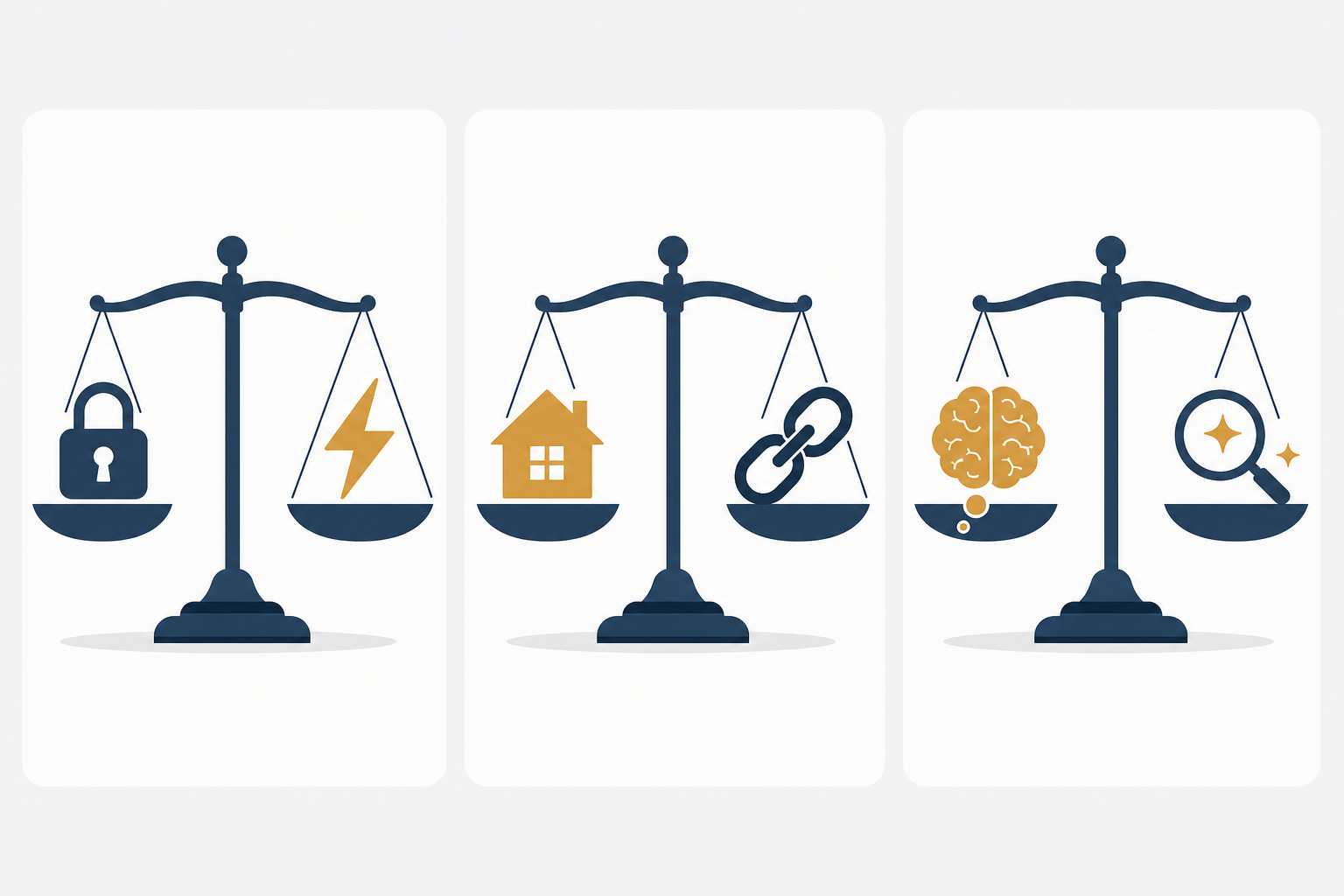
The shift from manual to AI-native PKM is not a pure upgrade — it involves real trade-offs that every practitioner needs to evaluate against their own priorities. These trade-offs fall into three main categories, and the right choice depends heavily on what kind of knowledge work you do and how you think about data ownership.
| Trade-Off | AI-Native PKM | Manual PKM (Obsidian, Logseq, etc.) | What's at Stake |
|---|---|---|---|
| Privacy vs. Convenience | Cloud AI processing required for embeddings and LLM inference; some tools (Reflect, Atlas) offer encryption but still process data on servers | Local-first tools like Obsidian keep all data on your device; no third-party access to your notes | If you work with sensitive client data, proprietary research, or personal health information, cloud AI processing may be a non-starter regardless of encryption claims |
| Vendor Lock-In vs. Data Ownership | AI-native tools use proprietary formats and APIs; exporting plain text may lose AI-generated metadata, embeddings, and link structures | Obsidian and Logseq use plain Markdown files; you own every byte and can move to any tool that reads Markdown | The more deeply you integrate AI features, the harder it becomes to leave. A tool that synthesizes answers from your corpus is harder to replace than a tool that just stores text |
| Cognitive Benefit vs. Speed | AI handles retrieval and surfacing; you see connections you didn't make yourself, but you don't practice the cognitive skill of linking | Manual linking forces you to articulate connections; the act of linking is itself a thinking exercise that builds understanding | If your primary goal is to think better through writing, manual linking may be irreplaceable. If your goal is to produce output faster, AI retrieval wins |
The privacy trade-off is the most concrete and the most context-dependent. Tools like Reflect offer end-to-end encryption for AI meeting notes, and Atlas states that user data is not used to train shared models. But the fundamental architecture of AI-native PKM requires sending your note content to a server for embedding generation and LLM inference. Even with encryption in transit and at rest, the server processes your plaintext to generate responses. For users who have already chosen local-first tools like Obsidian for data sovereignty reasons, this architectural reality may be a dealbreaker regardless of any privacy policy.
The cognitive trade-off is the most subtle and the most personal. Proponents of manual PKM argue that the act of linking is not a chore to be automated away — it is the primary mechanism through which understanding develops. When you force yourself to articulate how a new note connects to an existing one, you are engaging in active learning. AI retrieval short-circuits that process: it shows you connections, but you didn't make them, and you may not internalize them the same way. For knowledge workers whose primary output is thinking — researchers, writers, strategists — this loss of cognitive engagement may outweigh any efficiency gain.
The Market Context: Why This Shift Is Happening Now
The convergence of AI and PKM is not happening in a vacuum. Several market and technology trends have aligned to make 2025-2026 a inflection point for how knowledge workers manage information.
- The global PKM software market was valued at $1.8 billion in 2025 and is projected to reach $4.9 billion by 2034, growing at an 11.8% compound annual growth rate (CAGR), according to the Dataintelo report. North America held 37.2% of the market ($0.67 billion) in 2025.
- AI integration and intelligent automation are identified as the single most transformative driver of this growth. The report explicitly states that AI-enhanced PKM tools are not just a feature addition but a fundamental shift in how the category competes.
- Notion surpassed 30 million users in 2025, according to multiple sources including the Dataintelo report and the guptadeepak comparison. Its AI add-on at $10/user/month represents a significant revenue stream and validates that users are willing to pay for AI-powered knowledge retrieval.
- Obsidian, the leading local-first alternative, has grown a plugin ecosystem of over 1,000 community plugins (the conservative estimate from guptadeepak; other sources cite 1,500+). This ecosystem demonstrates that the manual-linking approach remains vibrant and that users are investing heavily in extending its capabilities.
- The pain point that AI tools address is massive: knowledge workers waste an average of 9.3 hours per week searching for information, and 80% report experiencing information overload, according to the GoLinks blog citing McKinsey research.
These numbers paint a clear picture: the market is large, growing fast, and AI is the primary growth vector. The 40-80% premium that AI features command over base subscription tiers — also from the Dataintelo report — suggests that users perceive significant value in AI-powered retrieval and synthesis. For a detailed breakdown of which tools charge what for AI and how the pricing models compare, the AI note-taking pricing analysis provides a comprehensive comparison.
Decision Path: Which Approach Fits Your Work Style?
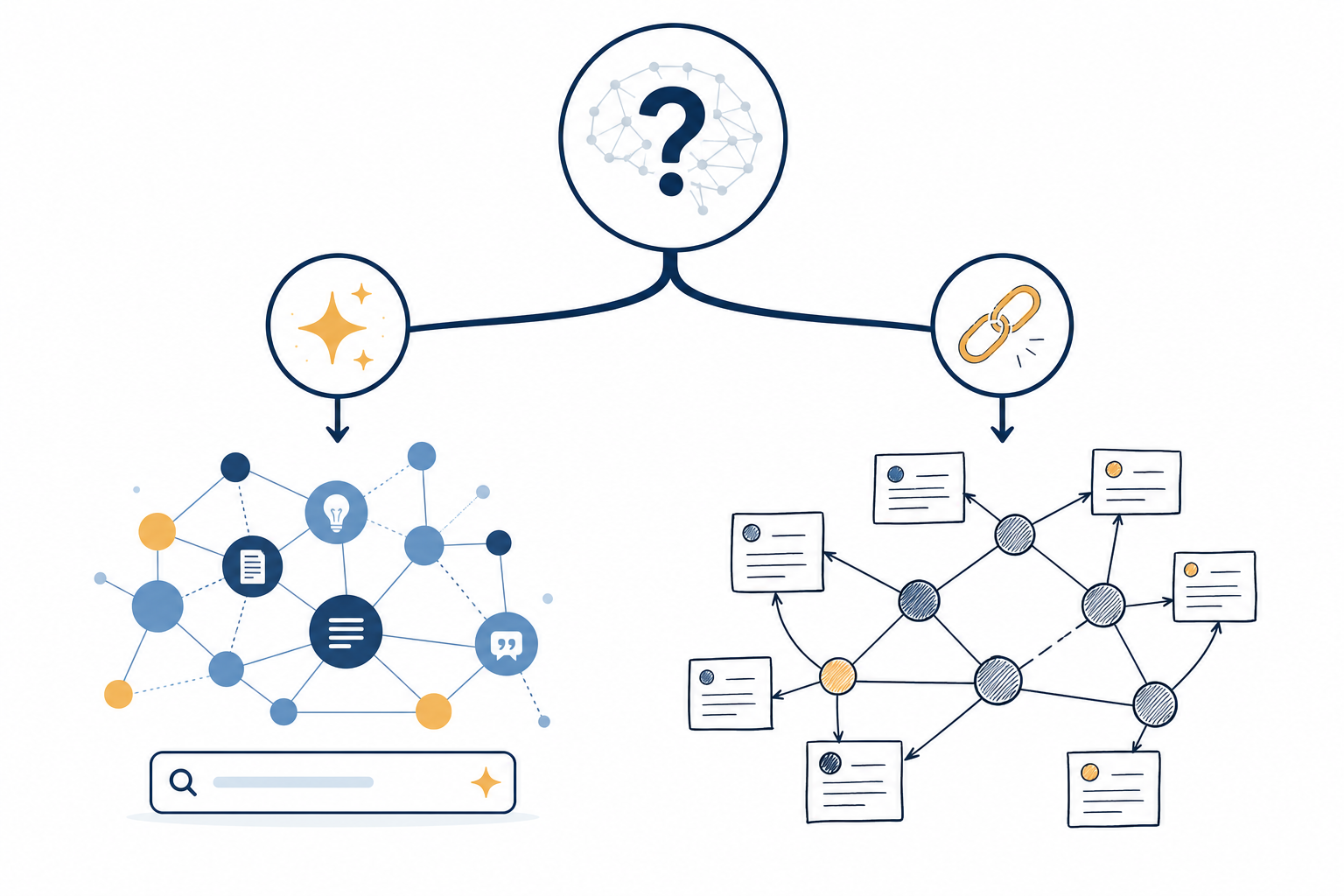
The decision between AI-native and manual PKM is not about which is "better" — it is about which aligns with your primary knowledge work output. The following framework is designed to help you evaluate your own patterns and choose accordingly.
| Your Primary Output | Recommended Approach | Why | Tool Examples |
|---|---|---|---|
| Synthesis and production (research reports, content creation, analysis, consulting deliverables) | AI-native PKM with semantic retrieval | Speed of surfacing relevant notes compounds faster when your goal is to produce output. AI handles the retrieval; you focus on synthesis. | Atlas, Notion AI, Mem |
| Deep understanding and learning (studying a new field, reflective writing, creative thinking, skill development) | Manual graph-based PKM with intentional linking | The act of manually connecting ideas builds understanding. AI retrieval would short-circuit the learning process. | Obsidian, Logseq, Roam Research |
| Mixed: you do both synthesis and learning in roughly equal measure | Hybrid: manual linking for core concepts + AI retrieval for project-specific research | Use manual linking for the ideas you want to internalize deeply. Use AI retrieval for the research you need to synthesize quickly. | Obsidian + AI plugin, Notion with selective AI use, Tana (supertags + AI) |
| You are new to PKM and haven't built a system yet | Start with AI-native; add manual structure later | The low setup cost of AI-native tools removes the biggest barrier to entry. You can add manual linking practices once you have enough notes to make linking meaningful. | Mem, Notion AI, Reflect |
For users whose primary job is synthesis — researchers producing literature reviews, analysts writing reports, content creators publishing regularly — AI-native tools offer a clear advantage. The faster you can surface relevant notes and see connections across your corpus, the faster you can produce output. The purpose-built AI productivity tools that have emerged in 2026 are designed specifically for this use case, and they integrate naturally with AI-native PKM workflows.
For users whose primary goal is understanding — students learning a new discipline, professionals building expertise in a new domain, writers developing a personal philosophy — the manual approach retains its advantage. The cognitive effort of linking is not a cost to be minimized; it is the mechanism through which understanding develops. An AI tool that surfaces related notes automatically may feel like a time-saver, but it may also prevent you from doing the mental work that leads to genuine comprehension.
The Hybrid Future: Combining AI Retrieval with Manual Linking for Depth
The most likely future for personal knowledge management is not a winner-take-all battle between AI-native and manual approaches, but a hybrid model that combines the strengths of both. Early signals from the tool landscape support this: Tana's supertags let users define their own ontology while AI handles retrieval. Obsidian's plugin ecosystem includes AI-powered search and auto-linking plugins that add semantic capabilities to a fundamentally manual system. Notion AI adds AI retrieval to a database-driven structure that still benefits from manual organization.
The hybrid model works because AI and manual linking address different parts of the knowledge management problem. AI excels at breadth — surfacing relevant notes across a large corpus, identifying patterns you might miss, and answering specific questions quickly. Manual linking excels at depth — forcing you to articulate connections, building a personalized knowledge graph that reflects your unique thinking, and creating the cognitive engagement that leads to understanding.
- Use AI retrieval for project-specific research and daily capture. Let the AI surface relevant notes when you are writing a report or preparing for a meeting. This is where speed matters most.
- Use manual linking for concepts you want to internalize. When you encounter an idea that changes how you think about your field, take the time to link it manually to related notes. The act of linking is the act of learning.
- Use AI-generated summaries and connections as discovery tools, not replacements for thinking. When an AI tool surfaces a connection you hadn't made, investigate it manually. Ask yourself why the connection exists and whether it reveals something about your thinking.
- Maintain data portability as a hedge. Even if you adopt an AI-native tool, ensure you can export your notes in a standard format (Markdown, plain text) so you are not locked in if your priorities change.
The broader AI productivity landscape is evolving rapidly alongside PKM tools. For knowledge workers building a comprehensive productivity stack, the category-by-category comparison of AI productivity apps provides a useful map of how AI is reshaping everything from meeting notes to project management. The PKM layer is just one part of that ecosystem, but it may be the most personal one — because it is the system that holds your thinking, not just your tasks.
The question is no longer whether AI will change personal knowledge management. It already has. The question is how much of the manual process you are willing to give up in exchange for speed, and whether the cognitive benefit of doing it yourself is worth the time it costs. For most knowledge workers, the answer will not be all or nothing — it will be a deliberate, evolving balance between the two.
Comments
Join the discussion with an anonymous comment.