
Most tool-hopping in personal knowledge management starts one layer too late. You install the personal knowledge management app, import your highlights, create a few folders or backlinks, then discover that the app is not really the problem. The problem is that you accidentally adopted a thinking contract you never agreed to.
PARA, Zettelkasten, CODE, and Johnny Decimal all work for somebody. That is the unhelpful part. The useful question is what each one asks your brain to keep doing when the novelty is gone: chase current action, connect ideas, process source material, or maintain stable locations.
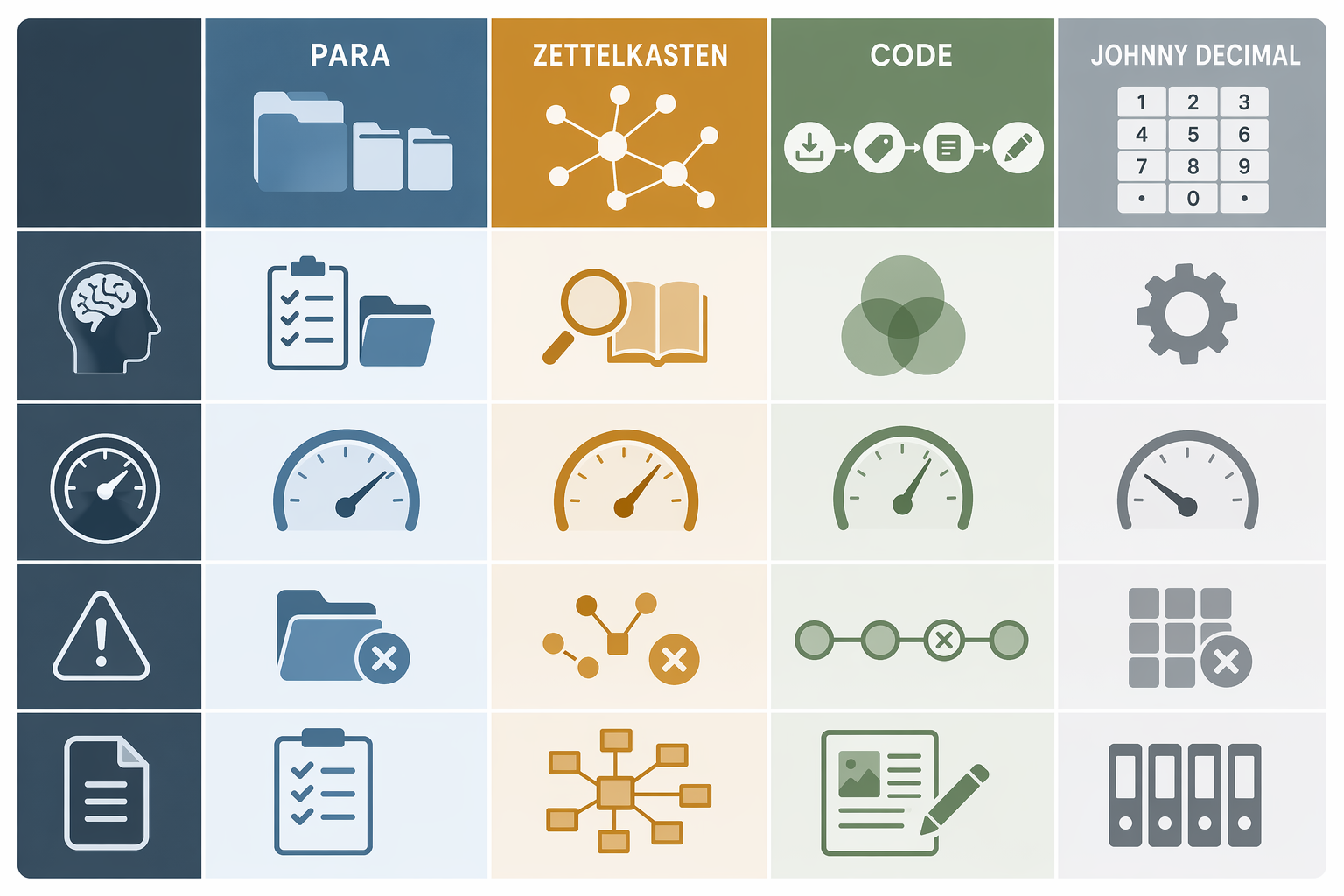
| Framework | Primary cognitive value | Best fit | Cognitive cost | Likely failure mode | App support you should look for |
|---|---|---|---|---|---|
| PARA | Actionability: sort information by whether it belongs to a project, area, resource, or archive | People who think in deadlines, responsibilities, and active workstreams | Regularly deciding where an item belongs as its usefulness changes | Everything keeps moving, so the system can feel restless when you want stable mental landmarks | Fast moving folders, databases, project spaces, archive views, and low-friction refiling |
| Zettelkasten | Idea connection: turn notes into linked, atomic claims that can generate later arguments | Researchers, writers, analysts, and anyone whose output depends on original synthesis | High per-note effort and delayed payoff before the note network becomes useful | Collecting links without writing clear notes; mistaking a graph for thinking | Backlinks, block or page links, local graph views, aliases, strong search, and durable plain-text or export options |
| CODE | Synthesis and expression: move captured information through organize, distill, and express | High-volume readers, course takers, creators, and operators who need consumed material to become usable output | Keeping a pipeline alive instead of letting capture become hoarding | Producing beautifully prepared resources that never become independent ideas | Web clipping, read-it-later intake, highlighting, progressive summarization, project-linked notes, and export into drafts |
| Johnny Decimal | Stable structure: give every category a durable numeric address | Systematic thinkers who want findability, file hygiene, and long-lived locations | Upfront taxonomy design and the discipline to keep categories bounded | A structure that becomes too rigid when work changes faster than the numbering | Nested folders, predictable numbering, file-system compatibility, saved searches, and visible paths |
That table is the decision in miniature. If your work is mostly “what needs my attention next,” PARA has a natural advantage. If your work is “what argument is trying to emerge from these fragments,” Zettelkasten is the stronger bet. If the bottleneck is “I consume a lot and use too little,” CODE may be the missing layer. If the pain is “I can never find the same thing twice,” Johnny Decimal deserves more respect than the fashionable graph view.
If you still need the broader basics of what qualifies as a PKM tool at all, start with the five core capabilities of a personal knowledge management app. Here, the assumption is narrower: you already know you want a PKM system, but you are trying not to choose the wrong operating logic again.
PARA: good when action is the organizing principle
PARA sorts material into Projects, Areas, Resources, and Archive. Its appeal is that it does not ask you to build a philosophy of knowledge before you get back to work. A project has an outcome. An area has ongoing responsibility. A resource may become useful later. An archive is no longer active. That is a blessedly plain set of buckets.
The mechanism is action-first classification. The same article, meeting note, or PDF can change status as your work changes. A market report might start inside a client project, later become a resource for an industry topic, then eventually move to archive. That motion is not a bug in PARA. It is the method doing what it was designed to do.
The cost is also exactly there. PARA asks you to keep judging material by its current usefulness. For someone juggling deadlines, that can be clarifying. For someone who wants a stable intellectual map, it can feel like living in a hotel room where every object is technically “organized” but nothing feels like home.
The strongest critique of PARA from the Zettelkasten side is not that PARA is sloppy. It is that PARA mostly manages resources around work, while a Zettelkasten tries to transform claims into a thinking system. Zettelkasten.de makes this distinction with a useful metaphor: PARA is closer to forestry and a lumberyard, while Zettelkasten is carpentry.[1]
That metaphor saves PARA from both overpraise and unfair dismissal. A lumberyard is not a failed chair. It is just not the chair. If you need a personal knowledge management app mainly to keep client work, research packets, goals, reference material, and someday-maybe files moving through your week, PARA is often the most forgiving starting structure.
Zettelkasten: high ceiling, high note-making cost
Zettelkasten is the method people reach for when folders start to feel dead. Instead of asking “where should this go,” it asks “what does this idea connect to?” The working unit is not a topic bucket but an atomic note: one idea, written clearly enough that future-you can link it, challenge it, reuse it, or combine it with another note.
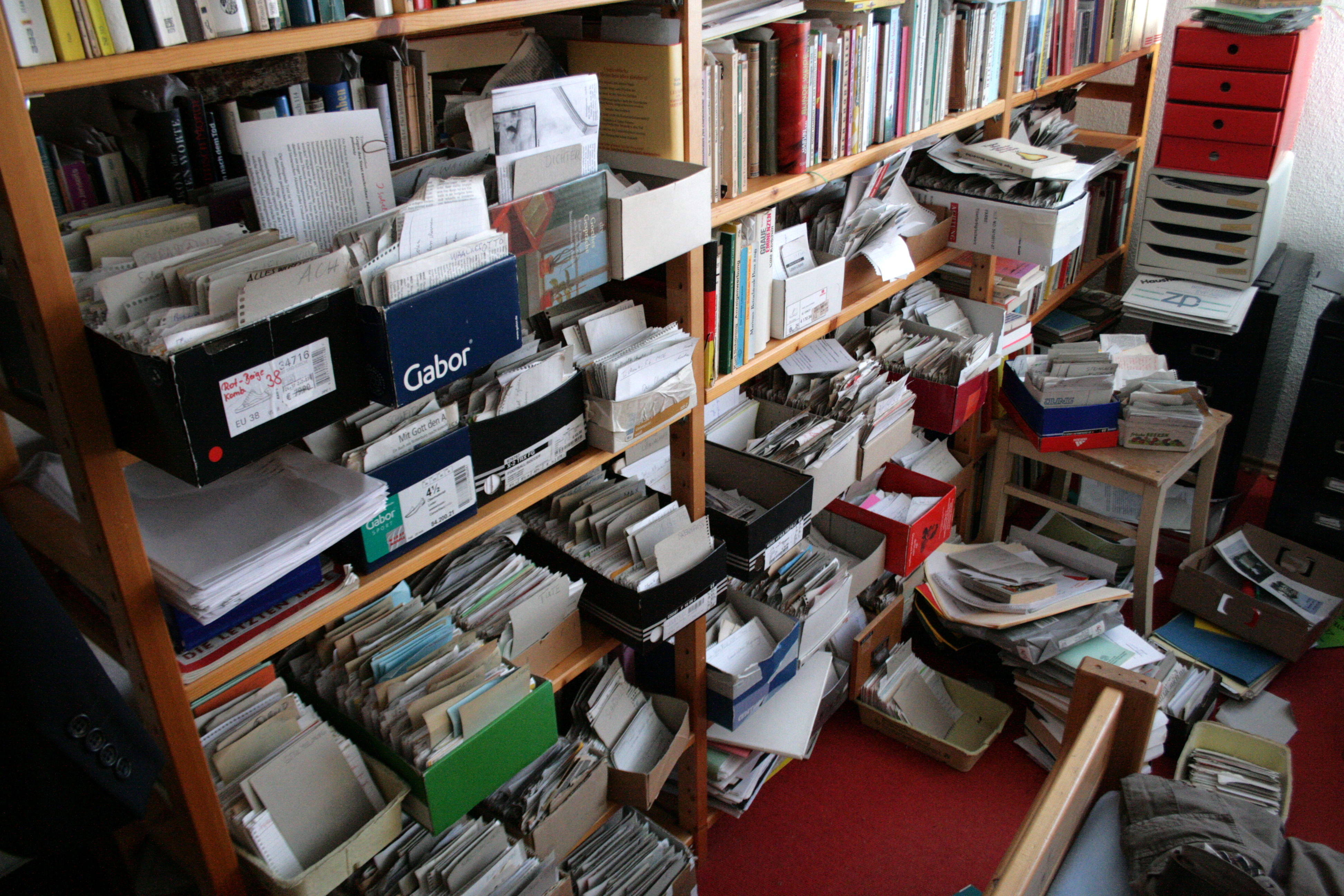
The reason Zettelkasten keeps surviving hype cycles is Niklas Luhmann’s output. The commonly cited baseline is more than 70 books and more than 400 articles from a collection of roughly 90,000 handwritten notes built over about 30 years.[2] Those numbers should impress anyone who produces intellectual work for a living. They should not become a moral obligation for everyone with a notes app.
Zettelkasten is slow because the useful work happens inside the note. A clipped paragraph is not yet a Zettel. A quote with a backlink is not yet a thought. The method starts paying off when notes are rewritten as claims, linked to neighboring claims, and allowed to disturb each other over time. Before that, a graph can become a very pretty map of procrastination.
This is why Zettelkasten fits people whose output depends on arguments rather than task completion alone. Academic writing, essays, research strategy, product thinking, long-form analysis, policy work, and serious creative nonfiction all benefit from a system that keeps unfinished ideas alive. The cost is that every note asks for interpretation. If you are exhausted and simply need to file the quarterly report, Zettelkasten will feel like a tax.
Matt Giaro’s comparison of PARA and Zettelkasten makes a similar practical distinction: PARA is easier to start because it follows action and context, while Zettelkasten is built for deeper idea development rather than immediate project sorting.[3] That is not a ranking. It is a warning label.
CODE: useful when capture needs to become expression
CODE stands for Capture, Organize, Distill, and Express. It is part of Tiago Forte’s Building a Second Brain approach and is usually paired with PARA. If PARA tells you where material lives by actionability, CODE tells you what should happen to material after it enters the system.[4]
The underrated strength of CODE is that it admits a common failure: most people collect far more than they use. Capture alone is cheap. Distillation is where the labor starts. Progressive summarization adds layers of emphasis so that a source becomes easier to reuse later, instead of remaining a full article, transcript, or book note that you vaguely remember saving.
CODE is especially good for people whose work begins with outside material: consultants reading client documents, creators processing podcasts and articles, managers taking notes from calls, students working through course material, or operators turning lessons into processes. It gives that incoming material a route toward output.
The limitation is that a well-distilled source is still often a source. Zettelkasten.de’s critique is useful here: Building a Second Brain can prepare resources outside the Zettelkasten, but that does not automatically create an independent network of ideas.[1] Highlighted passages, bolded summaries, and extracted takeaways can help you write faster. They do not by themselves force you to develop your own claims.
That makes CODE less of a rival to Zettelkasten than people sometimes pretend. CODE can feed the lumberyard. Zettelkasten can turn selected lumber into joints, frames, and finished pieces. If your main pain is an overflowing read-it-later queue, start with CODE. If your main pain is that your own arguments never get sharper, CODE may need a Zettelkasten-like layer behind it.
Johnny Decimal: the appeal of a permanent address
Johnny Decimal is the least glamorous of the four, which is probably why I trust parts of it. It gives information a numeric taxonomy: broad areas, bounded categories, and fixed addresses. Instead of relying on memory, search, or vibes, you build a map where a thing belongs at a known location.
Sébastien Dubois describes the appeal as structure and predictability: Johnny Decimal helps create constrained areas and categories that can be reused across folders, files, and notes.[5] Crystal Lee’s account is more revealing because it comes after disappointment. After trying PARA, she found the constant movement between folders cognitively draining and returned to Johnny Decimal because its fixed taxonomy gave her steadier places to put things.[6]
This is the part many app comparisons miss. Some people do not want more fluidity. They want less of it. They want to know that “research methods,” “tax records,” “product screenshots,” or “household documents” have durable addresses that will not be renamed every time a project changes shape.
The trade-off is setup cost. Johnny Decimal asks for taxonomy design before it can feel effortless. If your work is still changing every month, the numbering can become a monument to last quarter’s assumptions. Its public evidence base is also thinner than PARA or Zettelkasten; the best material tends to come from detailed practitioner writeups rather than broad comparative research.
Still, for findability, file hygiene, and long-term storage, Johnny Decimal solves a real problem. A personal knowledge management app with dazzling backlinks but no stable address system can become a junk drawer with constellations painted on the front.
The hidden question: what kind of output are you actually trying to produce?
A framework mismatch often looks like an app failure. The app feels too loose, too rigid, too busy, too blank, too folder-based, too graph-based. Sometimes that is true. More often, the tool is faithfully exposing a method you dislike using.
| If your dominant output is… | Start with… | Because the system’s default pressure is… |
|---|---|---|
| Finished projects, deliverables, campaigns, client work, operational goals | PARA | Move material toward current action |
| Essays, research arguments, theories, strategy memos, original analysis | Zettelkasten | Rewrite and connect ideas until they can surprise you |
| Articles, videos, courses, reports, briefs, reusable summaries | CODE | Turn consumed information into expressed material |
| Reference libraries, files, policies, household or business archives, long-term documentation | Johnny Decimal | Keep categories and locations stable enough to find again |
Notice that the decision is not about personality in the shallow sense. “Visual thinker” or “organized person” will not get you far. The better test is what must leave the system. A deadline? A draft? A decision? A body of linked arguments? A reliable archive? Your framework should bias the system toward that output before it rewards any aesthetic preference.
How the framework should affect your app choice
Once the method is clearer, app choice gets less mystical. You are no longer asking which personal knowledge management app is “best.” You are asking which app will make your chosen behavior cheap and your failure mode visible.
If you choose PARA
Look for fast restructuring. PARA works best when projects can be created, completed, archived, and rearranged without ceremony. Databases, project dashboards, folder trees, status fields, and saved views are more important than elaborate graph features. The app should make it easy to separate active work from reference material, then move items when their role changes.
A PARA-friendly app should also tolerate mixed material: tasks, notes, documents, links, meeting notes, and project plans. If the app treats every object as a philosophical note, PARA will feel heavier than it should.
If you choose Zettelkasten
Prioritize linking and note durability. Backlinks matter, but not as decoration. You need fast creation of atomic notes, easy links between notes, aliases or references, strong search, and enough export safety that you are not afraid to build a long-term thinking archive. Local-first storage or plain-text compatibility may matter if you expect the system to outlive your current subscription preferences.
Be suspicious of any app that sells the graph as the method. Zettelkasten lives in the quality of the note and the usefulness of the link. A graph view can help you inspect the network, but it cannot do the interpretation for you.
If you choose CODE
The capture and distillation path matters most. A CODE-friendly app should handle web clips, highlights, read-it-later imports, notes from books or videos, and progressive summarization without turning every source into a formatting chore. The route from source to draft should be obvious.
Also check whether the app can connect distilled material to projects. CODE collapses if “Express” is just an inspiring verb. The system should show where a summary will be used: a report, article, proposal, lesson plan, presentation, or decision.
If you choose Johnny Decimal
Do not choose an app that hides paths from you. Johnny Decimal benefits from visible structure: folders, nested pages, numbered categories, saved searches, and predictable file names. It should work with your operating system rather than trapping the taxonomy inside a private interface.
The app does not need to be exciting. It needs to let a numbered structure remain boringly reliable. That is the point.
For app-level trade-offs, use the detailed Obsidian vs Notion vs Logseq vs Tana vs Capacities comparison or the broader best PKM apps in 2026 guide after you have chosen the method you want the tool to support.
Durable systems usually become hybrids, but not on day one
The trap is treating a framework like a permanent identity. “I am a Zettelkasten person now.” “I use PARA.” “I’m switching everything to Johnny Decimal.” This is how resets get expensive. A method should earn territory inside your system, not annex your whole working life.
The forestry-versus-carpentry distinction is the cleanest way through the false fight. PARA and CODE are strong around resources, workflow, and movement toward output. Zettelkasten is strong where ideas need to be shaped into reusable arguments. Johnny Decimal can sit underneath either as an address system for folders, files, and stable categories.
Real systems often fail before they get that far because users expect one framework to handle every kind of material. One XDA Developers writer described abandoning PARA, Zettelkasten, CODE, and LATCH within six months; the recurring problem was not that each method was useless, but that multi-format work kept straining any single system’s assumptions.[7]
That account is anecdotal, but it is recognizable. So is Zain Rizvi’s conclusion after comparing PARA and Zettelkasten over two years: the binary itself was false, and the better rule was to adapt the system to yourself rather than adapt yourself to the system.[8]
Dubois’s published Obsidian setup gives a concrete implementation of that idea, combining Zettelkasten, PARA, and Johnny Decimal in one vault.[5] PageStash reaches a similar practical consensus: many effective knowledge workers end up with a hybrid such as PARA folders for projects, a Zettelkasten area for permanent notes, and tags for quick classification.[9]
The order matters. Hybridizing after lived use is different from starting with a grand unified theory. Start with the framework that matches your dominant output for the next several months. Then add the missing layer only when the friction is specific enough to name.
A practical choice for the next several months
If you are choosing today, choose by output rather than aspiration.
- Choose PARA if your notes mostly support active responsibilities and deliverables.
- Choose Zettelkasten if your notes need to become arguments, theories, or long-term intellectual work.
- Choose CODE if your main leak is between consuming information and expressing something useful.
- Choose Johnny Decimal if your pain is findability, stable structure, and long-term file organization.
Then choose a personal knowledge management app that makes that behavior easy. Not the app with the most impressive demo vault. Not the app that flatters the person you wish you were. The one that reduces the cost of the work you will actually repeat.
If you need a beginner-level methodology decision tree, use How to Choose Your First PKM Framework. If you are ready to implement, move to the 30-day starter workflow and keep the common PKM mistakes guide nearby before you decide the cure for friction is another full reset.
References
- Building a Second Brain and Zettelkasten, Zettelkasten.de
- Note-Taking Systems Compared, Atlas Workspace
- PARA Method and Zettelkasten, Matt Giaro
- BASB Overview, Forte Labs
- Johnny Decimal, Sébastien Dubois
- Two Approaches to PKM, Crystal J. Lee
- PARA, Zettelkasten, and other systems I abandoned within six months, XDA Developers
- PARA vs Zettelkasten: The False Binary, Zain Rizvi
- PKM Systems Compared 2026, PageStash