

Grok 4.6 and GPT-5.6 Sol both sit at 61 on the Artificial Analysis Intelligence Index in xAI’s launch table, which is a tidy way to make the comparison look settled before the work has started.[1] For AI note-taking, that tie is mostly a distraction. A note pipeline does not fail because a model is one point lower on a general index. It fails when the answer to “what did we decide?” misses the actual decision, when a transcript summary cannot be turned into a client update without rewriting, or when a normal batch of long meetings crosses a billing threshold nobody budgeted for.
FlowDesk tested Grok 4.6 vs GPT-5.6 Sol for AI note taking on August 25, 2026, using the same four-part battery for both models: a roughly 60-minute meeting transcript summary with decisions and action items, a large-library retrieval query over a multi-month note corpus, a notes-to-deliverable transformation, and a cost-per-processed-note calculation. The result was not a clean champion. Single-transcript summarization was close enough that most teams would not feel a daily difference. GPT-5.6 Sol pulled ahead when the note job involved a large archive or a polished downstream deliverable. Grok 4.6 was the cheaper default for ordinary transcript processing, and its first-token speed matters if people are waiting on the output instead of running it overnight.
All pricing and feature claims in this article were last verified on August 25, 2026. That date matters. Sol pricing had recently moved, and Grok’s long-context economics change sharply once a request crosses the 200K-token line.[3][4] If you are wiring either model into a Notion, Obsidian, Apple Notes, Evernote, or internal knowledge-base workflow, rerun the math against the exact API tier and prompt shape you plan to use.
The test battery
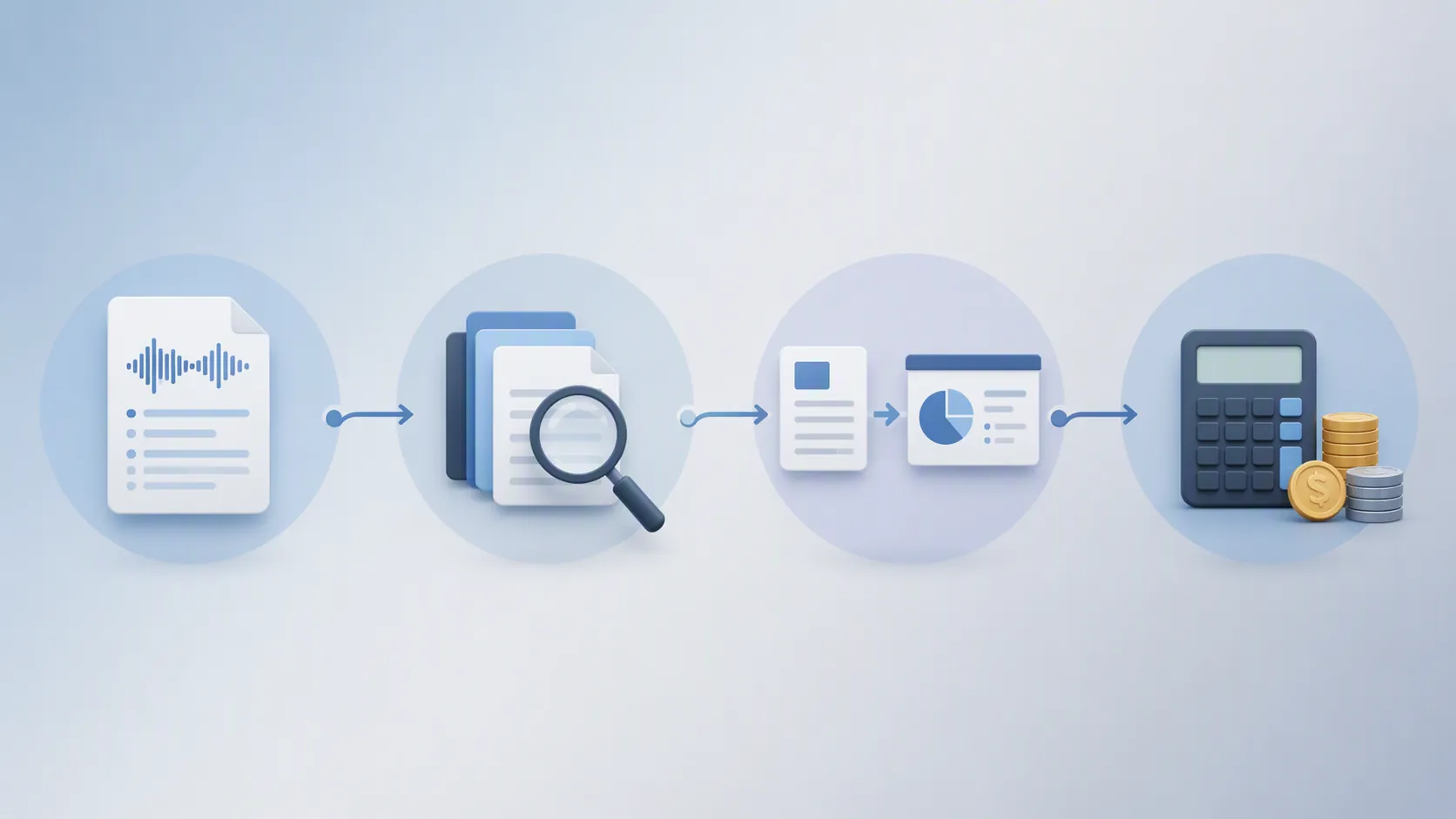
| Note job | What FlowDesk tested | Result |
|---|---|---|
| Transcript summarization | A roughly 60-minute meeting transcript into decisions, action items, risks, and owner-ready follow-ups | Near tie. Both produced usable summaries; differences were mostly editorial. |
| Large-library retrieval | A factual query requiring the model to locate a decision buried in a multi-month note library | GPT-5.6 Sol edge. It was better at carrying enough context to find and use the relevant note. |
| Notes-to-deliverable | Raw notes converted into a structured doc/deck-style output | GPT-5.6 Sol edge. Its output needed less downstream rewriting. |
| Cost per processed note | Routine note-processing economics using published task-level and headline-rate comparisons | Grok 4.6 edge. It is the cheaper default when the job is mostly routine summarization. |
The battery deliberately starts after capture. ChatGPT Record, Grok voice dictation, meeting bots, and recorder apps decide how audio becomes transcript. This comparison is about what happens after that: summarizing, retrieving, restructuring, and paying for processed notes. If the capture layer is still unresolved, compare the ChatGPT voice-mode routes for note-taking and the Grok voice dictation test before treating either flagship model as your note system.
Transcript summaries were close enough to make price matter
On the single-meeting transcript, both models cleared the practical bar: they identified the main topics, extracted decisions, grouped action items, and produced a summary that could be dropped into a workspace with light editing. GPT-5.6 Sol was somewhat better at turning messy discussion into a cleaner hierarchy. Grok 4.6 was more than good enough for the ordinary “send me the recap” job.
That is where a lot of note-model comparisons become overdramatic. If your team’s real workflow is 80 percent recurring standups, sales calls, customer interviews, or project check-ins, a slightly nicer paragraph is not automatically worth a higher per-note bill. The question becomes whether the cheaper model preserves the decision trail and assigns follow-ups accurately enough. In this run, Grok 4.6 did.
Independent task-level cost measurements point in the same direction. DataCamp’s write-up of Artificial Analysis measurements lists Grok 4.6 at about $0.84 per AA index task versus GPT-5.6 Sol at about $1.23.[2] That is not a direct note-taking score, and it should not be misread as proof that Grok is better at summaries. It does show why a team processing ordinary meeting notes at scale should not pay the Sol premium unless the extra capability appears in the part of the workflow that actually hurts.
The retrieval test exposed the real split

The large-library retrieval test was the first place the benchmark tie stopped being merely incomplete and started being misleading. We asked for a decision that was not in the most recent note and could not be answered well from a generic project summary. The model had to reach back into a multi-month library, identify the relevant prior discussion, and return the answer in a way a teammate could trust.
GPT-5.6 Sol handled that job better in this run. The important difference was not that it sounded more polished. It carried more of the library into the working request and was less likely to answer from nearby context while missing the buried decision. OpenAI publishes GPT-5.6 Sol with a 1.05M-token context window and reports MRCR v2 8-needle results of 91.5% at 256K–512K and 73.8% at 512K–1M.[3] Those are not note-taking results, but they line up with the failure mode we care about: whether a model can still retrieve the right fact when the note archive is large.
Grok 4.6’s context window is reported at 500K tokens, unchanged from Grok 4.5 in Kingy AI’s pricing and benchmark coverage.[4] That is still large by ordinary meeting-note standards. It is not the same job shape as a 1M-token library pass. If your archive is split into well-indexed chunks and your retrieval layer reliably sends only the right material, Grok’s smaller context may not matter. If the workflow often involves dumping a broad project history into the model and asking it to reconstruct what happened, Sol’s extra reach becomes operationally useful.
This is also where “AI note-taking” needs to be separated from “meeting summary.” A model can summarize the meeting in front of it and still be bad at answering a question six months later. Retrieval is where the person inheriting the note pile finds out whether the system preserved institutional memory or just produced neat recap pages.
Sol produced the cleaner deliverable; Grok produced the cheaper processed note

The notes-to-deliverable task favored GPT-5.6 Sol. We gave both models raw meeting notes and asked for a structured output closer to a working document or deck outline than a recap. Sol did more of the synthesis work before handing the file back: fewer loose bullets, clearer sectioning, and less manual repair before a human could use the output outside the note app.
That result is consistent with, but not proved by, the vendor-reported knowledge-work framing around GPT-5.6 Sol. OpenAI reports Sol at 53.6 on Agents’ Last Exam and 92.2% on BrowseComp ultra, and describes ChatGPT Work as pulling from sources such as Slack, Notion, Microsoft 365, and Google Drive.[3] Those figures are useful context for why Sol may feel stronger when notes are being turned into a work product. They are not a substitute for testing your own meeting transcripts, source documents, and output format.
xAI also reports knowledge-work benchmark wins for Grok 4.6, including GDPval-AA v2 at 1753 versus 1728, AA-Briefcase at 1577 versus 1502, and Harvey LAB at 15.8% versus 2.5% in its launch materials.[1] Those are vendor-reported results, and xAI notes that competitor figures are the best of self-reported or publicly available numbers.[1] They should keep anyone from dismissing Grok as a weak work model. They still do not erase what happened in this note-pipeline run: when the output had to become a deliverable, Sol required less cleanup.
The cost side pushes back hard. Memeburn’s headline-rate worked example puts Grok 4.6 at $8 versus GPT-5.6 Sol at $35 for 1M input tokens plus 1M output tokens.[5] Kingy AI’s worked example for 1M input tokens plus 250K output tokens puts Grok around $3.50 versus Sol around $12.50.[6] Those examples are simplified, and your cache use, output length, routing, retries, and context size can change the bill. They are still enough to make one point uncomfortable: if the downstream deliverable is not actually used, Sol’s cleaner prose becomes an expensive decoration.
The 200K-token billing cliff changes how safe Grok feels
Grok 4.6’s price advantage is strongest when requests stay in the ordinary zone. Kingy AI reports a 200K-token billing cliff where the whole Grok 4.6 request moves from $2 input, $0.50 cached input, and $6 output per 1M tokens to $4 input, $1 cached input, and $12 output per 1M tokens.[4] That matters for note systems because transcript batches do not always grow politely. A quarterly planning call, appended chat log, customer-history export, and prior notes can turn a cheap request into a long-context request without anyone noticing until the invoice arrives.
Artificial Analysis separately notes that Grok 4.6’s cached-input price rose from $0.30 to $0.50 per 1M tokens, with cost per task moving from $0.36 to $0.84.[7] That does not destroy Grok’s routine-summary advantage, but it narrows the margin for teams that rely on heavy cached context. A recurring note pipeline should track token length distribution, not just average meeting length. The expensive notes are usually the ones nobody sampled during setup.
Latency belongs in the same operational bucket. Published latency measurements put Grok 4.6 at about 40.4 seconds to first token at max effort versus about 213.5 seconds for GPT-5.6 Sol. That gap is not cosmetic if people are waiting after a call to send decisions, update the CRM, or paste follow-ups into a project channel. A slower model can still be the right model for an overnight archive reconstruction or board-ready deliverable. It is a worse default for quick recap loops unless the team has deliberately designed around the delay.
Capture features do not settle the model choice
ChatGPT Record is relevant, but it answers a different question. OpenAI’s help center documents Record features including reference to record history for prompts such as “what did we decide in Monday’s roadmap sync,” multi-speaker labels, and a 240-minute cap.[8] That is capture and record-management territory. It does not prove GPT-5.6 Sol is the better processing model for every note pipeline, especially if your transcripts already come from Zoom, Meet, Teams, a dedicated meeting bot, or a recorder app.
There is also a specification-history problem around Record. Earlier third-party coverage did not always match the live OpenAI help page on Plus support, speaker identification, and recording limits. For this article, the live help center is the source for current ChatGPT Record behavior, last checked August 25, 2026. The conflict is a reminder to avoid building a model decision on a capture feature unless you have verified the exact plan, workspace, retention setting, and export path your team will use.
The same caution applies to Grok voice-recording claims. Some adjacent AI-note coverage has mentioned Grok voice routes, but official xAI source support for a complete note-taking capture feature was not strong enough to use as evidence here. Treat voice capture as a separate product test, not as proof that Grok 4.6 or GPT-5.6 Sol should run the processing layer.
What prior Grok-vs-ChatGPT tests can and cannot tell us
There is no published source that directly tests Grok 4.6 against GPT-5.6 Sol for this exact note-taking workflow. The closest public comparison in the research set is tl;dv’s March 2026 Grok-vs-ChatGPT test across 28 tests and 7 categories, which used prior generations. In that run, Grok won research 15-0, ChatGPT won UX 15-3, and neither model hit a 150-word summary target: Grok produced 201 words and ChatGPT produced 172.[9]
That is useful as a warning, not as a verdict. It shows how quickly a model can look strong in one category and awkward in another, and how a simple instruction such as summary length can still drift. It does not tell you how Grok 4.6 and GPT-5.6 Sol behave on August 25, 2026, under a fixed note-pipeline battery. The dated FlowDesk run is doing that narrower job.
Which model to standardize on
Use Grok 4.6 as the economical default if your note pipeline is dominated by ordinary transcript summarization: meeting recap, action items, decisions, owner lists, CRM call notes, and project updates. The single-transcript quality gap was not large enough in this run to justify paying Sol prices for every routine note, and Grok’s faster first-token behavior makes it easier to keep the loop moving when people are waiting.
Pay for GPT-5.6 Sol when the expensive parts of your note workflow happen after the meeting: retrieving a decision from a large library, comparing scattered historical notes, turning raw notes into a polished deliverable, or letting a model work across a broad workspace context. That is where Sol’s larger context and stronger deliverable output showed up in the FlowDesk test.
Do not standardize on either model yet if you have not checked where the notes will live, how recordings are captured, what gets retained, whether exports are portable, and what privacy trade-offs the destination app imposes. Model choice is only one stage of the system. For a routing-style analogue, see the Qwen vs DeepSeek note-taking comparison. For a concrete precedent on wiring a model into Obsidian and tracking per-100-notes cost and latency, see the Qwen 3.8 Max Obsidian setup. For the destination-app layer, use the 2026 note-taking software comparison. And if the real goal is learning or retention rather than searchable operational memory, revisit the evidence in using ChatGPT for note-taking before replacing human notes with AI recaps.
The practical answer is conditional: Grok 4.6 for routine summaries at lower cost; GPT-5.6 Sol for large-library retrieval and deliverable-grade transformation when those jobs are frequent enough to pay for.
References
- Grok 4.6, xAI, August 12, 2026
- Grok 4.6, DataCamp
- GPT-5.6, OpenAI
- Grok 4.6 Price, Benchmarks, API, Cursor & Context Window, Kingy AI
- Grok 4.6 vs GPT-5.6 Sol 2026: Which AI Model Wins?, Memeburn
- Grok 4.6 vs GPT-5.6 Sol vs Claude Fable 5, Kingy AI
- Grok 4.6 Benchmarks and Analysis, Artificial Analysis
- ChatGPT Record, OpenAI Help Center
- Grok vs ChatGPT, tl;dv, March 2026