
Blue Prism in 2026: The State of Play After the SS&C Acquisition
When SS&C Technologies closed its $1.6 billion acquisition of Blue Prism in March 2022, the RPA market was still riding a wave of double-digit growth. Four years later, the landscape has shifted. The global RPA market, valued at $4.13 billion in 2023, is projected to reach $23.06 billion by 2032 — a compound annual growth rate of roughly 24% according to Fortune Business Insights. But the center of gravity has moved from pure-play RPA toward AI-native automation, and Blue Prism's position within that expanding market has become more specialized.
As of 2026, SS&C Blue Prism reports 3,571 production agents running across customer environments, 3,477 automated processes in production, and over 500,000 transactions processed by 35 AI agents. These numbers show a platform that is still actively deployed — but the growth trajectory tells a more complicated story. UiPath, by contrast, went public in 2021 with a ~$29 billion valuation and has maintained a dominant market share estimated at 30-35% of the RPA market, while Blue Prism's share sits in the 8-12% range according to industry estimates.
The acquisition by SS&C brought financial stability and access to a massive installed base of financial services customers, but it also slowed product velocity. Practitioners on Reddit and other forums have expressed concern that Blue Prism has stopped innovating and that the platform has been caught by Power Automate Desktop in terms of accessibility and developer experience. For enterprise leaders evaluating whether Blue Prism still makes sense for their organization, the answer depends heavily on two variables: your regulatory environment and your automation profile.
Where Blue Prism Still Wins: Governance for Regulated Industries
Blue Prism was named a Gartner Magic Quadrant Leader for the 7th consecutive year in 2025, and its G2 rating sits at 4.5 out of 5 stars based on 402 reviews. Those scores reflect a platform that remains best-in-class for one specific use case: unattended, governed, back-office automation in heavily regulated industries.
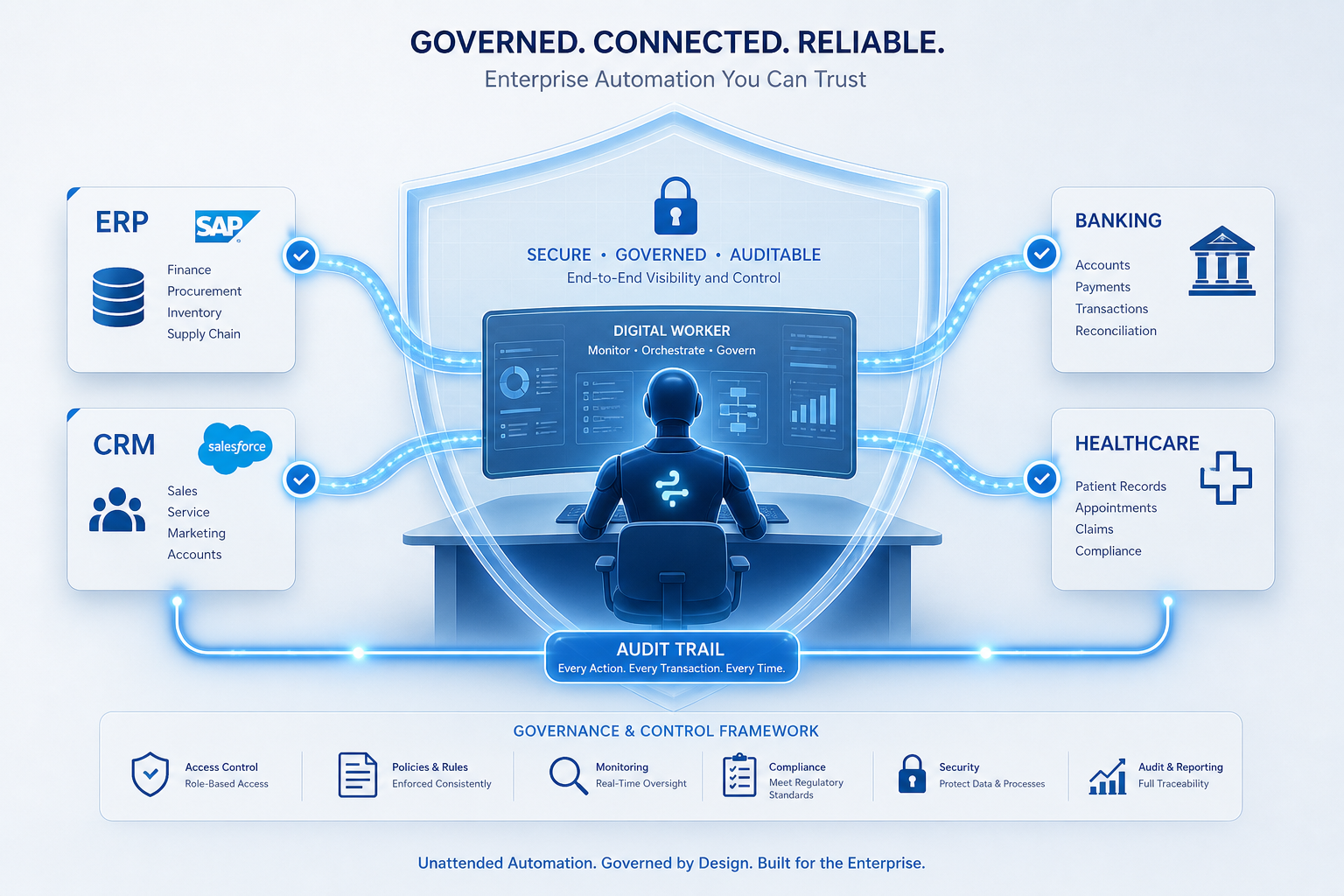
The platform's architecture was built from the ground up for auditability. Every action a digital worker performs is logged to an immutable audit trail. Role-based access controls, separation of duties, and version-controlled process deployment are baked into the product, not bolted on later. For a bank processing mortgage applications, an insurer reconciling claims payments, or a healthcare provider moving patient data between legacy systems, these governance features are not nice-to-haves — they are regulatory requirements.
For organizations where an auditor will eventually ask "who ran this process, when, and with what data?", Blue Prism's answer is more complete than any competitor's. UiPath and Automation Anywhere have closed the governance gap significantly in recent years, but Blue Prism's audit infrastructure remains the gold standard for unattended automation at scale.
Where the Gap Is Widening: AI, Attended Automation, and Developer Experience
The weaknesses that analysts and practitioners cite most frequently fall into three categories, and each has become more pronounced since the SS&C acquisition.
AI and Agentic Automation
Analyst commentary consistently places UiPath 12-18 months ahead of Blue Prism on AI-native breadth. UiPath's integration of large language models, document understanding, and AI Center into a unified automation platform has created a clear gap. Blue Prism has responded with its AI Gateway and WorkHQ offerings, but these arrived later and have not yet achieved the same ecosystem depth. For organizations that want to combine traditional RPA with AI-powered document processing, decision-making, or natural language interfaces, Blue Prism's capabilities are catching up — but they are not yet on par.
Attended Automation
Blue Prism was designed for unattended automation — digital workers running in the background without human intervention. Its attended automation capabilities exist but are less mature than UiPath's or Automation Anywhere's. If your automation strategy includes human-in-the-loop scenarios, desktop automation triggered by user actions, or front-office processes where a bot assists a customer service representative in real time, Blue Prism is not the strongest option in the market.
Developer Experience and Ecosystem
Blue Prism's learning curve is steeper than its competitors'. The platform uses its own proprietary object-modeling paradigm rather than visual flowchart-based design, which means new developers face a longer ramp-up time. Certification is paid-only, creating an additional barrier for teams that want to build internal capability without a large training budget. The community ecosystem is smaller — 402 G2 reviews versus UiPath's 7,250 — which translates to fewer third-party connectors, fewer community templates, and fewer answers on forums when something breaks.
For a deeper explanation of how traditional RPA differs from the emerging AI-driven automation paradigm, see our guide on AI Process Automation vs. Traditional RPA.
The Total Cost of Ownership Reality Check
The central question for any enterprise evaluating Blue Prism in 2026 is not "can it automate our processes?" — it can. The question is whether the total cost of ownership makes sense compared to alternatives that offer broader capabilities at lower or comparable price points.
Blue Prism's digital worker licensing is estimated at $13,000 to $20,000 per digital worker per year, based on third-party estimates from Kanerika, O-mega, and the UK G-Cloud catalog. This puts Blue Prism at the higher end of the RPA pricing spectrum. But licensing is only the visible tip of the cost iceberg.
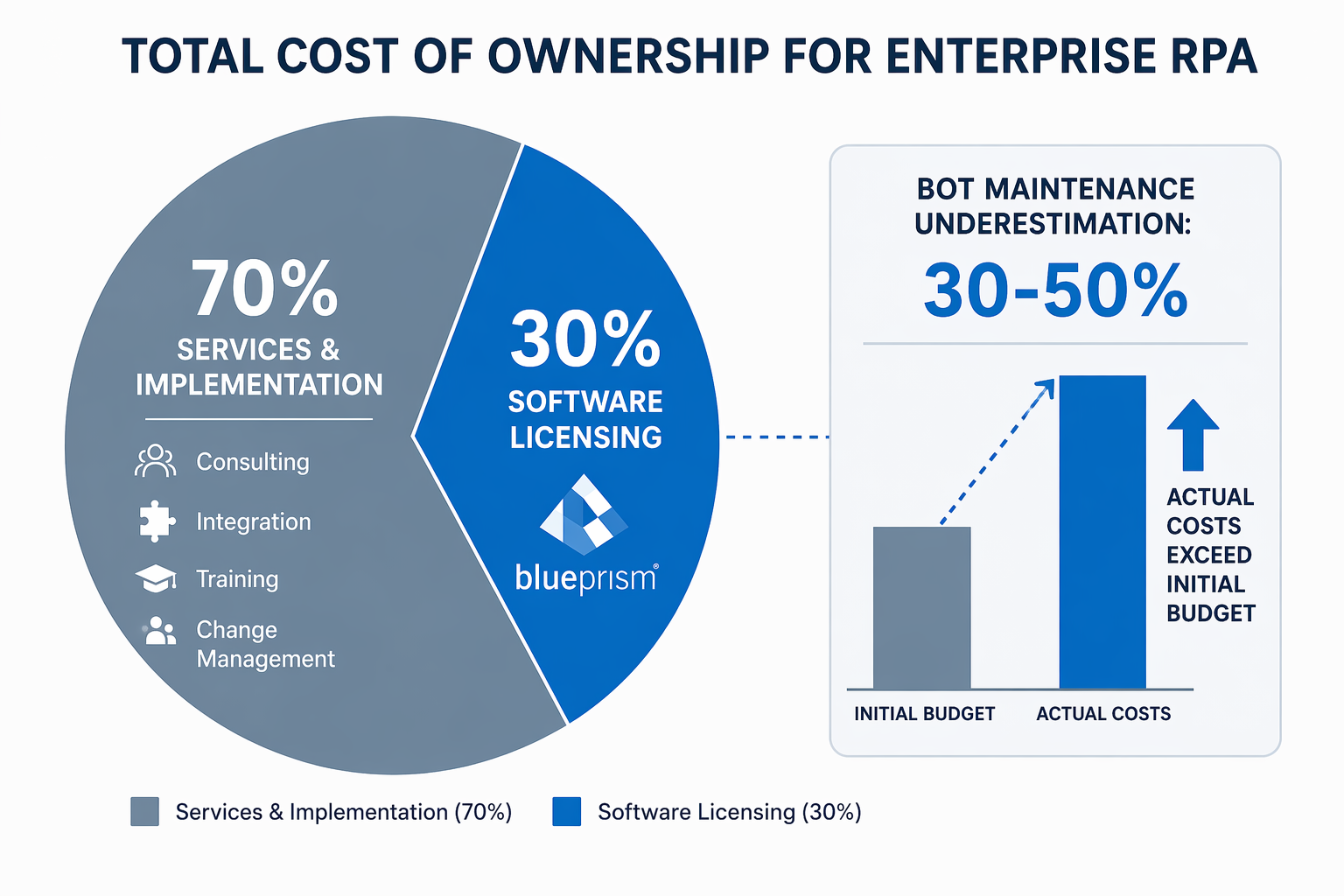
Implementation and integration services account for roughly 70% of total RPA spend, while software licensing accounts for only 30%. This ratio, cited by O-mega's analysis, means that a $15,000 annual license for a single digital worker typically comes with $35,000 or more in implementation costs in the first year. The second hidden cost is maintenance: bot maintenance costs are frequently underestimated by 30-50% in initial business cases, a finding attributed to Deloitte and EY.
To make this concrete, here is a 3-year TCO projection for a 50-digital-worker deployment:
| Cost Category | Year 1 | Year 2 | Year 3 | 3-Year Total |
|---|---|---|---|---|
| Software Licensing (50 bots × $15K avg) | $750,000 | $750,000 | $750,000 | $2,250,000 |
| Implementation & Integration (~70% of Year 1) | $1,750,000 | $350,000 | $350,000 | $2,450,000 |
| Bot Maintenance (30-50% under-budgeted) | $225,000 | $375,000 | $375,000 | $975,000 |
| Training & Certification | $150,000 | $75,000 | $75,000 | $300,000 |
| Total Estimated TCO | $2,875,000 | $1,550,000 | $1,550,000 | $5,975,000 |
For a detailed breakdown of Blue Prism's licensing tiers, hidden fees, and negotiation strategies, see our companion article: Blue Prism Pricing 2026: Complete Cost Analysis, Hidden Expenses, and Total Cost of Ownership.
What Real Deployments Achieve: Case Study Evidence
TCO projections are useful, but what matters is whether the investment delivers measurable business outcomes. Three publicly documented case studies illustrate the range of results organizations have achieved with Blue Prism.
- Banorte, one of Mexico's largest financial groups, reported processing times reduced by 60% after deploying Blue Prism for back-office automation in banking operations. The bank automated high-volume, rules-based processes across multiple departments, achieving the speed improvement while maintaining full audit compliance.
- Kimberly-Clark, the global consumer goods company, delivered $140 million in business value through its Blue Prism automation program. This figure represents cumulative value across multiple automated processes in finance, supply chain, and customer operations — demonstrating that enterprise-scale RPA can generate returns that justify the upfront investment.
- ABANCA, a Spanish financial institution, achieved 60% faster process execution in its banking operations after implementing Blue Prism. Like Banorte, ABANCA operates in a heavily regulated environment where audit trails and compliance were non-negotiable requirements.
These outcomes are real and impressive. They also share a common profile: large, regulated organizations automating high-volume, rules-based, unattended back-office processes. That is precisely the use case where Blue Prism excels.
Five Alternative Paths for Your Automation Strategy
If Blue Prism's governance strengths align with your needs, it remains a strong choice. But for organizations that do not fit the regulated-unattended profile, several alternatives deserve serious evaluation.
| Path | Best For | Key Tradeoff |
|---|---|---|
| UiPath | Organizations needing the broadest AI ecosystem and attended automation | Higher per-bot cost than Power Automate; steeper learning curve than low-code alternatives |
| Automation Anywhere | Balanced RPA with strong AI and attended capabilities | Smaller community than UiPath; less governance depth than Blue Prism |
| Microsoft Power Automate | Microsoft-centric shops needing low-cost, integrated automation | Limited unattended scale; less mature governance for regulated industries |
| AI-Native Platforms (e.g., Workato, n8n, custom LLM pipelines) | Teams that want to skip traditional RPA and build AI-driven automation from scratch | Requires stronger technical capability; less structured governance out of the box |
| Hybrid Approach | Organizations that maintain Blue Prism for regulated processes and adopt a second platform for AI/attended needs | Higher total platform management overhead; requires integration between two automation stacks |
For a detailed feature-level comparison of the three leading RPA platforms, see Blue Prism vs UiPath vs Automation Anywhere: Which RPA Platform Fits Your Organization in 2026?. For a broader view of the automation tool landscape, our 14 Best Business Process Automation Tools Compared in 2026 covers pricing, use cases, and buyer guidance across the full market.
Decision Matrix: Which Path Fits Your Profile?
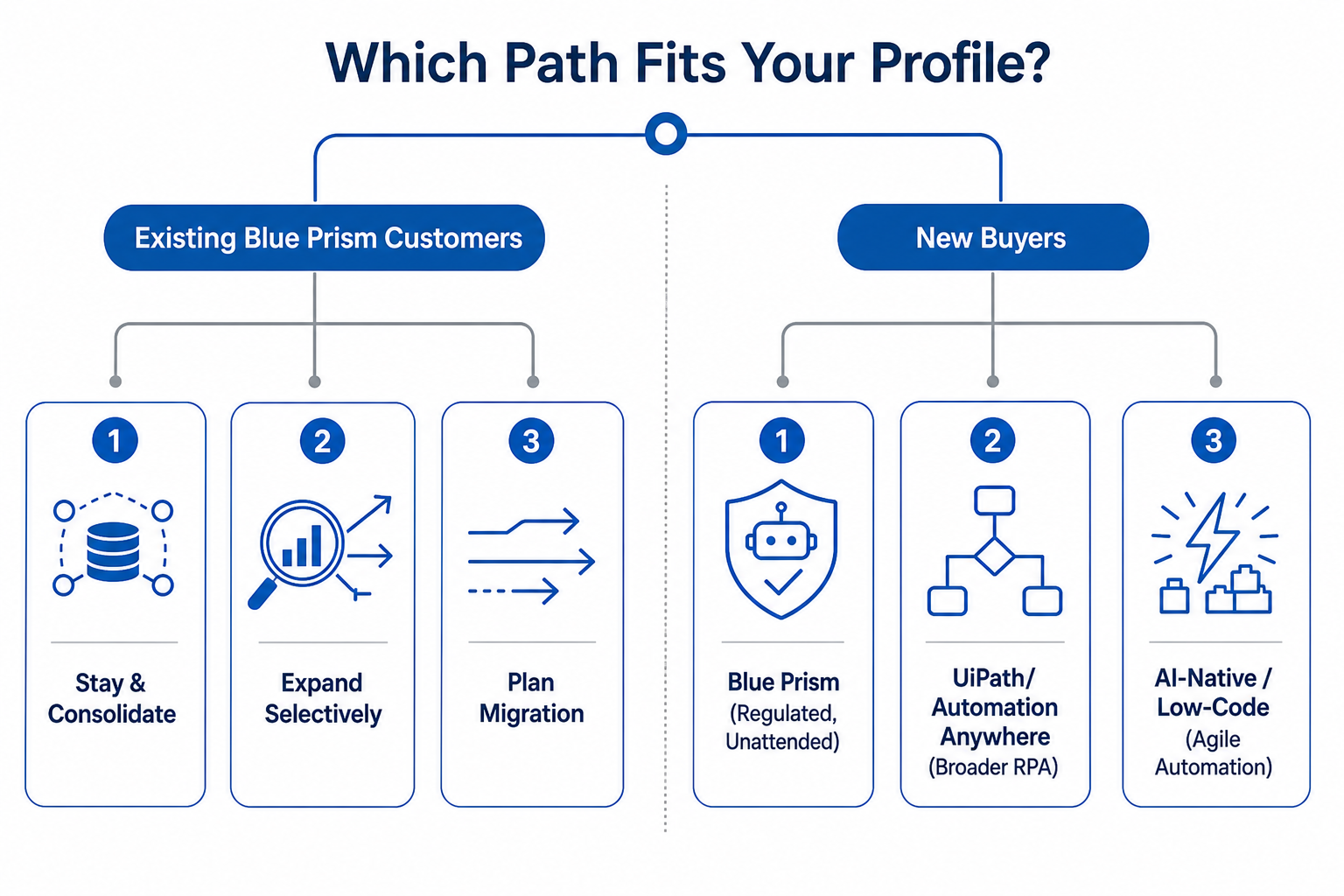
The following matrix maps organization profiles to recommended automation paths, using five evaluation criteria: compliance requirements, AI readiness, budget, in-house technical expertise, and automation scope (attended vs. unattended).
| Organization Profile | Compliance Needs | AI Readiness | Budget | Recommended Path |
|---|---|---|---|---|
| Regulated enterprise (banking, insurance, healthcare) with heavy unattended automation | Critical | Low to Medium | High | Blue Prism (stay or adopt) |
| Regulated enterprise needing both attended and unattended automation | Critical | Medium to High | High | UiPath or Automation Anywhere |
| Mid-market company with moderate compliance needs | Moderate | Medium | Medium | Automation Anywhere or Power Automate |
| Microsoft-centric organization with basic automation needs | Low to Moderate | Low to Medium | Low to Medium | Microsoft Power Automate |
| Startup or tech-forward team building AI-native workflows | Low | High | Variable | AI-native platform or hybrid approach |
| Existing Blue Prism customer with heavy investment and satisfied users | Critical | Low to Medium | High | Stay & Consolidate |
| Existing Blue Prism customer needing AI/attended capabilities | Critical | Medium to High | High | Hybrid (Blue Prism + second platform) or Plan Migration |
Recommendations for Existing Blue Prism Customers
If your organization already runs Blue Prism, your decision framework is different from a new buyer's. You have existing automations, trained staff, and sunk costs in implementation and integration. The question is not "should we start with Blue Prism?" but "should we stay, expand, or plan a migration?"
Stay & Consolidate
If your organization is heavily invested in Blue Prism (50+ automations, trained COE team, deep integration with core systems) and operates in a regulated industry where governance is the primary automation requirement, staying the course is the most pragmatic option. The cost and risk of migrating 50+ automations to a new platform — a 7-12 month full re-implementation program according to Kanerika's analysis — often outweigh the benefits of switching, especially if your automation needs are primarily unattended and rules-based.
Expand Selectively
If your organization has a moderate Blue Prism footprint (10-30 automations) and your future automation pipeline includes both unattended and attended processes, consider a hybrid approach. Keep Blue Prism for the regulated, unattended workloads where its governance features are irreplaceable. Evaluate a second platform — UiPath or Power Automate — for attended automation, AI-driven processes, and use cases that require a lower barrier to entry for citizen developers.
Plan Migration
If your organization's automation strategy is shifting toward AI-native capabilities, attended automation, or a broader developer ecosystem, and your Blue Prism footprint is still small enough to migrate without massive disruption, planning a migration to UiPath or an AI-native platform may be the right long-term move. Budget for a 7-12 month migration timeline for 50+ automations, and factor in the cost of retraining your automation team on the new platform's development paradigm.
Recommendations for New Buyers
For organizations evaluating Blue Prism for the first time, the recommendation is more straightforward — and more restrictive.
- Choose Blue Prism if: your organization operates in a heavily regulated industry (banking, insurance, healthcare, government), your automation scope is primarily unattended back-office processes, and audit trail completeness is a non-negotiable requirement. Blue Prism's governance architecture remains unmatched for this specific profile.
- Do not choose Blue Prism if: your automation strategy includes attended automation, AI-powered document processing, or citizen developer involvement. The platform's learning curve, paid-only certification, and slower AI innovation make it a poor fit for organizations that need flexibility and speed over governance depth.
- Consider a broader RPA platform (UiPath or Automation Anywhere) if: you need a balance of attended and unattended automation, want access to a larger developer community and ecosystem, and need AI capabilities that are integrated into the platform rather than bolted on.
- Consider an AI-native or low-code platform if: your organization is building automation from scratch, has strong technical talent, and wants to skip the traditional RPA paradigm entirely in favor of AI-driven workflows.