
Blue Prism should still be on the shortlist in 2026 for a particular kind of buyer: an enterprise that needs centrally governed, unattended robotic process automation for regulated back-office work, and is willing to pay for architecture, controls, and operating discipline. It should not be treated as a default RPA pick just because the brand has been around the enterprise automation table for years. The platform remains recognized by Gartner as an RPA Leader, with SS&C Blue Prism announcing its seventh consecutive Leader placement in June 2025, but that recognition does not erase the procurement question that matters most: whether your organization can absorb the cost, skills curve, and product constraints that come with it.[1]
The short version is blunt. Use Blue Prism when compliance-mandated unattended automation, audit trails, role-based control, and centralized change governance are worth more than fast rollout. Avoid it when the business case depends on attended desktop assistance, broad citizen development, or AI-native automation becoming productive in the near term.

Where Blue Prism is a strong fit—and where it starts to break
| Blue Prism is a serious fit when... | Blue Prism is a weak fit when... |
|---|---|
| Automation is mostly unattended, high-volume, and back-office. | Users need attended bots working beside contact-center agents or front-line staff. |
| The process touches regulated data and must withstand audit review. | The priority is rapid departmental rollout by nontechnical citizen developers. |
| The organization already has, or will fund, a centralized automation CoE. | The team expects low-code experimentation without a heavy support model. |
| Change control, reusable objects, RBAC, and traceability are buying criteria. | Near-term AI-native document understanding, agentic workflows, or generative AI orchestration are decisive. |
| A multi-year TCO model has been approved beyond license cost. | Procurement is comparing vendors mainly by per-bot price. |
That table is more useful than a generic feature checklist because Blue Prism’s strengths and weaknesses come from the same design choices. Its architecture was built for controlled enterprise automation, not for casual desktop scripting. That is why it can look expensive and slow beside lighter tools, then suddenly look sensible when the automation estate enters finance operations, insurance claims, healthcare administration, public-sector case processing, or any workflow where a failed bot becomes a control failure.
Readers who need a feature-by-feature product profile can use the deeper SS&C Blue Prism tool profile. This review is more concerned with the buying decision: what you are really committing to after the demo ends.
The pricing problem is not the bot license
Blue Prism pricing is difficult to evaluate from public information because SS&C Blue Prism does not publish a simple itemized public price list for production deployments. Its own plans and pricing page routes buyers into plan-level inquiry rather than a transparent quote sheet.[2] The most detailed public cost estimates available in 2026 come from third-party pricing analyses, procurement references, and community reports, so every number below should be treated as directional rather than contractual.
The public estimates still matter because they show the shape of the cost model. O-mega.ai’s 2026 pricing guide estimates Blue Prism Enterprise on-premises licensing at about $13,000 per digital worker per year, Blue Prism Cloud at about $23,400 per digital worker per year, and Next Gen hybrid pricing around £15,000 to £19,000 per year. The same guide estimates Process Intelligence add-ons at roughly £78,000 or more per year.[3] O-mega.ai is an AI-native competitor, so its comparisons should not be read as neutral procurement advice, but its figures are consistent enough with the broader market conversation to be useful as a caution.
| Cost item | Publicly available estimate or buying implication |
|---|---|
| Enterprise on-premises digital worker | About $13,000 per year, based on third-party 2026 pricing analysis |
| Blue Prism Cloud digital worker | About $23,400 per year, based on third-party 2026 pricing analysis |
| Next Gen hybrid | Roughly £15,000-£19,000 per year, based on third-party 2026 pricing analysis |
| Process Intelligence add-on | Roughly £78,000+ per year, based on third-party 2026 pricing analysis |
| Production free tier | No free community edition for production use identified in the cited pricing materials |
| Implementation and services | Often the larger budget line; should be modeled before vendor comparison |

The dangerous procurement mistake is to compare Blue Prism with UiPath, Automation Anywhere, or Microsoft Power Automate by bot license alone. In Blue Prism programs, license cost can be only a minority of the three-year spend. The same O-mega.ai analysis cites implementation and services as potentially representing up to 70% of total three-year cost, and estimates that three-year TCO per automated process can be two to three times the per-bot license fee alone.[3]
That is not just vendor padding. Blue Prism typically needs process discovery, solution design, environment setup, object design, testing, release management, production support, credential handling, monitoring, exception management, and compliance documentation. If the organization is automating a high-volume reconciliation process that touches financial data, someone has to define what happens when the bot fails, who reprocesses the queue, who approves object changes, and how evidence is retained for audit. Those activities belong in the business case from day one.
Community discussions around enterprise RPA pricing also show why buyers should be careful with public averages: real quotes vary by volume, region, cloud model, partner involvement, and enterprise discounting.[4] That variability is precisely why a Blue Prism business case should use a three-year ownership model rather than a year-one license scenario.
What belongs in a realistic three-year Blue Prism TCO model
- Digital worker licenses by environment, not just production bots.
- Cloud, on-premises, or hybrid infrastructure and environment management.
- Implementation services, partner fees, and internal automation CoE staffing.
- Training time for developers, controllers, business analysts, and support teams.
- Process discovery and Process Intelligence tooling where needed.
- Maintenance for application changes, credential rotations, queue exceptions, and audit evidence.
- Run support, incident handling, and regression testing after upstream system changes.
- Governance overhead: release approvals, segregation of duties, documentation, and control-owner review.
This is also where failed automation is expensive. Ernst & Young global RPA practice data, as cited in the O-mega.ai pricing guide and broader RPA literature, puts the share of initial RPA implementations that fail to achieve stated goals at roughly 30% to 50%.[3] That figure is not Blue Prism-specific, and it should not be used to claim that Blue Prism projects fail more often than others. The point is narrower: when a platform has high upfront planning, licensing, training, and services cost, weak process selection hurts more.
The best argument for Blue Prism is still governance
Blue Prism’s strongest case is architectural. Its client-server model, server-side processing orientation, role-based access control, and auditability make it better suited to centralized enterprise automation than tools designed primarily around individual desktop productivity.[5] In a regulated environment, those are not secondary features. They determine whether an automation program can survive contact with internal audit, risk management, and external examiners.
The design also pushes teams toward separation between process logic and reusable application objects. Blue Prism’s Process Studio and Object Studio model is not the fastest way to let a department automate a local task, but it can produce a more maintainable portfolio when dozens or hundreds of automations depend on the same systems.[5] A credentials object, an SAP interaction object, or a claims-system object can be governed and reused rather than recreated by every team with a slightly different naming convention and a different tolerance for shortcuts.
That matters in SOX-, HIPAA-, or Basel III-sensitive environments because the hard question is rarely whether a bot can click through an application. The hard question is whether the organization can prove who changed the automation, who approved the release, what data it touched, how exceptions were handled, and whether the control owner can defend the process months later. Blue Prism’s governance posture is the reason banks, insurers, healthcare organizations, and public-sector buyers still consider it even when other platforms look faster in a proof of concept.
For that narrow but important profile, the relevant comparison is not “Which RPA tool has the friendliest recorder?” It is “Which platform lets us industrialize unattended automation without inventing the control framework from scratch?” Readers evaluating this exact regulated-industry pattern may find the companion analysis on why banks, insurers, and healthcare organizations still choose Blue Prism more useful than a broad RPA market overview.
The same architecture slows adoption
Blue Prism’s discipline has a cost: it is not a lightweight tool for teams that want to move from idea to production in days. Comparative analysis has consistently described Blue Prism as requiring a steeper learning curve than UiPath, with proficiency more likely to take months than weeks.[6] That does not make the product badly designed. It means the buyer needs to fund the operating model that the product assumes.
A business analyst can contribute to process design and exception analysis, but Blue Prism programs generally work best when trained developers, solution designers, controllers, infrastructure owners, and compliance stakeholders are part of the lifecycle. If procurement sells the platform internally as a citizen-developer shortcut, the automation CoE will inherit the cleanup.
The unattended-only model is another structural constraint. Blue Prism has historically focused on unattended bots rather than attended automation that sits on an employee’s desktop and assists in real time.[5][7] That makes it a poor fit for contact centers, front-office workflows, and desktop-assistance use cases where a human worker needs a bot to respond during a live interaction.
The implication is practical. A claims back-office queue that can be processed overnight may suit Blue Prism well. A call-center agent who needs live guidance while a customer waits on the phone probably should not be forced into Blue Prism just because the enterprise already owns it.
AI readiness is the strategic gap to watch
Blue Prism is not obsolete, and dismissing it that way misses why large enterprises still buy it. But in 2026, the AI gap is material. Analyst and practitioner comparisons increasingly give UiPath an estimated 12-to-18-month lead in areas such as native document understanding, agentic automation, and generative AI integration.[7][8] That range should be read as a directional consensus, not a laboratory measurement. The exact gap is debatable; the buying risk is not.
The risk is that an organization standardizes on Blue Prism for a portfolio that soon needs more than deterministic task automation. If the roadmap includes unstructured document intake, AI-assisted decisioning, natural-language work orchestration, or agentic handoffs, Blue Prism may need adjacent tools to stay competitive. That can be a valid architecture, but it should be acknowledged as a hybrid strategy, not hidden inside a generic “AI-enabled RPA” slide.
For stable, rules-based, regulated work, that may be acceptable. Many enterprises would rather add AI carefully around a governed automation core than let every team experiment with unapproved models near sensitive data. For AI-first automation programs, however, Blue Prism is harder to justify as the primary innovation layer. The more your 2026 business case depends on AI-native capability rather than governed unattended execution, the more you should compare Blue Prism against alternatives or consider a hybrid approach such as the one discussed in Blue Prism vs AI-native automation.
Market position: respected, but not the center of gravity
Blue Prism still has enterprise credibility. Gartner Leader recognition, strong review sentiment in available public summaries, and a long history in regulated automation all count in its favor.[1] But the public review footprint and market conversation are much larger around UiPath, and secondary 2026 market-share summaries generally place Blue Prism behind the leading RPA platforms. Because some of the available review-count and market-share figures come from snippets or analyst-adjacent summaries rather than directly accessible primary reports, they are best used as mindshare signals, not as precise market measurements.
That matters for buyers because ecosystem size affects hiring, partner availability, community troubleshooting, reusable assets, and the confidence that a new automation developer has already seen your problem somewhere else. Blue Prism can still be the better fit for a controlled enterprise estate, but the smaller visible ecosystem increases the importance of internal capability planning.
If your shortlist is still open, the next useful step is not another standalone review. It is a direct comparison across operating models, AI capabilities, pricing structures, and governance assumptions. See Blue Prism vs. UiPath vs. Automation Anywhere vs. Power Automate when the question moves from “Is Blue Prism viable?” to “Which platform should we standardize on?”
The SS&C acquisition is a strategic uncertainty, not just a footnote
SS&C acquired Blue Prism in 2022 in a transaction valued at about $1.6 billion.[1] The acquisition gave Blue Prism a parent with deep financial-services presence, which may strengthen its relevance for banking, asset management, insurance, and adjacent regulated industries. It also creates a strategic question for buyers outside that center of gravity: will future R&D prioritize broad enterprise automation, or will the roadmap tilt toward SS&C’s strongest industry base?
There is no honest way to answer that definitively from public materials. The acquisition should not scare away a bank with a strong Blue Prism use case, and it should not be exaggerated into a product-decline narrative. But non-financial-services buyers should ask more pointed roadmap questions than they might ask of an independent RPA vendor: which capabilities are funded, which integrations are being modernized, how AI investment is being prioritized, and what customer segments appear to be driving product decisions.
For a deeper treatment of this specific risk, use the separate analysis of Blue Prism after the SS&C acquisition. In this review, the acquisition changes the diligence checklist more than the immediate product verdict.
Procurement decision rule for 2026
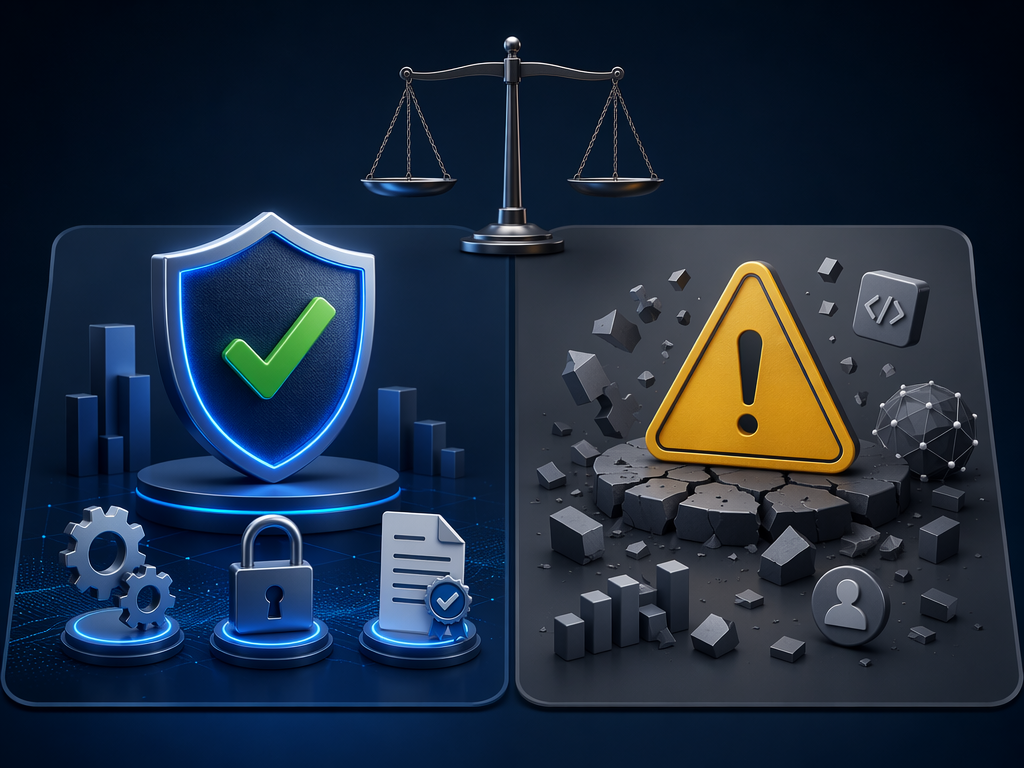
Put Blue Prism on the shortlist if the automation program is centralized, compliance-sensitive, mostly unattended, and backed by a real CoE budget. It is especially defensible when the cost of weak governance is higher than the cost of the platform: regulated data, audit exposure, segregation-of-duties requirements, repeatable back-office work, and executives who understand that automation operations continue after go-live.
Do not shortlist Blue Prism as the easiest way to start RPA. Do not buy it for broad attended automation. Do not make it the default choice for contact-center assistance. Do not assume business users will build production-grade automations without a disciplined delivery model. Do not approve it on license price alone. And do not treat AI capability as a checkbox if your automation strategy depends on modern document intelligence, agentic workflows, or generative AI orchestration in the near term.
The cleanest decision rule is this: Blue Prism is a strong investment when governance, auditability, and unattended scale justify the higher cost and learning curve. It is a poor investment when speed, attended desktop work, citizen development, or AI-native capability matter more than centralized control.
References
- SS&C Blue Prism Recognized as a Gartner Magic Quadrant RPA Leader for the Seventh Consecutive Year, BusinessWire, June 2025.
- Plans and Pricing, SS&C Blue Prism.
- Blue Prism Pricing: What Does It Cost You? 2026, O-mega.ai.
- Enterprise license costs for top RPA leaders, Reddit r/rpa.
- Blue Prism, Wikipedia.
- Blue Prism vs UiPath, IT Business Edge.
- Blue Prism vs UiPath, Kanerika.
- UiPath vs Automation Anywhere vs Blue Prism: Comparing RPA Tools, Zenesys.