
The uncomfortable 2026 choice is no longer whether robotic process automation Blue Prism is “modern enough.” That is too vague to be useful. The harder question is whether a process deserves Blue Prism’s governance-heavy operating model, or whether it should move to an AI-native platform that promises faster setup, less bot repair, and more tolerance for messy application interfaces.
A bank’s unattended loan-servicing workflow, a hospital revenue-cycle exception queue, and a finance team’s SOX-relevant reconciliation do not belong in the same decision bucket as a sales-ops enrichment task or an internal research assistant. Treating them as one automation backlog is how pilots look cheap and enterprise programs become expensive.

| Process profile | Better 2026 default | Why |
|---|---|---|
| Stable, regulated, audit-sensitive, unattended | Blue Prism | Deterministic execution, role controls, logging, and change governance matter more than rapid configuration. |
| Stable but high-maintenance because UI changes frequently | Compare both | Blue Prism may still fit if auditability dominates; AI-native self-healing claims deserve testing if breakage is the cost driver. |
| Dynamic, lower-risk, human-reviewed | AI-native platform | Natural-language configuration and faster iteration can matter more than strict bot determinism. |
| Exploratory workflow with unclear future volume | AI-native pilot or no-code/agentic layer | Do not over-engineer governance before the process has proved it should be industrialized. |
| High-volume regulated process with unclear decision logic | Fix process design before platform selection | Automation will not make an ambiguous control environment safer. |
That routing frame matters because Blue Prism and AI-native platforms are not merely two product categories with different feature lists. They imply different answers to who owns change, who explains an exception, who signs off on a control, and who gets called when a production bot silently stops matching the real process.
The Blue Prism cost conversation has to start after the demo
Blue Prism is rarely bought because it is the cheapest way to automate a task. Pricing triangulation in the available market material places Blue Prism digital workers around $10,000–$20,000 per digital worker per year, with implementation costs often modeled at roughly 2.5 times the software license cost and ongoing maintenance consuming 30%–50% of total RPA spend.[1][2][3][4]
Those numbers are not a line-item nuisance. They change the architecture decision. If an enterprise looks only at annual license cost, Blue Prism may appear expensive but manageable. Once implementation, controls, testing, exception handling, environment management, and bot maintenance are included, a realistic three-year total cost can land at two to three times the visible license fee.
| Cost layer | What buyers often underestimate | Why it matters in a 3-year view |
|---|---|---|
| Digital worker licenses | The annual recurring platform footprint | Useful for budgeting, but incomplete on its own. |
| Implementation | Process discovery, object design, testing, controls, deployment, and documentation | A slow build can be justified for durable regulated processes; it is harder to justify for volatile workflows. |
| Maintenance | Application changes, credential changes, exception patterns, queue tuning, regression testing | This is where traditional RPA programs often accumulate drag after the first wave of automations. |
| Governance overhead | Access reviews, change approvals, audit evidence, segregation of duties | Costly, but not optional in regulated environments. |
| Opportunity cost | Automation team capacity locked into bot upkeep instead of new process improvement | This is the opening AI-native vendors are trying to exploit. |
This is the strongest economic argument against overusing Blue Prism in 2026. Not that Blue Prism cannot deliver value; it can. The issue is that a governance-first RPA stack has a cost structure that should be reserved for processes where that governance actually reduces enterprise risk or protects high-volume operational value.
AI-native platforms press exactly on this weak point. O-mega.ai and MAIA Brain claim self-healing, computer vision, and natural-language task definition can reduce bot breakage and maintenance by as much as 80%.[1][5] That claim is commercially convenient for vendors selling the alternative, so it should not be treated as settled independent evidence. But the direction of the argument is credible: if fewer automations are brittle screen-scrapers and more workflows can adapt to interface variation, maintenance economics can change.
The buyer’s job is to separate a plausible cost improvement from a blanket replacement story. An AI-native workflow that saves development time but creates unexplainable decisions in a regulated process has not lowered total cost. It has moved cost into model oversight, exception review, audit defense, and remediation.
Why Blue Prism’s governance still matters
Blue Prism’s remaining strength is not nostalgia. It is architecture. Server-side logging, role-based access control, and a design model that separates Object Studio application logic from Process Studio business logic give process owners and control teams places to inspect, restrict, and govern automation behavior.[6][4]
That separation is not a cosmetic product detail. In a mature Blue Prism estate, a reusable object that interacts with a core banking screen, claims system, or ERP module can be controlled separately from the business process that calls it. If the application changes, the automation team can update the object without pretending every downstream business process has been redesigned. If a process changes, the business logic can be reviewed without handing every process designer the keys to every application interaction.
Server-side logging matters for the same reason. In an audit-sensitive workflow, the question is not only whether the bot completed the work. It is who approved it, what version ran, what data it touched, what exception path it followed, and whether the evidence survives beyond a user workstation. Blue Prism’s compliance posture, including references to SOC2, HIPAA, and SOX-aligned use cases in available vendor and review material, is part of why it remains credible in banking, insurance, healthcare, and government.[7][4]
This is also where the AI-native story needs more care. Natural-language setup is attractive when the workflow is low-risk and the cost of iteration dominates. It is less comforting when an auditor asks why an automation made a particular routing decision, whether the model’s behavior changed after a prompt update, and how the organization verified that the new behavior remained compliant.
There are ways to govern AI-assisted automation, but they are not free. Human-in-the-loop review, model evaluation, prompt/version control, access policy, test suites, and exception sampling become part of the operating model. If those controls are immature, “faster deployment” can simply mean faster movement of risk into production.
Where AI-native platforms deserve the first look
There are plenty of processes where Blue Prism’s discipline is more machinery than the work deserves. A marketing-ops enrichment flow, internal document triage task, partner data cleanup workflow, or semi-structured research process may change weekly. In those cases, the ability to describe a task in natural language, connect a model to unstructured inputs, and adapt when a page layout changes may be more valuable than a heavily engineered object layer.
The practical screen is not “Does this process use AI?” It is whether the organization can tolerate probabilistic behavior, incomplete explainability, and faster change. If the answer is yes because a human reviews the output, the downstream consequence is low, or the workflow is exploratory, an AI-native platform may be the better economic bet.
- Prefer AI-native automation when the process changes often and traditional RPA maintenance is the dominant cost.
- Prefer AI-native automation when unstructured input is central to the workflow and deterministic screen automation would require too many workarounds.
- Prefer AI-native automation when the output is reviewed by a human before it affects a customer, financial record, legal obligation, or regulated decision.
- Be cautious when AI-native automation is asked to make unattended decisions in workflows where auditability is not negotiable.
This is why a simple feature-grid comparison between Blue Prism, O-mega, Autonoly, Duvo, and agentic capabilities in UiPath misses the point. The valuable distinction is architectural: deterministic governed execution versus adaptive, model-mediated execution. For readers who need the foundational category split before a Blue Prism-specific decision, the site’s comparisons of RPA, no-code workflow, and AI agents, and of AI process automation versus traditional RPA, are the better starting layer.
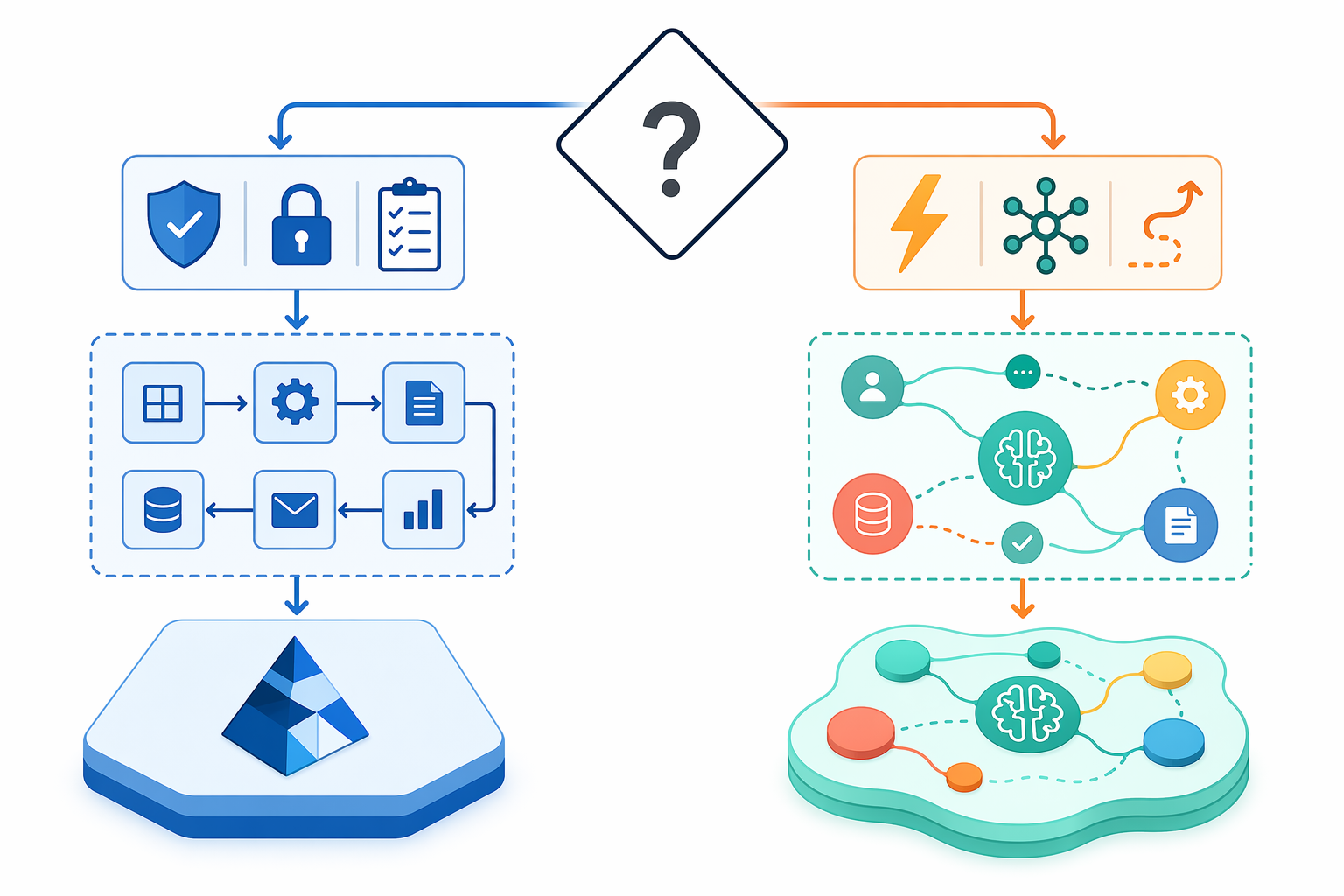
The process-routing test
Before choosing a platform, route the process. That means looking at compliance exposure, process stability, exception frequency, decision opacity, and production support burden before anyone falls in love with a demo.
| Question | If the answer points to Blue Prism | If the answer points to AI-native |
|---|---|---|
| Is the process regulated or audit-sensitive? | Yes: evidence, controls, and version traceability are central. | No, or controls can sit around the workflow rather than inside every bot action. |
| Is the process stable? | Yes: the workflow is mature, repeatable, and likely to run for years. | No: the work changes often and speed of adjustment matters. |
| Is unattended reliability required? | Yes: the bot must run in production with limited human review. | No: humans review outputs or intervene before consequences occur. |
| Is current maintenance caused by brittle UI interaction? | Maybe: if governance dominates, Blue Prism still fits. | Yes: self-healing and computer vision claims should be tested in a controlled pilot. |
| Can the organization explain the automation’s decision path? | Required: deterministic logic and logs are preferable. | Less critical: probabilistic assistance may be acceptable. |
| Would a wrong output create customer, financial, legal, or compliance harm? | Yes: route toward governed RPA or redesign the process first. | Low impact: AI-native experimentation is more defensible. |
A useful enterprise rule is to pilot AI-native automation where the organization already has safe review loops. Let the platform prove whether it actually reduces maintenance, accelerates configuration, and handles real exceptions. Do not start with the process that will require the most uncomfortable explanation if something goes wrong.
For Blue Prism, the equivalent rule is to stop sending it every automation candidate. Reserve the heavier platform for work that benefits from industrialization: high-volume, stable, compliance-exposed processes where the cost of governance is lower than the cost of weak control.
Blue Prism can still produce serious operating value
The case for Blue Prism does not rest only on theoretical governance. Kimberly-Clark is cited as achieving more than $140 million in value across 269 processes using Blue Prism, while Banorte is cited as achieving 60% faster loan processing.[2][1] These are not small proof points. They show what traditional enterprise RPA can still do when it is matched to large, repeatable operational work.
They should not, however, be overread. Large Blue Prism success stories often reflect programs that started before the current AI-native wave and were built around process standardization, operating discipline, and scale. They prove that Blue Prism can still be valuable. They do not prove that every new automation investment should use the same architecture in 2026.
This is the difference between installed-base credibility and next-process suitability. A successful Blue Prism estate may be worth maintaining and expanding in the right places. It may also contain candidates that should be rebuilt, retired, or surrounded by AI-assisted layers rather than cloned into the next wave of automations.
The RPA era is not ending, but its center of gravity is moving
The market data does not support a clean “RPA is dead” story. The RPA market is projected to grow from $4.13 billion in 2023 to $23.06 billion by 2032, according to market research cited by O-mega.ai.[1] The more useful reading is that automation demand is expanding while the growth narrative shifts toward AI-augmented and agentic capabilities.
That shift creates a real risk for Blue Prism buyers. Available analyst and market commentary indicates Blue Prism trails UiPath’s native AI capabilities by roughly 12–18 months, while Blue Prism’s AI Gateway and WorkHQ show movement but remain signals of an add-on and platform-extension strategy rather than proof of fully AI-native architecture.[2][8]
The SS&C ownership context adds another strategic question: whether innovation velocity outside financial-services-heavy use cases will keep pace with the broader agentic automation market. That is a risk factor, not a death sentence. Blue Prism is still shipping new capabilities, and its installed enterprise base gives it a serious path to hybrid modernization. But buyers should evaluate WorkHQ and AI Gateway as evidence of transition, not as a reason to assume Blue Prism has already become an AI-native platform.
A practical 2026 architecture split
For most enterprises, the right answer is not to abandon Blue Prism or to freeze the automation roadmap around it. The better move is a governed split.
- Keep or choose Blue Prism for stable, regulated, audit-heavy, unattended processes where logs, access controls, reusable objects, and deterministic execution reduce enterprise risk.
- Test AI-native platforms for dynamic, lower-risk workflows where maintenance reduction, faster configuration, and unstructured-input handling matter more than strict deterministic governance.
- Use human review as the bridge for early AI-native deployments, especially when outputs affect downstream systems or customer-facing work.
- Evaluate Blue Prism’s WorkHQ and AI Gateway as signs of modernization, while still asking whether the underlying process needs traditional governed RPA or a more adaptive AI-native layer.
- Model total cost over three years, not just first-year license price or pilot build speed.
The buying discipline is to make each process earn its architecture. A stable reconciliation that auditors inspect every year should not be pushed into an opaque AI workflow because the demo looked easier. A volatile internal workflow should not inherit a heavyweight RPA operating model because the enterprise already owns Blue Prism licenses.
In 2026, productivity at enterprise scale is not just speed. It is speed that does not create a cleanup queue for compliance, IT controls, and process owners six months later. Blue Prism still has a defensible place where that control burden is real. AI-native platforms deserve the growth budget where adaptability and lower maintenance can be tested without pretending model opacity has disappeared.
References
- O-mega.ai pricing guide, O-mega.ai.
- Kanerika Blue Prism analysis, Kanerika.
- UK G-Cloud catalog Blue Prism listing, UK G-Cloud.
- Blue Prism reviews and pricing discussions, PeerSpot.
- MAIA Brain automation maintenance claims, MAIA Brain.
- Blue Prism, Wikipedia.
- SS&C Blue Prism Gartner Magic Quadrant Leader page, SS&C Blue Prism.
- Blue Prism AI Gateway and WorkHQ coverage, IT Business Edge and Rootstack.