
The RPA Landscape in 2026: Why These Four Platforms Dominate
Robotic process automation has moved past its early hype cycle and into a phase of consolidation and specialization. The market, which IDC predicts will more than double to $8.2 billion by 2028, is now dominated by four platforms that have survived the shakeout: Blue Prism, UiPath, Automation Anywhere, and Microsoft Power Automate. Each has carved out a distinct niche, and choosing between them in 2026 means understanding which niche matches your organization's specific constraints.
The biggest shift reshaping this landscape is the rise of AI agents. Traditional RPA — where bots follow rigid, rule-based scripts — is giving way to agentic automation, where AI models can interpret unstructured data, make decisions, and adapt to changing conditions. Every platform on this list is racing to embed AI capabilities, but they are approaching it from very different starting points. Blue Prism is leaning on its security pedigree to build a trusted AI gateway. UiPath is leveraging its massive developer ecosystem to embed AI into every layer of its platform. Automation Anywhere is doubling down on cloud-native document intelligence. And Microsoft is weaving automation directly into the tools millions of people already use every day.
This article provides a structured, evidence-based comparison of these four platforms. We will examine pricing, deployment options, security, AI capabilities, and attended versus unattended automation. The goal is not to declare a single winner — there isn't one — but to help you map your organization's regulatory environment, budget, and tech stack to the platform that fits best.
Comparison at a Glance: Pricing, Deployment, and Core Strengths
Before diving into each platform's strengths and weaknesses, here is a side-by-side overview of the four contenders. The pricing data below is based on publicly available information, third-party estimates, and peer reports as of mid-2026. Enterprise pricing for all four platforms is negotiable and varies significantly by volume and contract length.
| Feature | Blue Prism | UiPath | Automation Anywhere | Microsoft Power Automate |
|---|---|---|---|---|
| Pricing Model | Per-bot annual license (~$10k–$20k/bot/year) | Per-user or per-bot; Enterprise starts at ~$420/user/month | Subscription-based; basic plans from ~$750/bot/year | Per-user/month; Premium from $15/user/month; Process from $150/bot/month |
| Deployment | On-premises, cloud, hybrid | Cloud, on-premises, hybrid | Cloud-native (SaaS-first), on-premises available | Cloud-only (Azure); on-premises via Windows Server |
| Primary Target User | Large regulated enterprises (finance, healthcare, government) | Enterprises and mid-market; broadest use case coverage | Enterprises needing cloud agility and document AI | Microsoft-centric organizations; citizen developers |
| Core Strength | Veracode Level 5 security, ironclad audit trails | Largest automation ecosystem, flexible pricing, strong AI | Cloud-native architecture, IQ Bot for document processing | Low cost, deep Microsoft ecosystem integration |
| Key Weakness | High cost, declining mindshare, weaker attended automation | Can be expensive for small deployments; complex licensing | Smaller community than UiPath; less on-premises depth | Limited complex enterprise automation; cloud-only |
| G2 Rating (Reviews) | 4.5/5 (402 reviews) | 4.6/5 (7,250 reviews) | 4.5/5 (5,545 reviews) | 4.4/5 (870 reviews) |
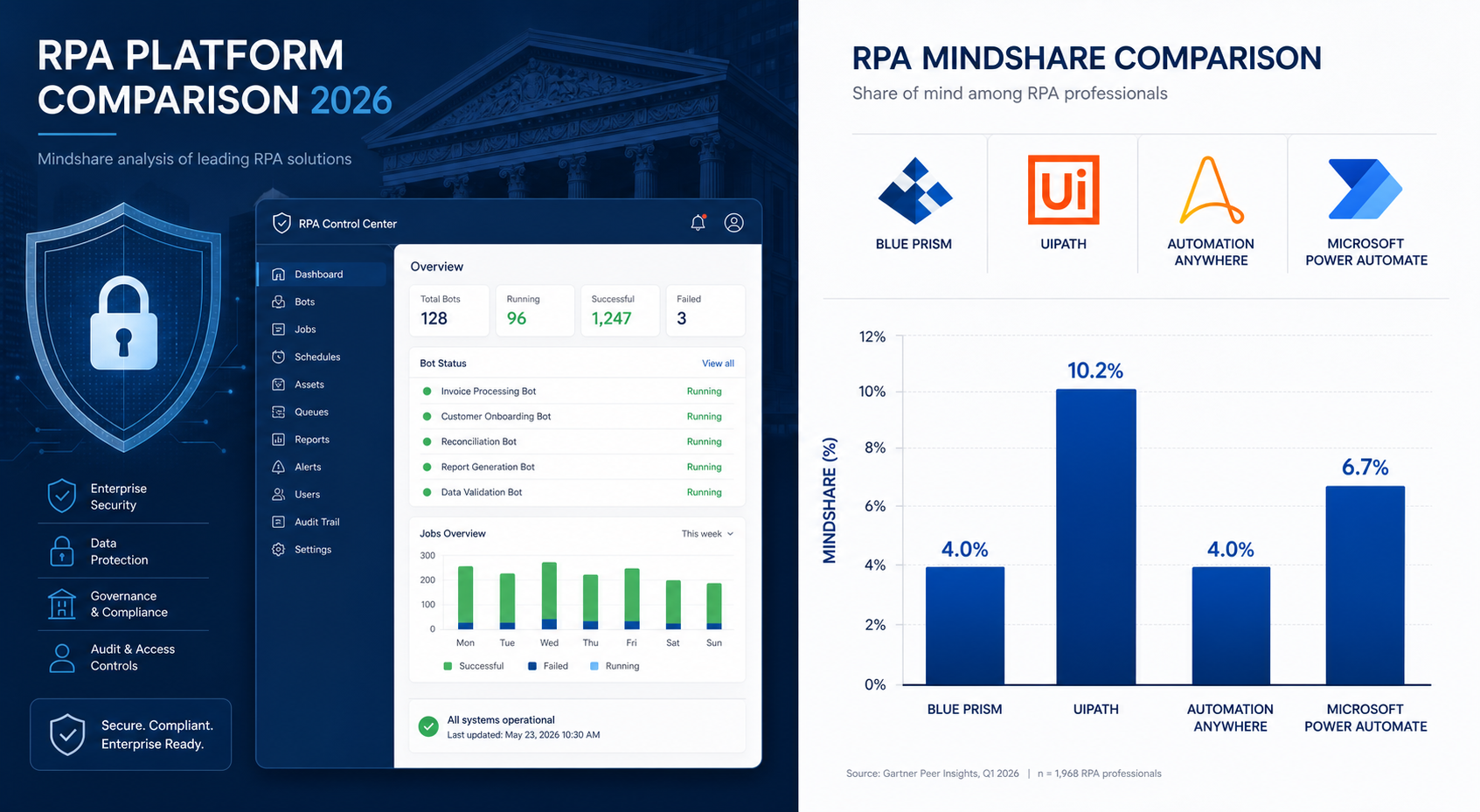
| PeerSpot Mindshare (June 2026) | 4.0% (down from 9.4% YoY) | 10.2% | Not separately tracked in source data | 6.7% |
Blue Prism: The Security-First Choice for Regulated Industries
Blue Prism has built its reputation on one thing above all else: security. The platform holds a Veracode Level 5 security certification, the highest available, and provides what KeyMark describes as an "iron-tight audit trail." These credentials have made it the default choice for financial services, healthcare, and government organizations where compliance is non-negotiable. Over half of the top 100 financial institutions use Blue Prism, according to KeyMark.
However, the platform's position has eroded significantly since its acquisition by SS&C Technologies for approximately $1.6 billion in March 2022. PeerSpot mindshare for Blue Prism in the RPA category dropped from 9.4% to 4.0% year-over-year as of June 2026. Its G2 review count — 402 reviews — is dwarfed by UiPath's 7,250, a gap that signals vastly different levels of market adoption and community activity.
Strengths
- Enterprise-grade security: Veracode Level 5 certification and comprehensive audit trails make it the safest choice for regulated environments.
- Proven ROI in large-scale deployments: Blue Prism reports that Kimberly-Clark achieved over $140 million in cumulative business value and saved 1.6 million manual hours. Banorte reported 60% faster credit application processing and a 30% capacity increase.
- Strong on-premises capabilities: For organizations that cannot or will not move sensitive processes to the cloud, Blue Prism's on-premises deployment is mature and well-documented.
Weaknesses
- High cost: With per-bot licensing starting at around $13,000 per year and the Next Generation edition listed at £15,000–£19,000 per digital worker per year on the UK G-Cloud, Blue Prism is the most expensive option on this list. Implementation and integration services can account for approximately 70% of total RPA spend.
- Declining market presence: The 5.4 percentage point drop in PeerSpot mindshare year-over-year is a warning sign. Fewer new customers are choosing Blue Prism, which could lead to a smaller community and slower innovation over time.
- Weaker attended automation and AI/ML: PeerSpot reviewers consistently cite a lack of attended automation capabilities and difficulty handling unstructured data as key limitations. The platform's AI/ML integration is less mature than UiPath's or Automation Anywhere's.
- Steep learning curve: Users on Capterra and PeerSpot report that Blue Prism has a steep learning curve for new developers and that the user experience feels dated compared to competitors.
UiPath: The Market Leader with the Broadest Automation Ecosystem
UiPath is the clear market leader in RPA, ranked #1 by Gartner, Everest Group, and IDC according to Auxis. With over 10,000 enterprise customers and a G2 rating of 4.6/5 based on 7,250 reviews, it has the largest and most active user community of any platform on this list. Its PeerSpot mindshare of 10.2% is more than double Blue Prism's and significantly ahead of Power Automate's 6.7%.
UiPath's strength lies in its breadth. It offers flexible pricing with both cloud and on-premises deployment options, supports both attended and unattended automation equally well, and has invested heavily in AI capabilities through products like Autopilot and Maestro. The platform's developer community is a major asset — more developers know UiPath than any other RPA tool, which makes hiring and scaling easier.
Strengths
- Market-leading ecosystem: The largest community, the most third-party integrations, and the broadest library of pre-built components. This reduces development time and makes it easier to find expertise.
- Strong AI and automation capabilities: UiPath's Autopilot brings generative AI into automation design, while Maestro orchestrates complex multi-bot workflows. The platform handles both structured and unstructured data effectively.
- Flexible deployment and pricing: Supports cloud, on-premises, and hybrid deployments. Enterprise pricing starts at around $420/user/month, but the platform also offers per-bot and consumption-based options for different use cases.
- Excellent attended automation: UiPath is widely considered the best platform for attended automation — bots that work alongside human employees — making it suitable for front-office processes like customer service and sales.
Weaknesses
- Cost for small deployments: While flexible, UiPath's pricing can become expensive for smaller organizations or limited-scope deployments. The enterprise tier at $420/user/month is a significant investment for a small team.
- Complex licensing: UiPath's licensing model has multiple tiers and options (per-user, per-bot, consumption-based), which can be confusing to navigate without expert guidance.
- Overkill for simple automation: For organizations that only need basic task automation, UiPath's full platform may be more than they need. Power Automate or a simpler tool might be a better fit.
Automation Anywhere: Cloud-Native Agility and Document Intelligence
Automation Anywhere positions itself as the cloud-native alternative to Blue Prism and UiPath. Its platform is built on a SaaS-first architecture, which means faster deployment, easier scaling, and lower infrastructure overhead compared to on-premises-heavy competitors. With a G2 rating of 4.5/5 based on 5,545 reviews, it has strong user satisfaction and a substantial community.
The platform's standout feature is IQ Bot, its AI-powered document processing engine. IQ Bot can extract, classify, and validate data from unstructured documents like invoices, contracts, and forms — a common pain point in enterprise automation. Automation Anywhere also offers Automation Co-Pilot, its generative AI assistant for building and managing automations.
Strengths
- Cloud-native architecture: Faster to deploy and easier to scale than on-premises platforms. Automatic updates and lower infrastructure costs are significant advantages for organizations that can operate in the cloud.
- Superior document processing: IQ Bot is widely regarded as one of the best AI-powered document processing tools in the RPA space, making Automation Anywhere a strong choice for organizations that handle large volumes of unstructured documents.
- Strong attended automation: Like UiPath, Automation Anywhere offers robust attended automation capabilities, making it suitable for front-office and customer-facing processes.
- Competitive pricing: Basic plans start at around $750/bot/year, which is significantly less than Blue Prism's per-bot pricing and competitive with UiPath's entry-level options.
Weaknesses
- Smaller community than UiPath: While Automation Anywhere has a substantial user base (5,545 G2 reviews), it is still significantly smaller than UiPath's 7,250, which can mean fewer third-party integrations and a smaller talent pool.
- Less on-premises depth: While on-premises deployment is available, Automation Anywhere's architecture is optimized for the cloud. Organizations with strict on-premises-only requirements may find Blue Prism or UiPath more suitable.
- Less established in highly regulated sectors: Automation Anywhere has a presence in financial services and healthcare, but it does not have the same depth of security certifications or audit trail capabilities as Blue Prism.
Microsoft Power Automate: The Best Value for Microsoft-Centric Organizations
Microsoft Power Automate is the outlier on this list — not because it is less capable, but because it takes a fundamentally different approach. Rather than being a standalone RPA platform, Power Automate is a component of the Microsoft Power Platform, deeply integrated with Teams, SharePoint, Dynamics 365, and the broader Microsoft 365 ecosystem. For organizations that are already heavily invested in Microsoft, this integration is a massive advantage.
Power Automate's pricing is dramatically lower than its competitors. Premium plans start at $15 per user per month, and the Process license — which includes robotic process automation (attended and unattended) — starts at $150 per bot per month. This makes it accessible to organizations that would never consider spending $10,000+ per bot on Blue Prism. Its PeerSpot mindshare of 6.7% reflects its growing adoption, particularly among mid-market and enterprise organizations that are already using Microsoft tools.
Strengths
- Lowest cost: At $15/user/month for Premium and $150/bot/month for Process, Power Automate is dramatically cheaper than any other platform on this list. For organizations with large numbers of users, the cost difference is enormous.
- Deep Microsoft ecosystem integration: Power Automate connects natively to Teams, SharePoint, Outlook, Dynamics 365, Azure, and hundreds of other Microsoft services. No other platform can match this level of integration.
- Citizen developer friendly: Power Automate's low-code interface and integration with Power Apps and Power BI make it accessible to business users who are not professional developers. This can dramatically increase the number of automation projects an organization can execute.
- AI Builder and Copilot integration: Microsoft's AI Builder allows users to add AI models (form processing, object detection, text classification) to their flows without writing code. Power Automate Copilot brings generative AI to flow creation and management.
Weaknesses
- Limited complex enterprise automation: Power Automate is excellent for departmental and mid-complexity automation, but it struggles with the kind of large-scale, mission-critical, multi-system processes that Blue Prism and UiPath handle routinely.
- Cloud-only for core RPA: While desktop flows can run on Windows, the core Power Automate platform is cloud-based. Organizations with strict on-premises-only requirements will find this limiting.
- Smaller RPA-specific community: While the broader Power Platform community is enormous, the RPA-specific community is smaller than UiPath's. Finding experienced Power Automate RPA developers can be harder than finding UiPath developers.
- Less suitable for non-Microsoft shops: If your organization runs on Google Workspace, Slack, and AWS, Power Automate's integration advantage disappears. In that scenario, UiPath or Automation Anywhere would be a better fit.
Decision Matrix: Which Platform Should You Choose?
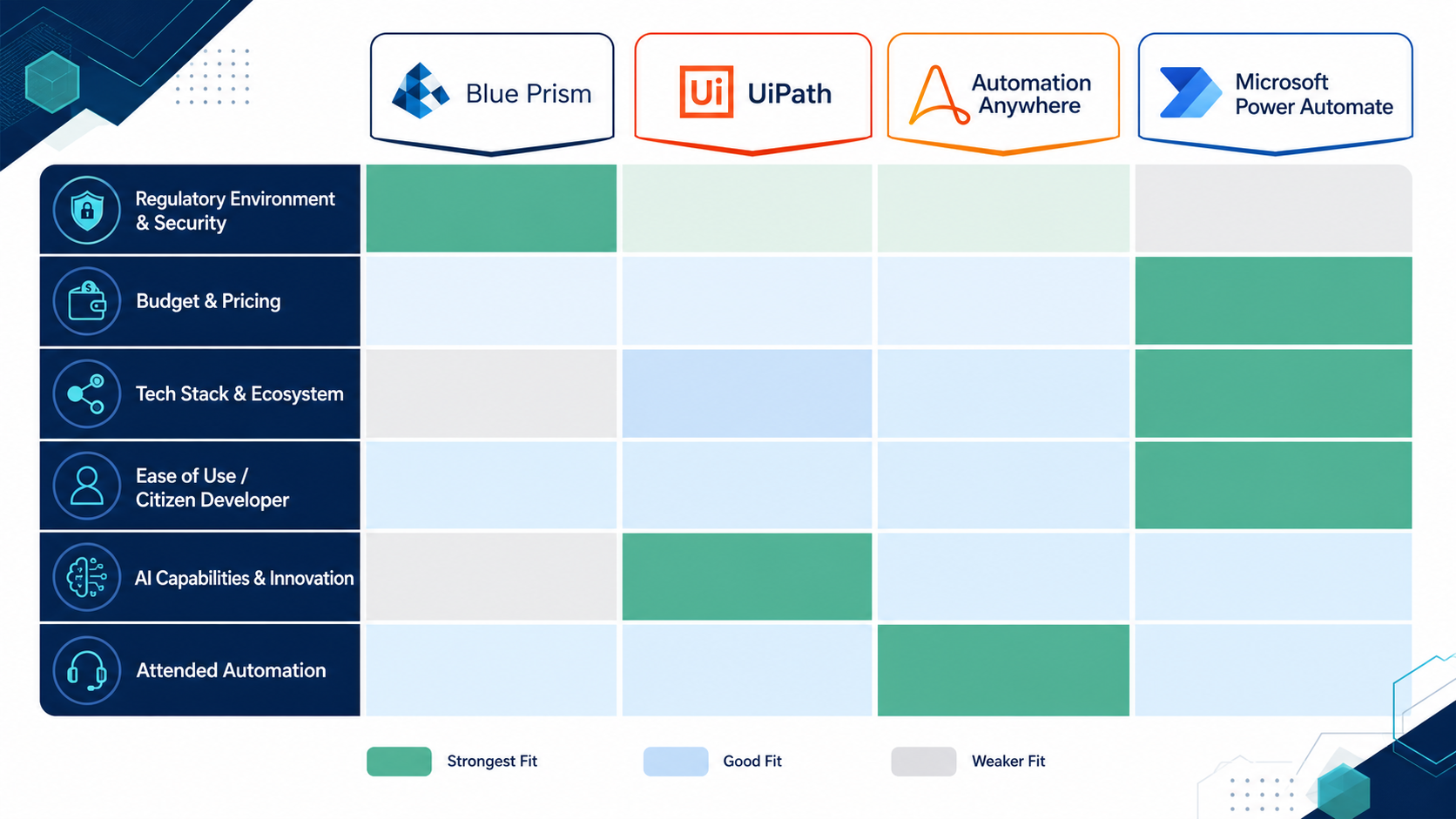
The right platform depends on three factors: your regulatory environment, your budget, and your existing tech stack. The table below maps common buyer profiles to the best-fit platform.
| If You Are... | Choose This Platform | Why |
|---|---|---|
| A regulated enterprise (finance, healthcare, government) with high security requirements and a large budget | Blue Prism | Veracode Level 5 security, ironclad audit trails, and deep experience in regulated environments make it the safest choice, despite the high cost. |
| A large enterprise with diverse automation needs, a strong developer team, and a moderate-to-high budget | UiPath | Market-leading ecosystem, flexible deployment, strong AI capabilities, and the largest talent pool make UiPath the safest bet for broad automation programs. |
| An enterprise that wants cloud-native agility, strong document processing, and attended automation | Automation Anywhere | Cloud-native architecture, IQ Bot for document AI, and strong attended automation make it ideal for organizations that want to move fast and handle unstructured data. |
| A Microsoft-centric organization with a limited budget and a focus on departmental automation | Microsoft Power Automate | Unbeatable value at $15/user/month, deep Microsoft ecosystem integration, and citizen developer accessibility make it the obvious choice for Microsoft shops. |
| A small or mid-size business evaluating RPA for the first time | Microsoft Power Automate or Automation Anywhere | Power Automate for Microsoft shops; Automation Anywhere for cloud-native flexibility. Both offer lower entry costs and faster time-to-value than Blue Prism or UiPath. |
The AI Agent Disruption: How Agentic Automation Is Reshaping RPA
The biggest trend in automation in 2026 is the shift from traditional RPA — where bots follow rigid, predefined rules — to agentic automation, where AI agents can perceive their environment, make decisions, and take actions autonomously. This shift is forcing every RPA vendor to reinvent itself, and the way each platform responds tells you a lot about its long-term trajectory.
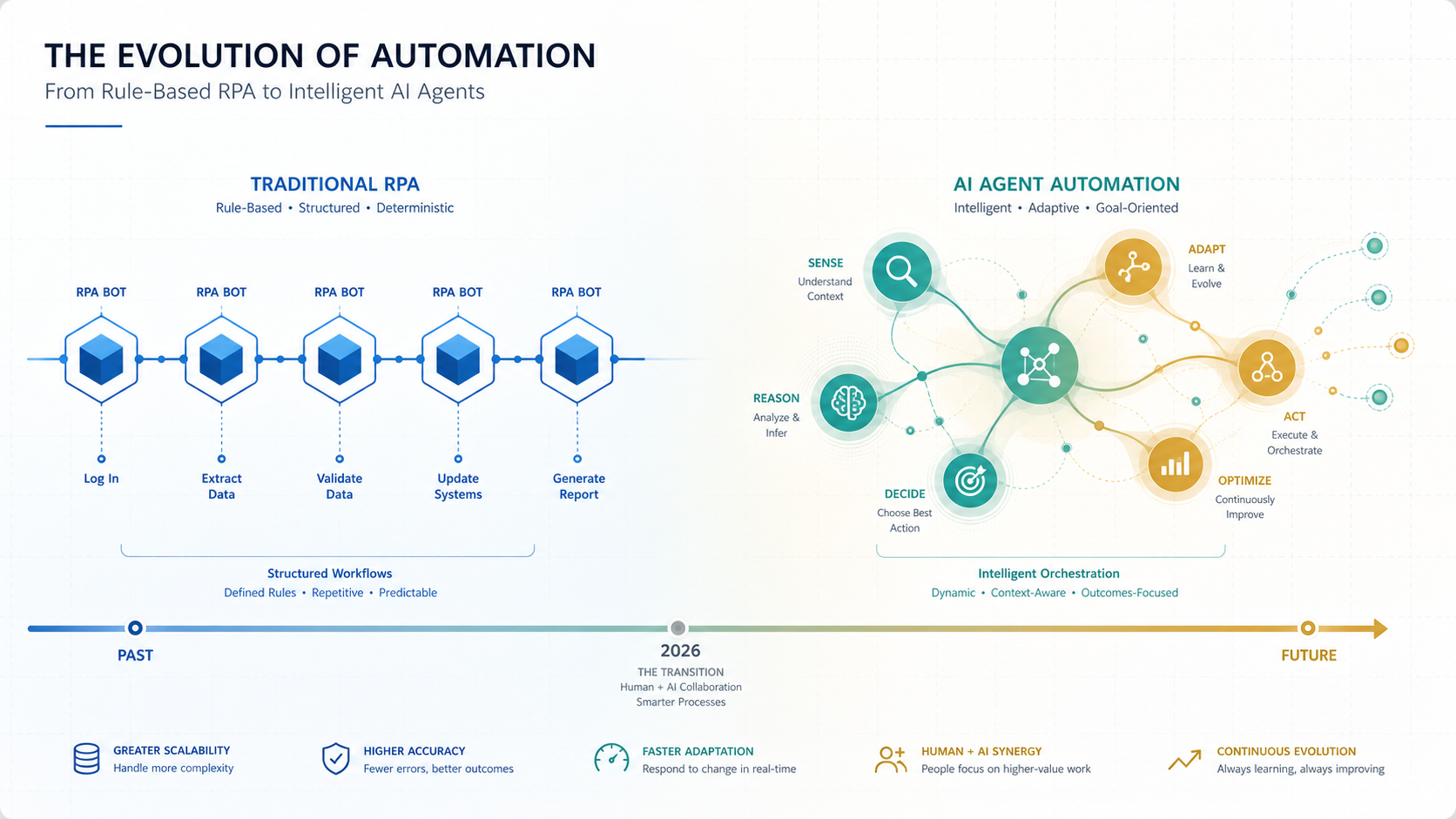
Blue Prism is betting that its security pedigree will give it an edge in the AI agent era. Its AI Gateway and WorkHQ platform are designed to provide a secure, auditable environment for deploying AI agents in regulated industries. The company reports 3,571 production AI agents and 35 AI agents processing 500,000 transactions. Gartner named SS&C Blue Prism a Leader in the 2025 Magic Quadrant for RPA for the seventh consecutive year, suggesting that its AI pivot is gaining traction.
UiPath is taking a different approach, embedding AI into every layer of its platform. Autopilot uses generative AI to help developers design automations faster, while Maestro orchestrates complex workflows involving both traditional bots and AI agents. UiPath's massive developer community gives it a significant advantage in the AI era — more developers building AI-enhanced automations means more pre-built components and faster innovation.
Automation Anywhere is focusing its AI efforts on document intelligence and attended automation. Automation Co-Pilot brings generative AI to automation design and management, while IQ Bot continues to evolve as a specialized AI for document processing. The cloud-native architecture makes it easier to deploy AI models and scale them across the organization.
Microsoft is weaving AI into Power Automate through Copilot and AI Builder. Copilot allows users to describe an automation in natural language and have it built automatically. AI Builder provides pre-built AI models for common tasks like form processing and object detection. For organizations already in the Microsoft ecosystem, this makes AI-powered automation accessible to non-developers.
Verdict: The Right Platform Depends on Your Context
There is no single "best" RPA platform in 2026. Blue Prism, UiPath, Automation Anywhere, and Microsoft Power Automate are all capable tools, but they serve fundamentally different buyer profiles. The choice comes down to three questions:
- What is your regulatory environment? If you are in a highly regulated industry with strict compliance requirements, Blue Prism's security credentials and audit trails make it the safest choice — despite its high cost and declining market share.
- What is your budget? If you are a Microsoft-centric organization with a limited budget, Power Automate offers unbeatable value. If you have a larger budget and need broad automation capabilities, UiPath is the market leader for good reason.
- What is your existing tech stack? If you are already deep in the Microsoft ecosystem, Power Automate is the obvious choice. If you have a heterogeneous tech stack and need cloud-native agility, Automation Anywhere is a strong contender. If you need on-premises deployment and enterprise-grade security, Blue Prism or UiPath are your best options.
The AI agent disruption adds another layer to this decision. All four platforms are investing heavily in AI capabilities, but they are approaching it from different angles. Blue Prism is building a secure AI gateway for regulated industries. UiPath is embedding AI into its entire ecosystem. Automation Anywhere is focusing on cloud-native document intelligence. Microsoft is making AI-powered automation accessible to everyone through Copilot and AI Builder.
The platform you choose today will shape your automation capabilities for years to come. Choose based on your current needs, but keep an eye on each platform's AI trajectory. The vendors that successfully bridge the gap between traditional RPA and agentic automation will be the ones that deliver the most value in the long run.