
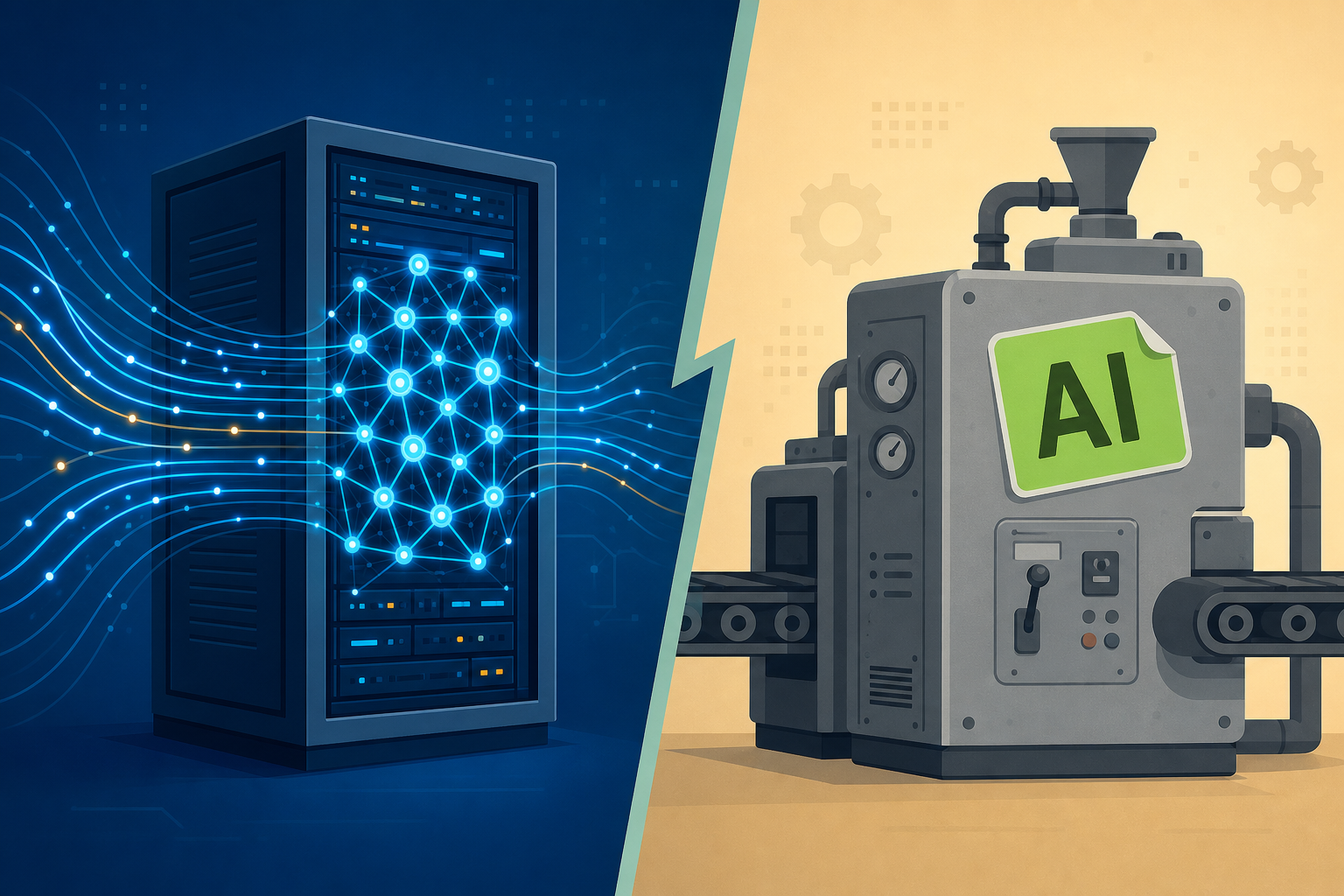
The AI-Automation Spectrum: From Rule-Based Engines to Autonomous Agents
Every process automation platform in 2026 claims to be "AI-powered." But the term covers everything from a simple if-this-then-that rule with a machine-learning label to a multi-agent orchestration system that plans, executes, and reflects on its own outputs. Understanding where a platform sits on this spectrum is the first step toward separating genuine capability from marketing veneer.
The Four Levels of Automation Intelligence
The automation landscape can be broken into four distinct tiers. Each tier represents a fundamentally different architectural approach, not just a feature toggle.
- Rule-Based: Fixed logic with no adaptation. Every path is hardcoded. Examples include basic email filters and legacy BPMN engines. These systems never learn from outcomes.
- Conditional Logic: Branching workflows with decision nodes. The system can choose between predefined paths based on input data, but it cannot generate new paths or infer context beyond the explicit rules.
- ML-Enhanced: Workflows that incorporate machine learning models for specific tasks — classification, prediction, or natural language processing. The workflow itself remains deterministic, but individual steps use AI models to process data. Kissflow's predictive routing and NLP-powered form processing sit here.
- Autonomous AI Agents: Workflows where an AI agent plans, executes multi-step tasks, maintains memory across sessions, and adapts its approach based on results. This is the tier that n8n's LangChain integration, Zapier Agents, and Workato's AIRO target. These systems can reason about what to do next, not just follow a script.
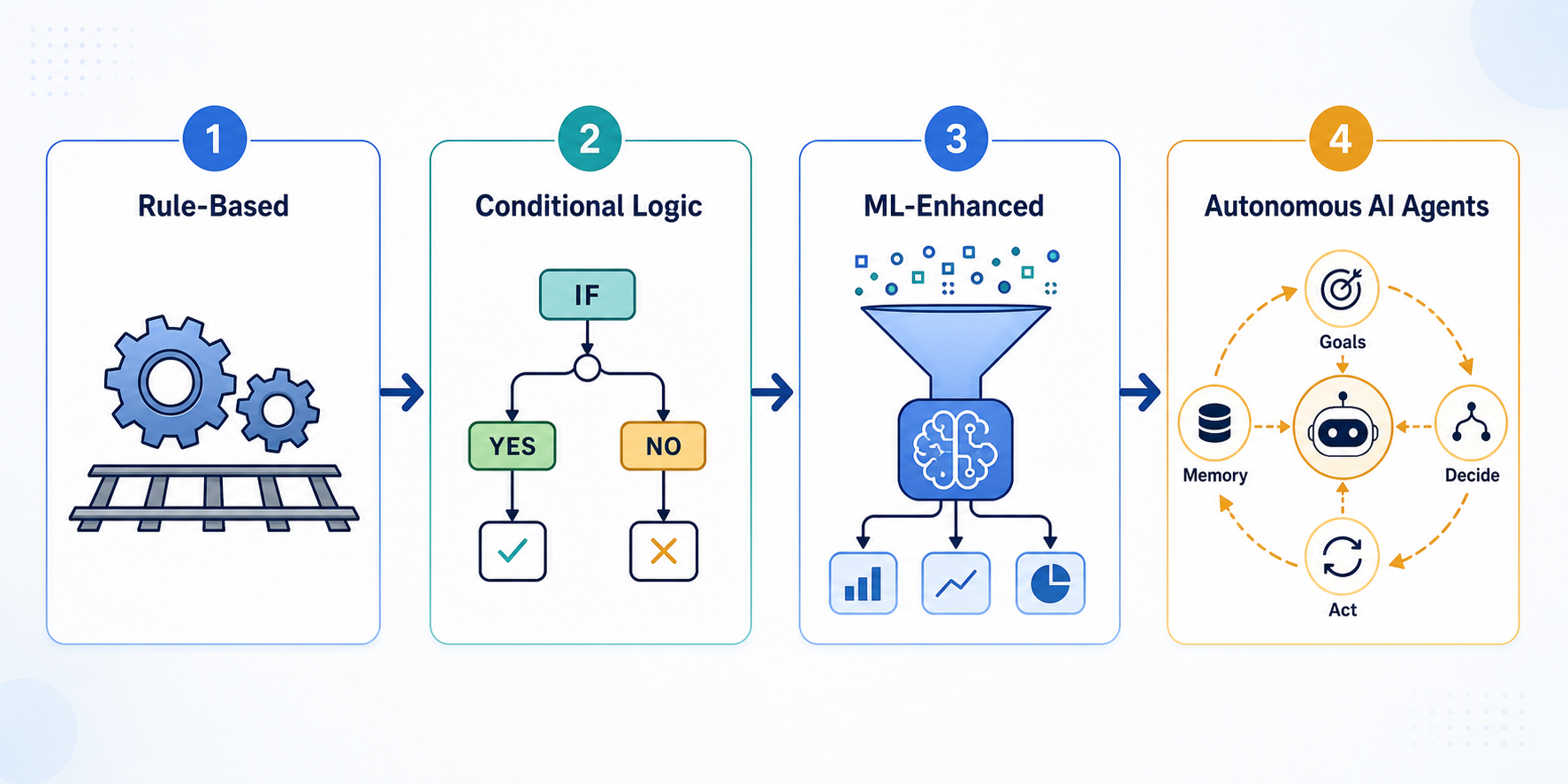
The critical insight for decision-makers is that most enterprise "AI automation" platforms in 2026 still operate at tier two or three. They bolt an AI model onto a step in a BPMN workflow, but the underlying orchestration engine has no awareness of what the AI is doing. A platform that lets you add an OpenAI call to a rule-based workflow is not the same as a platform where an AI agent decides which tools to call and in what order.
For readers who need a refresher on how these categories map to the broader automation ecosystem, our Workflow Orchestration vs. Automation vs. BPM vs. iPaaS decision guide provides the terminology framework used throughout this analysis.
Deep-Dive: AI Capabilities Across the Leading Platforms
The 2026 releases of the major automation platforms reveal a clear divide. Some invested in architectural AI depth — native LangChain integration, persistent agent memory, and self-hosted model support. Others added AI features as a surface layer on top of unchanged orchestration engines. The table below maps the key AI capabilities for five platforms that span the market.
| Capability | n8n 2.0 | Zapier (2026) | Make (2026) | Kissflow | Workato |
|---|---|---|---|---|---|
| AI agent orchestration | Multi-agent via AI Agent Tool Node | Zapier Agents (autonomous) | Make AI Agents | Predictive routing only | AIRO / Genies |
| Native LLM integration | LangChain, 70+ AI nodes | AI Copilot (natural language Zap creation) | Maia AI assistant | NLP form processing | Custom LLM connectors |
| Persistent agent memory | Yes — cross-execution memory | Limited session context | Limited session context | No | Enterprise context store |
| Self-hosted LLM support | Yes — full support | No — cloud only | No — cloud only | No — cloud only | No — cloud only |
| RAG / vector database support | Yes — native vector DB nodes | No | No | No | Via custom connector |
| Sandboxed code execution | Yes | No | No | No | Limited |
| Integration count | 1,000+ (unlimited via HTTP) | 8,000+ | 1,500–2,000 | Enterprise connectors | Enterprise connectors |
n8n 2.0: The Architectural Leap
n8n's January 2026 2.0 release represents the most significant architectural investment in AI-native automation among the platforms evaluated. The introduction of 70+ dedicated AI nodes, native LangChain integration, and persistent agent memory moves n8n from a developer-friendly workflow tool into a genuine AI orchestration platform. The AI Agent Tool Node allows multi-agent orchestration — one agent can delegate subtasks to specialized agents, each with its own memory and tool access.
For organizations that need to run AI workflows in regulated environments, n8n's self-hosted LLM support is a decisive differentiator. It is the only major platform that allows teams to run large language models on their own infrastructure, keeping data within internal servers. This capability directly addresses HIPAA, GDPR, and SOC 2 compliance requirements that cloud-only platforms cannot meet.
Zapier and Make: Accessible AI Agents with Guardrails
Zapier's 2026 update introduced Zapier Agents for autonomous AI task execution across its 8,000+ integrations, alongside an AI Copilot that builds Zaps from natural language descriptions. At $33.33/month for the Agents add-on, this is the lowest-cost entry point for non-technical teams to experiment with AI automation. However, Zapier's per-task pricing model means that AI-heavy workflows — which often require multiple steps per decision — can become expensive at scale.
Make's 2026 additions include the Maia AI assistant, which builds automation scenarios from natural language descriptions, and Make AI Agents. Make's credit-based pricing model introduces similar cost unpredictability for AI workflows. A single AI agent execution might consume credits for the LLM call, the tool calls, and the data transformation steps, making it difficult to budget for variable-volume automation.
For a detailed breakdown of how these pricing models affect total cost of ownership, see our analysis of the AI workflow automation token cost trap, which compares agent-based and deterministic workflow economics.
Kissflow and Workato: Enterprise BPM with AI Layers
Kissflow's AI capabilities — predictive routing, NLP-powered form processing, and smart exception handling — are purpose-built for enterprise business process management. These features add intelligence to specific steps within a BPMN workflow, but the orchestration engine itself remains rule-based. Kissflow is a strong choice for organizations that want AI-enhanced process management without rebuilding their BPM infrastructure, but it does not offer autonomous agent capabilities.
Workato's AIRO and Genies provide enterprise-grade AI automation with custom LLM connectors and a context store for maintaining state across workflows. Workato targets large enterprises with complex integration needs, but its pricing is custom-quoted and typically starts at $10,000/year, often reaching $50,000+ for substantial deployments. For organizations that already have Workato in their stack, the AI features add genuine value. For those evaluating a new platform, the opaque pricing and cloud-only deployment are significant considerations.
Real-World Benchmarks: Multi-Agent Workflows, CRM Updates, and Natural Language Creation
Architecture diagrams and feature lists only tell part of the story. The real test is how each platform handles concrete business scenarios. Below are three common use cases that reveal the practical differences between genuine AI depth and surface-level AI integration.
Scenario 1: Multi-Agent Content Generation Workflow (n8n)
A marketing team needs to generate, review, and publish weekly social media content across four channels. In n8n, this can be built as a multi-agent workflow:
- A research agent pulls trending topics from RSS feeds and social listening APIs, storing results in a vector database for RAG retrieval.
- A content agent receives the research context and generates draft posts using a self-hosted LLM, with persistent memory of previous post performance.
- A compliance agent reviews each draft against brand guidelines stored in a separate knowledge base, flagging violations before human review.
- A publishing agent schedules approved posts across platforms via API calls, logging results back to the vector database for future reference.
This workflow uses n8n's AI Agent Tool Node for multi-agent orchestration, LangChain integration for LLM calls, and vector database support for RAG. Each agent has its own memory context, and the entire workflow counts as a single execution under n8n's pricing model.
Scenario 2: Autonomous CRM Update (Zapier Agents)
A sales team receives lead data from multiple sources — web forms, email inquiries, and LinkedIn messages. Zapier Agents can be configured to:
- Parse incoming messages using natural language understanding to extract contact details, company size, and intent signals.
- Check the CRM for existing records and decide whether to create a new contact or update an existing one.
- Assign a lead score based on predefined criteria and route high-scoring leads to the appropriate sales representative via Slack.
- Log the interaction and update the CRM record with the AI-generated summary.
Zapier's strength here is the breadth of integrations — 8,000+ apps mean the agent can interact with virtually any CRM, messaging platform, or data source without custom API work. The limitation is that each step in the agent's reasoning process may count as a separate task, making high-volume lead processing expensive under Zapier's per-task pricing.
Scenario 3: Natural Language Scenario Creation (Make Maia)
A non-technical operations manager needs to create an invoice approval workflow. Using Make's Maia AI assistant, they can describe the process in natural language: "When a new invoice arrives in Gmail, extract the amount and vendor name, check if the amount is under $5,000, and if so, send it to the accounting team in Slack for approval. If approved, create a payment record in QuickBooks."
Maia translates this description into a Make scenario with the appropriate modules and connections. This dramatically reduces the time to create simple workflows, but the resulting scenario is still a deterministic rule-based flow — Maia does not add adaptive intelligence or agentic decision-making to the workflow itself.
Human-in-the-Loop: Which Platforms Support Meaningful Review Gates?
Autonomous AI execution is powerful, but most organizations — especially in regulated industries — need human oversight at critical decision points. The way each platform handles human-in-the-loop (HITL) workflows is a critical differentiator that is often overlooked in AI capability comparisons.
| HITL Feature | n8n | Zapier | Make | Kissflow | Workato |
|---|---|---|---|---|---|
| Approval gates in AI workflows | Yes — native approval nodes | Limited — via email/Slack steps | Yes — approval modules | Native — BPMN-based | Yes — enterprise approval workflows |
| Pause-and-resume for AI agents | Yes — agent can pause for input | No — agents execute autonomously | No — agents execute autonomously | N/A — no agent capability | Limited — via custom logic |
| Audit trail for AI decisions | Full execution logs + RBAC | Task history | Scenario history | BPMN audit trail | Enterprise audit logging |
| Manual override of AI decisions | Yes — pause, edit, resume | No — must stop and re-create | No — must stop and re-create | Yes — BPMN manual tasks | Yes — enterprise workflows |
| Role-based access for approvals | Yes — RBAC built in | No — team-level only | Limited — team-level | Yes — enterprise RBAC | Yes — enterprise RBAC |
For risk-averse organizations, the ability to pause an AI agent mid-execution, review its reasoning, and either approve, modify, or reject its next action is essential. n8n's architecture supports this natively — an AI agent can be configured to pause at any decision point, present its reasoning to a human reviewer via a dashboard or notification, and resume only after receiving input. This is fundamentally different from platforms where the AI executes autonomously and the human can only review the outcome after the fact.
Security and Compliance: The Self-Hosting Advantage for Regulated Industries
When AI automation involves processing customer data, financial records, or protected health information, the question of where the data travels becomes a compliance issue. Most cloud-based automation platforms send data to third-party LLM providers — OpenAI, Anthropic, Google — as part of AI agent execution. For organizations subject to HIPAA, GDPR, or SOC 2 requirements, this data flow can create compliance gaps that are difficult to close.
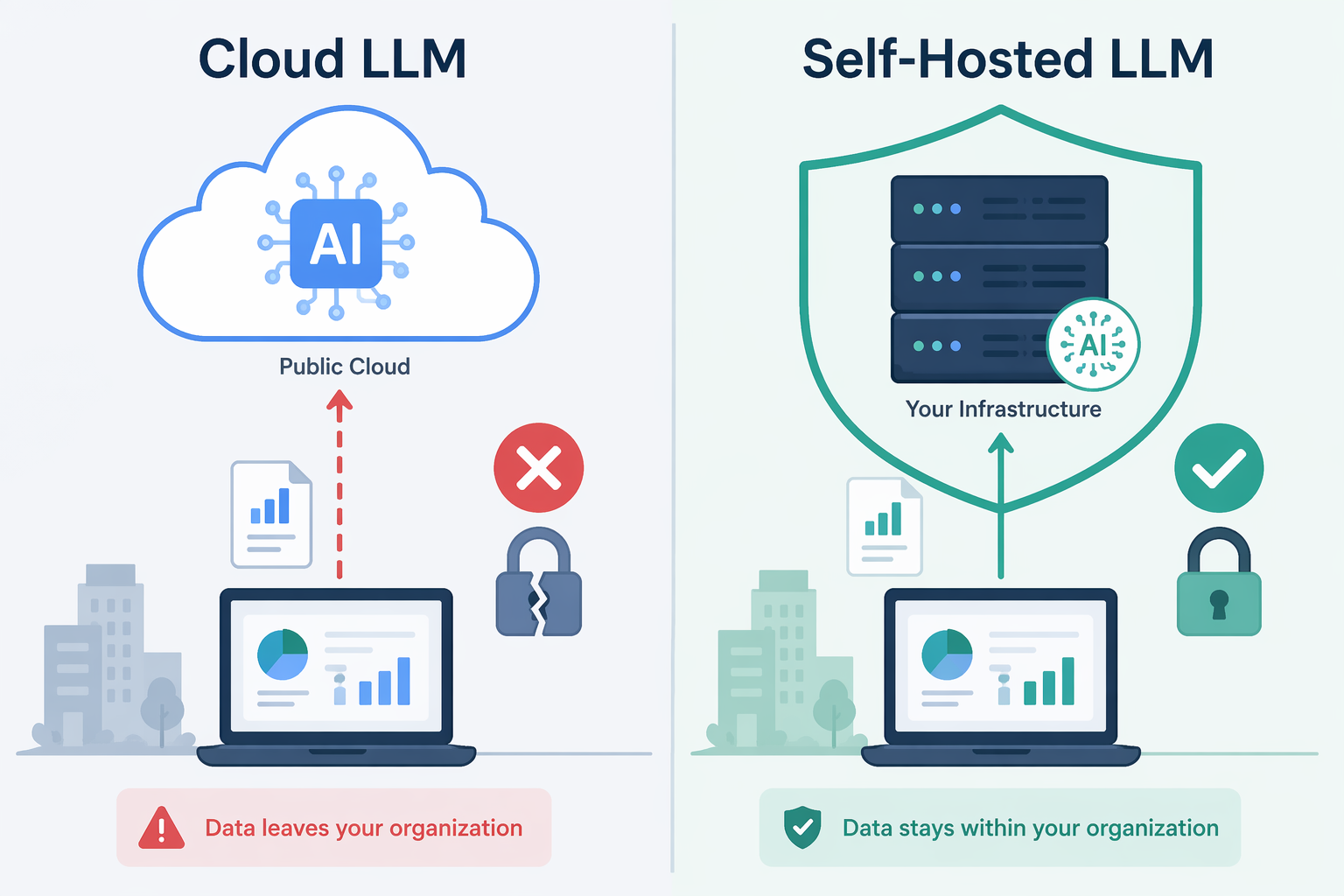
n8n is the only major platform evaluated that supports self-hosted LLMs alongside workflows. This means an organization can run an open-source model like Llama 3 or Mistral on its own infrastructure, with the automation workflow calling the local model endpoint. Data never leaves the internal network. For healthcare organizations processing patient records or financial institutions handling transaction data, this capability is not a nice-to-have — it is a prerequisite for AI automation.
n8n also supports SOC 2 Type II and SOC 3 compliance, secret management via AWS, GCP, Azure, and HashiCorp Vault, and role-based access control (RBAC) for workflow and agent permissions. These enterprise security features, combined with self-hosted deployment, make n8n the strongest option for regulated industries seeking AI automation.
For organizations in banking, insurance, and healthcare that require even stricter governance, our analysis of why Blue Prism remains the choice for regulated industries provides context on how traditional RPA platforms approach compliance compared to AI-native automation.
The Gartner Prediction: Preparing for Agentic AI in Your Automation Strategy
The shift toward AI-native automation is not speculative. Gartner VP Analyst Saikat Ray has stated that by 2028, 15% of day-to-day business decisions will be made autonomously by agentic AI, and 33% of enterprise software applications will embed such capabilities — an exponential shift from 2024's negligible levels.
"By 2028, 15% of day-to-day business decisions will be made autonomously by agentic AI, and 33% of enterprise software applications will embed such capabilities — an exponential shift from 2024's negligible levels." — Saikat Ray, VP Analyst, Gartner
This prediction has direct implications for the platform selection process. Organizations that choose a platform with genuine AI architecture today — one that supports multi-agent orchestration, persistent memory, and self-hosted models — will be positioned to adopt agentic AI workflows as the technology matures. Organizations that choose a platform with superficial AI features bolted onto a legacy rule engine will face a costly migration when their automation needs outgrow the platform's capabilities.
The question is not whether your organization will use agentic AI — the Gartner prediction suggests it is inevitable for most enterprises. The question is whether your current automation platform can support it without requiring a complete rebuild in two years.
Recommendation Matrix: Choosing the Right Platform for Your AI Maturity Needs
No single platform is the right choice for every organization. The table below maps each platform to specific organizational profiles, AI maturity levels, and use cases. Use it as a starting point for your evaluation, not as a final verdict.
| Platform | Best For | AI Maturity Level | Key Limitation | Not For You If |
|---|---|---|---|---|
| n8n | Technical teams needing self-hosted, deep AI orchestration with multi-agent workflows and compliance readiness | Autonomous agents (Tier 4) | Requires technical expertise for self-hosted deployment; smaller native integration library than Zapier | You need a no-code solution for non-technical team members, or you prefer a fully managed cloud service |
| Zapier | Non-technical teams wanting easy AI agent experimentation across 8,000+ apps | Autonomous agents (Tier 4) with limited depth | Per-task pricing makes AI-heavy workflows expensive; no self-hosted option; limited agent memory | You need complex multi-agent orchestration, self-hosted LLMs, or cost-predictable high-volume AI automation |
| Make | Visual power-users who want natural language scenario creation and AI agents at a lower entry price | AI-assisted deterministic (Tier 3) | Credit-based pricing creates cost unpredictability for AI workflows; agents lack persistent memory | You need enterprise compliance features, self-hosted deployment, or multi-agent orchestration |
| Kissflow | Enterprise BPM teams wanting AI-enhanced process management with predictive analytics and NLP | ML-enhanced BPM (Tier 3) | No autonomous agent capabilities; AI is a layer on BPMN workflows, not native orchestration | You need general-purpose workflow automation outside of structured BPM processes, or agentic AI |
| Workato | Large enterprises with existing Workato investment needing enterprise AI automation with custom LLM connectors | Autonomous agents (Tier 4) with enterprise guardrails | Custom pricing ($10k–$50k+); cloud-only; complex setup; overkill for small-to-mid-size teams | You are a small or mid-size team, need transparent pricing, or require self-hosted deployment |
For a broader comparison that includes platforms not covered in this AI-depth analysis, see our best process automation tools compared by tier for knowledge workers and teams. And for organizations weighing the tradeoffs between no-code accessibility and developer flexibility, our AI workflow automation showdown between no-code platforms and developer tools provides additional context.
The 2026 automation market rewards organizations that look past AI marketing labels and evaluate architectural depth. Platforms that invested in native AI agent capabilities — n8n with LangChain and self-hosted LLMs, Workato with AIRO, Zapier with Agents — offer genuine intelligent workflow capabilities. Platforms that added AI as a feature layer on legacy rule engines will struggle to keep pace as agentic AI becomes the standard. Choose accordingly.