
Bill Gates' August 26, 2026 essay makes a sharper claim than the familiar idea that AI will automate office routines. Its target is human cognition itself: AI can now “replace and even exceed human cognition,” Gates writes, and the first serious disruption will reach entry- and mid-level knowledge workers before it reaches everyone else. He expects the change to arrive “over the course of a decade rather than a few generations.” [1]
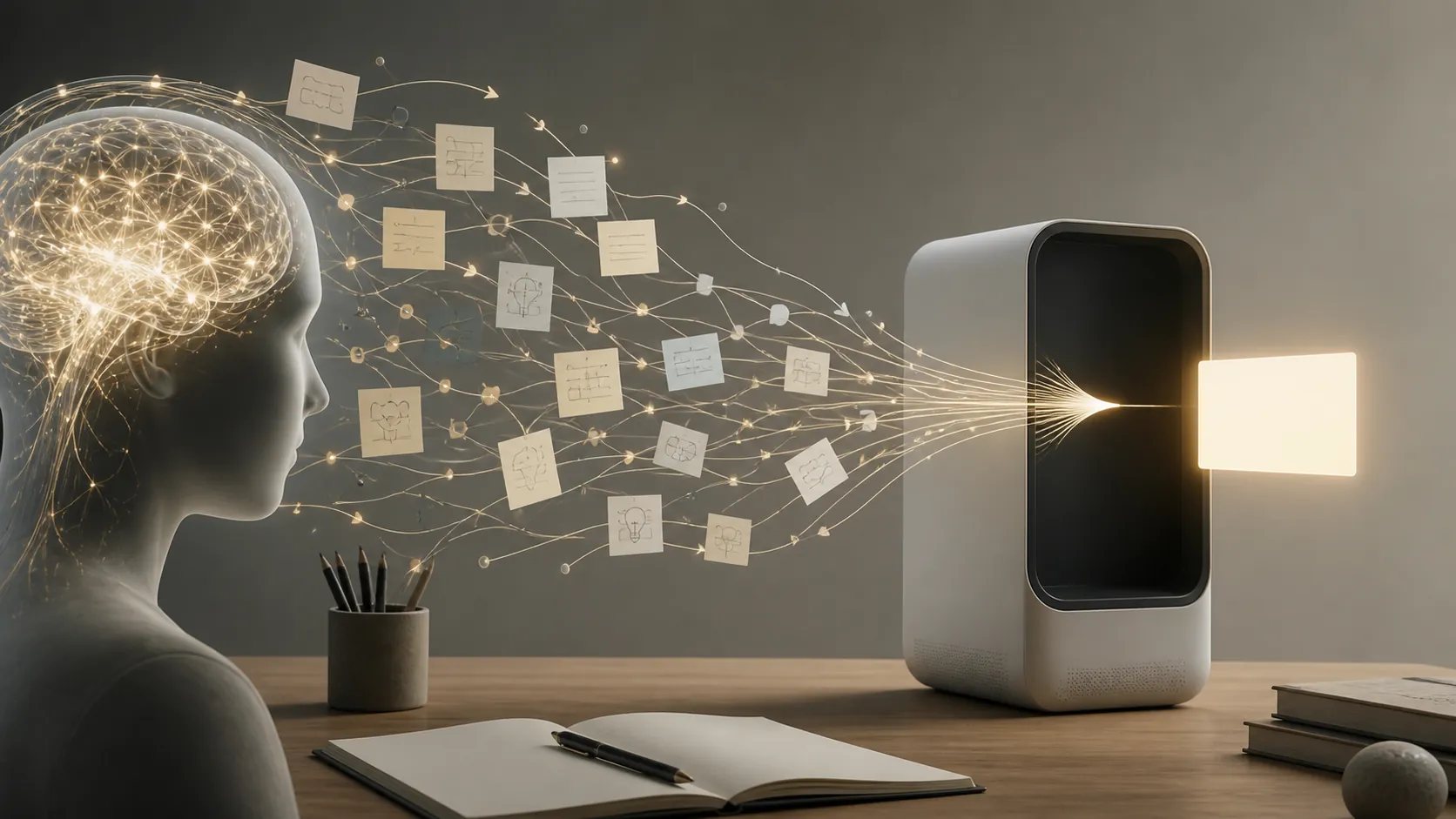
That is a meaningful departure from the optimism of Gates' March 2023 essay, “The Age of AI Has Begun,” where the emphasis was on AI as a tool that could help people work, learn, and solve problems. [4] In the new memo, the question is less whether AI can assist a knowledge worker and more when assistance becomes substitution: when the system produces work reliably enough that the person who used to check it is no longer required.
What Gates is actually predicting
Gates' sequence begins with jobs that already contain large amounts of structured language and judgment: sales, customer support, software engineering, and paralegal work. He then points toward loan assessment, data analysis, and patient triage. The jobs most exposed, in his account, are entry- and mid-level roles—the positions where people often gather experience by reviewing documents, preparing first drafts, classifying cases, and correcting routine mistakes.
The essay does not say that all white-collar employment has already disappeared. Its more limited present-tense claim is that white-collar work is “already being hit modestly.” The larger disruption is conditional on a future capability: “nearly error-free work” that can run “without a human checking in on it.” Gates also argues that waiting until people are already displaced or underemployed will be too late.
That condition matters. A system that drafts a competent answer still creates work for the person who checks sources, repairs omissions, handles exceptions, and accepts responsibility for the result. Gates' forecast treats the removal of that checking layer as the decisive inflection point. The essay does not establish when that point will arrive.
The Stanford evidence is narrower than the headline
The memo links to a Stanford Digital Economy Lab paper, “Canaries in the Coal Mine? Six Facts about the Recent Employment Effects of Artificial Intelligence.” Using ADP monthly payroll data through September 2025, the paper reports a 16% relative employment decline for workers ages 22–25 in occupations more exposed to AI, while older workers in those occupations remained stable. [2]
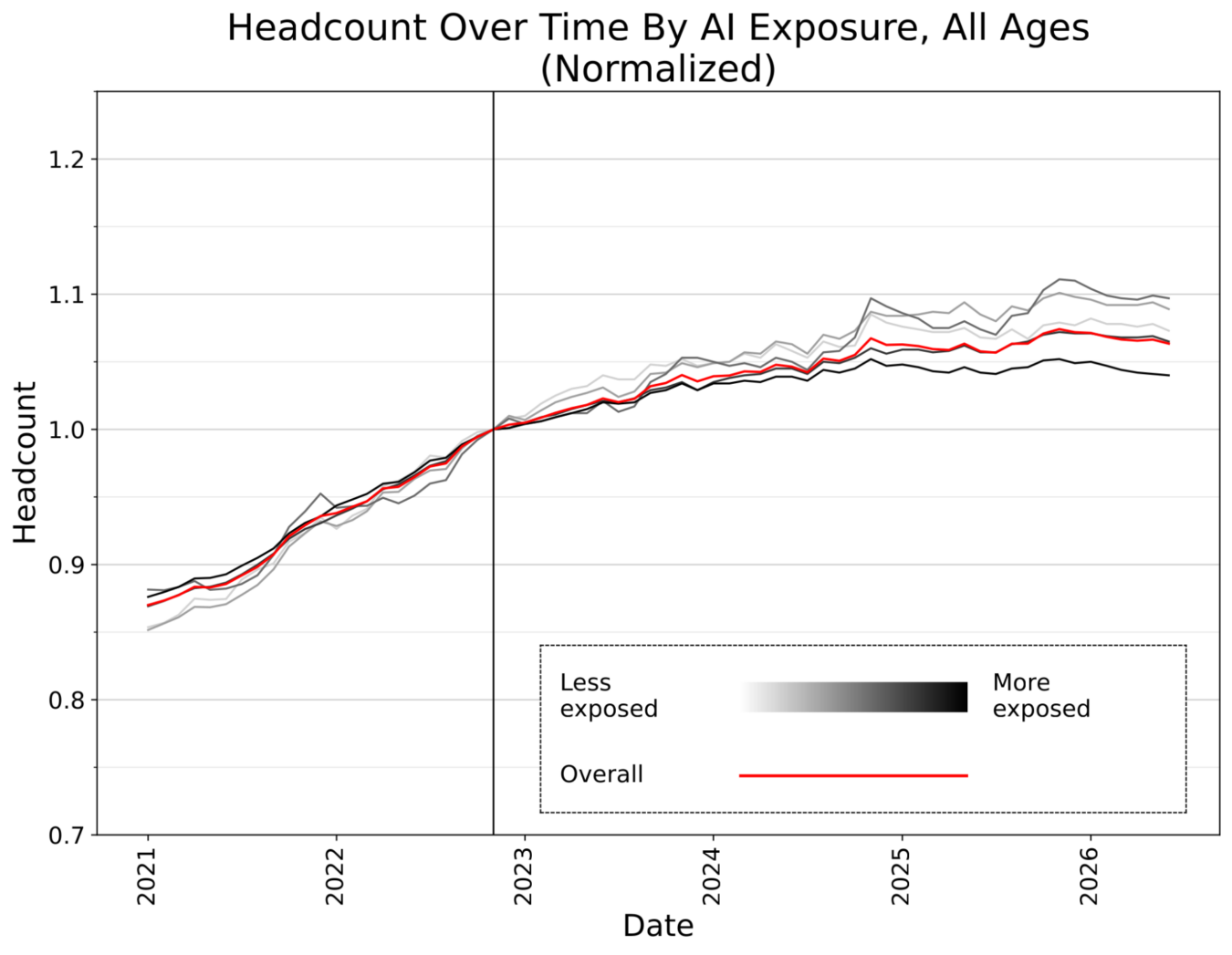
That is important evidence for a distributional problem: younger workers may be encountering a weaker entry point into occupations where AI can perform some of the tasks that once trained beginners. It is also consistent with Gates' focus on entry-level jobs.
It is not evidence that AI has already eliminated knowledge work generally. The finding concerns a specific age group, a defined set of AI-exposed occupations, and an employment measure. It reports an association between exposure and employment trends; it does not by itself show that AI caused every part of the decline. Nor does stable employment among older workers prove that their jobs are safe. It simply makes the broadest version of the memo's claim harder to defend than the narrower one.
For a new analyst, junior developer, researcher, or paralegal, the consequence is more specific than “a robot will take your job.” The first loss may be the supervised work that teaches the job: assembling the initial dataset, writing the first memo, handling a low-risk case, or comparing a model's output with the source material. If those tasks are automated, employers may still need experienced people to review the difficult cases while offering fewer opportunities to become experienced.
The critical-thinking survey points to a mechanism, not a verdict
Gates also cites Gerlich's study, “AI Tools in Society: Impacts on Cognitive Offloading and the Future of Critical Thinking.” The survey included 666 participants and reported an association between greater AI use, cognitive offloading, and lower critical-thinking performance, with a stronger reported effect among younger participants. Gates presents it cautiously: “one preliminary survey suggested.” [3]
The useful idea here is cognitive offloading: delegating a reasoning step rather than merely using a tool to reduce clerical effort. Asking software to format notes or search a document is different from asking it to decide what the document means, which objections matter, or whether the evidence supports a conclusion. The survey may indicate that repeated delegation is related to weaker engagement with those steps. It does not prove that AI use causes declining critical thinking, and it cannot tell us from its design whether a person who already relies less on deliberate reasoning is simply more likely to use AI.
That distinction is examined in the site's review of Did AI Actually Improve Note-Taking and Knowledge Work?. For someone maintaining notes, the risk is not that every generated summary makes them less intelligent. It is that the record gradually preserves the conclusion while losing the route taken to reach it.
Two columns: what can be checked and what still requires judgment
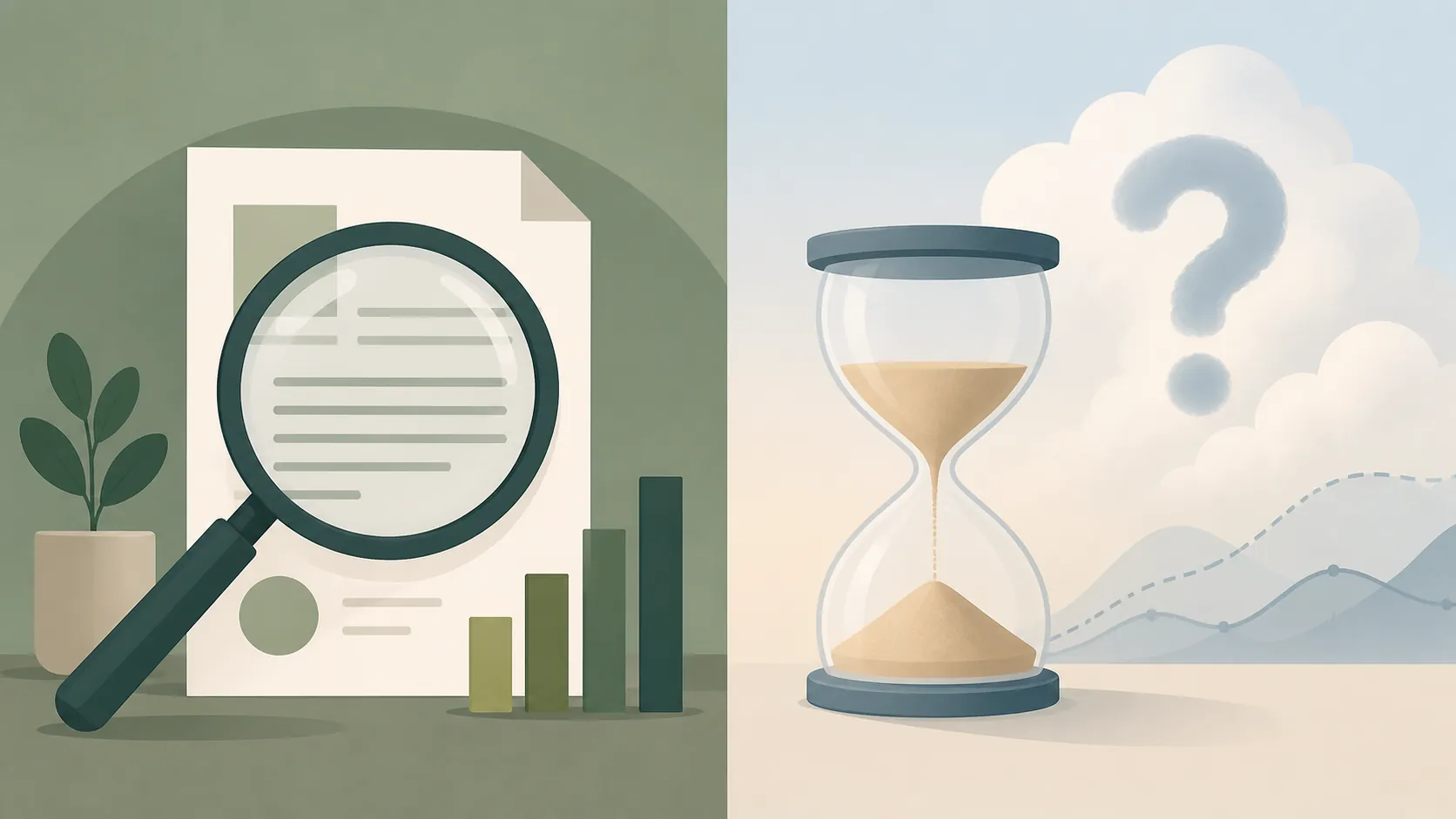
The memo becomes easier to evaluate when its materials are separated into two mental columns.
| Evidence column | Forecast column |
|---|---|
| The Stanford paper's reported employment decline among 22–25-year-olds in AI-exposed occupations, with older workers stable. | Knowledge-work disruption will unfold rapidly over roughly a decade. |
| Gerlich's survey of 666 participants and its reported association between AI use, cognitive offloading, and critical thinking. | AI will reach a “nearly error-free” level at which human checking is no longer needed. |
| The memo's present-tense claim that white-collar work is already being affected modestly. | Entry- and mid-level knowledge jobs will be the first broad wave of disruption. |
| The fact that both cited studies offer narrower findings than the memo's overall direction of travel. | A token-based tax can reliably capture the economic value of AI inference. |
The evidence column deserves attention without being inflated. The Stanford result is a warning about who may lose access to early-career work. The Gerlich result gives a plausible mechanism for why outsourcing reasoning could matter. Neither supplies a schedule for the labor market or a general law about human intelligence.
The forecast column is where the memo asks the reader to exercise judgment. A more reliable output does not, by itself, establish the date on which verification becomes unnecessary. Reliability is also task-specific: a clean summary can still omit the one qualification that changes a decision, and an apparently correct answer can leave no durable trail showing which sources were considered.
Productivity still depends on what remains in the record
For note-taking, this is the practical boundary. AI can be a processing layer beside a note app: it can extract themes, compare passages, suggest links, or turn rough material into a usable draft. It should not quietly become the only place where the reasoning exists. The discussion in Can ChatGPT Replace Your Note-Taking App? makes that division explicit.
The same issue appears in search. A generated answer may be faster to consume than a page of notes, but speed does not preserve the source, the uncertainty, or the discarded alternatives. Can AI Search Summaries Replace Your Note-Taking App? follows the durable-record question that Gates' “without a human checking” threshold leaves unresolved.
This is why the difference between clerical automation and reasoning substitution matters. If the tool removes transcription, formatting, or retrieval, the underlying judgment can remain visible. If it removes source comparison and conclusion-building, the user may retain a polished answer while losing the evidence of how it was formed.
The policy proposals are less settled than the employment warning
Gates' proposals for managing the transition include a tax tied to AI tokens and a large role for philanthropy and public policy. The essay also discloses his financial ties and notes that the Gates Foundation has about 19 years left to spend roughly $200 billion. Those details do not invalidate the argument, but they are relevant context for reading its recommendations as proposals from a participant in the technology economy, not as neutral measurements.
The token-tax idea also has a straightforward mechanism problem. A levy collected at metered API boundaries is easier to apply to hosted services than to local or open-weight inference, which can bypass that measurement point. That does not settle the broader question of how AI should be taxed, but it means the memo's proposed mechanism cannot be treated as an established solution.
A serious warning, not a settled timetable
Gates' direction-of-travel claim deserves attention. AI is being applied to work built around language, analysis, classification, and decisions; early-career workers may be exposed before established workers; and delegating reasoning can change what people practice. The Stanford employment finding and the Gerlich survey give those concerns real, checkable anchors, provided their limits stay attached.
What the memo does not provide is comparable evidence for its decade schedule, its “nearly error-free” threshold, or its token-tax mechanics. Those belong in the forecast column. For a knowledge worker, the immediate implication is less dramatic and more demanding: keep the sources, record the reasoning, and treat AI output as work to evaluate until the evidence—not the confidence of the memo—shows that checking can safely disappear.
References
- The turbulent AI era is here. The choices we make now are critical — LinkedIn, August 26, 2026
- Canaries in the Coal Mine? Six Facts about the Recent Employment Effects of Artificial Intelligence — Stanford Digital Economy Lab, November 13, 2025
- AI Tools in Society: Impacts on Cognitive Offloading and the Future of Critical Thinking — Societies, January 3, 2025
- The Age of AI Has Begun — GatesNotes, March 2023
Comments
Join the discussion with an anonymous comment.