
Generative AI became ordinary infrastructure in knowledge work during 2025. By August, 54.6% of U.S. adults ages 18–64 reported using it, up from 44.6% a year earlier.[1] Stanford’s 2025 AI Index also reported that 78% of organizations used AI in 2024, compared with 55% the year before.[2] Those figures establish adoption. They do not establish that people completed more useful work.

The more revealing number is smaller. In a November 2024 survey, workers who used generative AI reported saving an average of 5.4% of their work hours—about 2.2 hours per week for someone working 40 hours.[3] That is meaningful if the saved time becomes finished, accurate work. It is less impressive if it becomes another review queue filled with summaries that someone must check.
So the answer to whether AI improved note-taking and knowledge work in 2025 is neither a clean yes nor a clean no. Adoption is well supported. Average time savings are modest and self-reported. Larger gains appear in particular tasks and for particular workers, while the broad evidence does not show a reliable productivity lift across the board.
The productivity evidence is mixed for specific reasons
A 2025 California Management Review synthesis pooled 371 estimates and found no robust, publication-bias-free aggregate relationship between AI and productivity.[4] This does not mean that no one benefited. It means that the average effect is not stable enough to support the stronger claim that adding generative AI generally makes knowledge work more productive.
The design of the evidence matters. The Federal Reserve figure comes from workers reporting their own time savings, not from an audited measure of completed work, quality, or downstream rework. The California Management Review result is a meta-analytic conclusion about the available estimates, not a controlled demonstration that AI reduces productivity. Both are useful, but they answer different questions from a benchmark that measures how quickly a person completes a bounded task.
Those bounded tasks can produce much larger results. An MIT/BCG study reported a 38% improvement for consultants working inside the capability frontier, while research by Erik Brynjolfsson and colleagues found a 35% gain for workers in the bottom performance quartile and approximately no gain for more experienced workers.[5] The lesson is not that the average worker secretly gained 38%. It is that task fit and worker experience can determine whether assistance removes friction or adds supervision.
Note-taking contains both kinds of work. Asking an assistant to locate every note mentioning a source, extract action items, or compare a draft with the documents it cites is relatively bounded. Asking it to decide what an unfamiliar source means, what deserves a permanent place in a knowledge system, or which interpretation should guide a consequential decision is much less bounded. The first group is easier to inspect after the fact. The second can leave behind a polished explanation whose omissions are difficult to see.
There is also a known failure pattern for reliable-but-imperfect decision support. A systematic review of automation bias found an approximately 12% increase in commission errors when people worked with highly reliable but imperfect support.[6] That finding does not show that every AI note tool creates the same error rate, nor does it measure note-taking directly. It is a useful warning about the moment when confidence in a tool changes how carefully its output is checked.
Where the cognitive-cost claim stops
Microsoft Research surveyed 319 knowledge workers and collected 936 examples of AI-assisted work. Higher confidence in generative AI was associated with less reported critical-thinking effort, while greater confidence in one’s own ability was associated with more critical-thinking effort.[7] That is an important observation for anyone building a note workflow, but it is a correlation. The survey cannot establish that AI caused people to think less, or that using less reported effort caused poorer work.
The practical risk is therefore narrower than “AI makes people less intelligent.” A person may spend less effort because the task is genuinely easier, because the tool has handled a routine step, or because the person has accepted an answer too quickly. Those possibilities look similar in a time log. They do not have the same consequence when the note later becomes evidence for a decision.
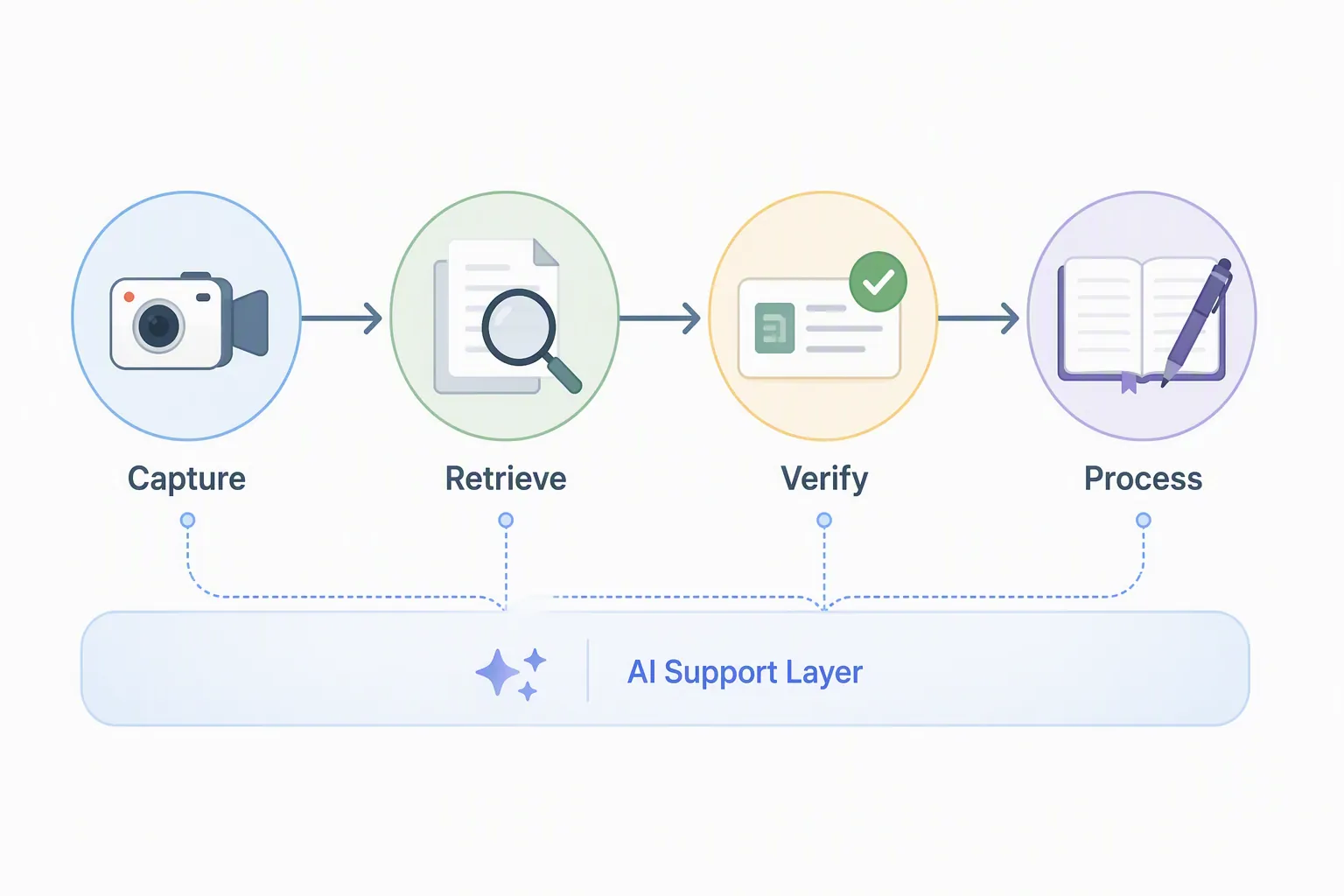
Configure the note system around an inspectable workflow
A defensible setup gives AI useful work without making it the processor of the system. The note should move through four visible stages:
- Capture material with enough source context to find it again.
- Retrieve relevant notes, passages, and documents when a question arises.
- Verify important claims against the original source rather than against the generated answer.
- Process the material yourself by interpreting it, connecting it to existing knowledge, and deciding what action follows.
AI can assist with the first three stages. It can shorten capture, surface an old note, cluster related material, and identify places where a draft does not match its sources. The fourth stage should remain visible as the user’s responsibility. That does not require rejecting summaries or refusing automation. It requires preserving the distinction between a generated representation of a source and your own considered understanding of it.
For source-heavy work, prefer workflows that keep retrieval bounded to material you can inspect. A source-bounded assistant makes it easier to trace an answer back to a document; an open-ended assistant may still be useful for brainstorming, but its fluency is not evidence that it understood your notes. The comparison between source-bounded and open AI note workflows is the relevant implementation detail here.
The configuration should also make review easier than acceptance. Keep the original passage or a durable source link beside an important summary. Mark uncertain interpretations instead of allowing them to enter the permanent notes as settled facts. Before using an AI-produced synthesis in a consequential document, check the cited material and look specifically for omissions, changed qualifiers, and claims that appear nowhere in the source.
Which application exposes these controls, where processing occurs, and whether AI is metered are separate setup questions. The dated map of AI changes in note-taking apps covers feature status rather than treating vendor claims as productivity evidence. For capture scope, processing choices, and review habits, use the personal AI policy for note apps.

What the 2025 evidence justifies
The strongest conclusion is about configuration, not a universal verdict on AI. Mainstream use is no longer in doubt. Average time savings exist in self-reported data but are modest and come from a survey conducted in November 2024. Larger improvements are concentrated in suitable tasks and among workers who have more room to benefit. The aggregate productivity relationship remains unreliable, and the critical-thinking findings do not prove cognitive decline.
That evidence supports AI as a capture, retrieval, and verification layer inside a note system. It does not support making AI the system of record or quietly delegating interpretation to it. The useful question after each assisted step is not how quickly a note appeared, but who can still explain where it came from, what it leaves out, and why it deserves to guide the next piece of work.
References
- The State of Generative AI Adoption in 2025 — Federal Reserve Bank of St. Louis, 2025
- The 2025 AI Index Report — Stanford Institute for Human-Centered Artificial Intelligence, 2025
- The Impact of Generative AI on Work Productivity — Federal Reserve Bank of St. Louis, 2025
- Seven Myths about AI and Productivity: What the Evidence Really Says — California Management Review, 2025
- How generative AI can boost highly skilled workers' productivity — MIT Sloan, 2023
- Automation bias: a systematic review of previous studies — International Journal of Medical Informatics, 2012
- The Impact of Generative AI on Critical Thinking: Self-Reported Reductions in Cognitive Effort and Confidence Effects From a Survey of Knowledge Workers — Microsoft Research, 2025
Comments
Join the discussion with an anonymous comment.