
Why Your Productivity System Keeps Failing (And It's Not Your Fault)
If you've ever adopted a new productivity method with enthusiasm, only to abandon it three weeks later when work got chaotic, you're not alone — and it's probably not a willpower problem. The harsh reality is that most productivity systems are designed for ideal conditions: a predictable workload, a clear inbox, and a calm mind. They break the moment real life shows up.
Consider this: according to research cited by Clockify, 82% of people don't have a dedicated time management system at all. That's not because 82% of people are lazy. It's because the systems they've tried didn't survive their first bad week.
This article isn't another list of '10 best productivity hacks.' It's a decision framework. We'll evaluate each major system against three real-world tests — long-term sustainability, bad-week resilience, and whole-life applicability — then match systems to your specific work persona. By the end, you'll know which method is worth your time and which one will quietly collapse when you need it most.
For a deeper look at the workplace fragmentation data behind the 'bad weeks' problem, see our companion article on workplace statistics and focus.
A Quick Taxonomy: What Each System Actually Does
Before we evaluate, let's establish a clear picture of what each major system actually offers — and where it falls short. The table below summarizes the core mechanism, one clear strength, and one honest limitation for each method.
| System | Core Mechanism | Clear Strength | Honest Limitation |
|---|---|---|---|
| GTD (Getting Things Done) | Capture, clarify, organize, reflect, engage | Unmatched mental clarity — nothing falls through the cracks | Under high workload, it becomes a maintenance system; backlogs grow faster than processing |
| Pomodoro Technique | 25-minute focused sprints with short breaks | Excellent for overcoming procrastination and maintaining focus | A focus technique, not a system — has no opinion on what to work on or why |
| Personal Kanban | Visual workflow with To Do, Doing, and Done columns | Reveals bottlenecks and limits work-in-progress naturally | Requires discipline to update; can feel lightweight for complex goals |
| Eisenhower Matrix | Prioritization by urgency and importance | 50% of users feel in control of tasks daily — highest satisfaction of any method | Only a prioritization step; offers no execution or review structure |
| 12 Week Year | Goal-setting, weekly planning, daily execution, scorekeeping, and review | Only system that passed the 15-year test for all three criteria | Requires upfront time investment to set goals and review weekly |
| Time Blocking | Assigning specific tasks to calendar slots | Forces realistic time estimates and protects deep work | Brittle under interruptions; requires strong calendar discipline |
Notice a pattern? Most of these methods are partial solutions. Pomodoro gives you focus but no direction. The Eisenhower Matrix helps you decide what matters but doesn't help you execute. Even GTD, which Todoist calls 'easily the most famous and lasting productivity method,' has a well-documented failure mode: when your inbox exceeds your processing capacity, the whole system grinds to a halt.
The Three-Test Evaluation: Which Systems Survive Real Life?
To separate genuine systems from techniques, we need a consistent evaluation framework. Drawing from the 15-year analysis published by 12-Week Breakthrough, we assess each method against three criteria:
- Long-term sustainability: Can you use this system for years without it breaking down or requiring constant reinvention?
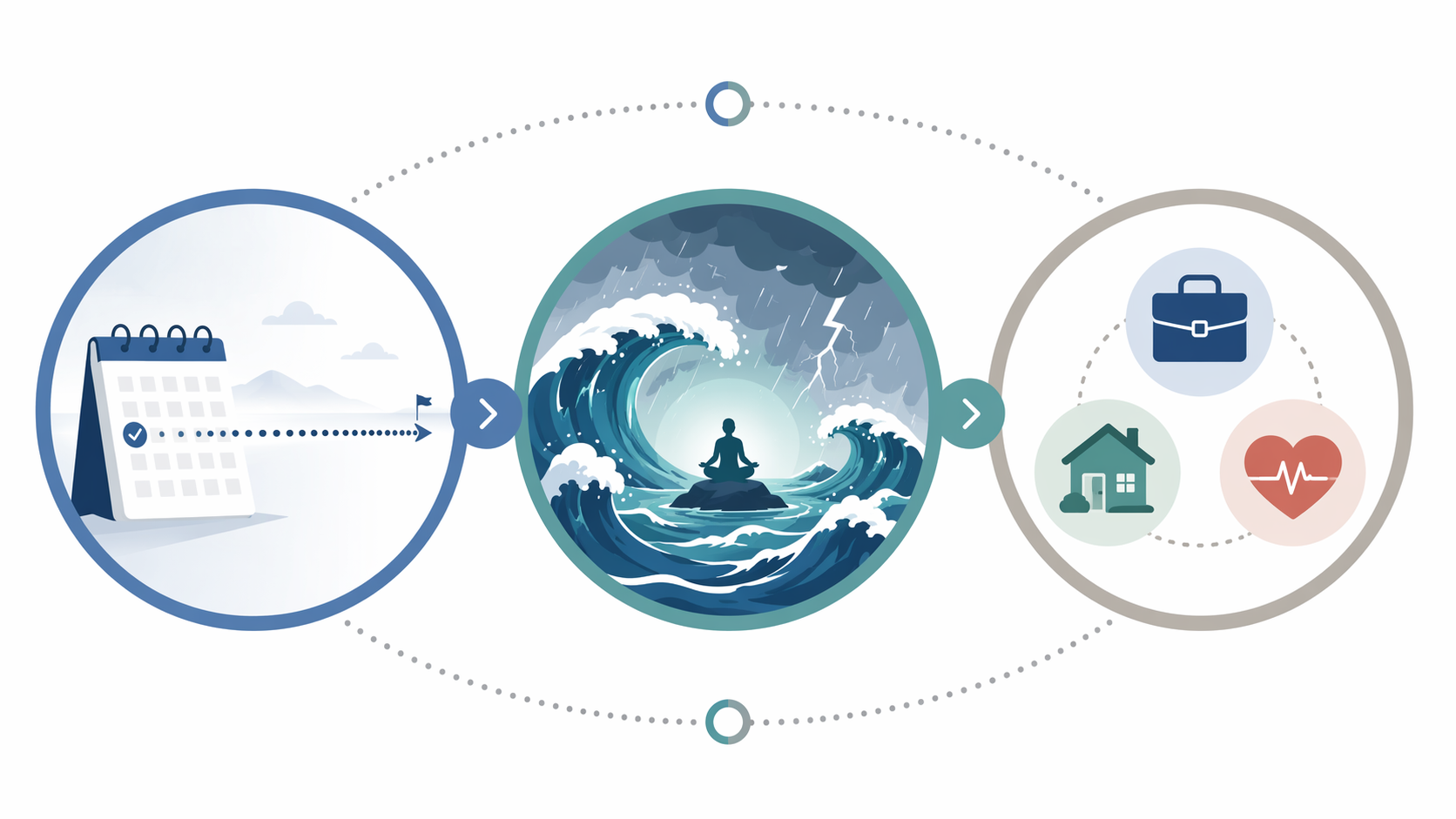
- Bad-week resilience: Does the system hold up under stress, low motivation, or a sudden workload spike — or does it collapse when you need it most?
- Whole-life applicability: Does the system handle career, health, personal goals, and relationships — or is it only useful for work tasks?
| System | Long-Term Sustainability | Bad-Week Resilience | Whole-Life Applicability |
|---|---|---|---|
| GTD | Moderate — works well for years if you maintain weekly review | Low — backlogs grow faster than processing under high workload | High — can capture any type of task or commitment |
| Pomodoro | Low — a technique, not a system; no structure for long-term goals | Low — skipping a sprint feels like failure; no recovery mechanism | Low — only addresses focus, not planning or life balance |
| Personal Kanban | Moderate — simple enough to maintain, but limited for complex goals | Moderate — visualizing bottlenecks helps, but doesn't resolve them | Moderate — works for projects, less useful for life goals |
| Eisenhower Matrix | Low — only a prioritization step; no execution or review cycle | Moderate — helps decide what to drop, but doesn't help you do the work | Moderate — useful for any domain, but incomplete on its own |
| 12 Week Year | High — built-in review cycles prevent drift | High — weekly reviews act as a recovery mechanism after bad weeks | High — designed for career, health, and personal goals simultaneously |
| Time Blocking | Moderate — effective but brittle under frequent interruptions | Low — one unexpected meeting can derail the entire day | Moderate — works for any domain, but requires rigid scheduling |
The key insight from this evaluation is that full-stack systems — those with built-in goal-setting, execution, and review cycles — consistently outperform partial techniques. GTD comes closest to being a full-stack system, but its reliance on a weekly review as the only recovery mechanism means it can't self-correct when you're underwater. The 12 Week Year, by contrast, has a weekly review built into its DNA, which acts as a natural reset button after a bad week.
Match Systems to Your Work Persona
The reason most productivity advice fails is that it's one-size-fits-all. A system that works for a solo freelancer will suffocate a team lead. A method designed for deep creative work will frustrate someone who spends their day in meetings. The following persona-matching framework is a heuristic — a starting point, not a scientific classification — to help you identify which system fits your actual work style.
| Persona | Primary Challenge | Recommended Core System | Supporting Techniques |
|---|---|---|---|
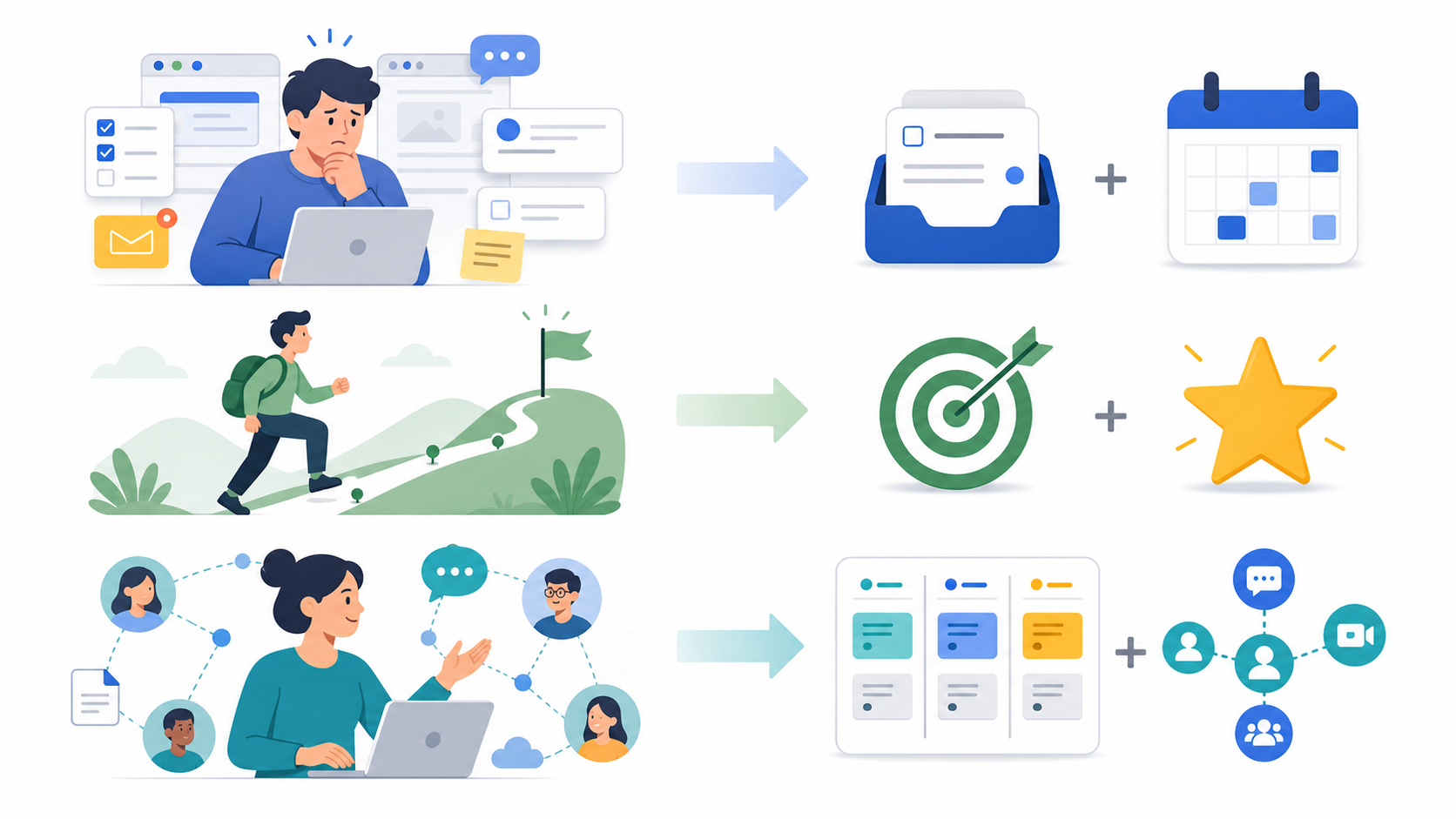
| The Overwhelmed Generalist | Too many inputs, too many contexts, no single source of truth | GTD + Time Blocking | Eisenhower Matrix for weekly prioritization; Pomodoro for focused execution |
| The Goal-Seeker | Clear ambitions but no structured path to achieve them | 12 Week Year | MIT (Most Important Tasks) for daily focus; weekly review for accountability |
| The Collaborative Team Member | Work is fragmented across meetings, messages, and shared projects | Personal Kanban | Time Blocking for deep work windows; Eisenhower Matrix for triaging requests |
| The Deep-Work Specialist | Needs long, uninterrupted focus blocks; easily derailed by context switching | Time Blocking + Pomodoro | Eisenhower Matrix for deciding what deserves deep work; weekly review to adjust blocks |
The Overwhelmed Generalist is the most common persona among knowledge workers. You have tasks coming from email, Slack, project management tools, meetings, and your own head. GTD's capture-and-clarify workflow is ideal here because it gives you a single inbox to process everything. The risk is that GTD becomes a maintenance treadmill — you spend all your time organizing and none doing. Pair it with Time Blocking to ensure you actually execute on what you've clarified. For tool selection, see our guide on choosing a PKM app based on your thinking style.
The Goal-Seeker knows what they want but struggles to translate ambition into daily action. The 12 Week Year is purpose-built for this: it compresses annual goals into 12-week sprints, with weekly reviews that force honest progress tracking. The built-in review cycle is the key — it provides a recovery mechanism when you have a bad week, which is exactly when most other systems fail.
The Collaborative Team Member lives in a world of shared responsibilities and constant communication. Personal Kanban's visual workflow is a natural fit because it makes work-in-progress limits visible to both you and your team. The challenge is that Kanban is lightweight — it doesn't provide goal-setting or review cycles. Supplement it with Time Blocking to protect your individual deep work windows.
The Deep-Work Specialist — writer, developer, researcher, designer — needs long, uninterrupted blocks to produce their best work. Time Blocking is non-negotiable here, but it's brittle under interruptions. Pomodoro sprints within those blocks can help maintain focus when motivation dips. The Eisenhower Matrix helps you decide which tasks are worth the deep-work investment in the first place.
The Verdict: No Single Best System — But a Winning Formula
After evaluating each system against the three real-world tests and mapping them to work personas, one conclusion is clear: there is no single best productivity system. Anyone who tells you otherwise is selling something — either a book, a course, or a subscription.
However, there is a winning formula that emerges from the data:
- One core full-stack system (GTD, 12 Week Year, or Kanban) that handles goal-setting, execution, and review.
- One supporting technique (Pomodoro, Eat the Frog, or Eisenhower Matrix) that addresses your specific weakness — focus, prioritization, or procrastination.
- A regular review habit (weekly or bi-weekly) that acts as a recovery mechanism when life gets chaotic.
The systems that fail are the ones that rely on willpower alone. Eat the Frog, for example, asks you to tackle your hardest task first thing — but if you're already exhausted, that's a recipe for guilt, not productivity. Full-stack systems have built-in recovery mechanisms: GTD has the weekly review, the 12 Week Year has its weekly scorekeeping, and Kanban has work-in-progress limits that naturally slow you down before you burn out.
Practical Next Steps: How to Test-Drive a System This Week
Analysis paralysis is the enemy of progress. Here's a concrete, low-commitment plan to test-drive a system this week:
- Pick one persona match. If you're not sure which persona fits, start with The Overwhelmed Generalist — it's the most common and GTD is the most forgiving system to learn.
- Commit to the core system for 7 days. No switching. No adding extra techniques. Just the core system and one supporting technique from the table above.
- Track one simple metric. At the end of each day, ask yourself: 'Did I complete my top 3 priorities?' That's it. Don't track hours, tasks completed, or any complex metric.
- Review at the end of the week. If you completed your top 3 priorities on at least 4 out of 7 days, the system is working. If not, ask: did the system break during a bad day, or did I not use it consistently?
- Adapt, don't abandon. If the system didn't work, change one variable — switch the supporting technique, adjust the review frequency, or try a different persona match. The goal is to find a system that bends to your life, not one that requires you to bend to it.
For a deeper dive into designing your workflow — including templates and tool stack recommendations — see our guide on how to design a personal productivity workflow system.
Comments
Join the discussion with an anonymous comment.