
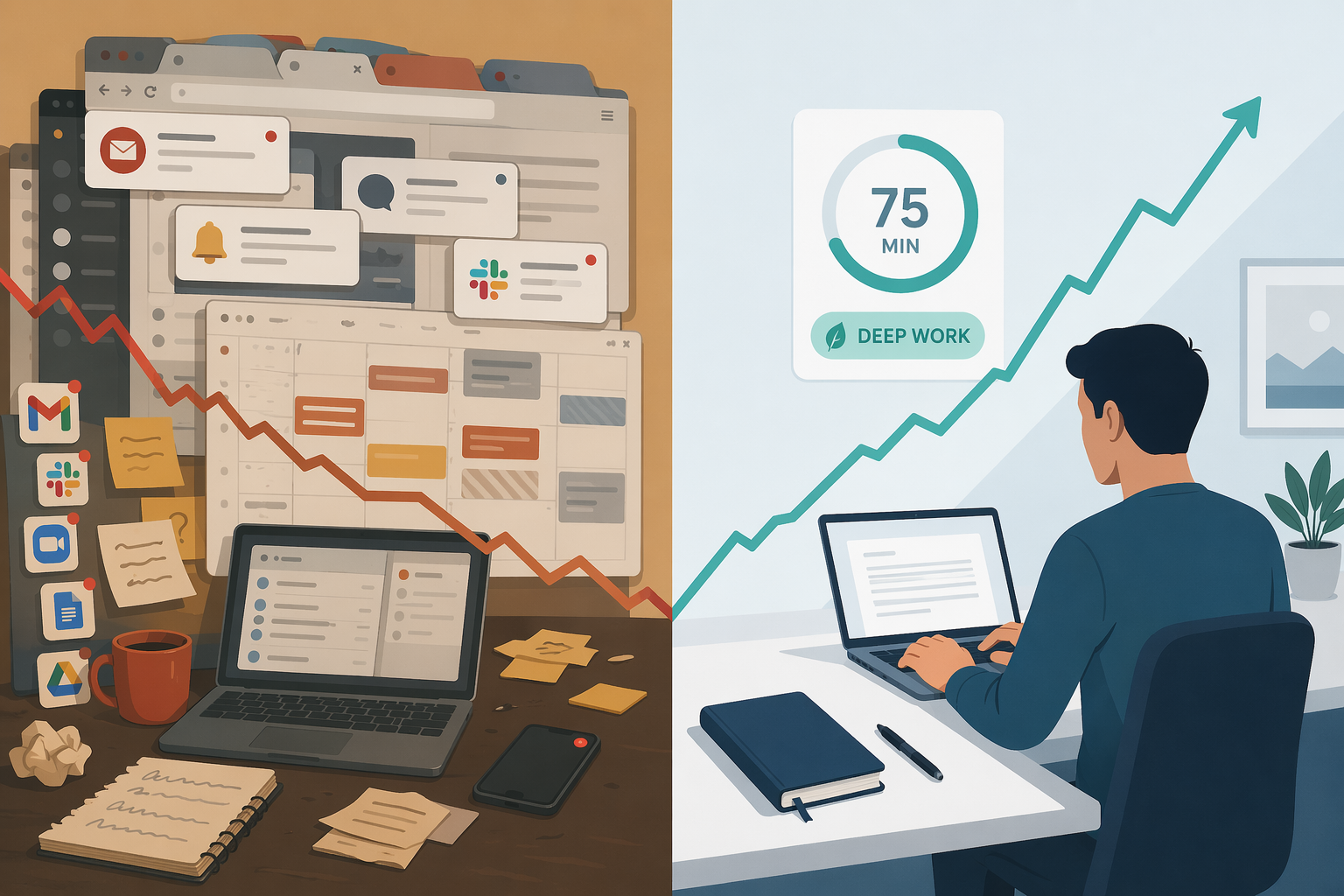
The State of Productivity in 2026: A Structural Crisis, Not a Personal Failure
If you feel like you're working harder than ever yet accomplishing less, the data says you're not imagining it — and you're not the problem. The latest workplace statistics paint a stark picture: global employee engagement fell to 20% in 2025, the lowest level since 2020, costing the global economy an estimated $10 trillion in lost productivity according to Gallup's 2026 report. The average knowledge worker is genuinely productive for only 2 hours and 53 minutes out of an 8-hour workday.
These numbers don't point to a lazy workforce. They point to a work environment that has been systematically engineered against deep focus. The culprit isn't a lack of willpower or poor personal habits — it's a set of structural patterns embedded in how modern knowledge work operates: meeting overload, constant digital interruptions, and the sprawling 'work about work' that consumes more time than actual output.
This article is not another list of generic productivity tips. It is a data-driven investigation into what is actually draining your time and what the evidence says will give it back. Every claim below is backed by 2025–2026 research from Gallup, Microsoft, Harvard Business Review, WorkTime, ActivTrak, and others. The goal is to move from feeling busy to being genuinely productive — and the path starts with understanding the structural thieves that are stealing your focus.
What's Eating Your Time: The Three Structural Thieves
Before you can fix your productivity, you need to know where your time actually goes. The research converges on three primary drains that collectively consume the vast majority of a knowledge worker's day. These aren't minor annoyances — they are structural features of how modern work is organized.
1. Meeting Overload: The Single Largest Time Sink
Meetings have become the default answer to almost every workplace question, and the data shows they are failing us. According to Microsoft's 2025 Work Trend Index, 71% of meeting time is considered unproductive by senior managers. A separate Atlassian survey found that 80% of workers say they would be more productive with fewer meetings. The cost is staggering: organizations that reduce meetings by 40% report a 71% increase in employee productivity, according to research from Harvard Business Review and Atlassian.
The problem is compounded by timing. Microsoft reports that half of all meetings occur during peak productivity hours — typically 9–11 AM and 1–3 PM — precisely when most knowledge workers are biologically primed for deep focus. This means the most valuable cognitive hours of the day are being carved up by status updates and progress checks that could often be handled asynchronously.
2. Digital Fragmentation: The 275-Interruption Day
The average Microsoft 365 user is interrupted every 2 minutes, accumulating roughly 275 interruptions per day. Each interruption carries a cognitive cost: it takes over 23 minutes to fully regain focus after a distraction, according to WorkTime. Knowledge workers switch between apps over 1,200 times per day, spending approximately 4 hours per week just reorienting after context switches.
The result is a workday dominated by reactive communication rather than proactive creation. Microsoft's data reveals that 57% of work time is spent communicating — in meetings, email, and chat — while only 43% is spent on actual creation. This imbalance means that the majority of your day is spent processing other people's priorities rather than advancing your own.
3. Work About Work: The Invisible Tax
Asana's research on the anatomy of work found that knowledge workers spend 60% of their workday on 'work about work' — the coordination, status tracking, and administrative overhead that surrounds actual productive tasks. This includes searching for information, updating project statuses, navigating between tools, and attending coordination meetings. Only 40% of the day is left for the skilled, strategic work that drives results.
| Structural Thief | Key Statistic | Source | Impact on Your Day |
|---|---|---|---|
| Meeting Overload | 71% of meetings unproductive; 40% reduction → 71% productivity gain | Microsoft 2025; HBR/Atlassian | Peak focus hours consumed by low-value syncs |
| Digital Fragmentation | 275 interruptions/day; 23+ min to refocus after each | Microsoft 2025; WorkTime 2026 | Reactive mode dominates; creation time shrinks |
| Work About Work | 60% of day spent on coordination, not creation | Asana (via Asian Efficiency) | Only 40% of time left for skilled output |
The AI Paradox: More Tools, Less Focus
Artificial intelligence was supposed to be the productivity silver bullet. Adoption has been rapid — WorkTime reports that 80% of employees now use AI tools in some capacity. Yet the expected productivity boom has not materialized. Instead, focus efficiency has dropped to a three-year low of 60%, according to WorkTime's 2026 data.
ActivTrak's 2025 research offers a clue as to why. AI users show 27 fewer focus minutes per day compared to non-AI users. They also log longer workdays (+8 minutes) and higher collaboration time (+17 minutes). The pattern suggests that AI tools, rather than freeing time for deep work, are being layered on top of existing workflows, adding complexity without removing the structural drains.
There is also a growing quality problem. Harvard Business Review's ongoing survey found that 40% of employees received 'workslop' — low-quality, AI-generated content that requires significant rework — in the past month. Each instance of reworking AI-generated content takes approximately 2 hours. The same HBR study of 3,500 people found that while AI users produced higher-quality work faster, their motivation dropped by roughly 11% and boredom rose by 20% when returning to tasks without AI assistance.
| Metric | AI Users | Non-AI Users | Source |
|---|---|---|---|
| Daily focus minutes | 27 fewer minutes | Baseline | ActivTrak 2025 |
| Workday length | +8 minutes longer | Baseline | ActivTrak 2025 |
| Collaboration time | +17 minutes higher | Baseline | ActivTrak 2025 |
| Motivation (post-AI task) | ~11% drop | Baseline | HBR 2025 |
| Boredom (post-AI task) | +20% increase | Baseline | HBR 2025 |
The lesson is clear: more tools do not automatically boost productivity. Without intentional workflow design, AI becomes just another source of fragmentation. For a broader discussion of this dynamic, see our framework explainer on Why Knowledge Workers Need Workflows, Not More Tools — And How AI Changes the Equation.
What Actually Works: Evidence-Based Interventions That Move the Needle
The data on what is broken is overwhelming. But the same research also points to specific, measurable interventions that have been proven to reverse the damage. These are not theoretical — they are backed by controlled studies and real-world implementations.
Protect 3.5+ Hours of Daily Focus Time
Worklytics' 2025 research identified a clear threshold: knowledge workers who achieve 3.5 or more hours of uninterrupted focus time per day report being significantly more productive than those who fall below this mark. This aligns with neuroscience research showing that the prefrontal cortex can sustain approximately 3–4 genuine deep work windows per day, each lasting roughly 90 minutes before cognitive fatigue sets in.
The challenge is that most knowledge workers never reach this threshold. With 57% of the day consumed by communication and an average of 275 interruptions, focus time is constantly fractured. Protecting 3.5 hours requires deliberate structural changes — not just willpower.
Cut Meetings by 40%
The single most impactful organizational change supported by the data is reducing meetings. The HBR/Atlassian research showing a 71% productivity increase from a 40% meeting reduction is not an outlier — it is consistent with multiple studies on meeting overload. Microsoft's data that half of all meetings occur during peak productivity hours suggests that simply rescheduling non-essential meetings to the afternoon could recover significant focus time.
For individuals, this means auditing your calendar and ruthlessly cutting or shortening recurring meetings. Ask: does this require synchronous discussion, or could it be an email or async update? The 80% of workers who say they would be more productive with fewer meetings are probably right.
Align Work with Biological Prime Time
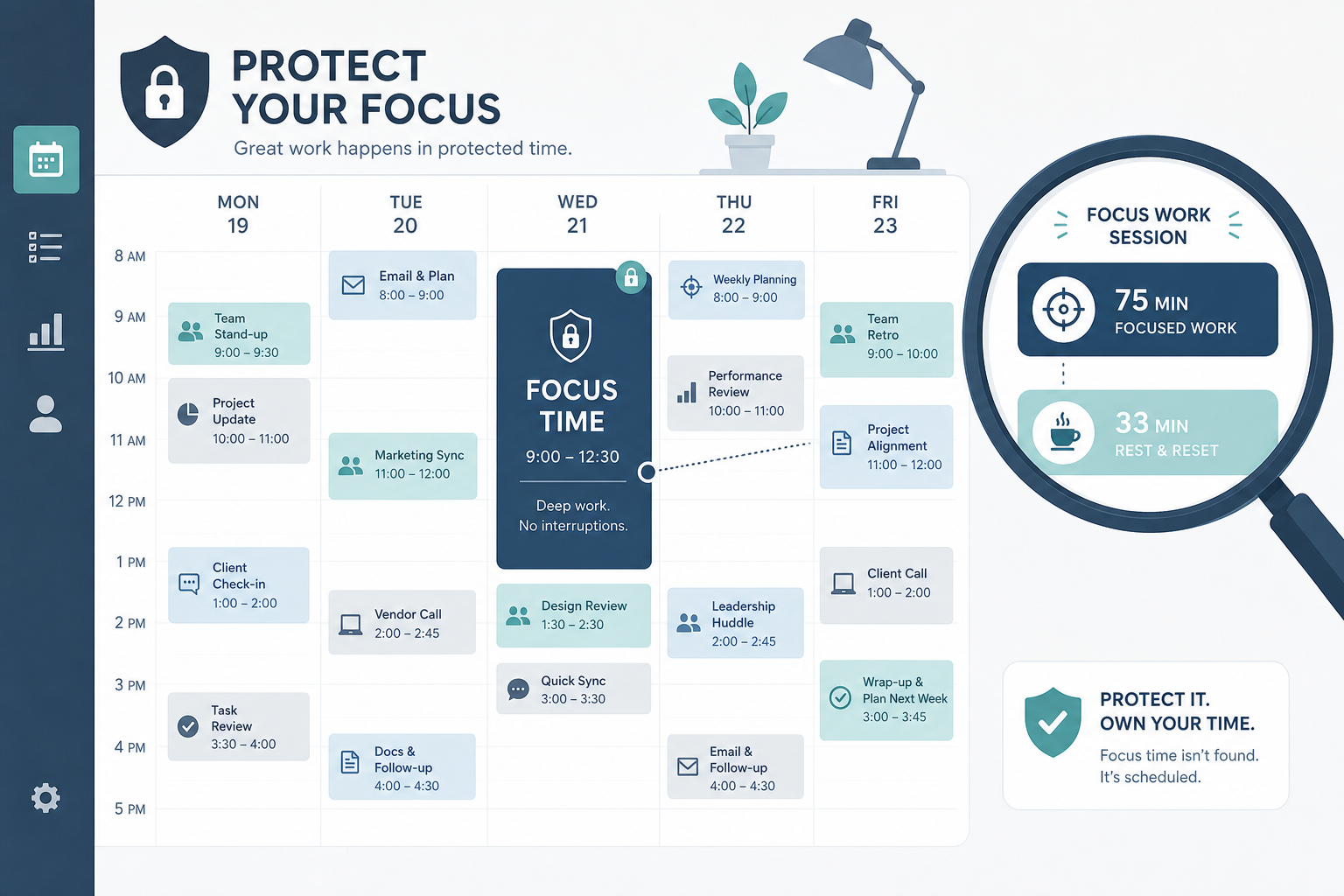
DeskTime's 2025 data on optimal work-rest ratios found that the most productive knowledge workers follow a 75-minute focus block followed by 33 minutes of rest — shifting from the older 52/17 Pomodoro standard. This 75/33 rhythm aligns with ultradian rhythms, the natural 90-minute cycles of peak cognitive performance that the human brain follows throughout the day.
The key is to schedule your most demanding cognitive work during your personal peak hours — typically the late morning for most people — and protect that window from meetings and interruptions. The Neurosity guide on deep work frameworks notes that humans have a biological ceiling of 3–4 genuine deep work windows per day, or roughly 3–4.5 hours. This aligns almost perfectly with the Worklytics 3.5-hour threshold.
Adopt Flexible Schedules
Gartner's research found that flexible scheduling makes employees feel 43% more productive. This is not just a perception — ActivTrak's 2025 data shows that remote workers gain approximately 29 more productive minutes per day and achieve 22.75 hours of deep focus per week compared to 18.6 hours for in-office workers. Hybrid workers are also 33% less likely to quit, according to Stanford research.
The mechanism is straightforward: flexible schedules allow workers to align their work hours with their biological prime time, avoid peak commute stress, and create longer uninterrupted focus blocks. The data suggests that the productivity gains from remote and hybrid work are real and measurable.
Use Non-Invasive Monitoring for Self-Awareness
A WorkTime case study at a UK bank involving 170 employees found that non-invasive productivity monitoring — where employees have access to their own data — delivered a 46% increase in active time within just 3 days. The key phrase is 'non-invasive' and 'transparent': 72% of employees accept productivity monitoring when it is transparent and they have access to their own data.
The takeaway for individuals is not that you need surveillance software. It is that self-tracking — even a simple time log for a week — can dramatically increase your awareness of where your time actually goes. Most people overestimate their deep work time by a factor of 2–3x. Seeing the real numbers is often the first step to change.
| Intervention | Evidence | Source | Personal Action |
|---|---|---|---|
| Protect 3.5+ hours focus time | Significantly higher productivity above threshold | Worklytics 2025 | Block calendar; treat as non-negotiable |
| Cut meetings by 40% | 71% productivity increase | HBR/Atlassian | Audit calendar; replace syncs with async |
| Align with biological prime time | 75/33 work-rest ratio optimal | DeskTime 2025 | Schedule deep work during peak hours |
| Adopt flexible schedules | +43% perceived productivity | Gartner | Negotiate schedule around your peak time |
| Use self-monitoring | +46% active time in 3 days | WorkTime case study | Track time for one week; identify leaks |
Your Personal Productivity Playbook: Turning Data Into Daily Action
The research is clear, but knowing the data is not the same as changing your habits. Here is a concrete playbook based on the evidence above — designed for the individual knowledge worker who wants to reclaim their focus without waiting for organizational change.
Step 1: Audit and Cut Your Meetings
- Review your recurring meetings. For each one, ask: what would happen if this meeting were canceled? If the answer is 'nothing,' cancel it.
- Shorten standing meetings from 60 to 30 minutes, and from 30 to 15. Parkinson's Law applies: work expands to fill the time allotted.
- Move status updates to async channels (Slack, email, project management tools). Reserve synchronous time for decisions and problem-solving.
- Block your peak focus hours (typically 9–11 AM and 1–3 PM) as 'no meeting' zones. Microsoft's data shows half of all meetings currently occupy these windows.
Step 2: Schedule Focus Blocks During Your Biological Prime Time
- Identify your peak cognitive hours. For most people, this is late morning (roughly 9 AM–12 PM). For some, it is early morning or late afternoon. Track your energy levels for a week to find your pattern.
- Schedule 75-minute focus blocks during your peak window, followed by a 33-minute break. This 75/33 rhythm is the optimal work-rest ratio identified by DeskTime's 2025 research.
- Aim for at least two focus blocks per day to reach the 3.5-hour threshold that Worklytics identifies as the productivity tipping point.
- Treat these blocks as non-negotiable. Use 'Do Not Disturb' mode as your default during focus time, not as an exception.
Step 3: Batch Communication and Mute Notifications
- Check email and chat on a schedule — twice per day (mid-morning and late afternoon) is a good starting point. The average knowledge worker is interrupted every 2 minutes; batching communication eliminates the vast majority of these interruptions.
- Mute all non-essential notifications by default. DeskTime's 2026 guide explicitly warns that 'work apps are guilty of ping-ification' and recommends muting them.
- Use communication tools' scheduling features to send messages during your batch windows, not when you think of them. This prevents you from becoming the source of someone else's interruption.
Step 4: Use Automation Selectively to Eliminate Low-Value Tasks
The AI paradox shows that adding tools without redesigning workflows creates more fragmentation, not less. But selective automation of genuinely low-value, repetitive tasks can reclaim meaningful time. Focus on automating: calendar scheduling, meeting note capture and distribution, routine data entry, and file organization. The goal is not to automate everything — it is to eliminate the tasks that contribute to the 60% of the day spent on 'work about work.'
Step 5: Track Your Time for One Week
The WorkTime case study showed that simply having access to your own productivity data can increase active time by 46% in 3 days. You don't need enterprise monitoring software. A simple spreadsheet or a time-tracking app like Toggl or RescueTime will reveal the gap between where you think your time goes and where it actually goes. Most people discover that their '2 hours of deep work' is actually 45 minutes of focused work scattered across a day of fragmentation. That awareness is the first step to change.
The Bottom Line: Productivity Is a System Problem, Not a Willpower Problem
The data tells a clear story. Global engagement is at 20%. The average knowledge worker is productive for less than 3 hours per day. 57% of work time goes to communication, not creation. 71% of meetings are unproductive. 275 daily interruptions destroy focus. And despite 80% AI adoption, focus efficiency has dropped to a three-year low.
These numbers are not a reflection of lazy or unmotivated workers. They are the predictable outcome of a work environment that has been optimized for availability and responsiveness rather than for deep, focused output. The crisis is structural, not personal.
But the same data that diagnoses the problem also prescribes the solution. Protecting 3.5+ hours of daily focus time, cutting meetings by 40%, aligning work with biological prime time, and using automation selectively are not theoretical suggestions — they are evidence-based interventions with proven results. A 71% productivity gain from meeting reduction. A 46% increase in active time from self-monitoring. A 43% boost in perceived productivity from flexible schedules.
Comments
Join the discussion with an anonymous comment.