
The honest answer is this: 60–67°F is a defensible default for adults who want better next-day focus, not a proven universal focus-maximizing temperature. Cleveland Clinic sleep psychologist Michelle Drerup recommends keeping the bedroom between 60 and 67°F, while Sleep Foundation points to about 65°F and a doctor-recommended 65–68°F range for adults.[1][2]
That is useful before bed because it gives you a number to try tonight. It is also incomplete. A bedroom set to 65°F does not feel the same under a heavy duvet, beside a heat-running partner, in a humid apartment, or for an older adult whose thermoregulation is different. The room number is only one part of the sleeping environment.
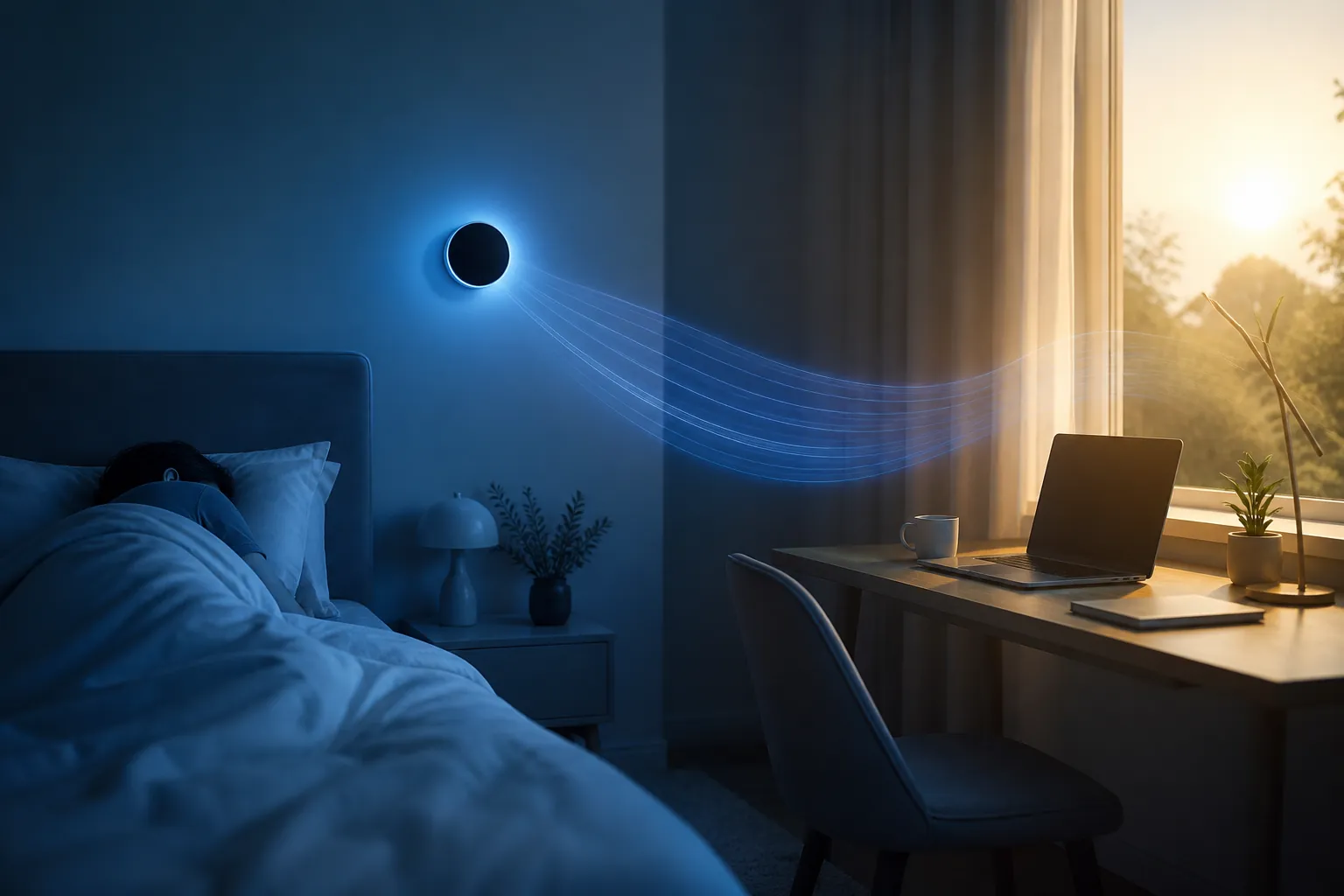
Still, the thermostat belongs in the same category as caffeine timing, nap length, and evening light: a small lever that can affect whether tomorrow morning’s deep-work block starts cleanly or begins with friction. The case is strongest when it is kept in order: bedroom temperature can change sleep continuity and sleep structure; disturbed or shortened sleep is linked to next-day cognitive interference and mistakes; therefore, bedroom temperature is a reasonable productivity setting, though not a direct cognition switch.
Why cooler bedrooms keep showing up in sleep guidance
The basic physiology is not mystical. Human core body temperature starts falling roughly two hours before sleep under circadian control. The first non-REM sleep episode is most likely to happen when that decline is steepest. During REM sleep, active thermoregulation is suppressed, which makes the sleeping body more vulnerable to warm conditions; the review by Harding, Franks, and Wisden notes that warmth can cut REM time.[3]
That helps explain why a cooler room can be helpful without making “coldest tolerable” the goal. Sleep is easier when the environment helps the body shed heat at the right time. Too much warmth works against that decline. Too much cold can become its own arousal source, especially if hands, feet, or the face feel chilled.
The same physiology also explains why a thermostat number is not the whole answer. The 2019 review describes humans trying to establish a skin microclimate around 31–35°C, with room temperature around 19–21°C helping create that condition; bedding, pajamas, mattress materials, and airflow all change that microclimate.[3] A person under a winter duvet in a still room can effectively be sleeping in a warmer pocket than the thermostat says.
| What you can set | What your body experiences | Why it matters |
|---|---|---|
| Bedroom thermostat | Ambient room temperature | The easiest lever to test, but not the whole sleep climate |
| Blanket and clothing | Skin microclimate | Can make the same room temperature feel too warm or too cold |
| Airflow and humidity | Heat loss from skin and breathing comfort | Can change how tolerable a temperature feels |
| Partner, mattress, room insulation | Heat retention around the body | Can make a “correct” number fail in practice |
So the popular 60–67°F answer is best read as a starting range for adults, not a commandment. It is cool enough to fit mainstream sleep guidance and the body-temperature mechanism, but flexible enough to adjust when the bed itself is doing more warming than the room.
The closest evidence to the thermostat is not actually 65°F
The most relevant field evidence is not a lab study where everyone sleeps in identical bedding. Baniassadi and colleagues studied 50 community-dwelling older adults across 10,903 person-nights using bedroom sensors and Oura rings. In that sample, sleep efficiency and total sleep time were highest when bedroom temperature was 20–25°C, or 68–77°F.[4]
That warmer optimum should slow down anyone tempted to write a single-number rule. This was an older-adult sample, not a study of college students or 32-year-old software engineers protecting a coding block. Older adults may have different thermal comfort needs, different bedding habits, different housing conditions, and different baseline sleep patterns. The result does not erase the 60–67°F adult guidance; it shows why population and measurement context matter.
The same study still makes the productivity case harder to dismiss. As bedroom temperature rose from 25°C to 30°C, sleep efficiency dropped by 5–10%, and total sleep time fell by roughly 60 minutes from 22°C to 30°C.[4] Those are not tiny biometric-score fluctuations. For a person trying to protect next-day work, an hour less sleep is a concrete loss.
The authors also interpreted the sleep-efficiency drop as large enough to influence cognitive performance, next-day activity, stress, and mood.[4] That is their interpretation, and it is reasonable. It is not the same as proving that changing a younger adult’s thermostat from 72°F to 66°F will produce a measurable jump in morning focus. The directly measured part is bedroom temperature and sleep; the productivity part starts as an inference from what sleep does to the next day.
Where the focus claim becomes reasonable
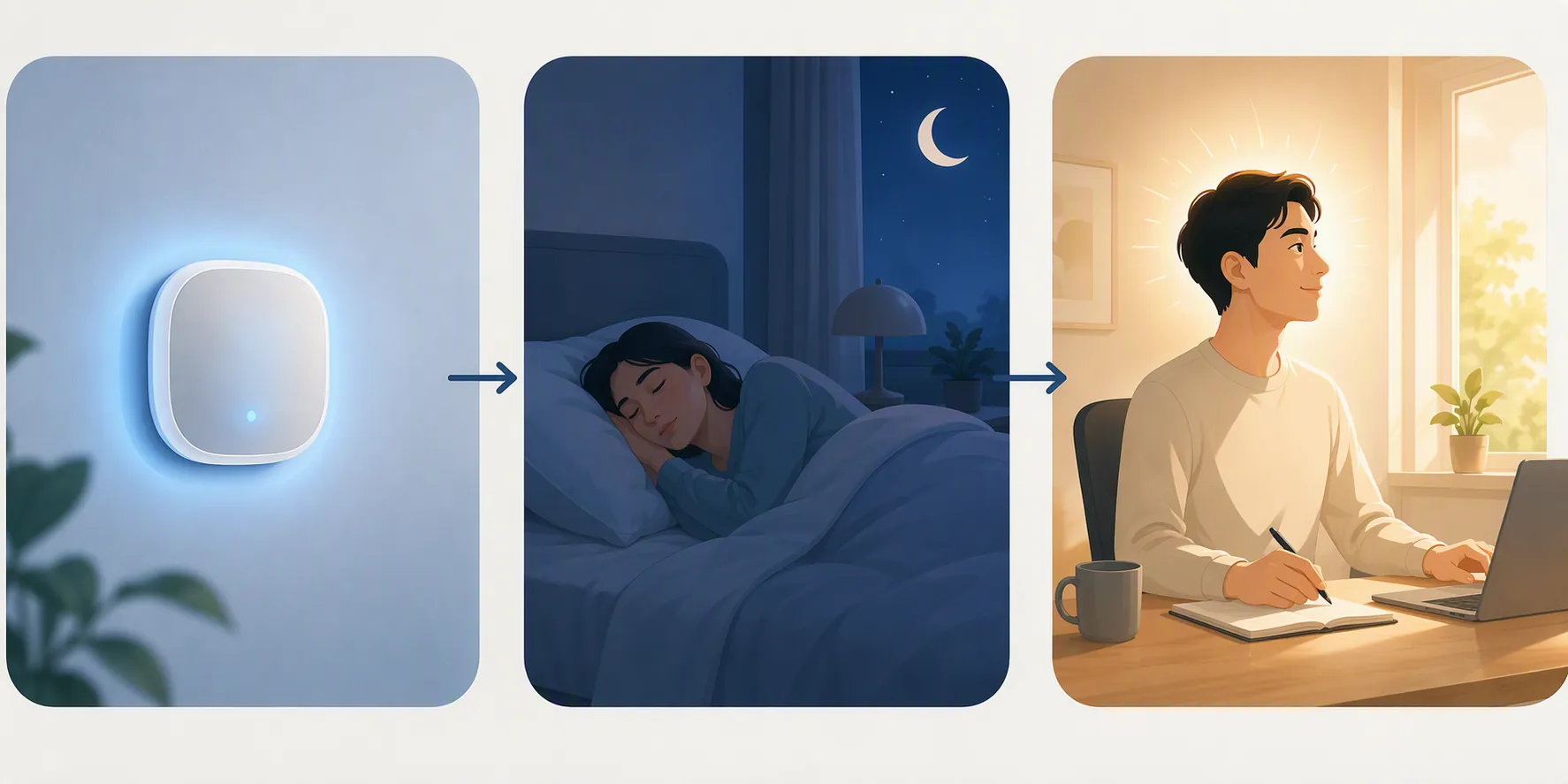
The bridge from sleep to work performance is better supported than most productivity folklore, but it still needs careful wording. In the Work-Family-Health Study reported by Penn State, 130 middle-aged IT workers slept about 16 minutes less than usual and showed one additional point on a next-day cognitive-interference scale.[5] That does not mean every 16-minute loss has the same effect for every worker. It does mean small changes in sleep duration can show up in the exact place knowledge workers feel first: concentration.
Poll data point in the same direction, though with the usual limits of self-report. In the National Sleep Foundation’s 2025 Sleep in America Poll, 58% of respondents said insufficient sleep negatively affects their productivity, and 58% said they struggle to complete tasks without mistakes when they do not get enough sleep.[6] That is not a controlled trial of bedroom temperature. It is population-level reporting of how people experience the sleep-to-output connection.
This is why the thermostat belongs in a productivity conversation. If warmth can reduce sleep efficiency or total sleep time, and even modest sleep loss is associated with next-day cognitive interference, then the temperature setting is not merely about comfort. It is one upstream condition that can make the next morning more or less expensive.
That evidence chain is similar to the way other focus claims should be audited: first ask what was measured, then ask how close that measurement is to the outcome you care about. The same approach applies to posture claims in Does Better Posture Really Improve Focus and Productivity? and to eating-window claims in Does Time-Restricted Eating Boost Focus and Cut Dementia Risk?. Temperature has an advantage over both: the experiment is cheaper and easier to reverse.
Heat and cognition: useful signal, less direct evidence
The broader cognition evidence is interesting, but it moves one step farther away from the bedroom. Krebs analyzed more than 31,000 users and 1.15 million Lumosity games, finding that above a 16.5°C outdoor-temperature threshold, each additional 1°C was associated with a 0.13% performance cost. Compared with a 15–18°C best band, scores were 0.73% lower at 21–24°C, 0.90% lower at 24–27°C, and 1.46% lower at 27°C or above.[7]
The consecutive-day pattern matters for real life. Krebs found that effects compounded with repeated hot days, from a 0.34% performance decline after 1–2 hot days to a 1.21% decline after 7 or more hot days.[7] Anyone who has tried to think through a heat wave will recognize the shape of that problem: the first bad night is annoying; the fourth bad night starts to change the week.
But Krebs did not measure bedroom temperature. The paper measured outdoor air temperature and cognitive-game performance. Sleep loss is one plausible channel, and it fits the bedroom-temperature evidence, but it is still synthesis. Outdoor heat can affect cognition through sleep, indoor heat exposure, commute stress, dehydration, air conditioning access, or other pathways. Treating Krebs as proof that a 65°F bedroom improves Lumosity scores would be overclaiming.
Population-scale reporting adds context rather than a precise setting. A Keck School of Medicine of USC release on the All of Us cohort reported 14,232 adults and more than 12 million nights, with a 10°C nighttime temperature increase associated with 2.63 minutes of lost sleep; West Coast residents lost nearly three times as much sleep as other regions.[8] That is press-release reporting, not a peer-reviewed bedroom-temperature prescription, but it reinforces the direction: warmer nights can cost sleep at scale.
What to set tonight
For most adults using sleep to protect focus, start at 65°F if you can. If that is too cold, test the broader 60–67°F band rather than forcing the exact midpoint. If you wake cold, add warmth at the bed before raising the whole room. If you wake hot, sweaty, or uncovered, lower the room by 1–2°F or reduce bedding before assuming the guidance does not apply.
- Run the test for several ordinary nights, not one unusual night after travel, alcohol, illness, or a late deadline.
- Change one thing at a time: thermostat, blanket weight, pajamas, fan, or window.
- Judge the result by sleep continuity and morning focus, not by whether the number looks ideal.
- If you share a bed, optimize the microclimate first: separate blankets often solve more than thermostat arguments.
If you use a wearable, treat it as a rough trend tool rather than a court verdict. A tracker can help compare awakenings, sleep duration, and consistency across similar nights, but the practical question is simpler: did you fall asleep without fighting the room, stay asleep more reliably, and start work with less cognitive drag? The wearable angle is useful when it stays subordinate to that question, as in broader productivity comparisons like Garmin Cirqa vs Whoop: Which Boosts Productivity Better?.
When the 60–67°F default is not the right target
Do not treat this range as a moral obligation if it makes sleep worse. Older adults may prefer and perform better at warmer bedroom temperatures, as the Baniassadi field study suggests for its sample.[4] People without reliable cooling may need to prioritize fans, shade, airflow, lighter bedding, hydration, or sleeping location before any precise thermostat target is realistic. People with infants, medical vulnerabilities, unusual heat sensitivity, or cold sensitivity need narrower guidance than a productivity article can provide.
Also, bedroom temperature is not a treatment plan. Persistent insomnia, night sweats, breathing problems, loud snoring with pauses, unexplained awakenings, or sleep that remains unrefreshing despite reasonable changes should go to a clinician. A cooler room can remove one source of sleep friction; it cannot diagnose what is happening at 3 a.m.
For daytime recovery choices, the same boundary applies. A short nap can be useful, but it is not a substitute for fixing repeated bad nights; the evidence breakdown in What Research Reveals About Gen Z Napping at Work is a better frame than pretending naps erase the cost of a warm, fragmented sleep environment.
The practical rule
Use 60–67°F as the starting setting for adult focus-oriented sleep, with 65°F as the simplest first test. Move from there based on comfort, bedding, age, health context, and what happens across repeated mornings. The target is not a perfect scientific number. The target is fewer warm awakenings, steadier sleep, and a morning work block that does not begin by paying back last night’s heat.
References
- What Is the Ideal Sleeping Temperature for My Bedroom? — Cleveland Clinic
- Best Temperature for Sleep — Sleep Foundation
- The Temperature Dependence of Sleep — Frontiers in Neuroscience, 2019
- Nighttime ambient temperature and sleep in community-dwelling older adults — Science of the Total Environment, 2023
- Just 16 minutes of sleep loss can harm work concentration the next day — Penn State
- Sleep and Productivity — National Sleep Foundation, 2025
- Temperature and cognitive performance: evidence from Lumosity games — Environmental and Resource Economics, 2024
- Study links rising temperatures to reduced sleep in U.S. adults — Keck School of Medicine of USC, December 2025
Comments
Join the discussion with an anonymous comment.