
Better posture can improve productivity and focus, but the useful version of that sentence is narrower than the one usually sold with chairs, standing desks, and posture reminders. The credible pathway is not “sit up, send more oxygen to your brain, become sharper.” It is more ordinary: reduce discomfort that steals attention, use posture changes to manage alertness, and avoid letting small aches become chronic work friction.
That distinction matters because a comfortable, healthy knowledge worker is not the same person as someone finishing a long afternoon with a hot neck, a tingling hand, or a back that keeps making them shift in the chair. The evidence is strongest for the second person. Pain can tax output before anyone calls in sick, and that is where posture and workstation habits have their best claim on productivity.
The evidence separates into different claims
Before treating “posture” as one big productivity lever, it helps to ask what was actually measured. Some studies measure real work loss. Some measure validated cognitive tasks. Some measure proxy computer activity. Some measure mood or perceived difficulty. Those are not interchangeable.
| Claim | What the evidence supports | How much weight to give it |
|---|---|---|
| Musculoskeletal discomfort reduces productivity while people are still at work | Symptomatic computer workers reported substantial productivity loss, mostly from reduced performance rather than sickness absence; chronic and widespread symptoms predicted later reduced productivity [1][2]. | Strongest practical pathway |
| Alternating sitting and standing can affect alertness or effort | A 2024 experiment found higher arousal and faster simple processing, but no gains in working memory, inhibition, or task switching; a 2018 randomized trial found no significant differences in working speed, reaction time, or concentration [3][4]. | Plausible, conditional, not a universal performance boost |
| Sit-stand desks raise productivity by about 6.5% | One 8-person exploratory pilot found normalized productivity of 0.62 in sitting-only weeks versus 0.66 when workers could switch postures, using effective computer interactions as a proxy [5]. | A research clue, not a benchmark |
| Upright posture improves mood, confidence, or task difficulty | Effects appear in specific settings: high test-anxiety students, mood and processing-speed measures, tired participants, or older-adult memory associations [6][7][8][9]. | Interesting, bounded, easy to overextend |
| Small breaks reduce the pain drain | Short microbreaks during computer work reduced perceived discomfort without hurting performance [10]. | Low-cost and useful when discomfort is the problem |
The strongest mechanism is presenteeism: pain while still working
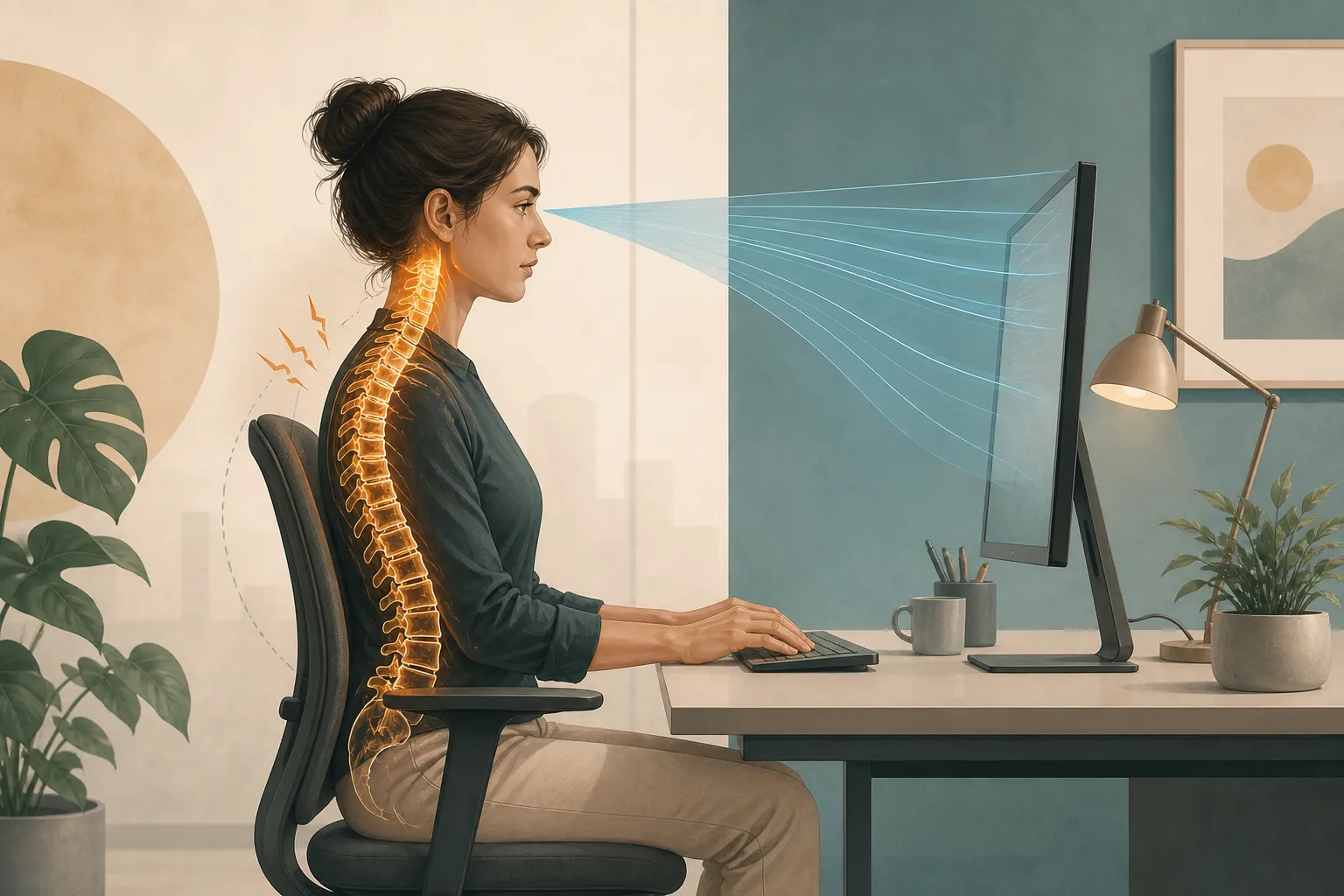
The most convincing posture-productivity evidence does not look like a glamorous focus hack. It looks like a worker who is present, typing, attending the meeting, and getting less done because their neck, shoulder, hand, or arm symptoms keep intruding.
In the PROMO study of 654 symptomatic computer workers, 26% reported productivity loss. When workers had both neck/shoulder and hand/arm symptoms, that figure rose to 36%. The important part is where the loss came from: only about 32% was sickness absence, leaving most of the loss as reduced performance while people were still at work. Each 1-point increase in pain intensity on a 0–10 scale raised the odds of productivity loss by about 1.26 times [1].
That is the productivity story a spreadsheet often misses. A person may still be answering messages, editing a document, or moving blocks around in Notion, but the task now includes a second job: noticing the shoulder, shaking out the wrist, changing position, deciding whether the ache is getting worse, then trying to re-enter the sentence they were writing. None of that has to be dramatic to be expensive.

A prospective study of 2,914 young adults points in the same direction over time. Chronic symptoms lasting more than 90 days were a main risk factor for reduced productivity, with a prevalence ratio of 2.50; widespread symptoms were also a main risk factor, with a prevalence ratio of 2.30 [2]. That does not prove that one posture correction prevents all later productivity loss. It does make recurring discomfort harder to dismiss as a harmless background annoyance.
This is where workstation changes earn their keep. A chair, desk height, keyboard position, monitor height, or break habit is worth changing when it reduces the symptoms that are already competing with the work. The goal is not an ideal silhouette. It is less physical interference during a long computer day.
Sit-stand evidence is real, but much narrower than the marketing
Standing desks sit in the middle of this topic because they are visible, expensive enough to feel consequential, and easy to turn into a promise. The better reading is more restrained: alternating posture may change arousal and perceived effort, but standing is not a reliable executive-function upgrade.
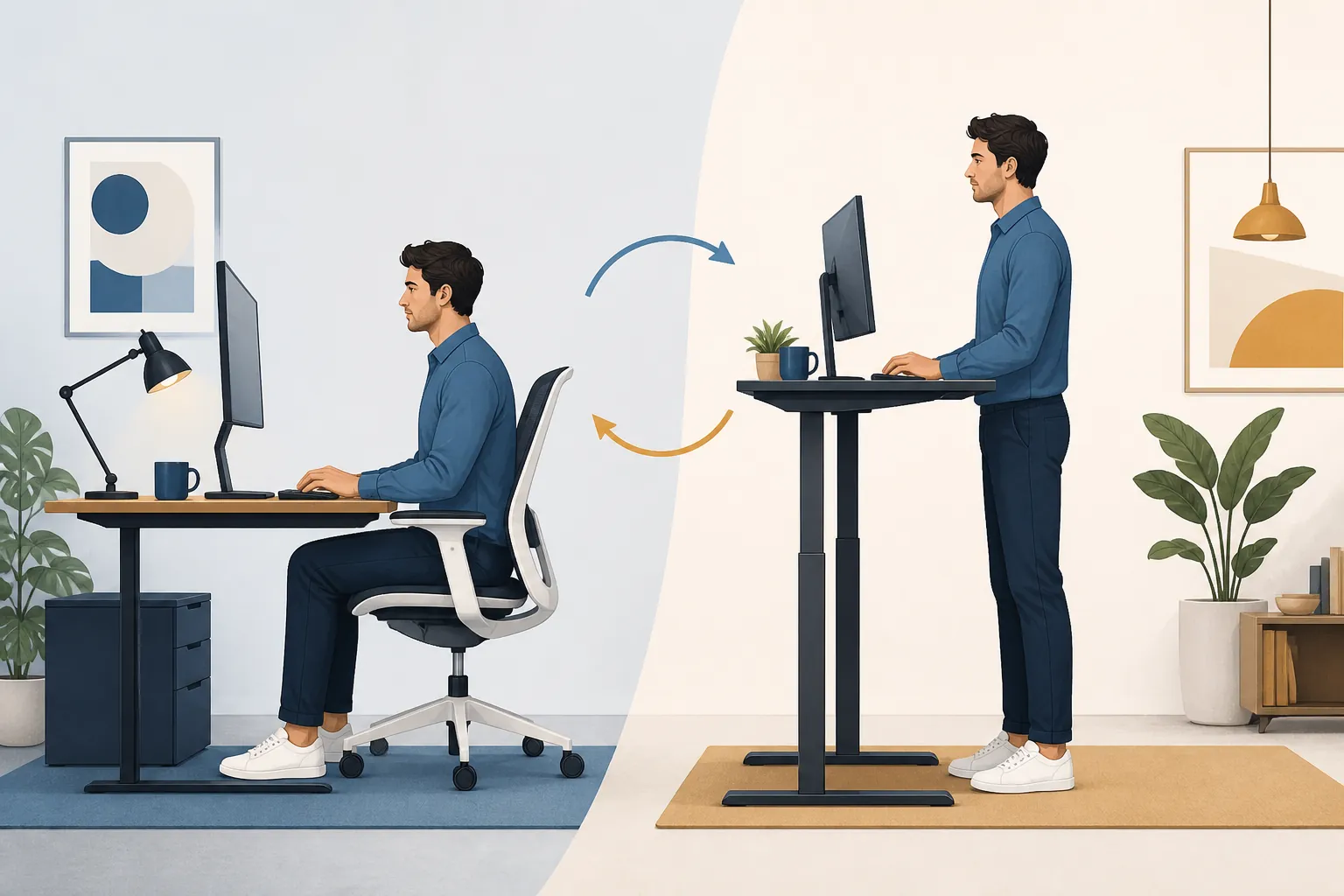
In a 2024 Psychophysiology study with samples of 43–46 participants, alternating between sitting and standing acutely increased self-reported, neural, and cardiac arousal. It also reduced subjective and physiological effort costs and sped simple flanker-task processing. But the same study did not find gains in working memory, inhibition, or task switching. The cumulative heart-rate-variability pattern was read as a possible rest-recovery benefit, not proof that standing makes people broadly smarter at work [3].
That lines up awkwardly, but usefully, with a 2018 randomized trial of 45 participants comparing alternating sit/stand work with sitting-only work. It found no significant differences in working speed, reaction time, or concentration. The reported effect sizes were tiny, with Cohen’s d values from 0.007 to 0.057, though the authors also noted that the study was underpowered [4]. A null result in an underpowered study should not be inflated into “standing never helps.” It should stop the stronger claim: “standing reliably improves focus.”
Then there is the number many readers have seen: roughly a 6.5% productivity lift. In a 6-week exploratory pilot of 8 office workers, normalized productivity averaged 0.62 during sitting-only weeks and 0.66 when workers were free to switch postures. Standing time also had a moderate correlation with productivity, r=0.436, p=0.004. But the productivity measure was “effective computer interactions,” a real-time proxy rather than a validated output metric [5].
That pilot is worth noticing because it tries to measure behavior during real computer work instead of asking people how productive they felt. It is not large enough to become a shopping argument. Eight workers are not a norm for office productivity, and more computer interactions do not automatically mean better writing, clearer analysis, fewer mistakes, or more valuable decisions.
Mood, anxiety, tiredness, and memory findings are useful only inside their boundaries
Some posture studies are genuinely interesting and still too specific to carry broad productivity advice. They may explain why sitting up sometimes feels helpful during a hard task, an anxious moment, or a tired afternoon. They do not show that every comfortable desk worker gets a general focus upgrade from holding a more upright position.
In a mental-math study of 125 students, the same task felt harder in a slouched posture, with difficulty rated 6.2 out of 10, than in an erect posture, rated 4.9 out of 10. But the effect was driven by students with high test anxiety, who rated the slouched condition 7.0 versus 4.8 erect; the effect was absent in low-anxiety students [6]. That is a useful finding for anxious test-takers. It is not a blanket statement about all knowledge work.
A 2021 study of 82 participants found upright posture associated with more positive mood, with d=0.50, and faster processing, with d=0.42, without an accuracy difference [7]. Those are meaningful mood and speed signals, but they should stay in their lane. Faster processing on a study task is not the same thing as finishing better strategic work on a Tuesday afternoon.
The memory evidence is even more bounded. In 160 adults aged 50–89, forward neck angle was associated with poorer verbal episodic memory, r=0.29, p=0.0002 [8]. The age range and correlational design matter. This can support curiosity about posture, aging, and cognition; it cannot support a causal claim that a younger desk worker will remember more project details by changing neck angle alone.
Tiredness may be another special case. In a study of 22 participants, poor sleep slowed N-back reaction times when people were supine but not when they were upright, suggesting upright posture may help maintain arousal when tired [9]. That is closer to the everyday experience of perking up when you sit or stand more actively. It still describes an arousal condition, not a permanent cognitive upgrade.
What is worth changing at your actual desk
The practical standard is simple: change posture or workstation habits when they reduce discomfort, restore alertness, or stop symptoms from accumulating. Be much more skeptical when the promise is that posture alone will improve executive function in an already comfortable person.
- If neck, shoulder, hand, or arm symptoms are interrupting work, treat the setup as a productivity issue, not just a comfort issue. Pain-related presenteeism is the best-supported pathway.
- If sitting for long stretches makes you dull or restless, alternating sitting and standing is reasonable to test. Judge it by whether it improves comfort and alertness during your real tasks, not by a promised universal percentage gain.
- If you are anxious, tired, or mentally stuck, a more upright posture may help with perceived difficulty or arousal. Keep the claim local: it may help that state, not transform your baseline ability.
- If you are already comfortable and focused, do not expect posture alone to upgrade working memory, inhibition, task switching, or concentration.
The lowest-friction intervention may be the least glamorous one. In a computer-work study, roughly 30-second microbreaks every 20 minutes reduced perceived discomfort without a detrimental performance effect [10]. That is not a productivity miracle. It is a way to remove one source of physical drag before it becomes the thing you keep working around.
So yes, better posture can improve productivity and focus when “better” means less pain, less numbness, fewer awkward static positions, and enough arousal to keep working. The 6.5% sit-stand figure belongs in the category of promising lead, not personal forecast. The work worth doing is smaller and more useful: adjust the desk, vary the posture, take the break, and measure whether the body stops interrupting the work.
References
- Loss of Productivity Due to Neck/Shoulder Symptoms and Hand/Arm Symptoms: Results from the PROMO-Study — Journal of Occupational Rehabilitation, 2007.
- Risk factors for reduced productivity in a cohort of young adults with neck or upper-extremity musculoskeletal symptoms — Scandinavian Journal of Work, Environment & Health, 2008.
- Alternating between sitting and standing improves arousal and attenuates effort costs — Psychophysiology, 2024.
- Alternating between sitting and standing during office work: A randomized controlled trial — Ergonomics, 2018.
- Using real-time computer interactions to measure office productivity during sit-stand workstation use: an exploratory pilot study — BMC Public Health, 2023.
- Do Better in Math: How Your Body Posture May Change Stereotype Threat Response — NeuroRegulation, 2018.
- Effects of posture on mood and cognitive performance — Acta Psychologica, 2021.
- The Association Between Forward Head Posture and Verbal Memory in Older Adults — Frontiers in Aging Neuroscience, 2016.
- The effect of body posture on cognitive performance: a question of sleep quality — Frontiers in Human Neuroscience, 2014.
- Computer terminal work and the benefit of microbreaks — Applied Ergonomics, 2001.
Comments
Join the discussion with an anonymous comment.