
The most comforting sentence during an AI outage is also the one that hides the problem: the notes are still there.
Usually, that is true. Your Obsidian vault may still be sitting on disk. Your Notion workspace may still contain the meeting page, the project hub, the research database, and the stray paragraph you captured between calls. The impact of a Claude outage on productivity and notes is not usually that the underlying text vanishes. The sharper problem is that the workflow you built around that text may stop functioning at the exact point where you now expect the system to think with you.
That distinction matters because many modern note systems no longer treat AI as an optional garnish. Claude is often used as the capture assistant, the summarizer, the tagger, the query layer, the meeting-note cleaner, and the migration helper. When that layer goes dark, the database can remain intact while the working system becomes unusable.
The 2026 outages were a stress test, not a one-off scare
The useful thing about the 2026 Claude incidents is not that they prove Claude is uniquely unreliable. They show what happens when a note-taking workflow has placed core labor in a remote AI service. DeployFlow’s outage guide describes a March 2 incident with roughly 10 hours of intermittent instability affecting claude.ai, the API, Claude Code, and Cowork; a June 2 sub-agent runaway-token bug that consumed Pro and Max plan quotas in minutes; and later model-specific degradation on June 5, June 18, and July 6 involving Opus 4.6 versus Haiku behavior [1]. StatusGator, a third-party monitor rather than Anthropic itself, listed 124 Claude outages since January 2026, with the usual caveat that monitoring services define and count outages in their own ways [2].
| Date | Reported issue | Why note workflows cared |
|---|---|---|
| March 2, 2026 | Roughly 10 hours of intermittent instability affecting claude.ai, API access, Claude Code, and Cowork [1] | Chat-based note work and API-backed integrations could both fail, including setups users may have assumed were safer than the web app. |
| June 2, 2026 | Sub-agent runaway-token bug consuming Pro and Max plan quotas in minutes [1] | A workflow can be blocked by quota exhaustion even when the service is not simply “down.” |
| June 5, June 18, and July 6, 2026 | Model-specific degradation involving Opus 4.6 versus Haiku behavior [1] | A pipeline tied to a specific model can degrade unevenly instead of failing cleanly. |
| Since January 2026 | StatusGator recorded 124 Claude outages, using its own third-party monitoring definitions [2] | The risk belongs in architecture planning, but the count should not be treated as an Anthropic-confirmed universal metric. |
The March event also had visible user scale. DeployFlow reports that more than 2,000 users reported issues on Downdetector during the March outage, with 60% of complaints centered on Claude Chat, 24% on the mobile app, and 8% on Claude Code [1]. Those shares do not tell us how many people lost note-taking productivity specifically. They do show that the surfaces commonly used for conversational capture and processing were part of the pain.
What breaks when Claude is part of the note pipeline
A plain note app has familiar failure modes: sync stalls, the app crashes, search indexing gets weird, an export format drops metadata. An AI-assisted personal knowledge management system adds a less visible failure mode: the notes remain reachable, but the machine that turns them into usable working material disappears.
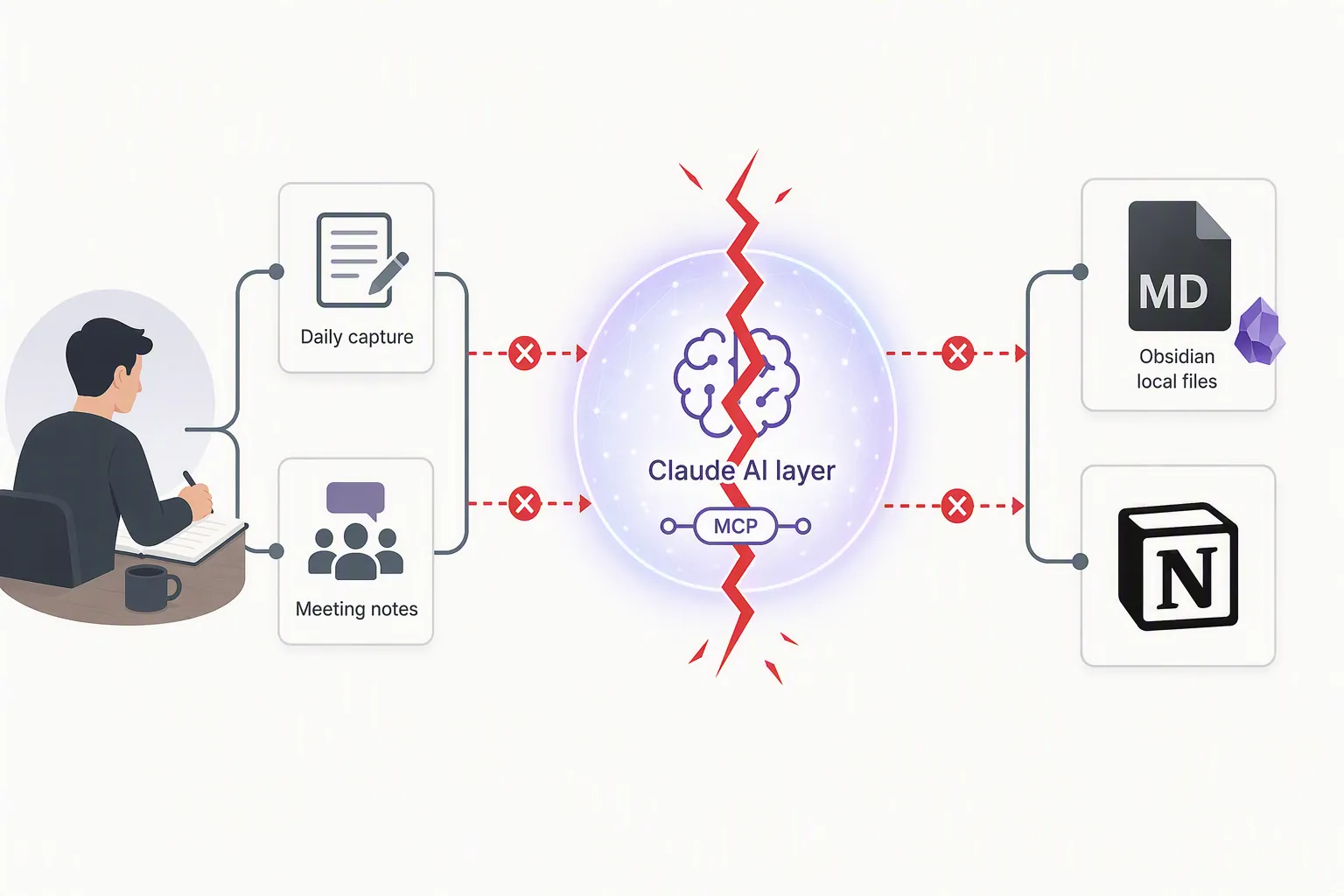
In a Claude-plus-notes setup, the fragile path often looks like this:
- Daily capture is dictated or pasted into Claude, then rewritten into a daily note.
- Meeting transcripts are sent through Claude before they become cleaned notes, action items, or project updates.
- Claude writes into, reads from, or reorganizes an Obsidian vault through MCP tooling.
- A Notion database or page structure is treated as the storage layer, while Claude performs summarization, extraction, and routing.
- Vault queries are no longer typed into search; they are asked through the AI layer.
- Tags, frontmatter, metadata, and summaries are generated midstream instead of being added by hand.
The Obsidian Forum guide to automating note generation with Claude Desktop and MCP servers is a good example of the pattern: Claude is not merely commenting on notes after the fact; it is positioned as a working bridge into the vault [3]. A separate guide to building an AI second brain with Obsidian and Claude frames the same general direction: local notes become more powerful because Claude can help structure, retrieve, and reason over them [4]. That is genuinely useful. It is also exactly why an outage hurts.
The failure point is not “Obsidian failed” or “Notion failed.” It is that a workflow with multiple stages has routed one or more core stages through Anthropic’s infrastructure. If capture depends on Claude, new notes may not enter the system in the expected form. If processing depends on Claude, raw meeting text may pile up without summaries or action lists. If retrieval depends on Claude, the user may still have search and folders, but not the question-answering interface they trained themselves to use. If metadata depends on Claude, a partially processed note may be stranded between raw capture and trusted archive.
That is why API instability matters for note-takers. The March 2 timeline cited by DeployFlow includes API access, not only the public chat interface [1]. A user who moved Claude out of the browser and into an MCP-backed workflow might feel more “integrated,” but integration is not the same as insulation.
Obsidian survives locally, but your Obsidian workflow may not
Local-first tools deserve credit for what they actually protect. If your Obsidian vault is a folder of Markdown files on your machine, those files are not erased because Claude is unavailable. You can open them, search them, edit them, copy them, back them up, and move them. That is a real advantage over systems where access to the data itself depends on a remote account.
But a local vault does not automatically make an AI-dependent workflow local-first. If the daily note is only drafted after Claude cleans a voice dump, the local file is waiting for a remote step. If meeting notes arrive as raw transcripts and only become useful after Claude extracts decisions, the vault is intact while the processing line is jammed. If you query the vault by asking Claude, then a Claude outage can remove the interface you now use to think through the archive.
This is the tension behind the broader Notion-to-Obsidian migration conversation: local files reduce one class of risk, but they do not cancel every AI dependency you attach to them. FlowDesk’s migration guide on Why AI Safety Is Driving the Notion-to-Obsidian Shift is useful here because the decision is not “cloud bad, local good.” The better question is which parts of the work can continue when each provider disappears.
Notion is not reducible to “cloud risk” either
Notion gets flattened too easily in these debates. A Notion workspace can be an excellent operational database, especially when teams need shared views, permissions, comments, and lightweight project management. The Claude outage lesson is more specific: if Notion is the storage surface and Claude is the processing surface, then the workflow inherits the availability profile of both.
That distinction changes the comparison. A Notion page that already contains a cleaned meeting summary remains useful. A raw transcript waiting for Claude to extract owners, deadlines, and decisions is a different artifact. A project database with human-maintained fields is still navigable. A database whose next useful view depends on Claude generating tags or converting messy notes into structured properties is more exposed.
What we know, and what we are inferring
There is an important evidence boundary here. The outage reports show that Claude surfaces and integrations experienced disruption in 2026 [1][2]. The MCP guides show how Claude can be wired into note generation, vault access, and second-brain workflows [3][4]. There is not, from the materials available, a published study that directly measures “Claude outage damage to note-taking productivity” across Obsidian, Notion, or other note apps.
So the conclusion should stay narrow: when users route capture, processing, retrieval, or metadata creation through Claude, Claude availability becomes part of the note system’s reliability. The exact productivity loss varies by user, by fallback habits, by how much raw material remains understandable without AI, and by whether the affected surface is chat, API, model-specific access, or quota.
That narrower claim is enough. It does not require pretending that every Claude user lost the same percentage of productivity or that every AI note workflow broke in the same way.
Why the outage feels so severe after the workflow has adapted
Anthropic’s own productivity research helps explain the emotional shape of the outage without turning it into a note-taking-specific measurement. Anthropic reported that Claude reduced task completion time by about 80% across 100,000 real conversations and estimated that it could add 1.8% to annual US labor productivity [5]. Those figures describe productivity gains under working conditions, not measured losses during downtime. Still, they make the dependency legible: if a user has rebuilt a daily workflow around a faster processing step, losing that step does not feel like losing a toy. It feels like losing the conveyor belt.
The more dramatic version of that feeling appeared in a claim by startup founder Chen Jin, reported by NDTV, that a brief Claude outage led to a 90% productivity drop across Silicon Valley [6]. That should be treated as an anecdote, not a verified measurement. It is useful only because it captures how dependency sounds from inside a culture that has normalized AI as a working substrate.
For notes, the same feeling appears at a smaller and more practical scale. The user is not helpless because the files are gone. The user is stuck because the next intended action has no local replacement. A backlog of unsummarized meetings is not data loss, but it is still work loss. A vault that can only be comfortably queried through Claude has not disappeared, but it has become harder to use at the moment the user needs it.
AI dependency now belongs in the app comparison table
A serious note-taking comparison in 2026 cannot stop at export formats, sync reliability, privacy, offline access, and migration risk. Those still matter. But if an AI provider performs capture, processing, retrieval, or migration, then provider availability is part of the product experience even when the note app itself is healthy.
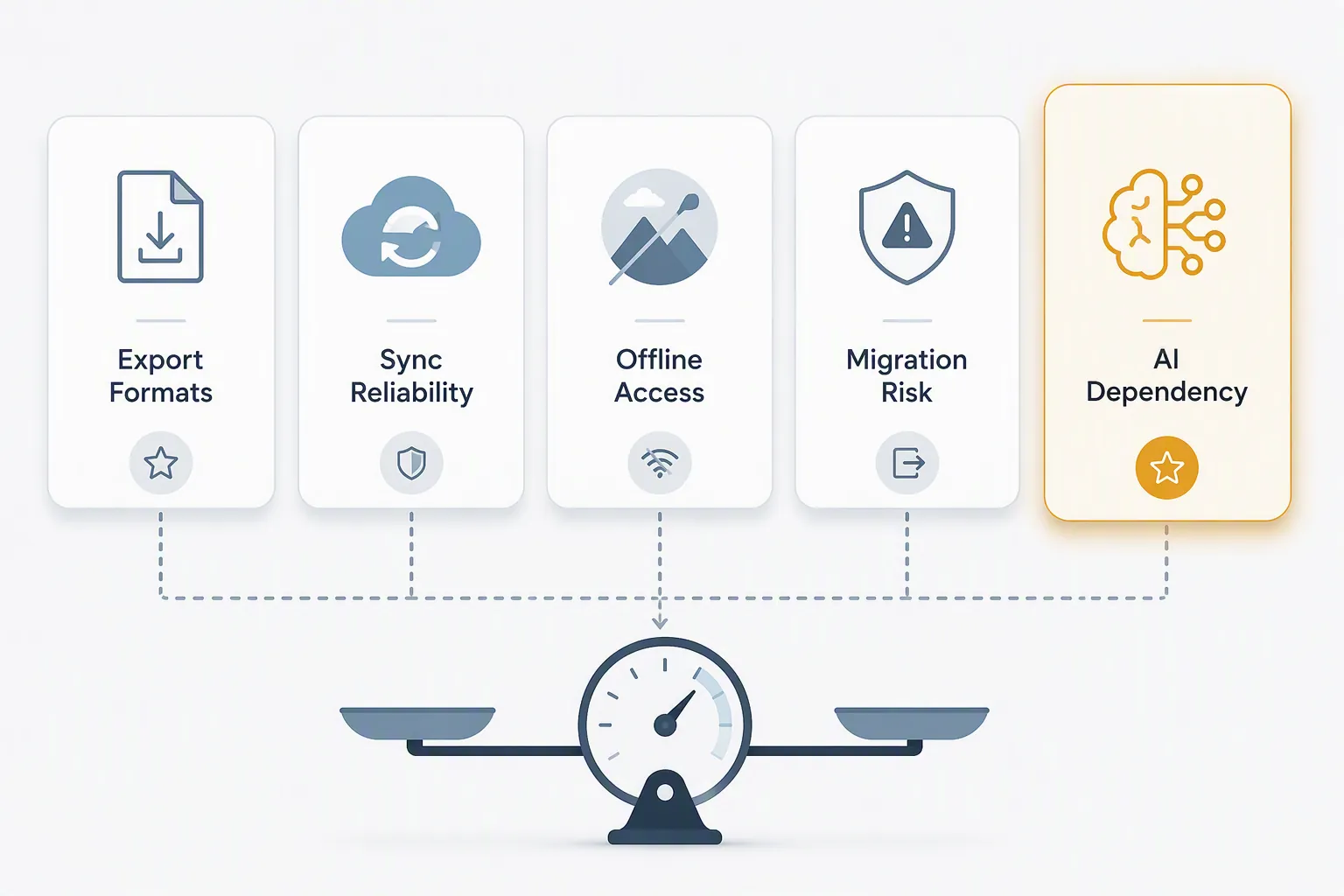
| Comparison criterion | Old question | AI-era question |
|---|---|---|
| Export formats | Can I get my notes out? | Can I also export or recreate AI-generated summaries, tags, embeddings, prompts, and metadata? |
| Sync reliability | Do my notes appear on every device? | Which parts of the workflow fail if sync works but the AI provider does not? |
| Offline access | Can I read and edit without the internet? | Can I capture, process, and retrieve notes acceptably without the AI layer? |
| Privacy | Where is my note data stored? | Which notes, prompts, transcripts, and database fields are being sent to an external AI service? |
| Migration risk | Can I leave this app later? | Can I leave the AI workflow later without losing the way my system is organized? |
| AI dependency | Is there an AI feature? | Does the note system degrade gracefully when that AI feature disappears? |
This is why “Obsidian plus Claude” and “Notion plus Claude” should not be compared only as file model versus cloud workspace. They should be compared as operating systems for work. A user who left Evernote because they wanted durable Markdown files may have solved format lock-in while accepting a different lock-in: the assumption that Claude will be available whenever notes need to be converted into usable knowledge.
The same issue is not Claude-specific. A ChatGPT outage can expose similar fragility when capture, summarization, or retrieval depends on OpenAI instead; FlowDesk’s sibling comparison, ChatGPT Is Down? Try a Note-Taking App With Its Own AI, looks at that adjacent failure mode. The common question is whether the intelligence layer is optional assistance or mandatory infrastructure.
For readers actively choosing tools, this should move from an afterthought into scoring. FlowDesk’s Best Note-Taking Apps 2026: Head-to-Head on AI, Data Portability, and Offline Integrity is the more natural place to compare products side by side; the Claude outages explain why AI dependency deserves a column.
The practical test: how does the system degrade?
ThoughtWorks’ analysis of the June 2026 Claude outage recommends three shifts that translate cleanly into note systems: graceful degradation, dependency auditing, and AI-specific observability [7]. Those sound like engineering terms because they are. They are also useful for anyone who has accidentally turned a notebook into a distributed system.
- Graceful degradation: decide what the non-AI version of the workflow is before the outage. Raw meeting notes should have a place to land. Daily capture should have a plain-text path. Search should remain usable without conversational retrieval.
- Dependency auditing: mark which steps require Claude, which require the note app, which require sync, and which work locally. The important discovery is often that “just one AI step” sits before every useful output.
- AI-specific observability: track failures that do not look like classic downtime, including quota exhaustion, model-specific degradation, API instability, and partial completion. A note pipeline can fail messily without producing a clean error message.
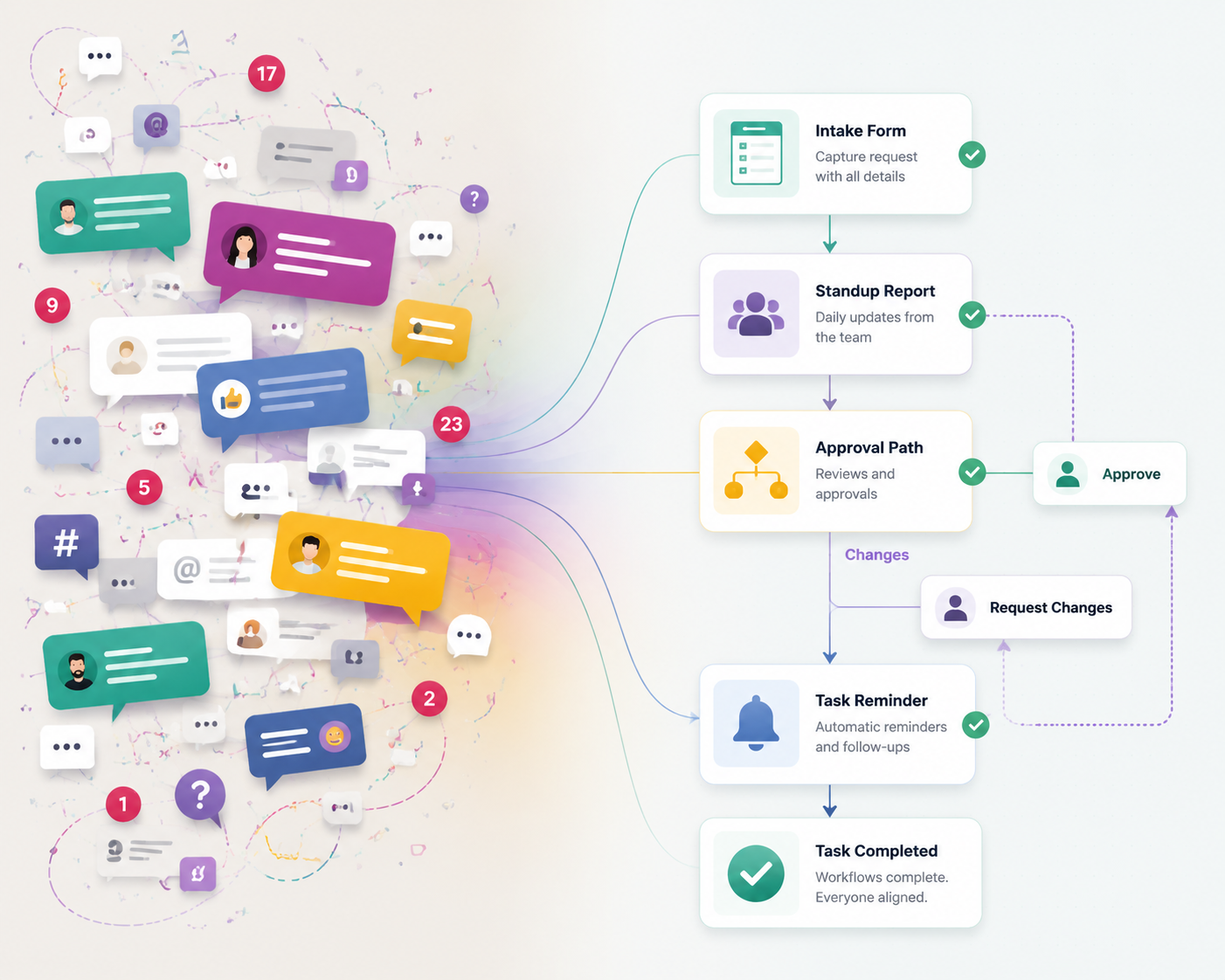
A simple audit is enough to expose the architecture. Take one common path, such as “record meeting → transcript → Claude summary → project note → action tags → weekly review.” Then remove Claude from the chain. If the answer is “I can still store the transcript, but I cannot process, classify, or retrieve it in the way my system expects,” the system has not failed completely. It has failed at the work-producing layer.
Do the same for migration. If Claude helped create the taxonomy, generate page titles, normalize tags, or rewrite notes into a new structure, ask whether that structure remains understandable without Claude. Otherwise, the migration may have moved your notes into a better container while leaving the operating logic in a provider you do not control.
This is the larger ecosystem bet behind AI-heavy note-taking. FlowDesk’s piece on AI Singularity Makes Note-Taking App Choice an Irreversible Bet treats that as a long-term platform question. The 2026 Claude outages make it operational and immediate: what happens on an ordinary workday when the assistant is not there?
The clean rule for comparing AI note setups
A note app does not have to be anti-AI to be resilient. It has to make clear which parts of the system are durable data, which parts are cloud service, and which parts are AI-mediated workflow. Claude can be valuable enough to miss badly when it is gone. That is the point. Useful dependencies deserve to be named, tested, and compared.
If Claude going down makes your note system unusable even while your notes still exist, you are no longer just choosing a note-taking app. You are choosing an AI dependency model.
References
- Claude / Anthropic Outage: Protect Claude Infrastructure, DeployFlow
- Claude Outage History, StatusGator
- Automate Note Generation in Obsidian with Claude Desktop and MCP Servers, Obsidian Forum
- How to build your AI second brain, Substack
- Estimating productivity gains from Claude, Anthropic
- Brief Claude AI Outage Led To 90% Productivity Drop In Silicon Valley, Claims Startup Founder, NDTV
- Claude outage June 2026, ThoughtWorks





Comments
Join the discussion with an anonymous comment.