
The Problem: Information Overload and Bounded Rationality
Knowledge workers today face a relentless flood of inputs: emails, messages, meeting notes, ideas, requests, and deadlines. The human mind, for all its sophistication, was not built to juggle dozens of open threads simultaneously. Cognitive scientists refer to this limitation as bounded rationality — the idea that our decision-making capacity is constrained by the finite resources of working memory and attention. When the volume of incoming information exceeds what we can process, decisions degrade, stress rises, and important tasks slip through the cracks.
David Allen’s Getting Things Done methodology addresses this mismatch head-on. Instead of asking people to remember more, GTD teaches them to offload everything into an external system — a practice that aligns directly with decades of research into distributed cognition and cognitive load. For a step-by-step introduction to the workflow, see our Getting Things Done (GTD) Explained: The Complete Guide.
External Memory: Why Your Brain Is for Having Ideas, Not Storing Them
The most fundamental cognitive principle behind GTD is distributed cognition or the extended mind thesis. This line of research, notably developed by Andy Clark and David Chalmers, argues that human cognition does not stop at the skull — it routinely extends into the environment. We use physical and digital artifacts as external memory stores. A notebook, a calendar, or a to-do list becomes part of our cognitive system.
In the only peer-reviewed academic paper to examine GTD directly, Heylighen & Vidal (2008) concluded that David Allen’s method is strongly supported by research in situated, embodied, and distributed cognition. They wrote:
The brain heavily relies on the environment as an external memory, a trigger for actions, and a source of affordances, disturbances, and feedback.

GTD’s first step — capturing everything into an “inbox” — is a direct application of this principle. By recording every task, idea, and commitment externally, you stop relying on your brain as a storage device. Your mind, freed from the burden of reminding itself, can focus on processing and acting. The Second Brain method operates on a similar insight: both systems treat external information management as an extension of biological memory.
- Reduces cognitive load by offloading storage to an external system.
- Eliminates the need to hold task reminders in working memory.
- Creates a single, trusted repository so nothing is forgotten.
- Frees up mental resources for higher-order thinking and creativity.
The Zeigarnik Effect: How Open Loops Consume Mental Bandwidth
In the 1920s, Russian psychologist Bluma Zeigarnik observed that waiters could remember complex orders only as long as the orders were incomplete. Once the meals were served, the details vanished. This became known as the Zeigarnik effect: the brain tends to keep unfinished tasks active in memory, repeatedly drawing attention to them, until they are either completed or a concrete plan is made to complete them.
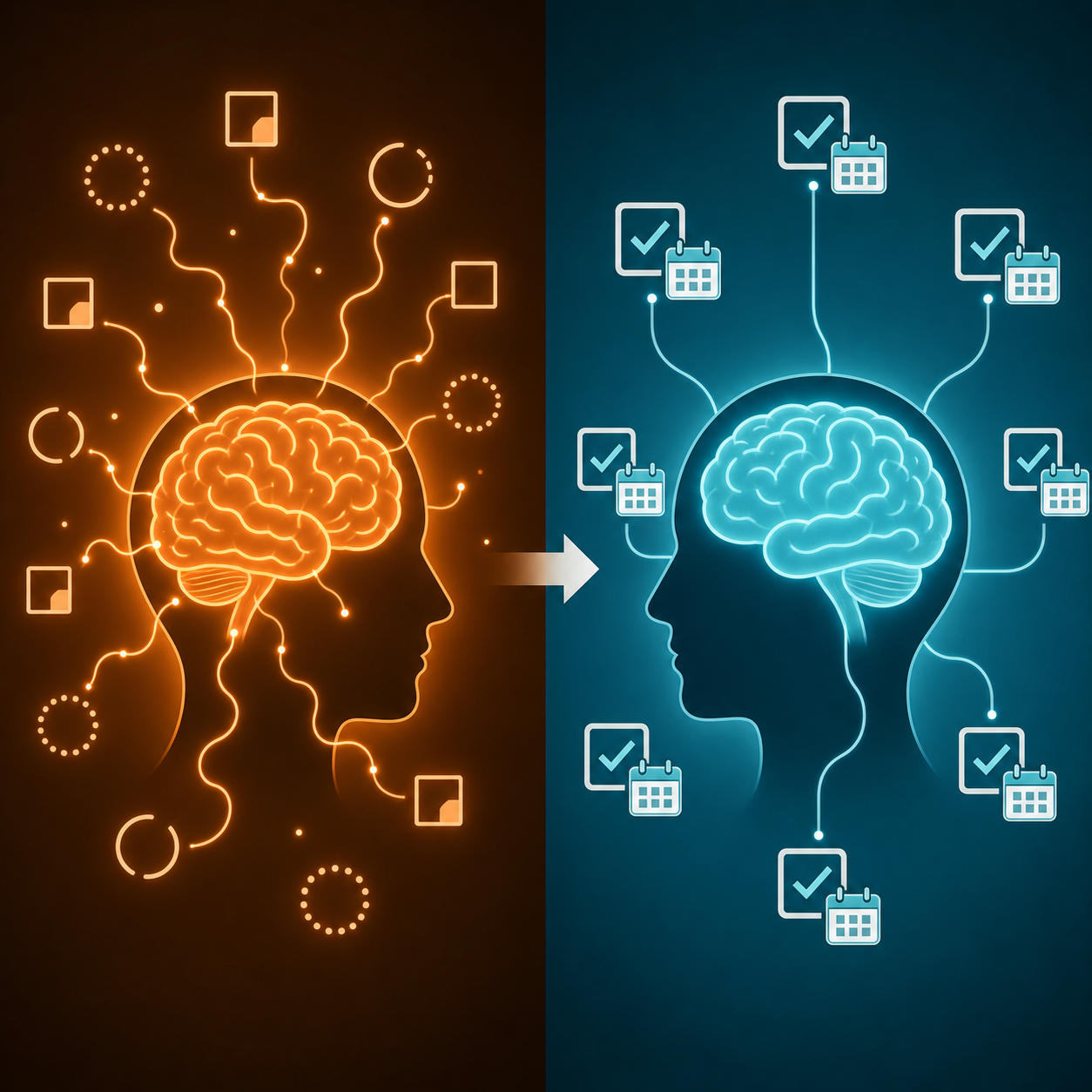
GTD exploits this effect in a clever way. Instead of urging you to finish every task immediately, it asks you to define the next action for each open loop. Once a specific, actionable next step is identified and recorded, the brain interprets the loop as “handled” — the mental reminder system quiets down. As the Float resource explains:
Our brains are wired to remember unfinished tasks and continually draw our attention to them. Once we create a plan to complete the tasks, the signals stop.
Cognitive Load Theory: Reducing Working Memory Load Improves Decision Quality
Cognitive load theory, developed by John Sweller in the 1980s, distinguishes three types of load: intrinsic (inherent difficulty of a task), extraneous (unnecessary mental effort due to poor presentation), and germane (effort devoted to learning and problem-solving). Knowledge work is plagued by extraneous load — the mental energy wasted on remembering tasks, switching contexts, and searching for information.
GTD reduces extraneous load by providing a structured external system. When you don’t have to hold task details in working memory, your available cognitive capacity increases. Research has shown that increased cognitive load reduces creativity and leads to poor decision-making — a point echoed by the Float article’s summary of the literature. By organizing tasks into lists (Next Actions, Projects, Waiting For, Someday/Maybe) and a calendar, GTD transforms an amorphous mental burden into a scannable, prioritized system.
- Offloading reduces working memory load, leaving more capacity for deep thinking.
- Clear categorization eliminates the need to mentally sort tasks on the fly.
- Reduced extraneous load is linked to better decision quality and creativity.
- External lists serve as a single point of truth, eliminating cognitive search.
This principle also connects with the PARA method, which groups information into Projects, Areas, Resources, and Archives. Both GTD and PARA aim to minimize the cognitive overhead of deciding where something belongs.
Situated and Embodied Cognition: Why Context-Based Action Lists Work
Situated cognition theory emphasizes that thinking is not a purely internal process — it is shaped by the physical and social environment. We are better at performing actions when the environment provides appropriate cues. GTD’s context lists (e.g., @phone, @computer, @errands) explicitly leverage this principle. By grouping tasks by the setting in which they can be done, you reduce the cognitive cost of context switching and increase the likelihood of action.
| Context | Example GTD List | Cognitive Principle at Work |
|---|---|---|
| @phone | Calls to make, voicemails to check | Environment triggers the action; no need to mentally recall what to do when phone is in hand. |
| @computer | Emails to send, research tasks | Being at the computer activates the relevant set of tasks, reducing decision friction. |
| @errands | Grocery lists, bank visits | Physical location provides cues; list prevents forgetting while out. |
| @home | Household chores, personal projects | Home environment primes for domestic tasks; list ensures nothing is overlooked. |
| Anywhere | Reading, brainstorming | Tasks that require no special context can be done in any environment. |
Heylighen & Vidal note that GTD’s context-based approach aligns with the idea of affordances — opportunities for action that the environment offers. When you see your phone, you are reminded of @phone tasks; when you sit at your desk, @computer tasks become salient. This reduces the mental effort of deciding what to do next.
The 2-Minute Rule: Implementation Intentions and Task-Switching Costs
One of GTD’s most famous rules — if a task takes less than two minutes, do it immediately — is often dismissed as common sense. But cognitive science offers a deeper explanation. The rule reduces two major mental costs: the
Comments
Join the discussion with an anonymous comment.