
The tiring part is not that you have tried to improve your life. The tiring part is opening another template, course, planner, or “reset” method and recognizing the same private hope: maybe this one will finally make the rest of you behave.
That is where the “self development vs productivity” question actually matters in 2026. Productivity asks whether you can execute: finish the proposal, protect focus, reduce rework, move the right tasks through the day. Self-development asks whether you are becoming more capable, steady, healthy, honest, or confident over time. Those are different questions. But the practices with the best evidence behind them mostly meet in the same place: repeated behavior under real conditions.

That overlap is a relief, if you let it be. It means you do not need to decide whether you are a “productivity person” or a “self-growth person” before you can act. You need to choose one behavior-change practice that has a decent chance of surviving tomorrow afternoon, then verify whether it works in your own notes.
The useful overlap is smaller than the advice market suggests
A large self-improvement market does not prove that self-improvement advice works. It proves that people keep looking. One 2026 statistics compilation, citing Grand View Research, puts the self-improvement market at about $51 billion in 2025 and projects it to about $67.2 billion by 2030; the same compilation reports self-help print book sales up 14.7% in 2025 and coaching revenue around $5.34 billion. [1]
Those numbers are useful context, not a verdict. They explain why a tired reader keeps being sold a new life architecture. They do not tell you whether a vision board, a morning routine, a sleep intervention, or an accountability partner changes anything you can observe.
For that, the better starting point is an evidence map. ClearerThinking’s Self-Help Evidence Pyramid reviewed roughly 500 techniques drawn from more than 100 books and 23 therapies, then ranked 82 techniques by evidentiary support. [2]

What survives evidence grading
The uncomfortable finding is not that everything is fake. It is that the strongly supported core is small compared with the amount of advice people are asked to adopt. The strongest practices in ClearerThinking’s map are ordinary enough to disappoint the part of the brain that wants a new identity: sleep, exercise, implementation intentions, self-monitoring, specific goals with feedback, commitment devices, stable-cue habits, habit stacking, social support, nature exposure, and gratitude journaling. [2]
They are also portable. Sleep can support a calmer life and better work output. Exercise can be framed as health, mood, agency, or attention. Implementation intentions can help you write every morning, take medication consistently, shut down work on time, or stop losing receipts. Self-monitoring can serve a revenue target, a spending habit, a food log, a focus block, or a gratitude practice.
This is why the distinction between productivity and self-development becomes less dramatic once you ask what actually changes behavior. The label may change the story you tell about the practice. The mechanism often stays the same.
| Practice | How it can serve productivity | How it can serve self-development |
|---|---|---|
| Implementation intentions | Turns “work on the report” into a cue-based plan: when X happens, I do Y. | Turns a vague intention into a repeatable response in ordinary life. |
| Self-monitoring | Shows whether focus blocks, reviews, or task limits are happening. | Makes a desired change visible enough to adjust without guessing. |
| Specific goals with feedback | Clarifies what done means and who or what reports progress. | Creates a learning loop instead of a wish. |
| Stable-cue habits and habit stacking | Attaches useful behavior to an existing moment in the day. | Reduces dependence on mood, inspiration, or a newly purchased system. |
| Sleep and exercise | Protects attention, energy, and task follow-through. | Supports wellbeing without turning every feeling into a productivity problem. |
| Social support | Adds accountability, coordination, or review. | Makes change less private and less dependent on willpower. |
The same map also puts a number of popular techniques in weaker territory. Manifestation, vision boards, positive affirmations, power posing, and the 10,000-hour rule appear in the questionable tier; the law of attraction and multitasking hacks appear as unsupported. [2]
That does not mean every person who likes a vision board is foolish, or that a pleasant ritual has no private value. It means the ritual should not be treated as if it has the same evidentiary status as sleep, self-monitoring, cue-based planning, or feedback. The cost is not only money. It is the repeated feeling that you failed a method that may never have been very well supported.
Two research findings that keep the setup honest
Two findings are especially useful when a practice leaves the book page and enters your calendar.
A habit is not late just because it missed day 21
Gardner and Lally’s habit-formation review reports that automaticity plateaued at a median of 66 days, with a range from 18 to 254 days. [3] The point is not to replace the old “21 days” myth with a new sacred number. The point is to stop treating ordinary variability as failure.
A stable cue matters because your future self needs less to remember. “After I open my laptop, I write one sentence in the daily note” is more usable than “I will become more disciplined.” If your routine keeps breaking when it moves into an app, the same principle is behind this guide to why daily routines break in note apps.
Approach goals deserve a modest preference
In a PLOS ONE randomized trial of 1,066 participants, approach-framed New Year’s resolutions had a 58.9% success rate at one year, compared with 47.1% for avoidance-framed resolutions; the reported effect size was small. [4]
So the practical lesson should be modest too. If two goals are otherwise similar, write the one that says what you will do, not only what you will stop doing. “Read for 20 minutes after lunch” gives your day an action. “Stop scrolling at lunch” gives your day a prohibition and then leaves a hole.
This is not a guarantee. It is one useful bias in goal wording, supported by one trial. That is enough to use it; not enough to build a personality around it.
A self-verification setup for one practice
The cleanest move is to test one strong-evidence practice before adopting another full system. Not ten upgrades. Not a life dashboard with twelve color-coded identities. One practice, one cue, one place to record it, one review date.
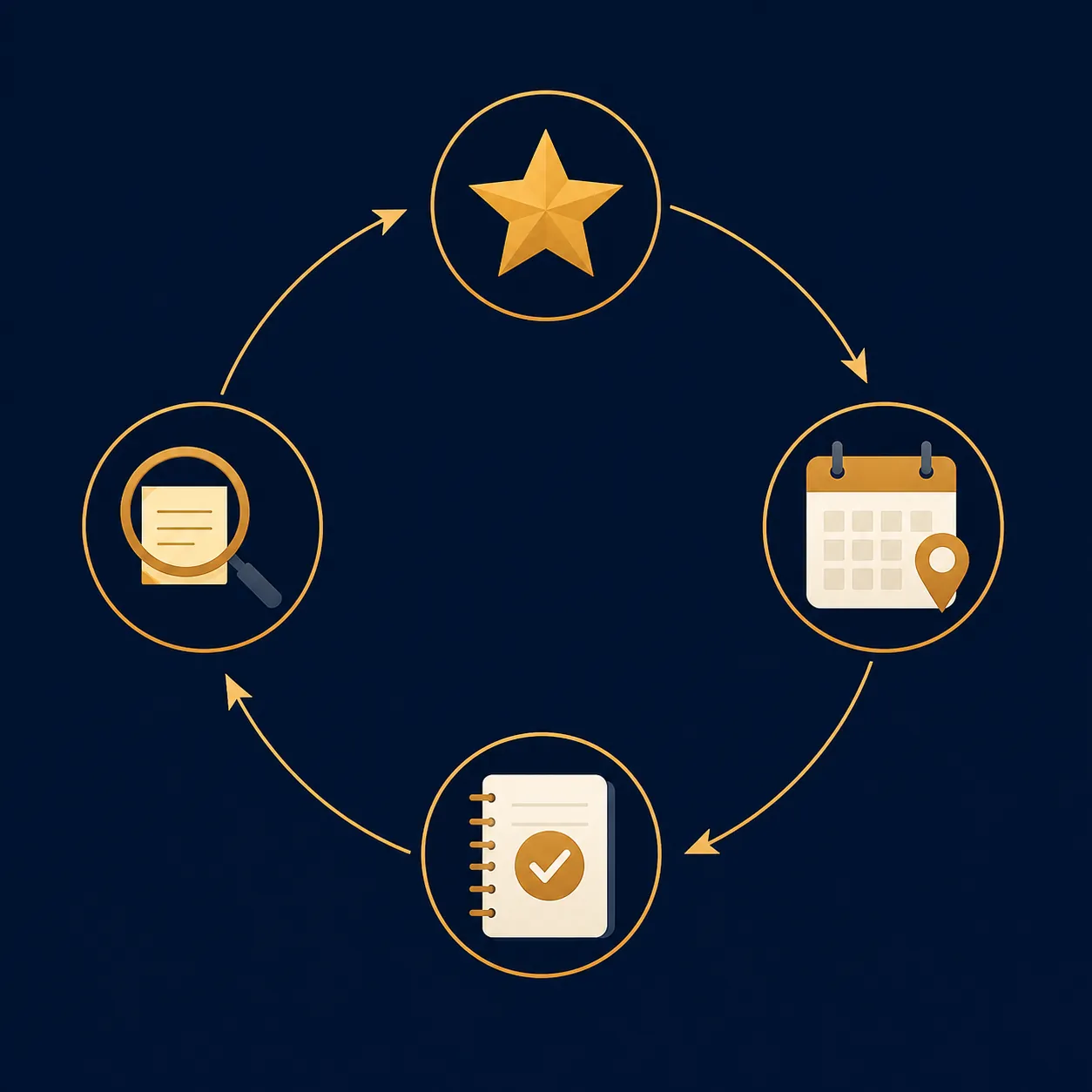
| Setup move | What to write in your notes |
|---|---|
| Choose one strong-evidence practice | Name the practice and the behavior it will change. |
| Write an implementation intention | Use an if-then or after-then sentence tied to a real cue. |
| Track the behavior | Record whether it happened, not whether you felt like the right kind of person. |
| Add feedback | Decide what signal will tell you whether the behavior is helping. |
| Set a dated review | Review after a realistic window before buying or adopting another system. |
1. Choose the practice by evidence, not by mood
Start with the strong-evidence list and pick the smallest practice that matches the friction you can actually see.
- If the problem is forgetting, choose an implementation intention or habit stacking.
- If the problem is drifting, choose self-monitoring.
- If the problem is vague success, choose a specific goal with feedback.
- If the problem is energy, choose sleep or exercise as the behavior layer, not as a moral diagnosis.
- If the problem is isolation or inconsistency, choose social support or a commitment device.
Sleep is one of the strongest mechanisms in the evidence map, but it is still best handled as a concrete behavior setup: bedtime cue, wind-down rule, environment change, morning feedback. If sleep is your chosen lever, keep the scope practical; this related piece on hot nights, sleep, and focus stays in that lane.
2. Write the commitment so tomorrow can understand it
A useful implementation intention is plain enough to be boring. Use a real cue, a visible action, and a small enough first version that you are not negotiating with yourself at the moment of action.
Practice: self-monitoring for deep work
Cue: after I open my laptop for the first work block
Implementation intention: After I open my laptop, I will write the one task that would make today meaningfully easier.
Minimum action: one sentence in the daily note
Feedback signal: did the first work block start with the named task?
Review date: Friday, 4 weeks from start
That example is hypothetical. The important part is not the wording. It is that the note tells your future self exactly where to begin, what counts, and when the experiment will be reviewed.
3. Track the behavior, not the aesthetic
Self-monitoring works best when it records the thing you said you would do. A checkbox can be enough. So can one line in a daily note. What matters is that the record survives a normal day.
A daily note is often the least dramatic place to put this, which is why it works. It is already where the workday leaves evidence. If your system needs a concrete home for capture, review, and lightweight tracking, use a simple workday notes setup rather than building a separate self-improvement cockpit.
For a two-week starter test, the tracking line might be no more than this:
Date:
Cue happened? Y/N
Behavior happened? Y/N
One-sentence note: what got in the way or what helped?
Feedback signal:
Avoid turning the log into a diary of self-judgment. The question is not whether you were motivated, impressive, or transformed. The question is whether the cue and behavior connected often enough to be worth continuing.
4. Add feedback that can correct you
A goal without feedback can feel pure because nothing contradicts it. That is the problem. Feedback gives the practice a way to become more accurate.
| If your practice is… | A useful feedback signal might be… |
|---|---|
| Writing before meetings | Did the meeting end with fewer unresolved decisions? |
| A shutdown routine | Did you reopen work after the shutdown? |
| Exercise before work | Did the planned session happen at the chosen cue? |
| Gratitude journaling | Did the entry happen, and did you keep the practice after the novelty faded? |
| Social accountability | Did another person see the commitment and the follow-up? |
Feedback does not have to be quantified to the decimal. It does have to be inspectable. If no one, including you, can tell whether the behavior changed, the practice is still mostly a story.
5. Make the environment carry some of the memory
Stable cues are easier when your notes and workspace do not hide the next action. Put the experiment where the cue already happens: the daily note, the project page, the recurring review, the bag you pack the night before, the browser page you open first.
If your note system has recently moved or sprawled, this is where structure matters. A clean PARA layer after migration can reduce the number of places your future self has to search; the setup guide for PARA after note migration is the environment side of the same problem.
How long to test before changing the system
The habit-formation range matters here. If automaticity can plateau anywhere from 18 to 254 days, then a four-day disappointment is not good evidence that the behavior is impossible. [3] It may be evidence that the cue is wrong, the action is too large, the feedback is missing, or the environment keeps interrupting the attempt.
That does not mean you must drag every experiment through months of misery. Separate three decisions:
- Adjust the cue if the cue rarely appears or is too chaotic.
- Shrink the behavior if the cue appears but the action does not happen.
- Stop the experiment if the behavior happens but the feedback shows it is not helping the problem you chose.
A dated review protects you from two equal mistakes: quitting every practice at the first dull patch, and clinging to a system because you already gave it a beautiful name.
A practical decision rule for 2026
When a new method asks for your money, time, or identity, run it through four questions before you rebuild your life around it:
- Is the core practice on the stronger side of the evidence map, or is it mostly a persuasive story?
- Can I write the behavior as an approach-framed action?
- Does the behavior have a stable cue and a place to be recorded?
- What feedback will tell me whether it is working before I adopt another system?
This decision rule is not anti-self-development. It leaves room for becoming healthier, kinder, more capable, more focused, or less scattered. It simply refuses to confuse that work with buying a costume for the person you hope to be.
Self-development and productivity will keep using different language. One will talk about growth; the other will talk about execution. In practice, the reliable move is the same: choose one strong-evidence behavior, attach it to a real cue, monitor it in the notes system you already use, add feedback, and put a review date on the page before you go looking for another life system.
References
- The State of Self-Improvement, 1% Better
- Self-Help Evidence Pyramid — 82 Techniques Ranked by Evidence, ClearerThinking
- Making health habitual: the psychology of ‘habit-formation’ and general practice
- A large-scale experiment on New Year’s resolutions: Approach-oriented goals are more successful than avoidance-oriented goals, PLOS ONE, 2020