
The practical question behind HIIT for cognitive function and focus at work is not whether hard intervals are good exercise. It is whether a short, sweaty break is a better use of a workday than coffee, scrolling, chores, or closing the laptop for ten minutes. The best answer is cautiously positive: short HIIT can improve lab-tested executive function, attention control, working memory, task-switching, and inhibitory control shortly after exercise. It has not been proven to increase real workplace output.
That distinction matters. A Stroop test result is not the same thing as finishing a strategy memo. A faster Trail Making response is not the same as navigating a messy standup. Still, those tests are not random party tricks. They measure cognitive skills knowledge workers use constantly: resisting distraction, holding information in mind, switching rules, and choosing the relevant signal under time pressure.

The cleanest positive evidence is on executive function, not “productivity”
The strongest HIIT-specific result comes from a 2025 meta-analysis of 18 studies with 827 participants. It found significant gains after HIIT across cognitive flexibility, working memory, task-switching, attention control, and inhibitory control. In comparisons with moderate-intensity continuous training, HIIT performed better on the Stroop test, with a standardized mean difference of −0.8, and on the Digit Span test, with a standardized mean difference of 0.3.[1]
Those two tests are worth translating carefully. The Stroop test asks people to suppress an automatic response and choose the task-relevant answer, which is close to the mental act of ignoring a Slack notification while resolving a spreadsheet discrepancy. Digit Span asks people to hold and manipulate short strings of information, which resembles the working-memory load of reading a client note while keeping the next decision in view. They are work-adjacent measures, not work itself.
| Cognitive domain | What the lab task is trying to capture | A reasonable workday analogy |
|---|---|---|
| Inhibitory control | Suppressing an automatic or distracting response | Not chasing every notification while doing a demanding task |
| Working memory | Holding and updating information briefly | Keeping several constraints in mind while editing, planning, or analyzing |
| Task-switching | Changing rules or task demands accurately | Moving from a meeting to a spreadsheet without carrying over the wrong frame |
| Attention control | Selecting relevant information under competing demands | Finding the important signal in a dashboard, email thread, or document |
| Cognitive flexibility | Adjusting to a new rule or interpretation | Reframing a problem when the first explanation stops working |
This is why the evidence is interesting for knowledge work, even if the productivity headline should stay on a short leash. The measured gains are in the machinery that supports focused work. The studies do not show that a person ships more code, writes a better brief, closes more tickets, or makes fewer judgment errors across an afternoon.
The timing window is the part a workday can actually use
A broader acute-exercise Bayesian meta-analysis sharpened the timing and dose picture. Looking at acute physical activity studies from 1995 to 2023 in adults aged 18 to 45, it found that cycling and HIIT produced the most consistent cognitive improvements, vigorous activity had the largest effects, cognition improved most clearly when tested after exercise, and exercise bouts under 30 minutes outperformed longer ones. Executive functioning was the key domain affected.[2]
For work purposes, “after” is doing a lot of work in that sentence. The evidence is not saying that people think better while gasping through intervals. It is mostly about the recovery period: the short span after the session when arousal is up, the body is settling, and cognitive testing begins.
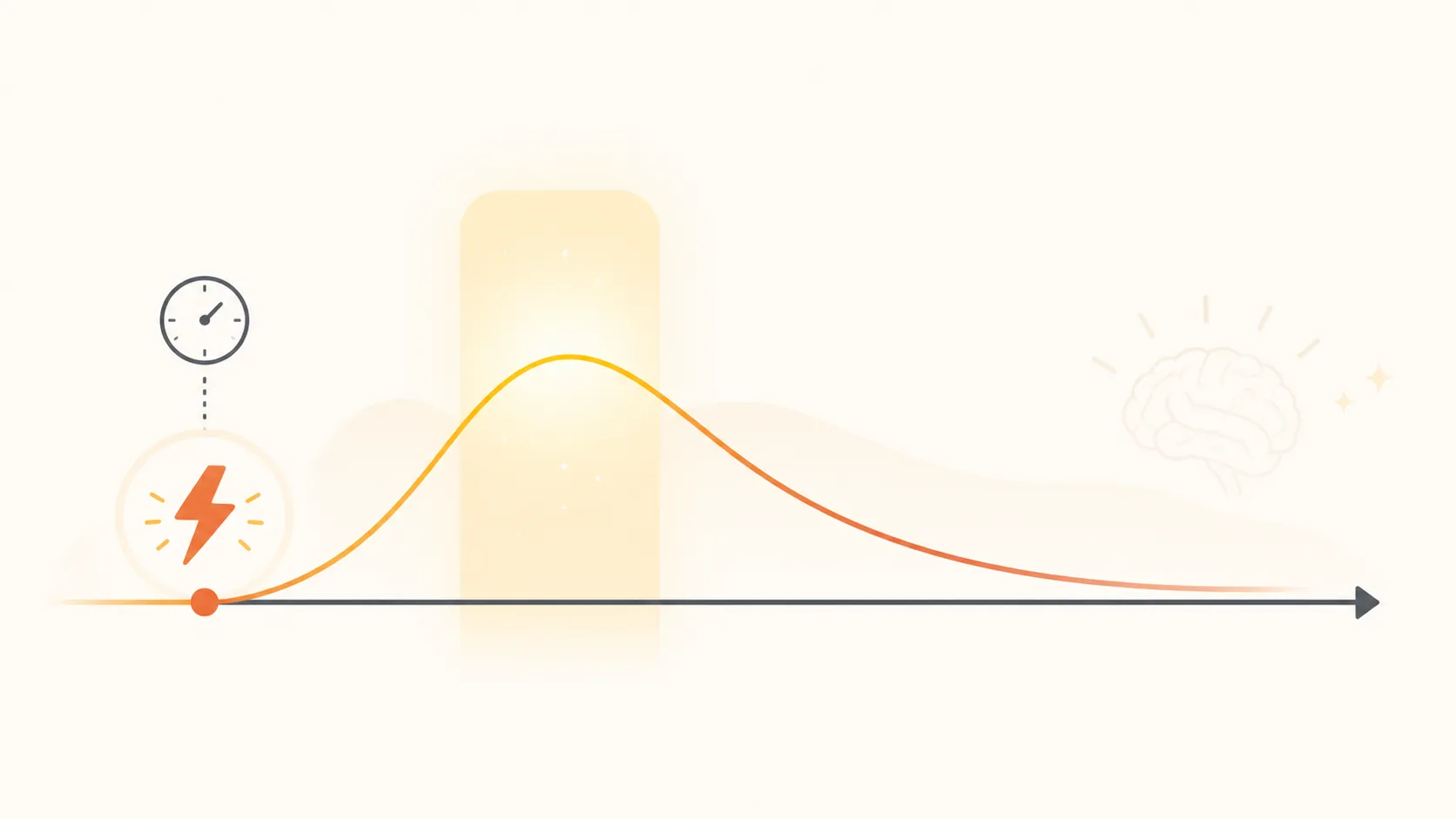
That makes HIIT more plausible as a pre-task reset than as a generic wellness habit inserted anywhere in the calendar. If the demanding work starts an hour after the workout because the shower line was long, a meeting ran over, and lunch arrived, the neat laboratory timing has already been blurred. If the next task starts ten to thirty minutes after the session, the schedule at least resembles the window in which many studies test cognition.
The acute sprint-interval studies give this timing a concrete shape. In one study of healthy younger adults, 6 all-out cycling intervals of 30 seconds shortened Stroop and Trail Making response times when cognition was measured 20 minutes after exercise.[3] Another acute HIIT protocol, 4 intervals of 4 minutes at 90% VO2peak, kept executive function elevated through 30 minutes of recovery while moderate continuous exercise returned to baseline.[1]
These are not office protocols. They are controlled exercise bouts followed by controlled tests. But they do suggest a usable hypothesis: if HIIT helps a work session, the benefit is most likely to show up soon after a short bout, on tasks that demand inhibition, switching, and working memory.
The workplace evidence is the weak link, not a footnote
The most important limiting evidence comes from a systematic review of high-intensity interval training, sprint interval training, and work-related cognitive function. It reviewed 36 HIIT/SIT-cognition studies. Significant cognitive improvements appeared in 55% of acute studies and 38% of chronic studies, but only 4 studies, or 11%, were conducted outside the laboratory. The two workplace-context trials found no significant cognitive benefit.[4]
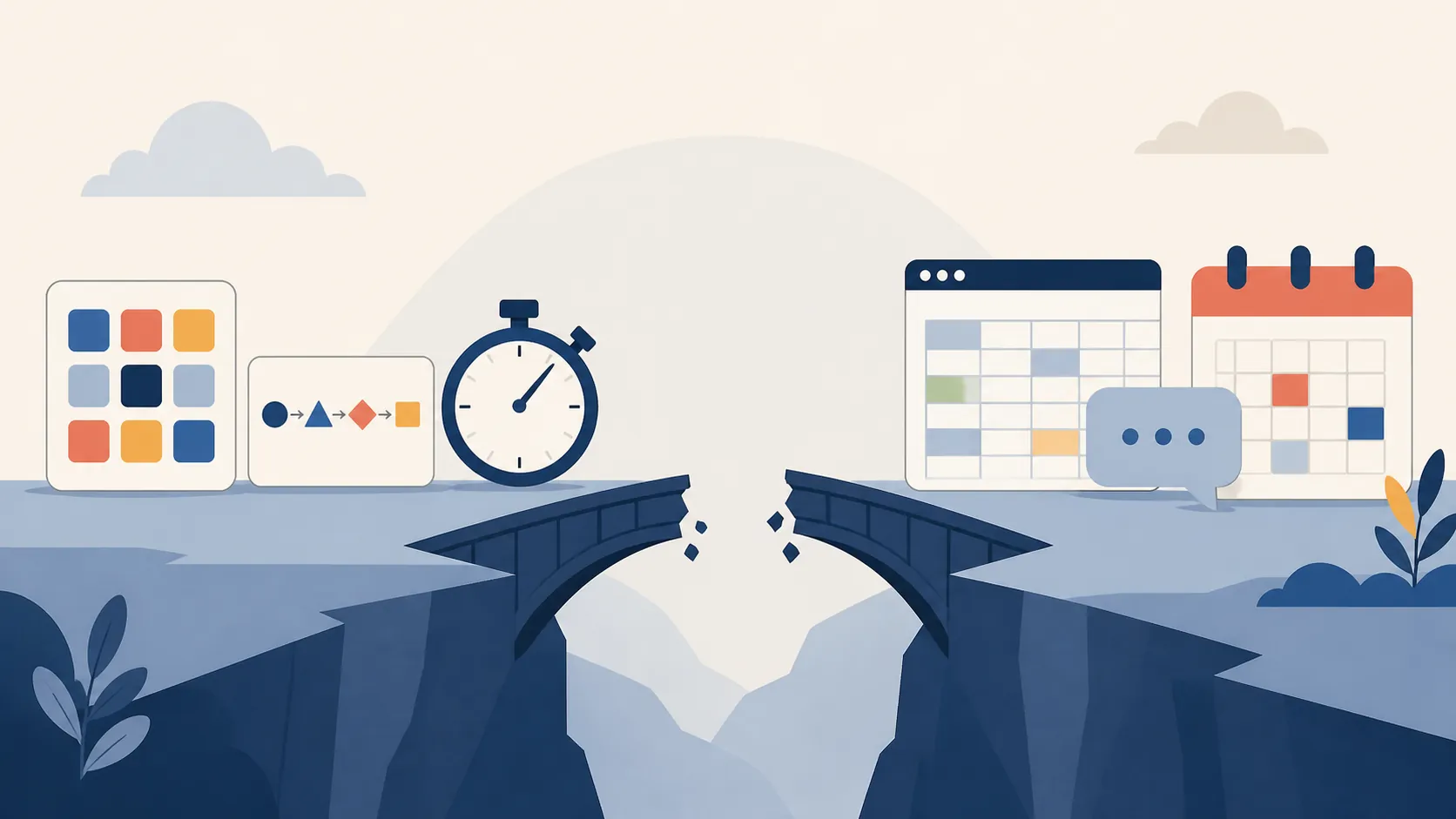
This is the transfer problem. Lab tasks isolate clean pieces of cognition. Work does the opposite. A real work session includes social interruption, emotional residue from meetings, ambiguous goals, fatigue, ergonomic friction, open tabs, and the small indignity of needing to stop sweating before rejoining a call. A statistically significant test result can be real and still too narrow to guarantee a better afternoon.
The same issue shows up in other focus claims. Brain-training programs, meditation apps, and productivity tools often improve the thing they repeatedly train or measure, while the promised transfer to everyday work is harder to prove. That is the central question in our comparison of brain-training apps for focus and productivity: does the test improvement travel into the work that actually matters?
For HIIT, the answer is not “no.” It is “not shown well enough yet.” The laboratory signal is promising. The workplace evidence is sparse and, so far, not convincingly positive.
Why the effect is biologically plausible
There are plausible pathways for a short hard session to affect cognition. Acute sprint interval exercise has been reported to increase both cognitive function and peripheral neurotrophic factors in humans, with lactate proposed as part of the pathway.[5] BDNF and related neurotrophic factors are often discussed because they are involved in brain plasticity and neuronal support; lactate is interesting because intense exercise changes lactate availability quickly.
The mechanism layer should make the cognitive findings less surprising, not more certain than they are. Peripheral markers are not the same as workplace attention. A blood marker rising after intervals does not prove that a product manager will make a better prioritization call twenty minutes later. It only helps explain why an acute cognitive effect could be real rather than magical.
Individual variation also matters. The review literature includes mixed results, and some acute studies found no cognitive difference compared with rest.[4] That fits the lived version of HIIT: one person returns alert and settled; another returns overheated, hungry, and annoyed by the next calendar invite.
What counts as a fair self-test
Because HIIT is cheap, reversible, and easy to stop, it is reasonable to test personally as long as the claim stays modest. A fair test does not ask, “Do I feel mentally clear?” five minutes after doing something intense. It asks whether a specific kind of work feels and performs better when placed soon after a short session.
- Use it before work that depends on inhibition, working memory, or task-switching: editing, analysis, planning, reviewing, or a difficult handoff.
- Keep the session short enough that the total interruption still fits the day. The acute evidence favors bouts under 30 minutes, but the workday cost includes changing, cooling down, showering, and re-entry.
- Place the demanding task soon after the session when possible, especially inside the rough 10- to 30-minute recovery window suggested by the acute evidence.
- Compare against a realistic alternative, not against doing nothing forever. The honest comparator may be coffee, a walk, a nap, quiet rest, or simply blocking distractions.
- Track the work outcome you care about: pages revised, errors caught, time to settle into a task, or quality of a review pass. Mood alone is too slippery.
This is also where lower-friction focus improvements may beat exercise on a given day. If the real problem is noise, sleep debt, notification design, or a calendar chopped into fragments, intervals are solving the wrong layer. For that side of the problem, see the environment-focused guide to improving focus naturally and the review of how six hours of sleep affects productivity.
The long-term brain claim is interesting, but it is a different claim
There is a separate, more speculative reason people get excited about HIIT and cognition: long-term brain health. One 6-month trial in 151 healthy adults aged 65 to 86 found that only the HIIT group improved hippocampal function, and that the improvement was retained at a 5-year follow-up after HIIT had stopped.[6]
That is intriguing. It is not permission to claim that a mid-career analyst, designer, manager, or engineer will protect long-term cognition by adding lunchtime intervals. The population, outcome, and time scale are different. Older-adult hippocampal function after months of training is not the same question as whether a 22-minute session improves focus before a 2 p.m. document review.
The practical verdict
HIIT is a plausible focus lever, not a proven workplace productivity system. The best evidence supports short-term improvements in executive function, attention control, working memory, task-switching, and inhibitory control, especially after short bouts and especially when cognition is tested after exercise rather than during it. The most useful workday bet is to schedule demanding cognitive work soon after a feasible short session.
It is not ideal for everyone, and it is not the first fix for sleep loss, poor recovery, injury risk, or a work environment built out of interruptions. If the logistics of sweating, cooling down, and re-entering meetings create more friction than focus, rest may be the better break. The adjacent decision of whether to recover with rest or chores is covered in this comparison of rest versus chores after work.
On the right day, with the right task waiting, a short hard session is worth testing. Just keep the unit of belief the same as the unit of evidence: better scores on executive-function and attention tasks shortly after exercise, not guaranteed better work.
References
- Meta-analysis of high-intensity interval training effects on cognitive function — Frontiers in Physiology, 2025
- A systematic review and Bayesian meta-analysis provide evidence for an effect of acute physical activity on cognition in young adults — Communications Psychology, 2024
- The Influence of Acute Sprint Interval Training on Cognitive Performance of Healthy Younger Adults — PMC
- High intensity and sprint interval training, and work-related cognitive function in adults: A systematic review — Scandinavian Journal of Medicine & Science in Sports, 2023
- Acute Sprint Interval Exercise Increases Both Cognitive Functions and Peripheral Neurotrophic Factors in Humans: The Possible Involvement of Lactate — Frontiers in Neuroscience, 2019
- Cognitive benefits from high-intensity interval training may last for years — Harvard Health