
You get home, put your bag down, and open your phone “for a minute.” The sink is visible from the couch. Laundry is somewhere in the background, becoming more morally significant by the second. Rest feels irresponsible because the apartment is not handled. Chores feel impossible because work has already taken the useful part of your brain. So you scroll, which is neither rest nor chores, and now there is a third thing to feel bad about.

The useful question is not whether rest or chores are morally better after work. The useful question is why you are forcing that decision to happen at the exact hour when your decision-making is least trustworthy.
Work exhaustion is not a niche complaint. Harvard Business Review reported that close to half of people said they were often or always exhausted because of work, a 32% increase over roughly two decades [1]. That matters because the evening rest-vs-chores dilemma is not happening in a neutral mind. The American Medical Association and Cleveland Clinic both describe decision fatigue as a state in which repeated choices make later decisions harder and more impulsive [2][3].
The sharper version comes from a 2022 Current Biology study covered by Medical News Today: after about 6.25 hours of demanding cognitive work, participants shifted toward lower-effort, more immediate-reward choices, while researchers also observed glutamate accumulation in the lateral prefrontal cortex [4]. That does not prove a clean “brain chemical causes doomscrolling” story; the causal relationship was not established. It does make one thing less mysterious: after a hard workday, the low-effort option can become more attractive before you have made any conscious argument for it.
So the evening routine after work should not begin with a fresh debate about rest vs chores to avoid fatigue. That debate is the trap. The better move is to decide the route before the evening arrives, then let the route choose what kind of recovery is needed and whether any chore belongs there at all.
Run the evening on a route, not a debate
The recovery literature gives better words than “take a break.” The four recovery experiences most useful here are psychological detachment, relaxation, mastery, and control. EU-OSHA’s synthesis of detachment and recovery research describes low detachment from work as linked with higher fatigue, emotional exhaustion, and need for recovery; it also notes that recovery is supported by leisure that is social, not overly effortful, and physically active [5].
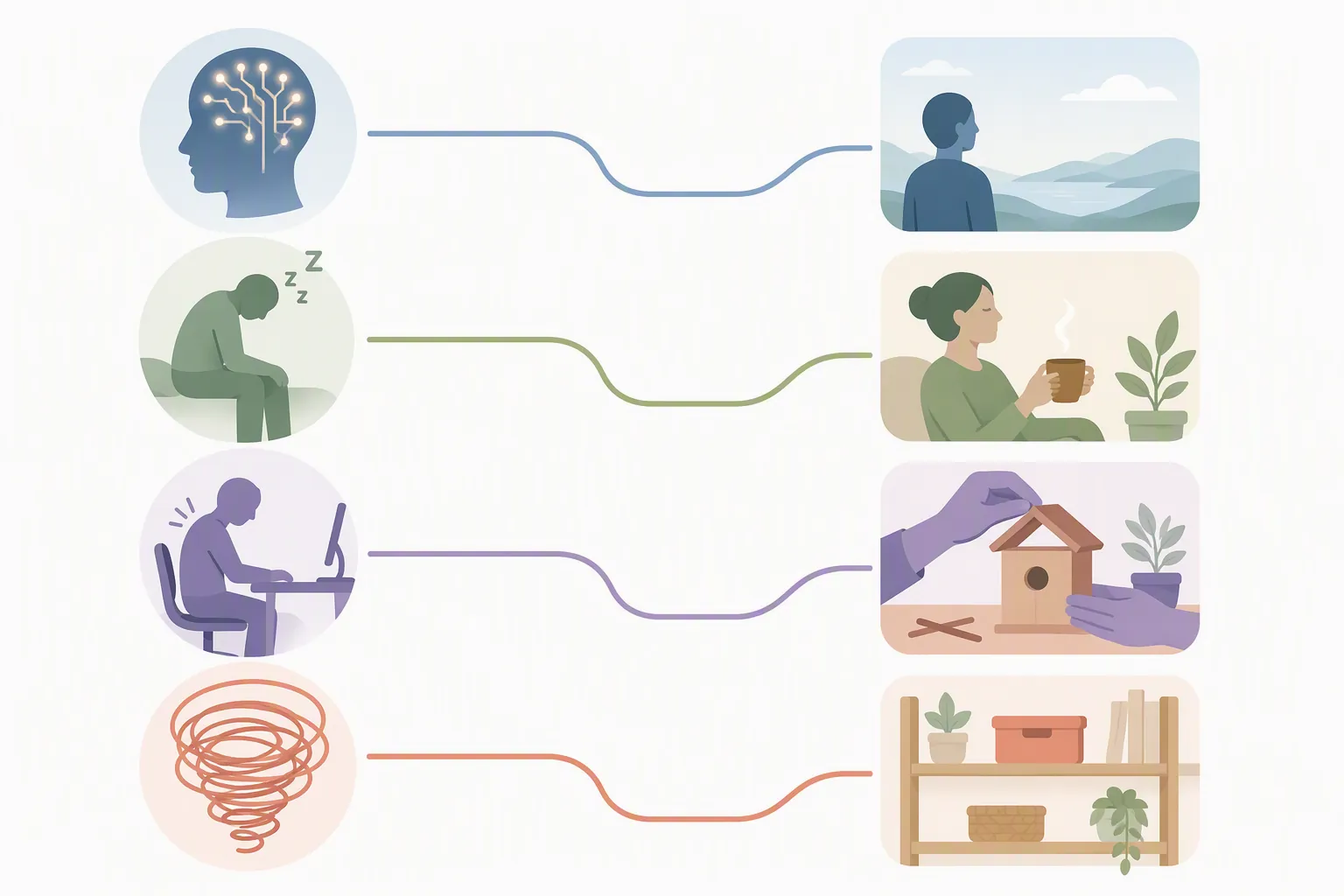
The table below is not a clinical protocol or a published taxonomy. It is a practical routing framework built from that recovery model and from the very ordinary fact that “tired” can mean several different things by 7 p.m.
| Dominant evening signal | What it feels like | Bad default it often produces | Route |
|---|---|---|---|
| Cognitive or decision fatigue | Every option feels too large; choosing dinner, laundry, shower, or rest all feel equally irritating | Scrolling, snacking, or starting three tasks without finishing any | Control: reduce choices to one pre-decided next action |
| Sleep debt or true sleepiness | Heavy eyelids, nodding off, feeling unsafe to drive, reading the same line repeatedly | Trying to become “productive” and stretching the night later | Sleep protection: stop routing into chores and protect bedtime |
| Physical stillness | Stiff hips, shallow breathing, restless body after sitting all day | Collapsing into passive screen time that leaves the body just as tense | Relaxation through low-effort movement: walk, stretch, light reset |
| Stress without detachment | The workday is over but your mind is still arguing, rehearsing, or monitoring messages | Checking one more thing, vent-scrolling, or cleaning angrily | Detachment first; then relaxation or a small mastery activity if energy returns |
| Flatness after monotonous depletion | Not exactly stressed, not exactly sleepy, just dulled and underused | Numbing out because nothing feels worth starting | Mastery: a small chosen activity that gives progress without becoming another job |
Cognitive fatigue needs control, not a better pep talk
Cognitive fatigue is the kitchen-at-7:18 problem. Nothing is objectively complicated. Put dishes in dishwasher. Start laundry. Eat something. Shower. Sit down. These are not advanced operations, which is why it feels so insulting when they become hard.
The mistake is treating this as a motivation shortage. By evening, the cost is often the choosing itself. If every option asks you to compare timing, effort, guilt, household expectations, and tomorrow’s consequences, the phone wins because it asks for no visible decision at all.
The recovery need here is control: fewer open loops, fewer menus, fewer “what now?” moments. Control does not mean forcing a heroic reset. It means the evening has a pre-decided first move so your tired brain does not have to invent one.
- If it is a normal tired night: eat or assemble food first, then do one bounded reset.
- If the room is bothering you: clear one surface or one sink zone, not the whole home.
- If you are stuck between options: use the same default order every time — body, food, one small reset, recovery.
- If you keep checking work: the first action is detachment, not chores.
A good control route is boring on purpose. The point is not to design the perfect evening. The point is to remove the open-ended argument that keeps you half-resting and half-punishing yourself.
Sleepiness is not a productivity signal
Sleep debt deserves different treatment because it is easy to disguise it as ordinary fatigue. Sleep.com distinguishes sleepiness and fatigue as related but different states: sleepiness points more directly toward the need for sleep, while fatigue can include low energy, low motivation, or depletion without necessarily being solved by an immediate nap [6].
If you are truly sleepy, do not route yourself into “productive recovery.” Do not use mastery. Do not start a clever chore sprint to earn rest. The route is bedtime protection: reduce stimulation, handle only what prevents tomorrow from becoming unsafe or chaotic, and move toward sleep.
That may mean the dishes wait. It may also mean one practical minimum happens first: medication, a child’s required item for morning, food put away, the door locked, the dog taken out. The distinction is not whether the task is noble. The distinction is whether it is necessary tonight or merely another way to delay sleeping while calling the delay responsibility.
A stiff body may need movement before the couch works
After a day of sitting, “rest” can become oddly unsatisfying. You lie down, but your shoulders are still up. Your breathing stays shallow. You are tired enough to avoid effort but restless enough that passive scrolling feels like the only tolerable middle ground.
This is where relaxation does not have to mean immediate stillness. A short walk, a slow stretch, putting away groceries while music plays, or ten minutes of very light tidying can be recovery if it helps the body downshift. The recovery literature’s point about physically active leisure is useful here, as long as it is not converted into another exercise mandate [5].
The test is how the activity behaves. If light movement makes you breathe more normally and leaves the evening simpler, it belongs. If it turns into a full workout you did not choose, or a cleaning spiral with a podcast at double speed, it has stopped being recovery.
Stress without detachment needs a boundary before it needs a mop
Some evenings the body is home and the mind is still in the meeting. You are replaying one comment, drafting tomorrow’s message, checking whether someone replied, or cleaning with the emotional tone of cross-examination.
The route here is detachment first. Not numbness, and not pretending the day was fine. Detachment means the work system stops receiving attention for a while. Close the laptop. Put the work phone where it cannot recruit your peripheral vision. Change clothes. Walk without work audio. Take a shower without using it as a strategy session.
Chores done before detachment often become contaminated. The dishes become proof that no one helps. The laundry becomes evidence that the whole household is unfair. Sometimes that evidence is real, but 8 p.m. rage-cleaning rarely produces a fair division of labor. It mostly produces a cleaner counter and a more activated nervous system.
After detachment, choose relaxation if you are keyed up, or mastery if the day left you dulled rather than overcharged. Mastery is not self-improvement theater. It is a small voluntary action with a felt sense of progress: cooking one simple thing because you want to, practicing a few chords, fixing a drawer that has annoyed you for weeks, reading something that is not work. The word “voluntary” is doing most of the work.
Chores help only when they are chosen, bounded, and small
Chores are not the villain. A small, pre-decided chore can create control. It can make tomorrow less abrasive. It can prevent the morning from opening with a lost badge, no clean cup, a child’s missing form, or a kitchen that makes breakfast feel like a negotiation.
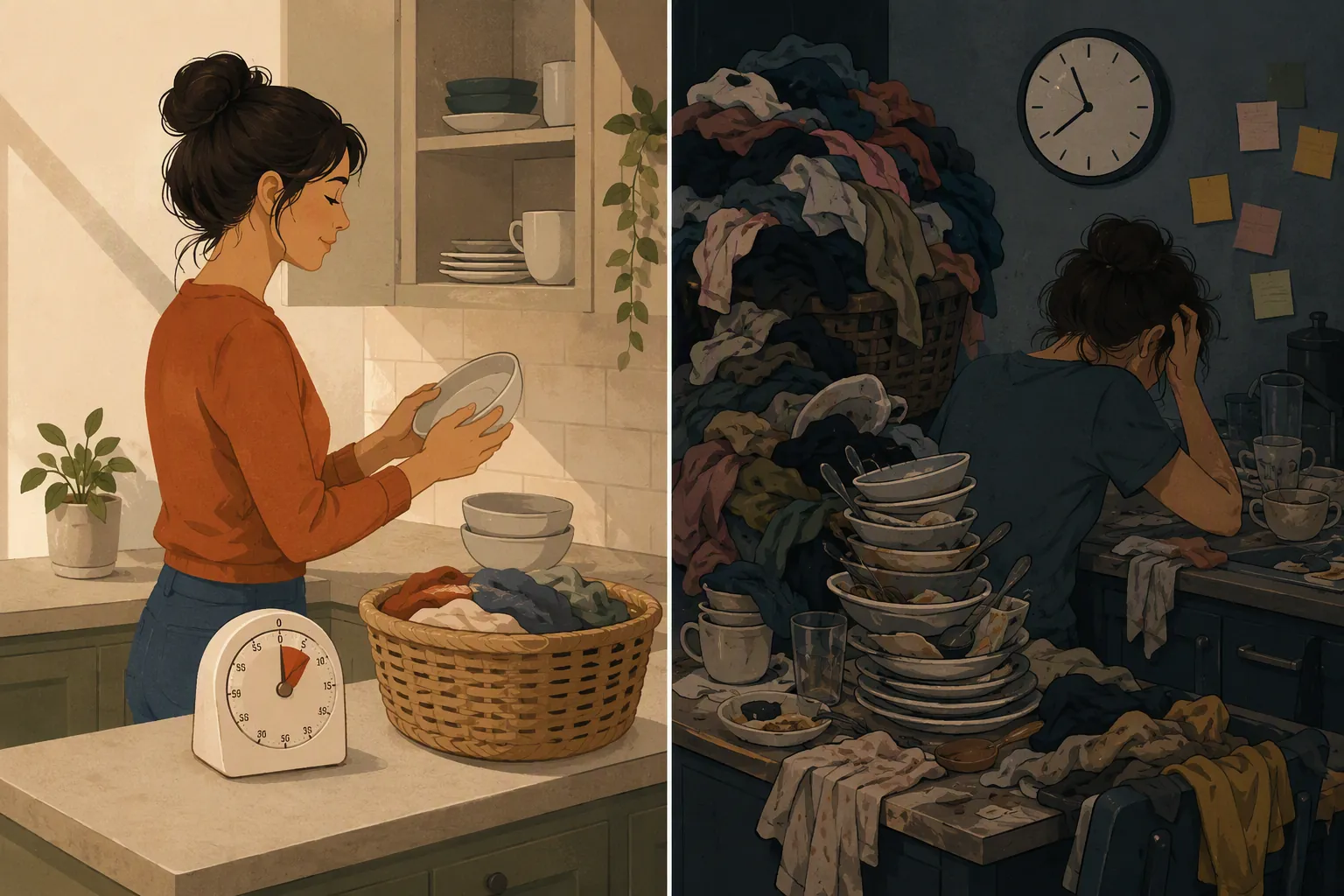
The damaging version is different. It is open-ended, guilt-driven, and expandable. You start with “I’ll just load the dishwasher,” then notice the counters, then the trash, then the bathroom, then the laundry, then suddenly rest has to fit into whatever scraps are left after the home has taken its emotional tax.
A chore belongs in the evening when it passes three tests.
- It was pre-decided before the depleted hour, or it is part of a known default.
- It has a hard boundary: one basket, one sink load, one lunch packed, ten minutes.
- It reduces tomorrow’s friction more than it steals tonight’s recovery.
That last test is the one most people skip. Vacuuming the whole place at 9:30 p.m. may feel virtuous, but if it pushes sleep later and leaves you resentful, tomorrow pays for tonight’s performance. Packing tomorrow’s bag, rinsing the pan that will smell awful by morning, or setting out medication is different. Those tasks have a clear end and a clear beneficiary.
In a shared home, “chosen” cannot mean “chosen by the person with the least ability to ignore mess.” The route has to be discussed earlier than the tired hour. Decide what the household minimum is on work nights, who owns which recurring task, and what is allowed to wait without becoming one person’s silent debt. A timebox is not a moral shield if someone else absorbs everything outside it.
The zero-energy default
Some nights you will not diagnose your fatigue correctly. Fine. The fallback should not require self-knowledge, journaling, or a fresh promise to become a different person. Routinery, a habit-tracker vendor, frames burned-out after-work routines around very small resets, including a 15-minute reset concept; the sequence below uses that spirit as a practical fallback, not as evidence that one specific routine works for everyone [7].

- Put the phone face-down or across the room. Not forever. Just remove the easiest non-decision.
- Handle the body: bathroom, water, medication, food if you need food.
- Set a 10- to 15-minute timer.
- Lie down, sit in low light, or take a quiet shower. No work audio. No “catching up.”
- When the timer ends, ask only one question: am I sleepy? If yes, protect bedtime. If no, choose one pre-decided route.
This fallback is deliberately small because zero-energy nights do not need a lifestyle system. They need a way to stop the evening from becoming a guilt machine. If one necessary chore must happen, make it the smallest version with the clearest ending: food put away, dishwasher started, school item placed by the door. Then stop.
What the route changes
A routing system will not erase burnout, sleep loss, caregiving pressure, or unequal household labor. It will not make every evening peaceful. It changes a narrower thing, which is still worth changing: the default is no longer an exhausted argument between rest and chores.
Rest counts when it matches the fatigue. Detachment when the mind is still at work. Relaxation when the nervous system is keyed up. Mastery when the day has left you flat and underused. Control when choice itself is the drain. Sleep when you are sleepy.
Chores belong after work only when they are deliberately chosen and bounded tightly enough not to steal the recovery they were supposed to support. Otherwise they are just another way for the workday to keep spending you.
So when the couch, sink, laundry, and phone all start making their case at once, do not ask, “What should I make myself do now?” Ask, “Which fatigue is dominant, and what recovery does it call for?” That is a smaller question. At night, smaller is the point.
References
- Burnout at Work Isn’t Just About Exhaustion. It’s Also About Loneliness, Harvard Business Review, 2017
- What doctors wish patients knew about decision fatigue, American Medical Association
- Decision Fatigue: What It Is and How to Avoid It, Cleveland Clinic
- Scientists find clues that may explain why we feel tired after mentally demanding work, Medical News Today
- Detachment and recovery after work - overview, EU-OSHA OSHwiki
- Why You’re Tired After Work—And What You Can Do About It, Sleep.com
- What to Do After Work When Burned Out, Routinery