

Introduction: The Handwriting Renaissance
For the better part of two decades, the default advice for students and professionals was simple: type your notes. It's faster, more legible, and easier to organize. Laptops and tablets became standard classroom equipment, and the humble pen and paper were relegated to a nostalgic afterthought. But a growing body of cognitive science research is challenging that assumption, and the pendulum is swinging back.
The resurgence of handwriting is being driven by two parallel forces. First, a wave of rigorous meta-analytic research — culminating in the largest study of its kind in 2024 — has confirmed that handwriting produces measurably better learning outcomes than typing. Second, the rise of powerful digital handwriting apps like Goodnotes, Notability, and Nebo has made it possible to capture handwritten notes on a tablet without sacrificing the organizational benefits of digital tools. The global note-taking app market, valued at roughly $7.91 billion in 2024, is projected to more than triple by 2032, with handwriting recognition and AI features cited as primary growth drivers.
This article is an evidence-based guide for anyone who takes notes — students in lecture halls, professionals in meetings, lifelong learners in online courses. We'll examine what the latest research actually says about handwriting versus typing, why the cognitive benefits exist, whether digital handwriting on an iPad or Android tablet delivers the same advantages as pen and paper, and how to choose a handwriting-first app that fits your workflow.
What the 2024 Meta-Analysis Found: 24 Studies, 3,005 Participants
In 2024, Flanigan and colleagues published a landmark meta-analysis in Educational Psychology Review that aggregated results from 24 separate studies across 21 articles, encompassing a total of 3,005 participants. The central question was straightforward: do college students who take handwritten notes perform better on assessments than those who type their notes?
The answer, across the entire body of evidence, is a clear yes. The meta-analysis found that taking and reviewing handwritten notes leads to higher achievement, with a statistically significant effect size (Hedges' g = 0.248; p < 0.001). To put that number in practical terms, the researchers calculated a hypothetical grade distribution: approximately 9.5% of students who take notes by hand would achieve an A grade, compared to only 6% of students who type their notes. The pattern reverses for lower grades: a higher percentage of typists would receive D or F grades.
| Metric | Handwritten Notes | Typed Notes |
|---|---|---|
| Hypothetical A-grade rate | 9.5% | 6% |
| Note-taking volume (Hedges' g) | Baseline | 0.919 (significantly more words) |
| Overall achievement (Hedges' g) | 0.248 (higher) | Baseline |
| Effect of test delay | No moderation | No moderation |
| Effect of assessment type (factual vs. conceptual) | No moderation | No moderation |
This finding is not a fluke of a single study. The meta-analysis aggregated data across two decades of research, and the handwriting advantage held consistently. The researchers concluded that handwritten notes are more useful for studying and committing information to memory than typed notes, ultimately contributing to higher achievement.
Why Handwriting Outperforms Typing: Level of Processing and Dual Coding
The meta-analysis confirms that handwriting produces better outcomes, but why? The researchers point to two complementary cognitive mechanisms that explain the advantage.
Deeper Processing Through Paraphrasing
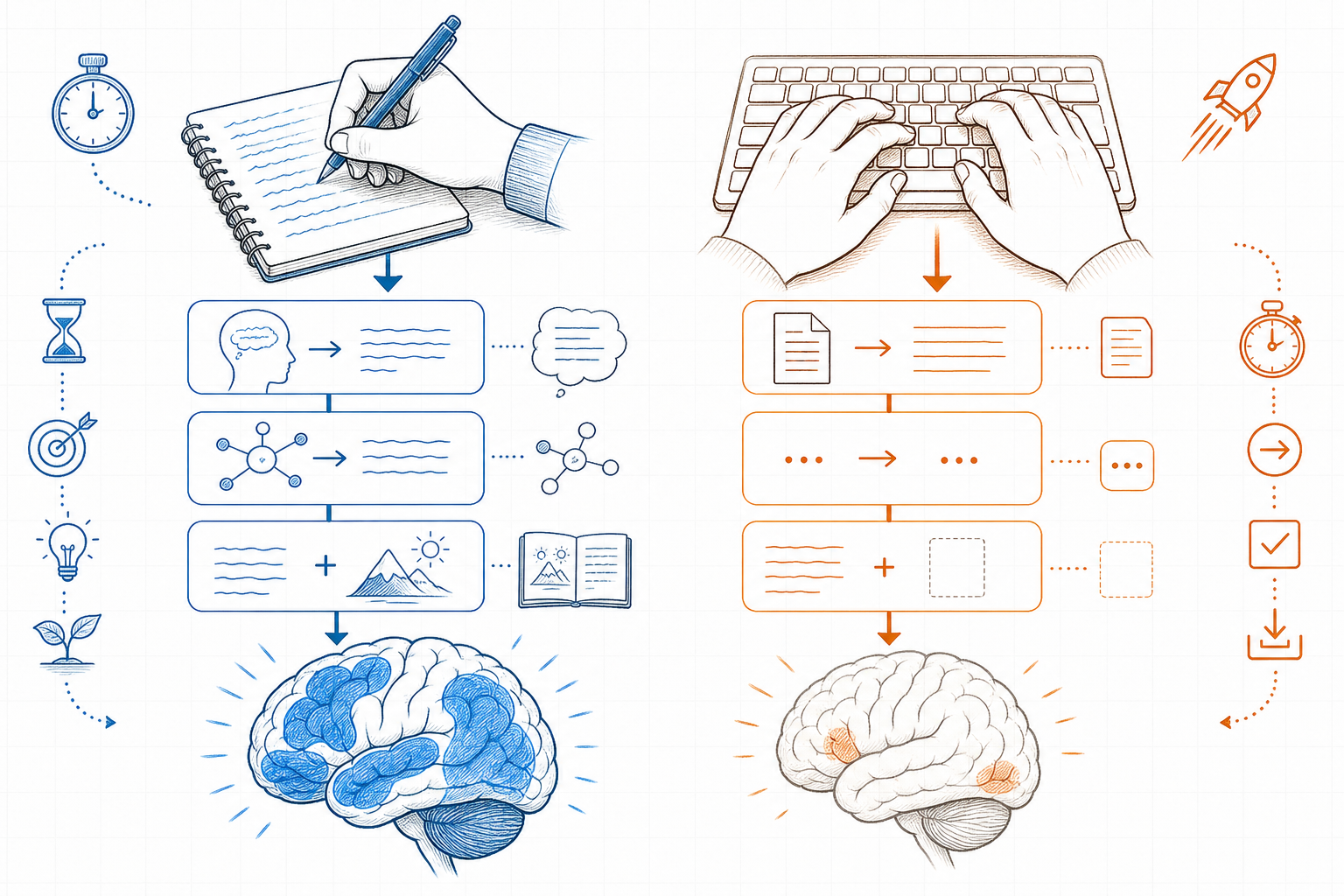
Handwriting is slower than typing. The average person types around 40 words per minute but writes by hand at roughly 13 words per minute. This speed constraint, often framed as a disadvantage, is actually the source of handwriting's cognitive edge. Because you cannot transcribe a lecture verbatim by hand, you are forced to listen, process, and rephrase information in real time. This act of paraphrasing — of translating the speaker's words into your own — requires deeper cognitive engagement with the material.
Typing, by contrast, allows near-verbatim transcription. The ease of typing means many students fall into the trap of becoming "dictation machines," capturing the lecturer's words without processing their meaning. The meta-analysis confirms this: typed notes contain more words and ideas from lectures, but this greater volume does not translate to better performance. The extra words are often shallow copies, not synthesized understanding.
Dual Coding: The Power of Drawings and Spatial Layout
The second mechanism is dual coding theory. Handwritten notes naturally incorporate more than just text — they include drawings, diagrams, arrows, spatial layouts, margin notes, and visual hierarchies. These visual elements create multiple memory pathways: the verbal information is encoded alongside a visual representation, making it easier to retrieve later.
A student sketching a biological process or drawing a flowchart for a business model is not just doodling — they are building a richer mental model of the concept. Typed notes, constrained by linear text and uniform formatting, rarely achieve this level of spatial and visual encoding.
- Handwriting forces paraphrasing and synthesis, leading to deeper processing.
- Handwritten notes naturally include drawings, diagrams, and spatial layouts, enabling dual coding.
- Typing enables verbatim transcription, which produces more words but shallower understanding.
- The speed advantage of typing becomes a cognitive disadvantage when it replaces active listening and synthesis.
Key Moderators: Test Delay, Review, and Assessment Type
A common question about the handwriting advantage is whether it depends on specific conditions — does it only help on immediate quizzes, or does it persist for final exams? Does it work for multiple-choice questions, or only for essays? The meta-analysis provides clear answers.
| Moderator | Finding |
|---|---|
| Test delay (immediate vs. delayed) | No moderation — the handwriting benefit holds regardless of when the test is taken. |
| Assessment type (factual vs. conceptual) | No moderation — handwriting improves performance on both factual recall and higher-order conceptual questions. |
| Opportunity to review notes before test | Review further boosts the handwriting advantage. Handwritten notes are more personally encoded and thus more effective as study material. |
The finding on review is particularly important. The researchers found that the opportunity to review handwritten notes before a test further boosted the performance advantage over typed notes. This makes intuitive sense: because handwritten notes are the product of active synthesis, they are more personally meaningful and easier to study from. A page of handwritten notes with diagrams, arrows, and margin questions is a more effective study aid than a page of linear typed text.
Does Digital Handwriting (iPad + Stylus + App) Replicate Paper's Benefits?
This is the critical question for anyone considering a digital handwriting app: does writing on a tablet with a stylus deliver the same cognitive benefits as writing on paper? The honest answer, based on the current research, is that we do not yet know.
The Flanigan et al. (2024) meta-analysis studied pen-and-paper handwriting exclusively. The studies included in the analysis did not test digital handwriting on tablets. This is a significant gap in the literature, and it would be irresponsible to claim that digital handwriting is proven to be equivalent to paper. However, we can reason from first principles about where the similarities and differences likely lie.
Where Digital Handwriting Likely Preserves the Cognitive Benefits
The two mechanisms that explain handwriting's advantage — slower pace forcing paraphrasing, and the ability to draw and create spatial layouts — are both present in digital handwriting. Writing with a stylus on a tablet is still slower than typing, so the paraphrasing benefit should be preserved. And modern handwriting apps fully support drawings, diagrams, arrows, and freeform layouts. In these respects, digital handwriting is much closer to paper than to typing.
Where Digital Handwriting Differs
Digital handwriting introduces variables that paper does not have. The tactile feedback of a stylus on glass is different from a pen on paper, and some research suggests that tactile feedback plays a role in motor memory encoding. The presence of a screen — with notifications, multitasking capabilities, and the temptation to switch apps — introduces potential distractions that paper does not. And the very features that make digital handwriting appealing, such as handwriting recognition and search, might alter the cognitive process in ways we do not yet understand.
That said, modern apps are adding features that paper cannot offer. Goodnotes 6, for example, offers AI-powered writing aids that can spellcheck and correct errors in the user's own handwriting style, and its audio recording feature syncs playback to individual handwriting strokes. Notability offers similar synced audio recording, allowing a student to tap on a word and hear what the lecturer was saying at that exact moment. These features could potentially enhance learning in ways that paper cannot, but they also introduce new variables that may change the cognitive dynamics of note-taking.
Practical Takeaways for Students and Professionals
The research supports a clear, actionable strategy: lead with handwriting for capture, and use digital tools for organization and retrieval. Here is a practical framework for applying the evidence.
- Handwrite during lectures and meetings. Whether you use pen and paper or a tablet with a stylus, the act of handwriting forces you to process and paraphrase information in real time. This is the single most impactful change you can make.
- Reserve typing for speed-intensive tasks. Typing is still the right tool for transcription, coding notes, drafting long documents, and any situation where raw speed matters more than comprehension.
- Adopt a hybrid workflow. Handwrite during capture, then convert your handwritten notes to text for organization and search. Apps like Nebo excel at handwriting-to-text conversion, and Goodnotes offers built-in OCR search that makes handwritten notes fully searchable without conversion.
- Review your handwritten notes within 24 hours. The meta-analysis shows that review amplifies the handwriting advantage. Set aside 10 minutes after each lecture or meeting to review, annotate, and connect your handwritten notes.
- Use drawings and diagrams deliberately. Don't just write words — sketch relationships, draw arrows, create flowcharts. The dual coding benefit is real, and it's one of the easiest ways to improve retention.
Caveats: Who This Research Does and Does Not Apply To
The Flanigan et al. (2024) meta-analysis is the most comprehensive study of handwriting versus typing to date, but it has important boundary conditions that must be communicated clearly. The research was conducted on college students taking notes from lectures. The findings do not necessarily generalize to other populations or contexts.
- K-12 students: The studies focused on college-aged participants. Younger students may have different cognitive development stages and motor skills that affect the handwriting-typing comparison.
- Workplace meetings: The lecture format — continuous spoken information with a single speaker — is different from the interactive, multi-speaker dynamics of most workplace meetings. The findings may not transfer directly.
- Students with disabilities: The research does not cover students with dyslexia, dysgraphia, motor difficulties, or other conditions that may make handwriting physically challenging or cognitively taxing. For these students, typing or voice transcription may be the more effective — and more accessible — option.
- Cost and device access: An iPad with an Apple Pencil and a subscription to a handwriting app can easily exceed $500. This is a real barrier for many students and professionals. Free or lower-cost alternatives exist, but the hardware investment remains significant.
For budget-conscious readers, our guide to free note-taking apps evaluates which free plans are genuinely usable versus limited trials, helping you make an informed decision without spending money upfront.
Recommendations for Choosing a Handwriting-First App
If you are ready to adopt a handwriting-first workflow, the app you choose matters. Based on the cognitive principles discussed in this article, here are the key criteria to evaluate when selecting a digital handwriting app.
| Criterion | Why It Matters | What to Look For |
|---|---|---|
| Handwriting feel | Low latency and palm rejection are essential for a natural writing experience that preserves the cognitive benefits of handwriting. | Sub-10ms latency, active palm rejection, pressure sensitivity support. |
| OCR and handwriting search | The ability to search handwritten notes is one of the key advantages of digital over paper. It enables the hybrid workflow of handwriting capture + digital retrieval. | Built-in OCR that indexes all handwritten text; ability to search across notebooks. |
| Audio sync | For lecture and meeting notes, audio synced to handwriting strokes allows you to tap on a word and hear what was being said at that moment. | Audio recording that syncs to individual strokes during playback. |
| Cross-platform availability | If you use multiple devices (iPad + Windows laptop, Android phone + Mac), cross-platform sync is critical for a seamless workflow. | Native apps on all your platforms; cloud sync that works reliably across devices. |
| Pricing model | Subscription costs add up over time. One-time purchase options offer better long-term value for budget-conscious users. | One-time purchase or low-cost annual subscription; clear upgrade path without feature gating. |
| AI features | AI-powered study tools (flashcards, summaries, quizzes) can enhance learning, but may require higher-tier plans. | Handwriting spellcheck, AI-generated flashcards, smart summaries, quiz generation. |
Several apps stand out as starting points for your evaluation. Goodnotes 6 offers a one-time purchase option (Special Edition at $35.99) or an annual subscription ($11.99/year for Essentials), with an optional AI Pass ($9.99/month) for advanced features. It supports Windows, Android, and web clients, though performance is strongest on Apple devices. Notability offers a free starter plan, a Standard plan at $14.99/year with handwriting search and iCloud sync, and higher-tier plans for AI study tools. Nebo excels at handwriting-to-text conversion and is available across platforms. Microsoft OneNote is free and cross-platform, though its handwriting experience is less refined than dedicated apps.
For a detailed, platform-specific comparison of stylus-compatible note-taking apps, see our Best Note-Taking App with Stylus in 2026 guide, which covers iPad, Android, and Windows options in depth.