
The Three Architectures of Process Automation in 2026
The process automation market is projected to reach between $26.01 billion (Mordor Intelligence) and $27.91 billion (Fortune Business Insights) in 2026, growing at a CAGR of roughly 9-11%. Yet despite this massive investment, a significant portion of automation initiatives fail to deliver. The primary cause is not a bad tool choice — it is choosing the wrong architectural paradigm for the problem at hand.
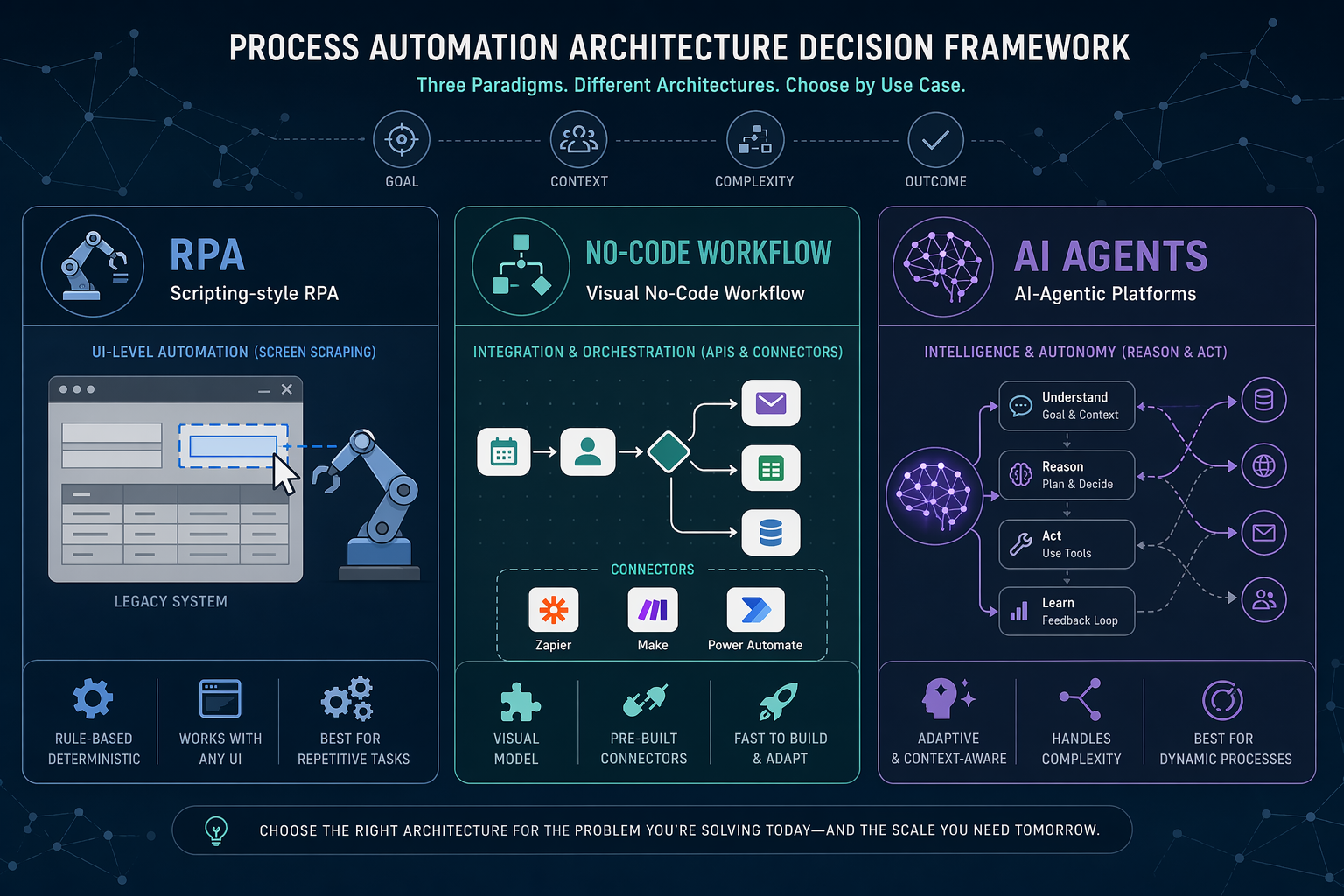
The 2026 landscape has three fundamentally different architectural paradigms, each solving a distinct class of problem:
- Scripting-Style RPA (UiPath, Automation Anywhere): Best for high-volume, screen-based tasks on legacy systems that lack APIs. It mimics human interaction with user interfaces.
- Visual No-Code Workflow (Zapier, Make, Power Automate): The fastest-growing segment, capturing 45% of new deployments. It excels at cross-app orchestration and is driven by citizen developers.
- AI-Agentic Platforms (Lindy, n8n AI, Gumloop): The newest category, designed for unstructured decision workflows where rules are not fully known in advance.
Organizations that pick the wrong paradigm waste an estimated 12-18 months on failed pilots. A technical lead evaluating automation for the next 3-5 years needs to understand not just which tool to buy, but which architectural approach aligns with their core problem. For a broader understanding of how these paradigms fit into the larger automation landscape, see our guide on workflow orchestration vs. automation vs. BPM vs. iPaaS.
Architecture Comparison at a Glance
Before diving into each paradigm, here is a structured comparison across the dimensions that matter most for a strategic decision. Market data is drawn from multiple sources; note that exact market size figures vary by methodology.
| Dimension | Scripting-Style RPA | Visual No-Code Workflow | AI-Agentic Platforms |
|---|---|---|---|
| Scope of Automation | Screen-based, UI interaction | API-based, cross-app orchestration | Unstructured decision workflows |
| Ideal Use Case | Legacy system data entry, mainframe tasks | Sales, marketing, HR process chains | Content analysis, dynamic routing, research |
| Technical Skill Required | Developer / RPA specialist | Citizen developer (non-technical) | Developer / AI-savvy builder |
| Scalability Ceiling | High (with bot farms), but brittle | Medium (limited by API availability) | Currently low (fewer than 10 reliable use cases) |
| AI Maturity | Low (add-on document understanding) | Low-Medium (deterministic rules) | High (LLM-native, but volatile) |
| Average Time-to-Value | 3-6 months | Days to weeks | Weeks to months (highly variable) |
| Total Cost of Ownership | High ($399/user/yr + infrastructure) | Low ($9-$20/month per user) | Variable (token costs + subscription) |
| Representative Tools | UiPath, Automation Anywhere, Blue Prism | Zapier, Make, Power Automate | Lindy, n8n AI, Gumloop, ChatGPT Agent Builder |
The market data reinforces the divergence. No-code/low-code platforms now capture 45% of new workflow deployments (Gitnux), and their adoption grew 35% year over year. Cloud deployment accounts for 62.15% of market revenue, while hybrid deployment — critical for regulated industries — is the fastest-growing segment at a 10.08% CAGR (Mordor Intelligence). Meanwhile, Gartner predicts that 40% of enterprise applications will embed AI agents by the end of 2026, signaling the rapid emergence of the third paradigm.
Deep Dive: Scripting-Style RPA — Best for Legacy Screen-Scraping at Scale
Robotic Process Automation (RPA) tools like UiPath (starting at $399/user/year) and Automation Anywhere were built for a specific problem: automating interactions with legacy systems that have no API, no modern interface, and no intention of getting either. An RPA bot logs into a terminal, copies data from one field, and pastes it into another — the same way a human would, but faster and at scale.
This paradigm has genuine strengths in the right context:
- Document understanding: UiPath and Automation Anywhere have invested heavily in AI-powered document processing, making them viable for invoice processing and form extraction from scanned documents.
- Attended and unattended bots: RPA supports both human-in-the-loop (attended) and fully autonomous (unattended) execution, giving flexibility in deployment.
- Process mining: Enterprise RPA suites include process discovery and mining tools that help identify which processes are worth automating.
However, the limitations are significant and well-documented. Gartner (cited by Mordor Intelligence and Cflow) reports that 30% of RPA projects fail within the first year. Other sources place the failure rate as high as 30-50% globally. The reasons are structural: RPA bots are brittle. A UI change in the legacy system — a button moved three pixels to the right — can break a bot that took months to build. Maintenance costs often exceed initial development costs within 18 months.
RPA remains the right choice when: you have mainframe or green-screen systems that will not be modernized for 5+ years; you need to automate high-volume, low-complexity data entry across dozens of legacy applications; and you have a dedicated RPA team that can manage bot maintenance. For any other scenario, the no-code workflow or AI-agent paradigm is likely a better fit.
Deep Dive: Visual No-Code Workflow — The Citizen Developer Engine
The no-code workflow segment — led by tools like Zapier ($19.99/month), Make ($9/month), and Microsoft Power Automate ($15/user/month) — is the fastest-growing paradigm in process automation. Adoption grew 35% year over year (Gitnux), and these platforms now capture 45% of all new workflow deployments. The reason is straightforward: they solve the most common automation problem — connecting SaaS applications — without requiring a developer.
The numbers supporting this paradigm are compelling:
- 248% three-year ROI: Forrester's 2024 Total Economic Impact study documented this return for enterprise workflow automation, with Power Automate as a primary example (Cflow).
- 84% enterprise adoption/planning: Gartner reports that 84% of enterprises are actively using or planning low-code/no-code platforms for workflow automation (Cflow).
- 3x process automation in year two: Organizations using low-code tools automate three times more processes in their second year compared to the first, as the learning curve flattens and the library of reusable workflows grows (Cflow).
- Over half see full ROI within 12 months: The quick time-to-value is a key differentiator from RPA (Cflow).
No-code workflow tools excel at cross-app orchestration: when a lead is created in Salesforce, create a task in Asana, send a Slack notification, and log the activity in Google Sheets. These are deterministic, rule-based processes that map cleanly to if-this-then-that logic. The visual builder makes them accessible to knowledge workers who understand the business process but do not write code.
The ceiling of this paradigm is reached when the process requires unstructured decision-making. If the next step depends on interpreting the sentiment of an email, extracting meaning from a PDF contract, or making a judgment call based on ambiguous data, a deterministic workflow cannot handle it. That is where the third paradigm enters.
Deep Dive: AI-Agentic Platforms — The Newest Paradigm for Unstructured Decisions
AI-agentic platforms represent the newest and most volatile paradigm in process automation. Tools like Lindy (from $39.99/month), n8n AI (free self-hosted or cloud from $20/month), Gumloop (from $30/month), and the ChatGPT Agent Builder (included with ChatGPT Plus at $20/month) are designed for workflows where the decision logic is not fully known in advance. Instead of following a fixed rule, an agent uses a large language model to interpret input, decide on the next action, and execute it.
Gartner predicts that 40% of enterprise applications will embed AI agents by the end of 2026 (Cflow). The potential is enormous: AI agents could handle tasks like triaging customer support tickets, summarizing meeting notes and creating action items, or routing complex procurement requests based on natural language descriptions. McKinsey estimates that AI-powered automation could add $2.6 to $4.4 trillion in annual economic value (Cflow).
However, the current reality is more measured. Most agent platforms today handle fewer than 10 integrated use cases reliably (n8n blog). The category is evolving so rapidly that tools launched in late 2025 — like ChatGPT Agent Builder and Gumloop — may have significantly different feature sets by Q3 2026. Pricing models are also in flux: n8n offers a generous free self-hosted tier, but agent-based platforms introduce token costs that can escalate unpredictably. For a deeper analysis of these cost trade-offs, see our article on the AI workflow automation token cost trap.
The key differentiator of AI-agentic platforms is their ability to handle ambiguity. A deterministic workflow says: "If email subject contains 'refund,' route to billing." An AI agent says: "Read this email, understand that the customer is requesting a refund due to a defective product, check the order history, determine eligibility, and draft a response." This capability is transformative, but it comes with trade-offs: higher latency, unpredictable token costs, and the risk of hallucination or incorrect decisions in edge cases.
For technical leads, the pragmatic approach is to use AI agents for the unstructured decision layer of a workflow, while keeping the deterministic execution layer in a no-code workflow tool. This hybrid pattern — agent decides, workflow executes — is emerging as the most reliable architecture for 2026.
Convergence Trends: Where the Market Is Heading
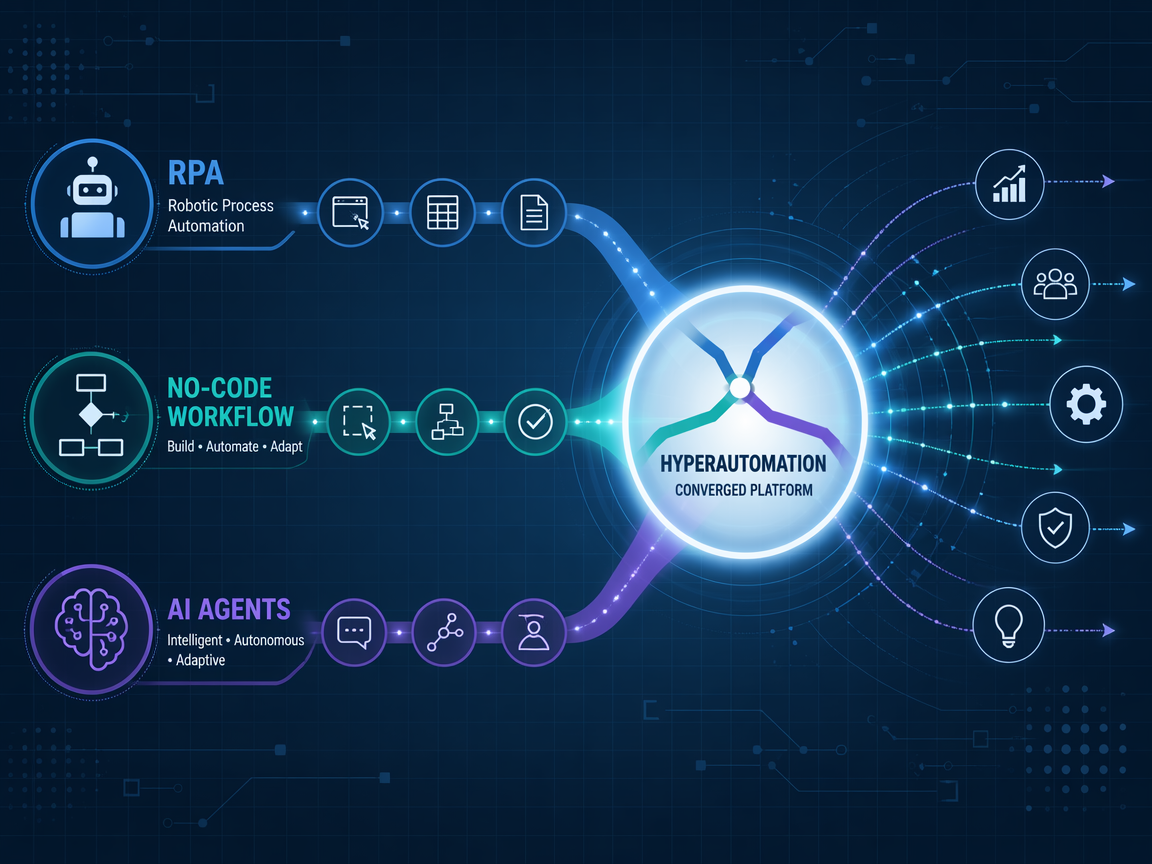
The three paradigms are not evolving in isolation. Vendors are aggressively converging features across categories, creating both opportunity and confusion for buyers.
- UiPath adding AI: The RPA leader has invested in document understanding and AI Center, adding LLM-based capabilities to its traditional bot platform.
- Power Automate adding RPA: Microsoft's no-code platform now includes desktop flow automation (UI-based RPA) alongside its API-based cloud flows, blurring the line between the two paradigms.
- n8n adding AI agents: The open-source workflow tool has added AI agent nodes, allowing users to insert LLM-powered decision steps into deterministic workflows.
- Hyperautomation adoption: The hyperautomation market — which combines RPA, AI, and low-code — is projected to include 80% of workflow processes by 2027, but only 29% of enterprises have adopted it so far (Gitnux).
This convergence means that the boundaries between paradigms will continue to blur. A tool you buy today as a "no-code workflow platform" may have RPA and AI agent capabilities within 12 months. The strategic implication for technical leads is to evaluate the architectural foundation — not just the current feature set. A platform built on a deterministic, API-first architecture will handle AI agents differently than one built on screen-scraping.
The cloud vs. hybrid deployment split is another critical convergence factor. Cloud deployment accounts for 62.15% of market revenue, but hybrid is growing fastest at a 10.08% CAGR (Mordor Intelligence). Regulated industries — healthcare (the fastest-growing end-user segment at an 11.22% CAGR), BFSI, and government — are driving hybrid adoption because they need data sovereignty. If your organization operates in a regulated environment, the ability to run automation on-premises or in a private cloud may be a non-negotiable requirement that narrows your options.
Decision Matrix: Which Architecture Should You Choose?
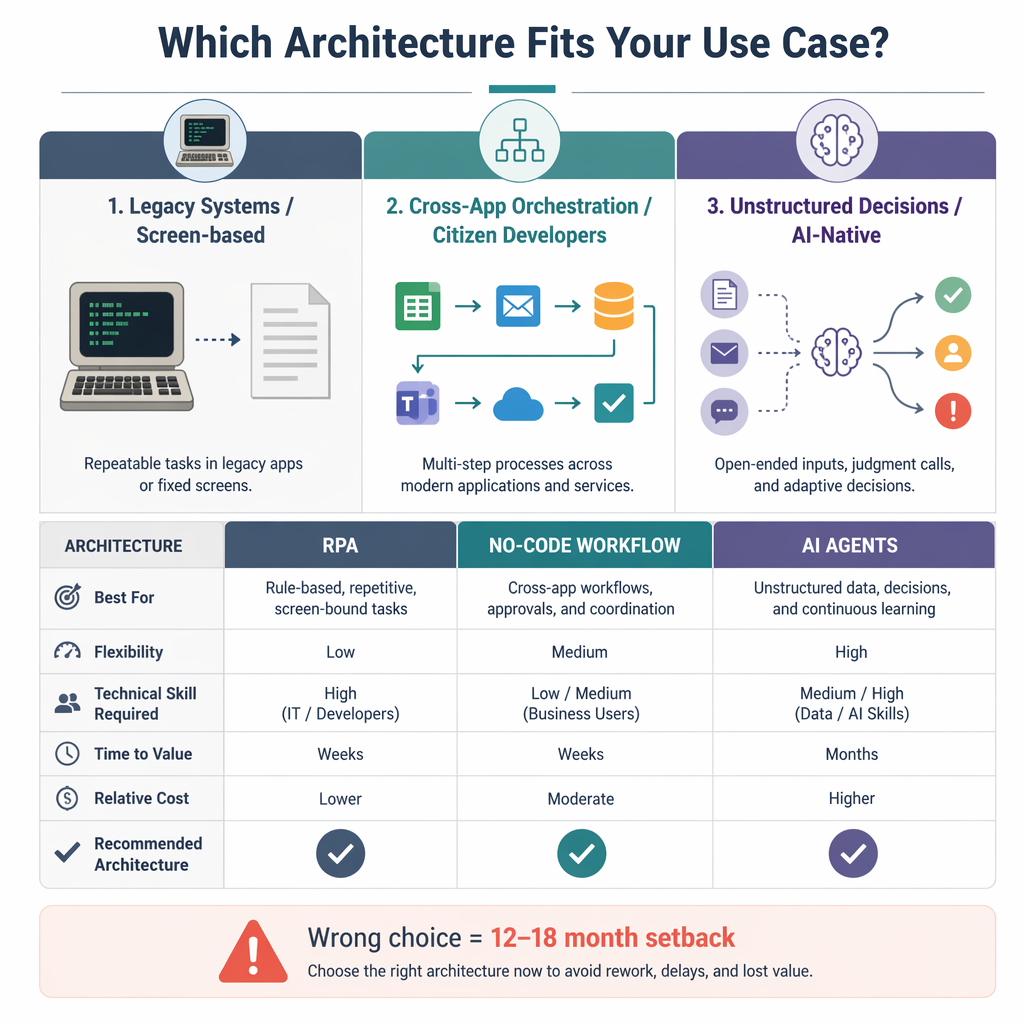
The following decision matrix provides clear "pick this if" guidance for each paradigm. Use it as a starting point for your evaluation, not as a final verdict.
| If Your Primary Need Is... | Choose This Architecture | Because... |
|---|---|---|
| Automating legacy mainframe or green-screen systems that have no API | Scripting-Style RPA | RPA is designed for UI-level interaction; no-code tools require APIs, and AI agents cannot interact with terminal interfaces directly. |
| Connecting modern SaaS applications (CRM, email, project management) with deterministic rules | Visual No-Code Workflow | No-code tools are built for API-based orchestration, offer the fastest time-to-value, and are accessible to citizen developers. |
| Handling unstructured decisions: interpreting emails, analyzing documents, routing ambiguous requests | AI-Agentic Platforms | Only AI agents can handle ambiguity and natural language input; deterministic workflows and RPA bots cannot make judgment calls. |
| Building a long-term automation program with a dedicated team and budget for infrastructure | Scripting-Style RPA (for legacy) + No-Code Workflow (for SaaS) | A dual-paradigm approach is often the right answer for enterprises with both legacy systems and modern SaaS stacks. |
| Starting small with a single team, minimal budget, and no dedicated automation staff | Visual No-Code Workflow | No-code tools have the lowest barrier to entry, with free tiers and pricing starting at $9-20/month per user. |
Caveats: Failed Projects, Vendor Lock-In, and Market Volatility
No evaluation of process automation architectures is complete without addressing the risks that technical leads must weigh before committing to a multi-year strategy.
- RPA project failure rate: 30-50% of RPA projects fail globally (Gartner via Cflow). The primary causes are UI brittleness, underestimated maintenance costs, and lack of process standardization before automation.
- Integration challenges: 41% of organizations report integration challenges with legacy systems (Gitnux). If your legacy systems cannot be accessed via API, your options narrow significantly.
- Skills gaps: 62% of companies report that skills gaps are slowing their automation scaling efforts (Gitnux). The choice of paradigm directly affects which skills you need to hire or develop.
- Vendor lock-in: All three paradigms carry lock-in risk. RPA bots are tied to the vendor's orchestrator. No-code workflows are tied to the platform's connector library. AI agents are tied to the underlying LLM provider. Evaluate data portability and export options before committing.
- AI-agent volatility: The AI-agentic category is evolving so rapidly that tools may change feature sets significantly within a single quarter. Tools like ChatGPT Agent Builder (launched late 2025) and Gumloop are still maturing. Flag this volatility in your procurement timeline.
The most successful automation programs in 2026 will likely be those that treat architecture as a strategic decision, not a feature comparison. They will match the paradigm to the problem, build hybrid stacks where appropriate, and maintain the flexibility to adapt as the market converges. The tools will change — the architectural thinking will not.