
Last verified for this article: June 27, 2026. Marketing automation workflow pricing changes often, and enterprise quotes are especially hard to compare because vendors package contacts, channels, onboarding, support, and compliance differently.
If the question is “what should we use now, and what will we regret in 18 months?”, start with stage, not feature count. A startup trying to respond to new leads quickly does not need the same platform as a $10M ARR company reconciling lifecycle stages with sales, and neither is shopping like an enterprise team coordinating email, SMS, app messaging, compliance review, and regional permissions.
| Company stage | Typical contact range | Likely team reality | Best-fit platforms | Pricing signals | Migration warning signs |
|---|---|---|---|---|---|
| Startup / early SMB | Up to roughly 5,000 contacts | Founder, generalist marketer, or small team needs campaigns live without specialist administration | ActiveCampaign, Brevo; Klaviyo or Omnisend for e-commerce | ActiveCampaign is reported at $39/month for 2,500 contacts; Brevo has a free plan with 300 emails/day and a reported $66/month level at 10,000 contacts | Daily send caps block launches; segments are becoming messy; sales follow-up depends on manual exports |
| Scale-up | Roughly 5,000–50,000 contacts; often $2M–20M ARR | Marketing, sales, and RevOps are all affected by one workflow change | HubSpot Marketing Hub Professional, Ortto, ActiveCampaign Pro with CRM alignment | HubSpot Marketing Hub Professional is reported from $890/month plus $3,000+ onboarding | Lead routing breaks; attribution is debated in meetings; lifecycle fields differ between CRM and marketing tool |
| Enterprise | Usually 50,000+ contacts or complex multi-region/channel operations | Specialists own operations, compliance, data governance, and channel orchestration | HubSpot Enterprise, Adobe Marketo Engage, Salesforce Pardot/Marketing Cloud Account Engagement, Braze | Marketo/Pardot-style platforms are commonly discussed at $1,250+/month minimums or custom pricing; Braze pricing is custom/opaque | Self-serve pricing is no longer the decision frame; procurement, security, regional consent, and channel scale now drive selection |
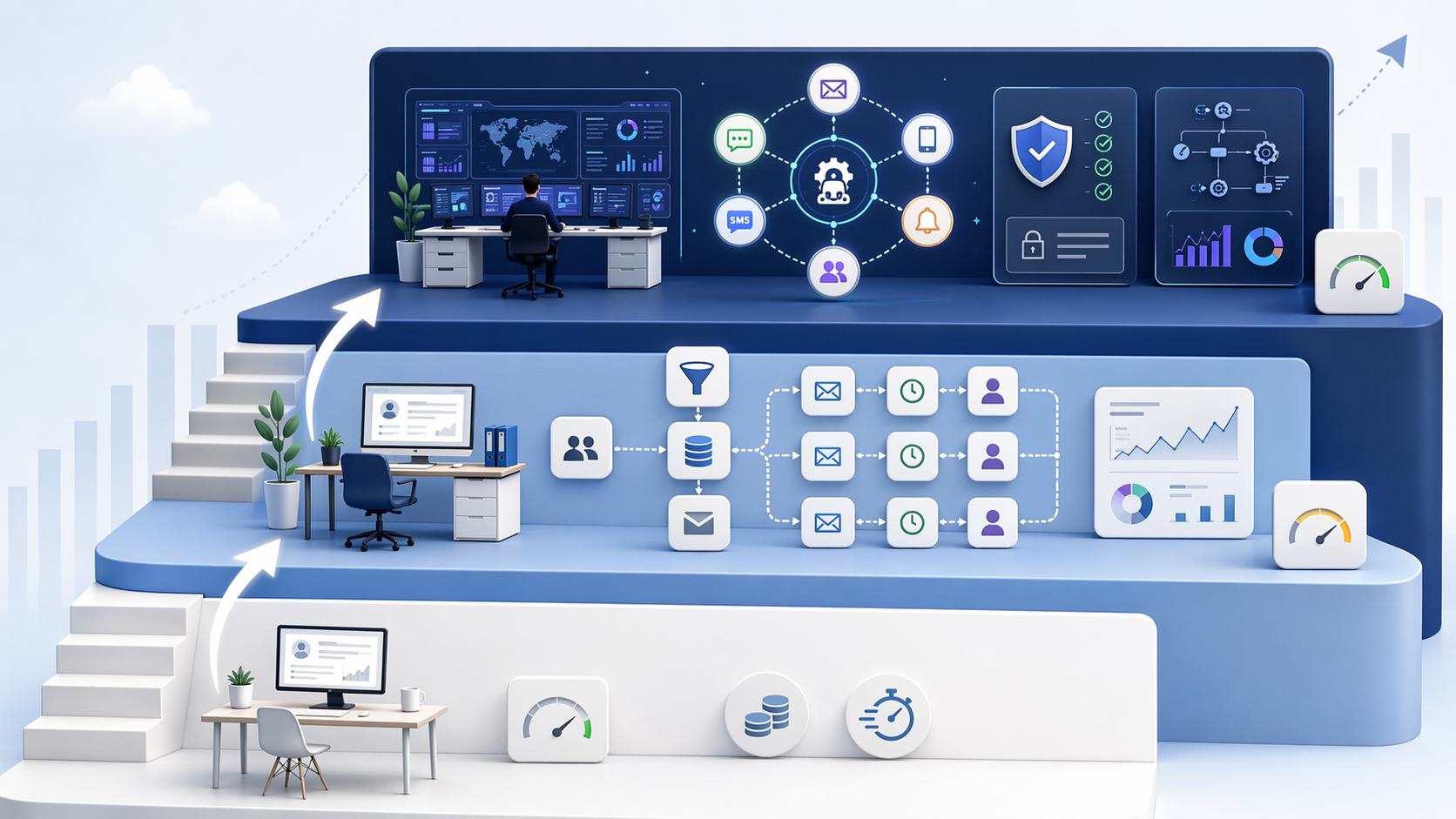
The quick recommendation by stage
For startups and early SMBs, the practical shortlist is ActiveCampaign or Brevo. ActiveCampaign is useful when workflow depth matters early: lead capture, basic scoring, follow-up sequences, and a lightweight CRM motion. Venture Harbour’s 2026 comparison reports ActiveCampaign at $39/month for 2,500 contacts and references its survey of more than 10,000 marketers when discussing the platform’s SMB fit.[1] Brevo is the budget and volume-sending answer when the team mostly needs reliable campaigns without a heavy automation admin burden; its free plan allows 300 emails per day, and Venture Harbour reports a $66/month level at 10,000 contacts.[1]
For scale-ups, the shortlist changes. HubSpot, Ortto, and ActiveCampaign Pro belong in the conversation because the work is no longer “send the campaign.” The work is making sure a webinar attendee, demo requester, dormant account, expansion lead, and recycled MQL all move through the right workflow without confusing sales. HubSpot Marketing Hub Professional is reported from $890/month plus $3,000+ onboarding, which is a very different purchase from a low-cost startup tool.[1] It can still be the cheaper decision if a long B2B sales cycle needs attribution, lifecycle reporting, CRM-native handoff, and fewer duct-taped integrations.
For enterprises, stop comparing self-serve SMB tiers as if they reveal the real cost. Marketo, Pardot/Marketing Cloud Account Engagement, Braze, and HubSpot Enterprise are bought for orchestration, permissions, governance, channel depth, and data structure. Insider One’s 2026 segmentation places enterprise-grade platforms in a different class from SMB tools, and Braze is treated as an enterprise omnichannel option rather than a simple email automation replacement.[2]
Automation is normal now; that does not make the buying decision easier
Marketing automation is not an exotic investment in 2026. OrbitForms reports that 81% of organizations use marketing automation, and Venture Harbour cites market research valuing the marketing automation market at $6.65 billion in 2024 with a projection of $15.58 billion by 2030.[3][1] Those numbers explain why every board deck and founder peer group now has an opinion on automation. They do not tell a 12-person company whether it should absorb HubSpot onboarding this quarter, or whether an e-commerce team should avoid a daily send cap before a seasonal launch.
The useful question is narrower: what workflow must survive the next six months, and what dependency will become painful in the next 18? A tool that is slightly underpowered can slow campaign testing. A tool that is too complex can slow everything: list cleanup, form changes, handoff rules, reporting, and the one urgent launch that now requires a specialist.
Startup stage: choose speed, cost control, and fewer places to break
At the startup stage, a marketing automation workflow usually has a short job description: capture the lead, segment the obvious differences, send the promised follow-up, notify the right person, and make it easy to launch the next campaign without opening a ticket. The platform should not require a dedicated operations hire before the company has proven which campaigns work.
ActiveCampaign is often the better startup fit when the team already knows it needs branching automations and a basic sales motion. The reported $39/month tier at 2,500 contacts keeps the starting cost low enough for a small team while still giving more workflow room than a plain newsletter tool.[1] That matters when the first operational bottleneck is speed-to-lead: someone fills out a form, gets the right sequence, and a human sees the right context without manually checking a spreadsheet.
Brevo is the more obvious choice when budget and sending volume dominate the decision. The free plan’s 300-emails-per-day limit can be enough for a very small list or steady trickle of lifecycle messages, and the reported $66/month level at 10,000 contacts makes it attractive for teams watching contact-based pricing closely.[1] The catch is operational, not philosophical: daily caps are easy to ignore until a launch, announcement, or reactivation push needs to go out at once.
E-commerce startups should branch earlier. Klaviyo and Omnisend are not merely “also good automation tools”; they are built around commerce events that B2B teams may not care about. Insider One reports Klaviyo at $45/month for 1,500 contacts and emphasizes its Shopify depth, while Gumloop’s 2026 review describes Omnisend as strong for omnichannel e-commerce workflows and reports $36/month at 2,500 contacts.[2][4] If abandoned cart, browse abandonment, post-purchase, SMS, and product-driven segmentation are central from day one, forcing that motion into a general B2B automation setup can create the wrong kind of simplicity.
The startup warning sign is not “we want more features.” It is when the team can no longer trust the basics: contacts are duplicated, sales does not know which leads are warm, unsubscribes or consent fields are handled inconsistently, or every campaign requires manual list surgery. That is when cheap starts becoming expensive.
Scale-up stage: the CRM relationship becomes the real product
The scale-up transition is where teams usually make the costly mistake. They either buy too much platform before their lifecycle definitions are stable, or they stay too long on a tool that was perfect when one marketer owned every campaign. Between roughly 5,000 and 50,000 contacts, especially around the $2M–20M ARR range, the automation platform starts carrying organizational agreements: what counts as a qualified lead, when sales should act, which source gets credit, how re-engagement works, and which fields are allowed to overwrite CRM data.
This is why HubSpot becomes compelling for many B2B scale-ups despite the step up in price. HubSpot Marketing Hub Professional’s reported $890/month starting point and $3,000+ onboarding cost are hard to justify if the company is sending a newsletter and two nurture sequences.[1] They make more sense when marketing needs clean landing pages, forms, campaign reporting, lifecycle stages, CRM visibility, sales notifications, list logic, and attribution in one operating environment.
The mistake is buying HubSpot as a badge of maturity rather than as an operating decision. If sales lives in another CRM and no one is prepared to govern fields, HubSpot can become another expensive place where partial truth lives. If the company is ready to standardize lifecycle stages and campaign reporting, the same platform can remove weeks of workaround labor across marketing and sales.
Ortto deserves attention when the company already has a CRM it intends to keep and wants marketing automation, journey orchestration, and customer data activation without necessarily moving the entire front office into HubSpot. ActiveCampaign Pro can also remain credible at this stage for teams that need deeper automation but do not yet have the attribution, governance, or sales complexity to justify a larger suite. G2’s review-based comparison is useful here because it reflects user-facing tradeoffs across marketing automation tools rather than only vendor positioning.[5]
A scale-up should evaluate platforms through workflow ownership. Who can edit a lead-routing rule? Who approves a scoring change? Which system is the source of truth for industry, company size, lifecycle stage, product interest, and consent? If the answer is “whoever built the workflow last year,” the platform decision is already drifting into RevOps debt.
- Choose HubSpot when the company wants CRM-adjacent marketing, attribution, landing pages, nurture, sales visibility, and reporting in a unified system.
- Choose Ortto when the company has an existing CRM or data setup it wants to preserve, but needs stronger customer journey automation.
- Stay with or upgrade ActiveCampaign when the team needs automation depth and affordability more than enterprise governance.
- Move e-commerce scale-ups toward Klaviyo or Omnisend when revenue depends on commerce-triggered journeys rather than sales-led pipeline stages.
For a more cost-specific view, compare this stage against the contact-volume breakpoints in the pricing deep-dive for 2,500, 10,000, and 100,000 contacts. Contact growth can make yesterday’s affordable platform look very different before the next annual renewal.
Enterprise stage: self-serve comparisons stop answering the real question
At enterprise scale, marketing automation workflow decisions become less about whether a tool can send the right email after the right form fill. The platform has to coordinate permissions, regions, brands, product lines, sales teams, data retention expectations, compliance review, and multiple channels. Opaque pricing is frustrating, but it is also a signal that the package is no longer just contacts times features.
Marketo and Pardot/Marketing Cloud Account Engagement are most relevant when Salesforce-native depth, B2B account processes, and mature operations teams matter. The pricing boundary matters here: these platforms are often discussed at $1,250+/month minimums or custom-priced tiers, but exact apples-to-apples comparisons are limited because packaging varies. Treat any simple price table as a starting point, not a procurement answer.
Braze belongs in the enterprise omnichannel branch. It is not the natural first purchase for a founder trying to send their first nurture sequence. It becomes relevant when lifecycle engagement spans email, SMS, push, in-app messaging, and event-triggered customer journeys at scale. Insider One’s enterprise segmentation and Gumloop’s 2026 platform notes both frame this kind of tool around broader orchestration rather than basic email automation.[2][4]
HubSpot Enterprise can be the right answer for organizations that want to stay in the HubSpot operating model while adding more governance, scale, and enterprise controls. It is not automatically less serious than Marketo or Salesforce-aligned options; the deciding factor is whether the company’s CRM architecture, reporting requirements, and compliance needs fit the HubSpot model.
The 18-month migration roadmap
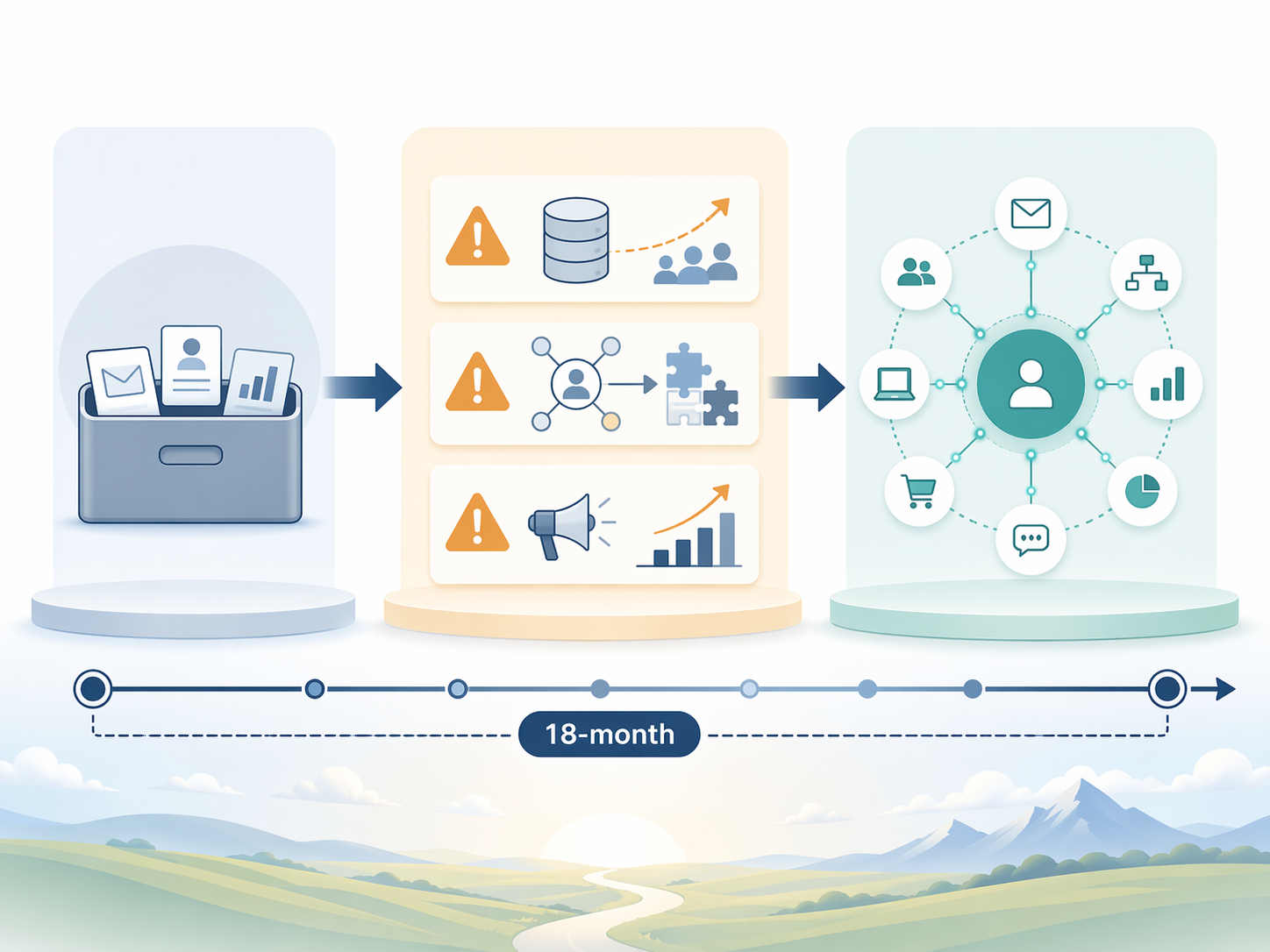
The best time to think about migration is before migration is urgent. OrbitForms explicitly warns against choosing only for the current moment and ignoring the next 18 months, because that is how teams end up in expensive rip-and-replace cycles.[3] The fix is not to buy the final enterprise platform on day one. It is to document the conditions that would force the next move.
| If this becomes true | Start reviewing | Why it matters |
|---|---|---|
| You are approaching 5,000 contacts and adding sales-led follow-up | HubSpot, ActiveCampaign Pro, Ortto | Segmentation, lead routing, and CRM field discipline begin to matter more than campaign sending alone |
| You are running multi-step nurture across product lines, audience segments, or regions | HubSpot Professional/Enterprise, Ortto, Marketo depending on CRM fit | Workflow governance becomes a team process rather than a single marketer’s memory |
| Sales disputes lead quality or campaign attribution every month | HubSpot, Salesforce-aligned automation, or a RevOps-led architecture review | The problem may be lifecycle design and CRM truth, not email functionality |
| E-commerce revenue depends on cart, browse, purchase, replenishment, SMS, and product events | Klaviyo, Omnisend, Braze at larger scale | Commerce-native triggers can outperform a general-purpose B2B workflow model for this motion |
| Security, compliance, region, or approval workflows block campaign velocity | Enterprise-tier HubSpot, Marketo, Pardot/Marketing Cloud Account Engagement, Braze | The buying committee is now evaluating control, auditability, and orchestration as much as marketing features |
A clean roadmap includes three documents, none of them elaborate. First, a field map: which fields exist in the automation tool, which exist in the CRM, which system owns each one, and which fields are allowed to sync both ways. Second, a workflow inventory: every live automation, what triggers it, what it changes, and who owns it. Third, a migration trigger list: contact count, ARR stage, channel needs, CRM changes, compliance requirements, and campaign calendar complexity that would force a platform review.
This sounds heavier than it is. A small company can keep the first version in a spreadsheet. The point is to avoid discovering, during a rushed migration, that no one knows why a segment exists, which nurture sequence still matters, or whether a CRM field is safe to overwrite.
How to make the final choice
If you are choosing this quarter, make the decision in this order: current stage, contact volume, sales or commerce motion, CRM dependency, channel complexity, compliance needs, then price. Price belongs in the list, but it should not be isolated from the work the platform will either remove or create.
For a founder or small marketing team, ActiveCampaign and Brevo are usually the first serious comparison. Add Klaviyo and Omnisend if the business is commerce-led; the e-commerce platform head-to-head is the better branch for that decision. For a scale-up, compare HubSpot, Ortto, and ActiveCampaign Pro against the CRM reality, not against a generic features grid. For an enterprise, evaluate Marketo, Pardot/Marketing Cloud Account Engagement, Braze, and HubSpot Enterprise through governance, orchestration, and integration depth.
The platform you buy should fit the workflows you can actually maintain. Then write down the trigger that would make you leave it. That is how a marketing automation workflow choice stays practical: not by finding a universal winner, but by choosing the current-stage platform with a credible 18-month path.
References
- 7 Best Marketing Automation Software (2026) — Venture Harbour
- 13 Best Marketing Automation Platforms for SMBs & Enterprises in 2026 — Insider One
- Marketing Automation Tools Compared: Find Your Best Platform for Growth — OrbitForms
- 10 best marketing automation platforms I'm using in 2026 — Gumloop
- I Tested G2's 10 Best Marketing Automation Tools: My Review — G2/Learn