
Introduction: The Blue Prism Investment Decision in 2026
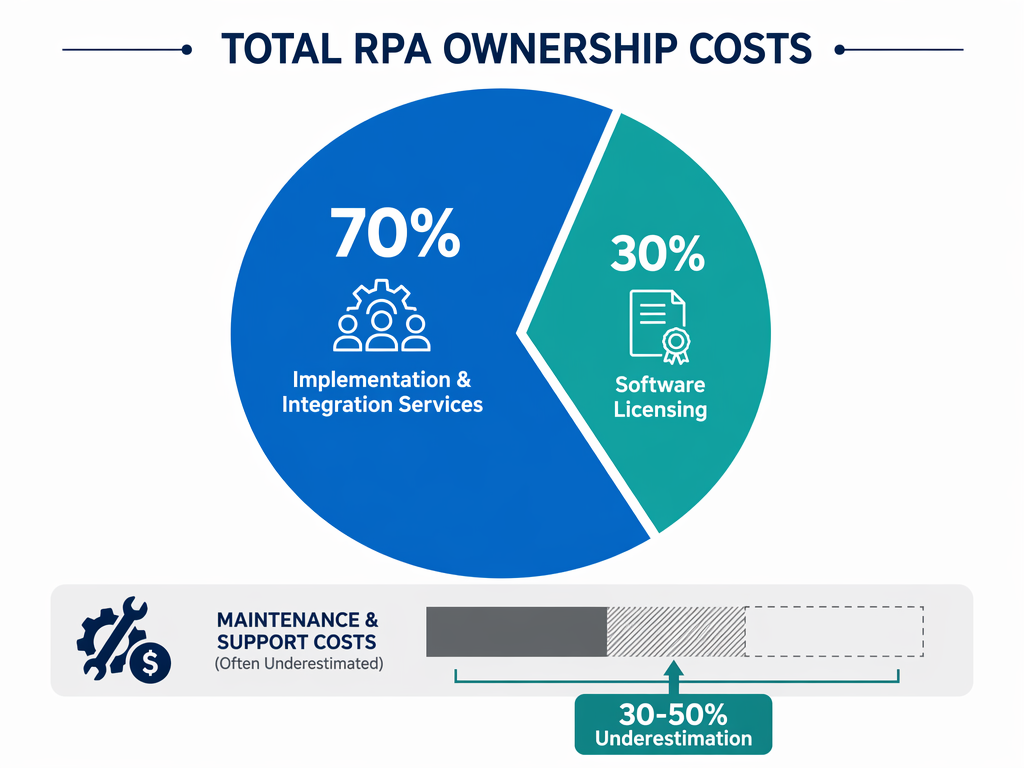
Every procurement decision for an enterprise automation platform comes down to a single question: does the return justify the cost? For organizations evaluating Blue Prism in 2026, that question is more complex than a simple price-per-bot comparison. The platform's enterprise-grade governance and audit capabilities command a clear premium in regulated industries like banking and insurance. But the total cost of ownership extends far beyond the license fee — implementation services alone can consume roughly 70% of total RPA spend, and ongoing maintenance is frequently under-budgeted by 30-50% in initial business cases, according to findings cited by Deloitte and EY.
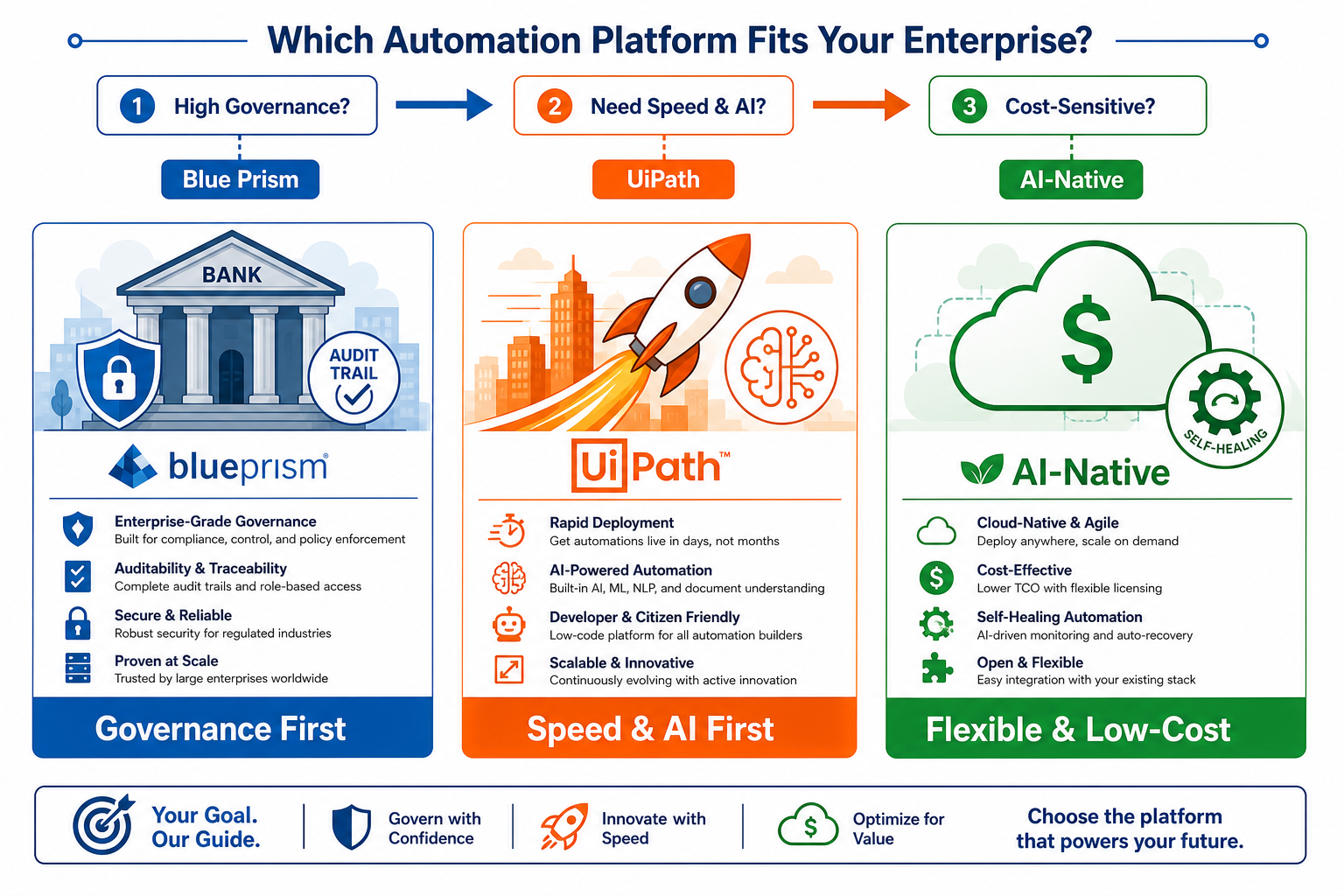
At the same time, the automation landscape has shifted. UiPath has built a commanding lead in AI-native capabilities, and analyst commentary consistently places Blue Prism 12-18 months behind on AI breadth. For organizations that need intelligent document processing, decision intelligence, or agentic automation, that gap carries real opportunity cost. This article is structured as a procurement-focused ROI analysis, not a feature comparison. We will decompose Blue Prism's pricing, model 3-year total cost of ownership for regulated and non-regulated environments, and build a decision framework that weighs governance requirements against AI readiness needs and total cost.
Current Blue Prism Pricing Landscape
Blue Prism does not publish transparent public pricing in US dollars. The official plans-pricing page returns Japanese-localized content without clear pricing tiers. The figures below are compiled from third-party estimates, UK G-Cloud procurement data, and analyst reports. They represent the best available benchmarks for budgeting purposes.
| Component | Estimated Cost | Source Notes |
|---|---|---|
| Per-digital-worker license (on-premise) | $13,000 – $20,000 / year | Kanerika, o-mega.ai estimates |
| Blue Prism Cloud bundle | £25,000 – £50,000 / year | o-mega.ai (UK G-Cloud data) |
| Blue Prism Next Gen (G-Cloud) | ~£15,000 – £19,000 / digital worker / year | UK G-Cloud catalog via o-mega.ai |
| Process Intelligence add-on | ~£78,000+ / year | o-mega.ai |
| UiPath enterprise plan (entry) | ~$420 / month | Kanerika (varies by contract) |
| Automation Anywhere entry-level | $750 / bot / year | o-mega.ai |
| Microsoft Power Automate (unattended RPA) | $150 / month / bot | o-mega.ai |
The per-digital-worker model is the most common licensing structure for on-premise deployments. Cloud bundles, which include hosting and infrastructure, shift some operational cost from the buyer to Blue Prism but come with a higher annual commitment. The Process Intelligence add-on, quoted at approximately £78,000 per year, is a significant additional cost for organizations that need process discovery and mining capabilities — a feature that is increasingly bundled into competitor platforms at lower tiers.
Decomposing Total Cost of Ownership: The Hidden 70%
The license fee is only the visible tip of the RPA cost iceberg. Multiple analyses, including a Duvo blog study cited by o-mega.ai, indicate that implementation and integration services represent approximately 70% of total RPA spend, while software licensing accounts for roughly 30%. This ratio is critical for budgeting: a $15,000-per-year digital worker license implies a total first-year cost closer to $50,000 when implementation, infrastructure, and training are factored in.
The full TCO breakdown includes several layers:
- Software licensing: 25-30% of 3-year total cost. The per-digital-worker fee, cloud subscription, and any add-on modules like Process Intelligence.
- Implementation and integration services: ~70% of total RPA spend. This includes process discovery, solution design, development, testing, and integration with existing ERP, CRM, and legacy systems.
- Infrastructure: On-premise deployments require servers, storage, networking, and IT administration. Cloud deployments shift this cost to the subscription but may include data egress and storage overage fees.
- Training: Blue Prism's instructor-led training is a paid 3-5 day program. By contrast, UiPath offers a free Academy with certification that takes 20-40 hours. For organizations training multiple developers, this cost difference adds up.
- Ongoing bot maintenance: Findings cited by Deloitte and EY indicate that organizations under-budget bot maintenance by 30-50% in initial business cases. Bots break when underlying applications change, requiring rework, testing, and redeployment.
The maintenance underestimation is particularly dangerous. A bot that runs reliably for six months may break when the underlying application updates its UI, API, or business logic. Each break requires diagnosis, redevelopment, testing, and redeployment — costs that are rarely included in the initial business case. Organizations that plan for a 30-50% maintenance buffer from year one are far more likely to sustain their automation programs through year three.
AI Readiness Gap Analysis: Blue Prism vs. UiPath
The most significant strategic risk for a Blue Prism investment in 2026 is the growing AI capability gap. Blue Prism has introduced AI Gateway as a governance layer for integrating large language models into automation workflows. UiPath, by contrast, has built AI Center as a native platform for embedding AI models directly into automations — without requiring a separate integration layer.
Analyst commentary consistently places Blue Prism 12-18 months behind UiPath on AI-native breadth, according to Kanerika. This gap manifests in several concrete areas:
| Capability | Blue Prism | UiPath |
|---|---|---|
| LLM integration | AI Gateway (governance layer, requires separate integration) | AI Center (native embedding, no separate layer needed) |
| Document understanding | Available via AI Gateway + third-party models | Native Document Understanding with pre-trained models |
| AI-powered process discovery | Process Intelligence add-on (~£78k/year) | Process Mining + Task Mining included in enterprise plans |
| Agentic automation | Early stage via WorkHQ (announced 2025) | AI Agent Builder (production, 2025-2026) |
| Pre-built AI models | Limited library, relies on external integrations | Extensive library of pre-built AI models and templates |
For organizations whose automation roadmap includes AI-powered document processing, decision intelligence, or agentic workflows, the 12-18 month gap is not an abstract concern — it directly affects time-to-value. A UiPath deployment can begin embedding AI into automations immediately. A Blue Prism deployment requires an additional integration layer, which adds complexity, development time, and cost. For organizations that primarily need governed, rules-based RPA — such as batch processing in a tightly regulated environment — the AI gap may be irrelevant. But for any organization that expects its automation platform to evolve with AI capabilities over a 3-year investment horizon, the gap represents a real risk of platform obsolescence.
3-Year TCO Scenarios: Regulated vs. Non-Regulated Environments
To make the investment decision concrete, we model two 3-year scenarios. Both assume a deployment of 10 digital workers — a typical starting point for a mid-size enterprise automation program. The models include licensing, implementation, infrastructure, training, maintenance, and the opportunity cost of delayed AI capabilities.
| Cost Category | Scenario A: Regulated (Banking/Insurance) | Scenario B: Non-Regulated (General Enterprise) |
|---|---|---|
| Digital workers | 10 | 10 |
| Annual license cost (per worker) | $17,000 (midpoint) | $17,000 (midpoint) |
| Total license cost (3 years) | $510,000 | $510,000 |
| Implementation services (~70% of year-1 spend) | $350,000 | $350,000 |
| Infrastructure (3 years) | $90,000 | $90,000 |
| Training (per developer) | $5,000 (paid, 5 developers) | $0 (free UiPath Academy, 5 developers) |
| Maintenance (year 2-3, 40% buffer) | $204,000 | $204,000 |
| AI capability opportunity cost | $0 (governance priority outweighs AI speed) | $150,000 (estimated value of 18-month AI delay) |
| Total 3-year cost | ~$1,154,000 | ~$1,304,000 |
| Effective cost per worker per year | ~$38,500 | ~$43,500 |
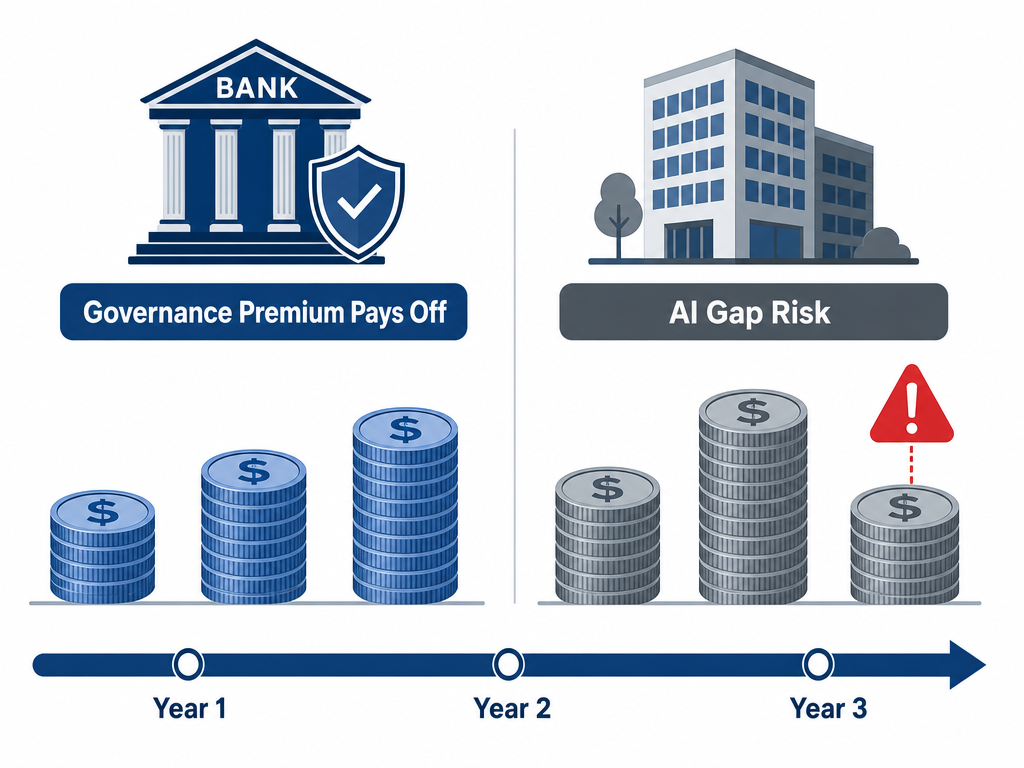
In Scenario A (regulated), Blue Prism's governance features — audit trails, role-based access control, security certifications — directly address compliance requirements that would otherwise require significant custom development on another platform. The AI capability gap is less relevant because the primary automation use cases are rules-based processes with strict audit requirements. The total 3-year cost of approximately $1.15 million is justified by the compliance value and risk reduction.
In Scenario B (non-regulated), the same license and implementation costs apply, but the organization gains no compliance premium from Blue Prism's governance features. Instead, it incurs an opportunity cost from the 12-18 month AI capability gap. If the organization's automation roadmap includes AI-powered processes, the delay in deploying those capabilities has a real financial impact — estimated here at $150,000 over three years. The effective cost per worker per year rises to approximately $43,500, making Blue Prism more expensive than UiPath on a total-value basis.
When Blue Prism's Premium Pays Off
Blue Prism's published case studies provide concrete evidence that in the right environment, the platform's premium delivers measurable ROI. These are not hypothetical projections — they are realized business outcomes from large-scale deployments.
- Kimberly-Clark: Over $140 million in cumulative business value and 1.6 million manual hours saved through Blue Prism intelligent automation. This scale of return is only achievable when the platform is deployed across a large, complex enterprise with high-volume processes.
- Banorte: Achieved 60% faster credit application processing and a 30% capacity increase using Blue Prism with AI document processing. In a regulated financial services environment, the combination of governance and automation speed directly improves customer experience and operational efficiency.
- ABANCA: Reduced customer inquiry response time by 60%. For a bank handling thousands of customer requests daily, this level of improvement translates directly to customer satisfaction and retention.
- SS&C: Achieved 95% faster credit contract data processing. In a high-volume, data-intensive operation, the speed gain from automation is transformative — and the governance layer ensures that every processed contract is auditable.
These case studies share common characteristics: large-scale deployments, complex processes, high governance requirements, and a long-term commitment to the platform. For organizations that match this profile, Blue Prism's premium is not a cost — it is an investment that pays for itself many times over.
When Blue Prism's Premium Doesn't Pay Off
For every organization where Blue Prism's governance premium is a clear advantage, there are several where it becomes a costly overinvestment. The following scenarios are strong signals that Blue Prism may not be the right choice:
- Limited compliance requirements: If your organization does not operate in a heavily regulated industry (banking, insurance, healthcare, government), you are paying for governance features you may never use. The compliance premium adds cost without adding value.
- Need for rapid AI/ML integration: Organizations whose automation roadmap depends on AI capabilities — document understanding, decision intelligence, agentic workflows — will find Blue Prism's 12-18 month AI gap a significant constraint. UiPath's native AI Center provides a faster path to AI-powered automation.
- Smaller-scale deployments: The per-digital-worker cost of $13,000-$20,000 per year is prohibitive for organizations that only need 2-5 bots. At that scale, the implementation costs (~70% of total spend) become disproportionately large relative to the automation value delivered.
- Value of community and training: UiPath's 1.5 million+ registered user community and free Academy certification (20-40 hours) provide a significant ecosystem advantage. Blue Prism's smaller community and paid training increase the total cost of building and maintaining automation expertise in-house.
- High risk of automation failure: Given that 30-50% of initial RPA implementations fail to achieve their goals (Ernst & Young), a lower-cost platform reduces the financial downside of a stalled or abandoned program. A failed Blue Prism deployment is a more expensive failure than a failed UiPath or Power Automate deployment.
For organizations in these scenarios, the decision is not about whether to automate — it is about which platform provides the best risk-adjusted return. Our Process Automation Tool Buyer's Guide 2026 provides a structured procurement framework for evaluating platforms against your specific requirements.
Alternatives Worth Evaluating
For organizations that decide Blue Prism's premium does not fit their profile, three main alternatives offer different cost structures and capability sets. The table below summarizes their entry-level pricing and best-fit scenarios.
| Platform | Entry-Level Pricing | Best Fit | Key Differentiator |
|---|---|---|---|
| UiPath | ~$420/month (enterprise plan) | AI-native automation, large-scale deployments | 276% ROI per Forrester TEI, 1.5M+ user community, free Academy |
| Automation Anywhere | $750/bot/year (entry-level) | Mid-market, balanced governance and AI | Lower per-bot cost, solid AI capabilities |
| Microsoft Power Automate | $15/user/month (cloud flows), $150/month/bot (unattended RPA) | Microsoft-centric organizations | Deep integration with Microsoft 365, Azure, and Dynamics |
For a detailed architectural and governance comparison of these three platforms, see our Blue Prism vs UiPath vs Automation Anywhere comparison. That article covers the technical and governance differences that inform the financial analysis presented here.
Conclusion: Building Your Decision Framework
The decision to invest in Blue Prism in 2026 comes down to four factors: governance requirements, AI readiness needs, total cost of ownership over 3 years, and organizational risk tolerance. Use the following checklist to evaluate whether Blue Prism is the right choice for your specific context.
- Governance requirements: Does your organization operate in a regulated industry where audit trails, role-based access, and security certifications are mandatory? If yes, Blue Prism's governance premium is a justified investment. If no, you may be overpaying for features you do not need.
- AI readiness: Does your automation roadmap include AI-powered processes within the next 18 months? If yes, the 12-18 month AI capability gap with UiPath represents a real opportunity cost. If your automation needs are primarily rules-based, the gap is less relevant.
- Total cost of ownership: Have you modeled the full 3-year TCO, including implementation services (~70% of spend), infrastructure, training, and a 30-50% maintenance buffer? If your budget only accounts for license costs, you are significantly underestimating the true investment required.
- Risk tolerance: What is the financial downside if your automation program stalls or fails? Given that 30-50% of initial RPA implementations fail to achieve their goals, a lower-cost platform reduces the financial risk of an unsuccessful deployment.
- Ecosystem and training: Does your team have access to the training and community support they need to build and maintain automation expertise? UiPath's free Academy and 1.5M+ user community provide a significant advantage for organizations building automation capabilities from scratch.
Blue Prism remains a powerful platform for the right organization. But in 2026, the decision to invest is no longer a simple choice between RPA vendors. It is a strategic choice about how your organization balances governance, AI readiness, and total cost over a multi-year automation journey. Use the framework above to make that choice with your eyes open — to both the costs and the capabilities.