
By 2 p.m., the problem can look like a discipline problem. The tab is open. The calendar block is protected. Slack is quiet. Coffee has done what coffee can do. Yet the reply that should take three minutes takes fifteen, the meeting drifts, and everyone leaves with the strange feeling that they were present but not quite sharp.
That is usually where productivity advice reaches for habits, apps, or motivation. Those can matter. But if you want to understand how air quality affects work productivity, the uncomfortable starting point is simpler: a perfectly ordinary office or home workspace can reach air conditions that measurably interfere with thinking.

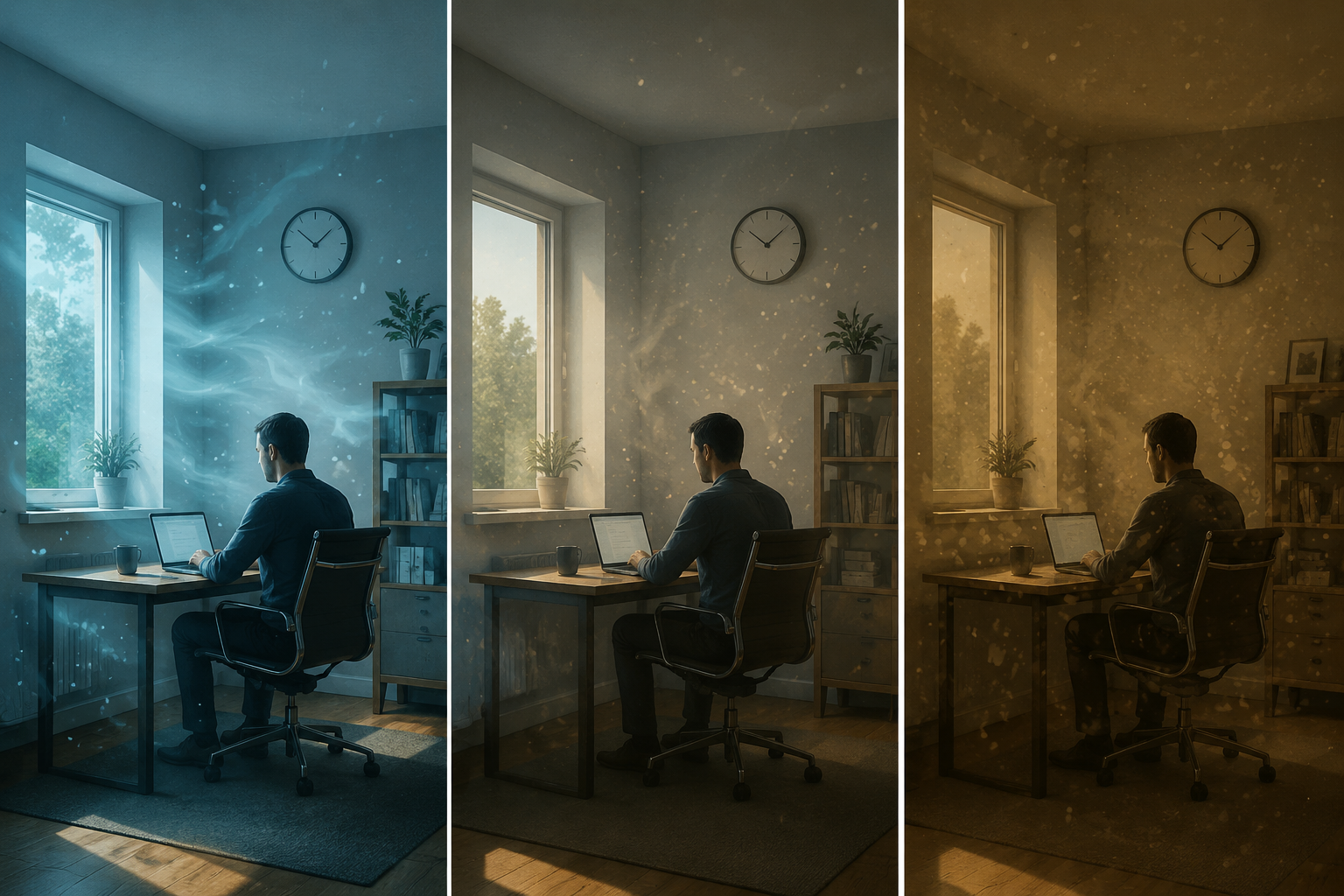
In a Lawrence Berkeley National Laboratory study, decision-making performance dropped significantly on six of nine measured cognitive scales when carbon dioxide reached about 1,000 ppm, a level many people would not experience as obviously extreme or hazardous.[1] That is what makes the finding hard to dismiss. This is not a story about someone working beside smoke, chemical fumes, or visible pollution. It is about air that can feel normal while the work gets slower.
The real-room context matters. A single-occupancy meeting room can exceed 1,000 ppm CO₂ within 45 minutes, and opening a window can drop CO₂ from 1,400 ppm to below 800 ppm in 15 minutes.[1] Those are the kinds of numbers that change the conversation. The issue is not whether indoor air quality belongs in a medical panic. It is whether the room is quietly adding friction to work you are already trying hard to do.
The Problem Is Ordinary Air, Not Obviously Bad Air
CO₂ is useful here because it makes stale indoor air visible. People exhale it. In a closed or poorly ventilated room, it rises. A high reading does not mean CO₂ is the only thing affecting cognition; it often acts as a practical signal that ventilation is not keeping up with occupancy. For a knowledge worker, that signal matters because the workday is full of enclosed rooms: home offices with the door closed, phone booths, small conference rooms, and bedrooms converted into workspaces.
The most useful shift is to stop treating afternoon brain fog as automatically personal. It may still be sleep, stress, food, workload, or a badly designed day. But if CO₂ climbs during a normal work block and attention drops with it, the environment deserves a place in the diagnosis.
This fits a broader pattern in workplace productivity: not every drain on output is visible to the person being drained. Meetings, interruptions, tool sprawl, and context switching get more attention because they are easier to name. Indoor air sits in the same category of hidden drag, except people often blame themselves before they think to check the room. For more on those less-visible drains, see the broader workplace analysis in The Real Personal Productivity Crisis.
What the Harvard COGfx Study Actually Adds
The Harvard COGfx study is the evidence people tend to remember because the effect size is large. In the 2016 Environmental Health Perspectives paper, cognitive scores were 61% higher in green building conditions and 101% higher in enhanced green building conditions compared with conventional office conditions.[2] The better-performing environments combined improved ventilation with lower volatile organic compound exposure, rather than changing only one office variable in isolation.[2]
That does not mean opening a window will double your output tomorrow. It means the indoor environment can be large enough to show up in controlled cognitive testing. That is already a stronger claim than most office-productivity advice can make.
The study is especially relevant to knowledge work because it did not measure only whether people felt better. It examined cognitive performance under different office-like conditions. The practical takeaway is not that every worker will experience the same percentage gain. It is that ventilation and pollutant levels can affect the kind of thinking that modern work asks people to do all day: using information, making tradeoffs, responding under pressure, and staying mentally available long enough to finish a task.
The sample was also not huge. The green-building phase included 24 participants, which means the results should not be treated as a universal productivity calculator.[2] Still, the finding is difficult to brush aside when it lines up with the LBNL decision-making results and later real-world worker data.
What Gets Worse When CO₂ Rises
The LBNL study found significant drops at about 1,000 ppm CO₂ in six cognitive domains: response time, strategic thinking, crisis response, information usage, focused activity, and decision-making.[1] Those labels can sound abstract until you translate them into an ordinary workday.
| Affected domain | What it can feel like at work |
|---|---|
| Response time | Messages, decisions, and small task transitions take longer than they should. |
| Strategic thinking | It becomes harder to see the shape of a problem instead of reacting to the latest input. |
| Crisis response | Urgent issues demand more effort because prioritizing and sequencing feel slower. |
| Information usage | Documents, dashboards, and notes are harder to turn into a clear next move. |
| Focused activity | The worker can remain seated and still fail to sustain useful attention. |
| Decision-making | Choices feel foggier, especially when tradeoffs are involved. |
The distinction matters. A person can appear productive from the outside while these functions degrade. They may still attend the meeting, answer the thread, or stare at the document. The cost shows up as latency, shallow analysis, rework, and decisions that require another pass later.
This is also why indoor air quality belongs next to focus technique, not instead of it. Time-blocking, notification control, and deep-work routines reduce avoidable interruptions. Cleaner, better-ventilated air improves the conditions under which those routines have a chance to work. If your current focus system is otherwise solid, the room may be one of the few remaining variables worth testing. For the behavioral side of that stack, see How to Focus Better.
The Evidence Moves Beyond One Lab Study
The Global CogFx study broadened the question by following 302 office workers across six countries.[3] In that study, every 500 ppm increase in indoor CO₂ was associated with response times slowing by 1.4% to 1.8% and correct output falling by 2.1% to 2.4%.[3] Each 10 μg/m³ increase in PM2.5 was associated with response times slowing by 0.8% to 0.9% and throughput falling by 0.8% to 1.7%.[3]
Those percentages sound modest compared with the COGfx headline numbers, but they may be more recognizable in daily work. A small slowdown repeated across dozens of decisions, messages, reviews, and handoffs becomes a tax on the day. It is not dramatic. It is cumulative.
PM2.5 deserves attention for a different reason. These fine particles can come from outdoor pollution that infiltrates indoors, cooking, combustion sources, and other indoor activities. In the Global CogFx findings, PM2.5 increases were associated with slower response times and lower throughput even at the relatively low indoor concentrations observed in the study.[3] That does not settle every question about higher-pollution settings, but it makes PM2.5 a practical productivity variable rather than only a long-term health concern.
A careful reading is still consequential: across controlled and real-world evidence, worse indoor air is linked to worse cognitive performance. The exact size of the effect will vary by person, room, task, and exposure. The direction is not reassuring.
What This Does Not Prove
The evidence is strong enough to act on, but not strong enough to turn into a universal productivity promise. The Harvard COGfx green-building phase had a small participant group.[2] The Global CogFx study was larger and more geographically broad, but it still measured a specific group of office workers under observed indoor conditions.[3] Individual sensitivity, building design, work type, outdoor air, and ventilation patterns can all change the result.
The time scale also matters. Much of the controlled evidence looks at acute exposure over hours, not what happens to a particular worker over months or years. That is enough to explain why a person might feel dull during a long meeting or late-afternoon work block. It is not the same as proving a specific long-term productivity loss for every office.
There is another common overreach: treating CO₂ as if it explains every slump. It does not. Sleep debt, stress, workload design, poor nutrition, medication, illness, noise, and interruptions can all produce similar symptoms. The useful claim is narrower: indoor air quality is one measurable factor that can degrade cognition even when the worker is otherwise doing the right things.
What to Do Starting Tomorrow
The first move is not to buy the most complicated device or become an amateur HVAC engineer. It is to make the invisible visible. A CO₂ monitor in the roughly $80 to $150 range can show whether your workspace crosses into levels where cognitive performance concerns become plausible.[1] Watch the number during the work blocks that usually feel worst: long calls, closed-door writing sessions, afternoon meetings, or days when the room is occupied by more than one person.
- Measure CO₂ during real work, not just when the room is empty.
- If CO₂ rises toward or above about 1,000 ppm, increase ventilation when feasible.
- Use window opening, door opening, fan placement, or HVAC settings based on what the building allows.
- Recheck after 10 to 20 minutes instead of relying on how the air feels.
- Track whether the worst work blocks correlate with higher readings.
The window example is useful because it is concrete: CO₂ dropping from 1,400 ppm to below 800 ppm in 15 minutes shows that a room can change quickly when ventilation improves.[1] Not every office has an openable window. Not every climate makes that comfortable year-round. But the principle is testable: when the number rises, change the airflow and see whether the room responds.
For PM2.5, the most practical home-office intervention is usually filtration. A HEPA purifier in the roughly $100 to $150 range can reduce indoor PM2.5 by more than 50% in a home office.[3] Placement matters less than people sometimes imply, but the basics are worth doing: size the purifier to the room, keep it running during work hours, avoid blocking the intake or exhaust, and replace filters on schedule.
| If you notice | Check first | Low-friction response |
|---|---|---|
| Brain fog after long calls | CO₂ during the call | Open a door or window if possible; increase ventilation before the next call. |
| A small room feels worse after 30 to 60 minutes | CO₂ trend over the work block | Add breaks that exchange air, not just breaks from the screen. |
| Work feels worse on smoky or polluted days | PM2.5 indoors | Run a HEPA purifier and keep outdoor air closed when outside air is worse. |
| A room smells stale but readings are unknown | CO₂ and PM2.5 instead of smell alone | Measure for a week before deciding what to buy or change. |
In shared offices, the worker often cannot control the system. Still, measurements can change the conversation from preference to evidence. A note saying “this conference room feels bad” is easy to ignore. A log showing repeated CO₂ spikes during normal occupancy is harder to wave away. The request also becomes more specific: adjust ventilation, reduce room occupancy, shorten closed-room meetings, or use a better-ventilated space for cognitively demanding sessions.
Treat Air Quality as Part of the Focus Stack
The most humane productivity advice often removes unnecessary friction before asking for more effort. Indoor air quality fits that standard. If the room is pushing CO₂ upward during the same hours you are asking your brain to write, analyze, decide, or negotiate, another willpower tactic may be the wrong first intervention.
A useful starting path is small: measure CO₂ for a week, ventilate when readings rise, add HEPA filtration if PM2.5 is a concern, and compare the hardest work blocks before and after. Poor air is not the whole productivity story. It is one of the few parts of the story you can often see, change, and retest.
References
- Elevated Indoor Carbon Dioxide Impairs Decision-Making Performance, Lawrence Berkeley National Laboratory, October 17, 2012.
- Associations of Cognitive Function Scores with Carbon Dioxide, Ventilation, and Volatile Organic Compound Exposures in Office Workers: A Controlled Exposure Study of Green and Conventional Office Environments, Environmental Health Perspectives, 2016.
- Impacts of Indoor Air Quality on Cognitive Function, Harvard Healthy Buildings.
Comments
Join the discussion with an anonymous comment.