

The 2026 Focus Crisis: Why Knowledge Workers Can't Concentrate
The average knowledge worker achieves only 2–3 hours of genuine deep focus per day — and even that figure is optimistic. According to the Hubstaff 2026 Global Benchmarks Report, only 39% of tracked work time is spent in genuine deep concentration. ActivTrak's 2025 State of the Workplace data found that the average focused session lasts just 24 minutes — still far below what cognitive science identifies as optimal — and that focus efficiency has been declining year over year.
The attention fragmentation problem is getting worse, not better. Researcher Gloria Mark at UC Irvine found that the average time a person spends on a single screen before switching has fallen to 47 seconds — down from 2.5 minutes in 2004 and 75 seconds in 2012. The median is even lower, at 40 seconds. And after an interruption, it takes an average of 25 minutes to fully return attention to a task.
There is also a newer wrinkle: the AI distraction paradox. Despite the promise of AI tools saving time, AI users log 27 fewer minutes of focus per day than non-AI users — even though they work longer total hours. The act of reviewing AI outputs, iterating on prompts, and switching between generation and evaluation creates a new texture of fragmented cognitive work that looks productive but erodes the sustained concentration that matters most.
What Deep Work Is — and Why It Is Increasingly Rare
Deep work is cognitively demanding, distraction-free activity that pushes your cognitive capability toward its limit and produces high-value output — the kind of thinking that solves hard problems, builds real expertise, and creates work that is difficult to replicate. It is distinct from the busy, reactive work that fills most modern workdays: answering messages, attending meetings, reviewing AI outputs, and context-switching between a dozen open tabs.
Deep work is rare in 2026 for structural reasons, not personal ones. Remote and hybrid arrangements eroded the physical context cues — commutes, dedicated office spaces, closed-door norms — that once helped workers mentally separate shallow from deep work. AI tools introduced a new category of effort that feels substantive but is cognitively fragmented. And the notification ecosystem now spans email, multiple chat platforms, project management tools, AI assistants, and calendar reminders simultaneously.
The Neuroscience of Attention: Why Your Brain Keeps Slipping Away
Understanding why focus fails is more useful than another list of tips. Three mechanisms explain most of what goes wrong.
Attention Residue
When you switch from one task to another, you do not arrive at the new task with a clean slate. Cognitive psychologist Sophie Leroy's research identified what she calls attention residue: a fragment of your attention remains stuck processing the prior task, degrading the quality of your thinking on whatever comes next. The more incomplete or cognitively loaded the prior task, the larger the residue. This is why checking email "just for a second" before a deep work session reliably ruins the first twenty minutes of it.
Task-Switching Costs
Every context switch carries a measurable cost. Research attributed to Meyer and colleagues estimates that task-switching can consume up to 40% of productive time — not because switching itself takes long, but because of the cognitive ramp-up required each time you return to a demanding task. The 47-second average screen-switch time Gloria Mark documented means most knowledge workers are paying this ramp-up cost dozens of times per hour.
Ultradian Basic Rest-Activity Cycles
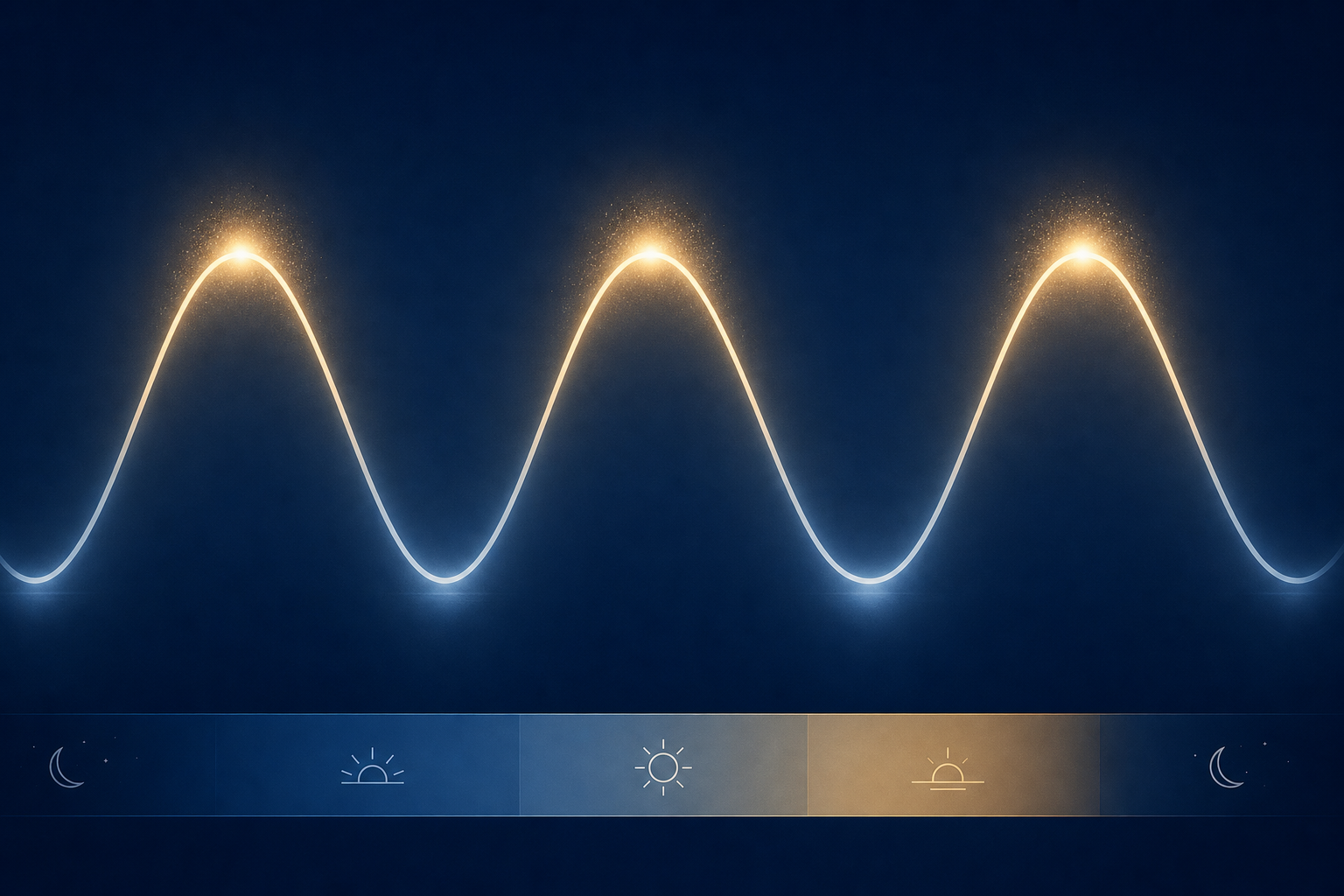
The most important — and most overlooked — mechanism is the one operating underneath your conscious awareness. Sleep researcher Nathaniel Kleitman, best known for discovering REM sleep, also identified the Basic Rest-Activity Cycle (BRAC): a roughly 90-minute oscillation between high-performance active phases and recovery troughs that continues throughout waking hours, not just during sleep.
During the active phase (approximately 75–90 minutes), the prefrontal cortex shows elevated beta EEG activity, the reticular activating system floods the cortex with norepinephrine and acetylcholine, and the default mode network — the brain's "mind-wandering" network — is suppressed. This is the biological window for sustained, high-quality cognitive work.
During the rest phase (approximately 15–20 minutes), beta activity drops, theta and alpha waves rise, the default mode network activates, and autonomic recovery processes engage. Cognitive psychologist Atsunori Ariga's research found that subjects who took breaks at roughly 90-minute intervals maintained near-initial performance levels throughout the session, while those who worked continuously showed steady degradation.
Seven Science-Backed Techniques for Deeper, More Sustained Focus
Each technique below is anchored to a specific mechanism from the neuroscience above — not a generic tip, but a direct response to a known biological or environmental cause of distraction.
1. Energy-Aligned Scheduling
Circadian rhythms create predictable windows of peak cognitive performance that differ by individual — roughly morning for most people, but not everyone. The critical insight is that deep work should be placed inside your personal circadian peak, not in whatever calendar slot is available. Microsoft's workplace research found that 50% of all meetings are scheduled during peak productivity hours (9–11 a.m. and 1–3 p.m.) — which means half of all meetings are directly competing with the hours when workers are most cognitively capable.
This is different from time-blocking as a scheduling tool. The goal is to identify your biological peak first, then protect it — rather than distributing work evenly across the day based on calendar availability. (For implementation-level scheduling mechanics, the article on time-blocking techniques for daily productivity covers the calendar layer in detail.)
2. Pre-Work Transition Rituals
Attention residue means that jumping directly from reactive work into deep work is almost always counterproductive. A 10–20 minute buffer zone before a deep work session — used to close open loops, review one clear objective, tidy the workspace, and take a few slow breaths — reduces the cognitive ramp-up time and clears residual fragments from prior tasks.
The ritual does not need to be elaborate. Its function is to signal a mode shift to the brain, not to achieve anything substantive. Even a simple sequence — close all unrelated tabs, write down the one thing you intend to complete, start a timer — creates enough of a transition to reduce the first-fifteen-minutes drag that plagues most deep work attempts.
3. Environment Design
Environment design is the highest-leverage technique in this list because it reduces the willpower cost of entering and staying in focus — rather than requiring you to overcome a bad environment through self-discipline every session. Several specific factors matter:
- Visual field elevation: Positioning screens at or above eye level increases alertness by activating the reticular activating system. Looking down — at a laptop on a desk without a stand — promotes a more relaxed, lower-alertness state.
- Lighting: Bright overhead lighting supports focused, alert states. Dim or warm lighting is appropriate for rest phases but works against deep work.
- Notification architecture: Every notification channel that remains active during a deep work session is a potential interruption costing up to 25 minutes of recovery time. The goal is zero interruptions during the session, not fewer.
- Physical context cues: Using the same environment — or the same physical signal, like a specific pair of headphones — exclusively for deep work trains the brain to associate that context with focused states, reducing the mental effort required to enter them.
- Subconscious environmental signals: Working in spaces associated with rest — a bedroom, a couch — requires more mental resources to tune out ambient associations and contributes to burnout over time.
4. 90-Minute Sessions with Genuine Defocus Breaks
Aligning work sessions with ultradian cycles means working for approximately 75–90 minutes and then taking a genuine 15–20 minute rest. The session structure follows a natural arc: the first 20–30 minutes engage attention networks, the middle period represents peak performance for complex problem-solving, and the final 10–15 minutes produce natural fatigue signals — mind wandering, fidgeting, declining output quality — that indicate the rest phase is beginning.
The break must be genuine defocus. Walking, nature exposure, or non-work conversation allow the default mode network to activate and the brain to consolidate what it has processed. Scrolling social media or switching to another demanding task is not rest — it keeps task-positive networks engaged and prevents the autonomic recovery that makes the next ultradian cycle productive. Andrew Huberman's recommendation of 1–2 focused 90-minute blocks per day, each followed by 10–30 minutes of genuine rest, aligns with both the ultradian science and the realistic ceiling for deep cognitive work.
5. Attention Training
Focus is a trainable capacity, not a fixed trait. Two practices have direct evidence behind them:
- Visual focus exercises: Deliberately directing sustained gaze to a single fixed point for 30–60 seconds before a work session activates the covert attention system and primes the brain for focused states. The visual and cognitive attention systems share neural infrastructure — training one supports the other.
- Short daily mindfulness practice: Even brief daily sessions of focused breathing — sitting still, attending to breath and surroundings — have been shown to rewire attentional networks so that sustained attention becomes easier in everyday work. The Harvard Health review of concentration research notes that this practice builds the brain's monitoring process — its ability to notice when attention has drifted and redirect it.
6. Shallow-Work Batching and Meeting Reduction
The structural enemy of deep work is not individual distractions — it is a work culture that distributes shallow obligations (meetings, messages, reviews) throughout the day, preventing any sustained uninterrupted window from forming. The research on this is unusually direct: reducing meetings by 40% yields a 71% increase in productivity according to HBR/Laker study findings. Half of all meetings are scheduled during the hours when workers are most cognitively capable.
Batching shallow work — consolidating email, messages, and administrative tasks into two defined windows per day (one late morning, one late afternoon) — protects peak hours without eliminating responsiveness. The goal is not to become unreachable but to make shallow work predictable and contained rather than randomly distributed across the day.
7. Managing the AI Distraction Paradox
AI tools create a new category of shallow fragmentation that does not look like distraction. Reviewing generated outputs, iterating on prompts, evaluating AI-drafted content, and switching between generation and editing are each individually brief — but collectively they produce the same attention residue and task-switching costs as any other context switch.
The practical response is to treat AI tool interactions as shallow work and batch them accordingly — outside deep work sessions, not interleaved with them. Use the deep work session for the cognitive work that genuinely requires your full attention: the synthesis, the judgment, the original thinking. Use AI tools in the shallow work windows for drafting, summarizing, and formatting tasks that do not require sustained depth.
Building Your Personal Deep Work System: Four Scheduling Archetypes
Cal Newport's four deep-work philosophies from his book Deep Work remain the most useful framework for structuring how deep work fits into a working life — but the 2026 context of hybrid schedules, AI tool integration, and distributed teams requires adapting them rather than applying them literally. Think of these as combinable archetypes rather than mutually exclusive choices.
| Archetype | Structure | Best for | 2026 Adaptation |
|---|---|---|---|
| Monastic | Total isolation from shallow work for extended periods — weeks or months | Researchers, writers, or specialists with minimal external obligations | Rarely viable for most knowledge workers; useful as a temporary sprint model (e.g., one week of deep isolation for a major project) |
| Bimodal | Alternating between deep-work days (full isolation) and shallow-work days (meetings, messages, collaboration) | Knowledge workers with some scheduling autonomy who can protect 1–2 full days per week | Most practical 2026 adaptation: designate one full deep-work day per week with no meetings scheduled; use remaining days for shallow obligations |
| Rhythmic | Fixed daily deep-work blocks at the same time each day — typically 2–4 hours in the morning | People with predictable schedules who can defend a recurring morning block | Works well in hybrid environments with consistent home-office days; harder to sustain on high-meeting days |
| Journalistic | Opportunistic deep work — dropping into deep focus whenever a gap appears in the schedule | Experienced practitioners who can rapidly transition into deep focus without a ramp-up ritual | Requires strong pre-work ritual skills to minimize attention residue; not recommended for beginners |
Common Obstacles and How to Overcome Them
Most people encounter the same four obstacles when trying to implement these techniques. Each has a specific response grounded in the mechanisms already described.
- Open-plan offices that make environment design difficult. You cannot redesign the office, but you can create a portable context signal: noise-canceling headphones as a do-not-disturb signal, a specific playlist associated only with deep work, or booking a private room for deep work blocks. The brain responds to consistent contextual cues regardless of whether they are architectural or behavioral.
- Meeting cultures that colonize peak hours. This is a structural problem requiring a structural response. Blocking your peak hours on the shared calendar as recurring "focus time" — before others can schedule over them — is more effective than declining individual meetings reactively. If you have any scheduling autonomy, treat peak-hour protection as a non-negotiable default rather than a preference to be negotiated.
- Treating the rest phase as wasted time. The rest phase is when the brain consolidates, integrates, and recovers. Skipping it to "keep working" degrades the quality of the next session. The 15–20 minute rest phase is not a reward for finishing work — it is a required maintenance interval for the next 90-minute cycle. Scheduling it explicitly, rather than waiting to feel tired enough to stop, is the only reliable way to protect it.
- Using AI tools during deep work sessions. The AI distraction paradox is real: prompt-and-review loops fragment attention in the same way that checking messages does. During a deep work session, AI tools should be either closed entirely or used only for a single, pre-defined purpose with no switching between generation and evaluation. The evaluation work belongs in the shallow-work window.
Quick-Start Action Plan: Your First Week of Biologically Aligned Focus
The goal for the first week is not to overhaul your entire workflow. It is to collect one week of personal data and establish one protected block. Everything else can be added incrementally.
- Track your energy peaks for one week without changing your behavior. Note when you feel most alert and cognitively sharp — not when you have the most calendar space, but when your brain is actually at its best. Do this for five consecutive workdays before drawing any conclusions.
- Protect the first 90 minutes of your identified peak time for a single deep task. Block it on your calendar, close all unrelated applications, silence all notifications, and commit to one task only. Do not check email, messages, or AI tools during this window.
- Design one environmental trigger that signals deep work mode. This can be physical (a specific workspace, a pair of headphones, a cleared desk) or behavioral (a 5-minute pre-work ritual). Use the same trigger every session to build the contextual association.
- Batch all communication into two daily windows outside your peak hours. Choose one window in the late morning and one in the late afternoon. Outside these windows, email and messages stay closed. This is the single change that most directly protects the peak-hour block.
- Schedule a genuine 15–20 minute rest phase after each 90-minute block and treat it as non-negotiable. Walk, sit outside, or have a non-work conversation. No screens, no messages, no AI tools. The rest phase is not optional — it is what makes the next block possible.
Comments
Join the discussion with an anonymous comment.