
If you are trying to figure out how to be productive with OCD, the most honest starting point is probably not a calendar, an app, or a morning routine. It is the private complaint that sounds like a character flaw until you look closely: I am working twice as hard and still falling behind.
That complaint deserves to be taken literally. A person with OCD may spend an hour on an email that takes a colleague ten minutes, not because they are lazy, careless, or unmotivated, but because the task has been joined by another task: neutralizing doubt. Psych Central puts the correction bluntly: people with OCD “are working harder, not slacking off.”[1] Balanced Mind of NY describes the same productivity trap in practical terms: intrusive thoughts, rituals, and perfectionistic loops can consume the space where ordinary task completion should happen.[2]

The hidden cost can be large. PA Psychotherapy, citing Ruscio et al. 2010, reports average daily estimates of about 5.9 hours spent on obsessions and 4.6 hours on compulsions among people with OCD.[3] Those figures should be read carefully because they are being used here through a secondary citation, not as a fresh analysis of the original dataset. Still, they name something many knowledge workers recognize immediately: the workday may look full from the outside while much of it is being spent inside checking, reviewing, rehearsing, undoing, and trying to reach a feeling of certainty that does not stay.
This article is educational, not medical advice, diagnosis, or a substitute for treatment. OCD is a clinical condition. Productivity adjustments can reduce friction around work, but they do not replace care from a qualified mental health professional.
Why Ordinary Productivity Advice Often Backfires
Most productivity systems assume the main problem is organization: tasks are scattered, priorities are unclear, time is unprotected, or distractions are too available. Those problems are real. But OCD can make the failure point much more specific. The work may be organized and still not move because the brain is treating uncertainty as danger.
A standard timer can help someone who drifts. For someone caught in an OCD loop, the timer can become another rule to satisfy perfectly. A checklist can help someone remember next actions. For someone checking compulsively, the checklist can become a document to re-check, reformat, and distrust. A clean task manager can reduce noise. It can also create a new place to seek the impossible state of feeling completely sure.
That is why productivity with OCD cannot be built only around doing more. The system has to ask a sharper question: does this tool interrupt the OCD cycle, or does it give the cycle a more professional-looking interface?
The mechanism matters. BOLD Health describes OCD as affecting executive functions, including working memory, cognitive flexibility, and inhibitory control.[4] In plain workday terms, obsessions occupy mental workspace; compulsions consume time; switching becomes harder; stopping becomes harder; and the task in front of you starts competing with a second, internal task that feels urgent even when it produces no useful output.
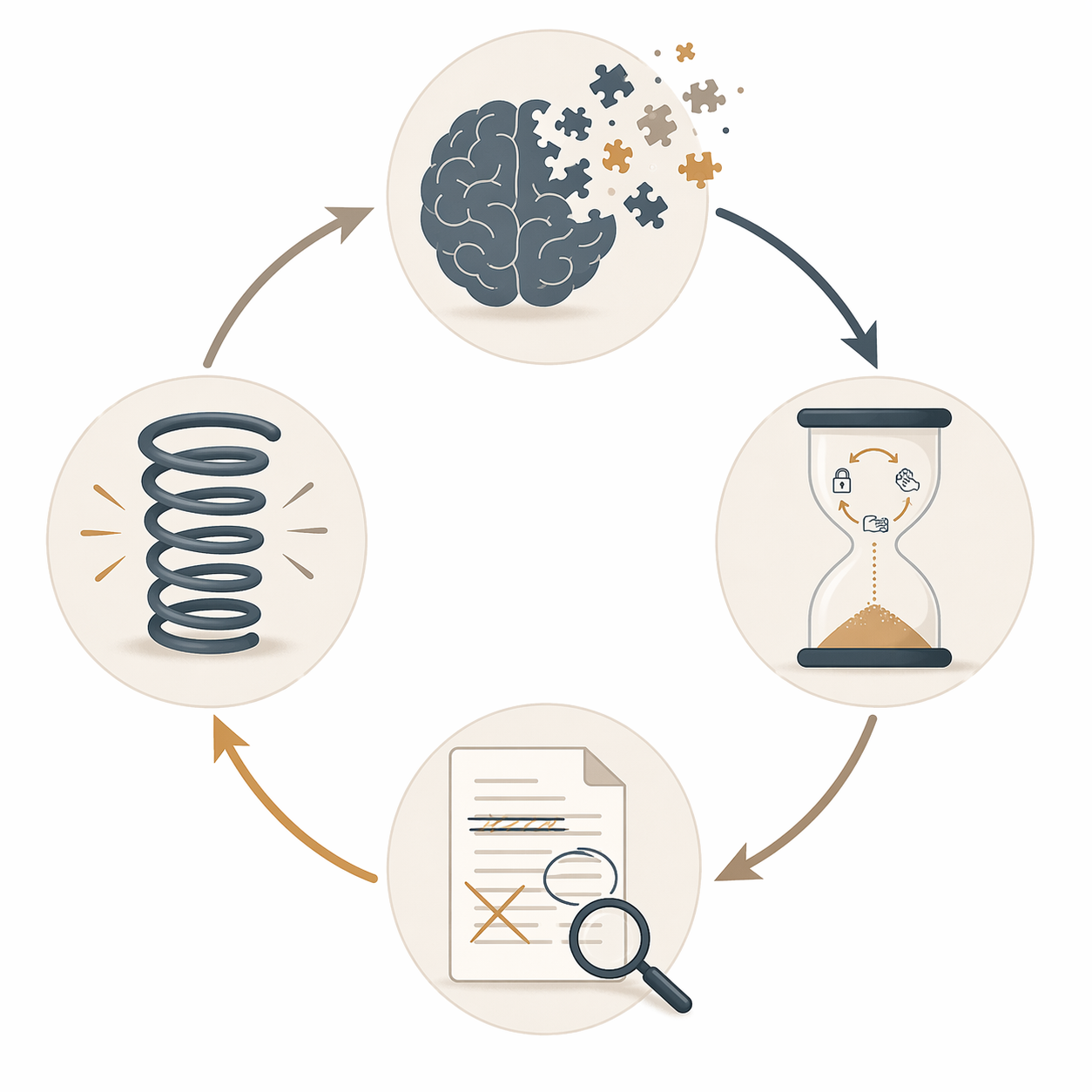
The Loop That Eats the Workday
A typical knowledge-work loop can start quietly. An intrusive thought appears while you are writing, planning, coding, designing, studying, or replying to a client: What if this is wrong? What if I missed something? What if the tone sounds careless? What if I accidentally caused a problem?
The obsession is not the same as normal professional care. Carefulness usually helps the task converge. OCD doubt keeps moving the finish line. You answer the concern, then the mind asks for another pass, another search, another reassurance check, another rewrite. The task is no longer “send the email.” It becomes “send the email only after I feel certain enough,” and the feeling may never arrive in a stable way.
| Part of the OCD cycle | What it can look like at work | Productivity consequence |
|---|---|---|
| Obsession | Intrusive doubt about accuracy, harm, tone, ethics, contamination, order, or responsibility | Working memory is pulled away from the task |
| Compulsion | Checking, rereading, rewriting, reassurance seeking, mental reviewing, restarting | Minutes or hours disappear without proportional progress |
| Perfectionistic rework | The draft, spreadsheet, notes, or message never feels finished | Output slows even when effort is high |
| Stress | Pressure rises because time is slipping | Symptoms can intensify, making the next task harder |
Stress is not just an unpleasant side effect here. Psych Central cites Adams et al. 2018 on stress worsening OCD symptoms, which creates an especially punishing productivity spiral: symptoms slow the work, the delay raises pressure, and the pressure can intensify the symptoms.[1] Advice that simply raises urgency—work faster, be tougher, stop overthinking—can push directly on the part of the system that is already overloaded.
This also explains why praise can be confusing. A person may be known as careful, thorough, conscientious, or “detail-oriented” while privately losing evenings to rework. Some carefulness is valuable. The problem is the point where review stops improving the product and starts serving the compulsion.
Put the Boundary Where the Compulsion Usually Takes Over
The practical move is not to make the whole day stricter. It is to locate the handoff point: the moment when useful work becomes certainty-seeking. For many people, that point appears during review. The email is already understandable. The spreadsheet has already been checked against the source. The assignment already meets the instructions. But the mind wants one more pass to make the discomfort drop.
That is where a checking window helps. Instead of vaguely promising to be “less perfectionistic,” define when checking is allowed, what counts as checking, and what happens when the window closes. Psych Central includes time-limited checking as a practical approach for OCD-related productivity problems.[1] The important detail is that the window must be tied to work quality, not to the feeling of relief.
- For a routine email: one content pass, one recipient/attachment pass, then send.
- For a report: one pass against the brief, one pass for obvious errors, then submit to the next reviewer if there is one.
- For notes: stop when they can support the next action, not when they feel complete.
- For research: decide the search limit before searching, because the compulsion is very good at inventing one more source.
A timer may still be useful, but only if its job is narrow. It is not there to create panic. It is there to protect the stopping rule you already chose. If a timer becomes something you reset repeatedly until the task feels right, it has stopped being a productivity tool and become part of the ritual.
If you already use time blocking or time management software, keep the tool boring. A calendar block can say “draft client response” and include a five-minute review window at the end. It does not need a complex scoring system for how certain you felt. For broader tool selection, a time management software guide can help with structure, but with OCD the central design question remains whether the tool reduces rituals or multiplies them.
Build Buffers That Are Not Secret Failure Zones
A packed calendar is hard on almost everyone. With OCD, it can become combustible. If one task runs long because checking took over, the next task starts under threat. Then the mind has less room, stress rises, and the next checking loop becomes more likely. Balanced Mind of NY recommends structured schedules and buffer time as supports for managing OCD’s effect on daily functioning.[2]
The buffer is not an apology for being slow. It is an engineering choice. If transitions are vulnerable, protect transitions. If review windows tend to spill over, place a visible gap after high-risk tasks. If meetings trigger mental replay, do not schedule the most precision-heavy work immediately afterward when you can avoid it.
- Place a recovery gap after tasks that usually trigger checking, reassurance seeking, or mental review.
- Leave administrative tasks away from the day’s most demanding cognitive work when possible.
- Protect a small end-of-day shutdown block so unfinished loops do not automatically follow you into the evening.
- Use fewer, clearer task blocks rather than a calendar so granular that maintaining it becomes its own compulsion.
This is where productivity systems need to support mental health instead of extracting more effort from an already strained person. A broader mental-health productivity redesign can be useful if your current system rewards urgency, constant self-monitoring, or impossible daily plans.
Separate “Done” From “Feels Right”
One of the crueler parts of OCD at work is that completion and relief can separate. The task can be done while the body still reports danger. If the rule is “I stop when it feels right,” then the compulsion gets veto power over the workday.
A better stopping rule is external and task-based. “Done” means the file meets the acceptance criteria. The email answers the question. The invoice uses the correct information. The notes can support the next meeting. The code passes the agreed checks. The study session produced usable recall, not beautiful pages. Made of Millions and TreatMyOCD both discuss “good enough” standards and done-lists as ways to counter OCD-driven perfectionism and distorted self-assessment.[5]
A done-list is different from a to-do list. A to-do list can become evidence of failure when it keeps growing. A done-list records completed actions in plain language: sent draft to Jamie, corrected the two figures, attended the meeting, logged the follow-up, submitted the form. This matters because OCD can make the day feel unproductive even when useful work happened.
Keep the done-list simple. If it becomes a courtroom brief proving that you deserve rest, it has drifted. The point is to give your future self a factual record, not another document to perfect.
Use Scheduled Worry Carefully
Scheduled worry time can help some people contain rumination by giving intrusive concerns a defined place instead of letting them sprawl across every task. Psych Central includes scheduled worry time among strategies for managing OCD-related productivity strain.[1] The word “carefully” is doing real work here.
If scheduled worry becomes scheduled compulsing—thirty minutes of reassurance seeking, mental checking, reviewing old conversations, or researching the same fear—it is not serving the workday. A safer version is brief, structured, and oriented toward next actions. Write the concern. Note whether there is a concrete action that belongs on the calendar. If there is not, return to the current task when the window ends.
This can feel unsatisfying. That is partly the point. A productivity system that requires complete internal certainty before moving on will keep handing the schedule back to OCD.
Put Grounding Between Tasks, Not Just at the End of Collapse
Micro-breaks are often sold as a way to refresh attention. With OCD, they can also interrupt carryover. Balanced Mind of NY recommends grounding and brief breaks as part of managing OCD’s interference with daily life.[2] The useful break is not a disappearance into avoidance. It is a short reset between one cognitive demand and the next.
- Stand up and name the next physical action before opening another tab.
- Take a brief breathing pause after sending something that usually triggers rechecking.
- Use a short walk between a meeting and precision work if mental replay tends to hijack the next block.
- Close the document before starting the break so the break does not become a disguised review session.
The difference between recovery and ritual is worth watching. Recovery makes the next chosen action more available. Ritual tries to make uncertainty disappear.
When Self-Management Is Not Enough
Productivity adjustments can reduce the damage around the edges of OCD. They can protect time, lower avoidable stress, and make compulsions harder to perform automatically. But they are not the same as treating OCD. If the checking window collapses every day, rituals consume significant time, work avoidance grows, distress remains high, or the productivity system itself becomes another compulsion, the next productive step is clinical support.
Exposure and response prevention, usually called ERP, is a specialized form of cognitive behavioral therapy for OCD. NOCD/TreatMyOCD reports a 65–80% symptom reduction range for ERP based on its clinical framing, and also describes an expectation that many people may begin seeing results in about 8–12 weeks.[6] That should not be read as a guarantee for every person. Outcomes vary, and other research has reported lower rates, including 50–60% clinically significant improvement among completers.[7]
The practical reason ERP belongs in an article about productivity is not that therapy is a better “hack.” It is that ERP targets the certainty-seeking loop itself. If the root loop is still running, the calendar has to fight the same battle every morning.
Medication can also be part of OCD treatment. The National Institute of Mental Health describes treatment options for OCD that include psychotherapy and medication, and reports that OCD affects about 1.2% of U.S. adults in a given 12-month period.[8] That prevalence figure is a U.S. adult 12-month estimate; it is not the same as global lifetime prevalence, which uses a different frame.
Workplace support may matter too. The International OCD Foundation notes that OCD may qualify for workplace accommodations under the Americans with Disabilities Act depending on the individual situation.[9] Accommodations are not favors or shortcuts. They can be the difference between a role designed around actual functioning and a role that quietly punishes someone for symptoms they are trying to manage.
Reasonable supports might include protected focus blocks, written instructions, adjusted review processes, predictable deadlines, or flexibility around treatment appointments. The right accommodation depends on the job and the impairment; it is better handled with qualified guidance than improvised in isolation.
A Productivity System That Stops Feeding Certainty-Seeking
The workable system is usually less heroic than the one people try to build after falling behind. It has fewer places to check. It defines review before anxiety defines it. It leaves buffers where symptoms have historically eaten time. It treats “good enough” as a work standard, not a personality failure. It records what got done because OCD is not a reliable narrator of effort.
Generic productivity methods can still be useful, but they need modification. If you are comparing systems such as Pomodoro, GTD, calendar blocking, or task batching, a productivity methods comparison can help you choose a structure. With OCD, the deciding factor is not which method sounds most efficient. It is which method least rewards compulsive checking, endless refinement, and pressure-driven overcontrol.
When the adjustments help, they protect attention, time, and recovery. When they do not, treatment is not a failure of productivity. It is the root-level productivity intervention.
References
- OCD Can Make It Hard to Be Productive, Psych Central.
- OCD and Productivity, Balanced Mind of NY.
- OCD Statistics, PA Psychotherapy.
- OCD and Executive Functioning, BOLD Health.
- Perfectionism and OCD, Made of Millions.
- How Effective Is ERP Therapy for OCD?, NOCD/TreatMyOCD.
- The Effectiveness of Exposure and Response Prevention for Obsessive-Compulsive Disorder, National Library of Medicine.
- Obsessive-Compulsive Disorder, National Institute of Mental Health.
- OCD and the Americans with Disabilities Act, International OCD Foundation.
Comments
Join the discussion with an anonymous comment.