
The daylight saving time productivity impact is easy to underestimate because the visible loss is only one hour. Most teams can absorb one rough Monday. The bigger problem is that the spring-forward transition changes the shape of the workweek: people arrive biologically earlier, early work gets thinner, recovery gets pushed into later hours, and managers still expect the calendar to behave as if nothing changed.
The best evidence for that two-week drag comes from a University of Oregon study of 174,505 GitHub users. Researchers found reduced early-morning productivity after the spring transition, especially before 10 a.m., with the effect lasting up to 14 days. Workers appeared to compensate later in the day, but the morning deficit did not simply vanish; it moved work into a less orderly part of the schedule, where reviews, handoffs, and fatigue already compete for attention.[1]
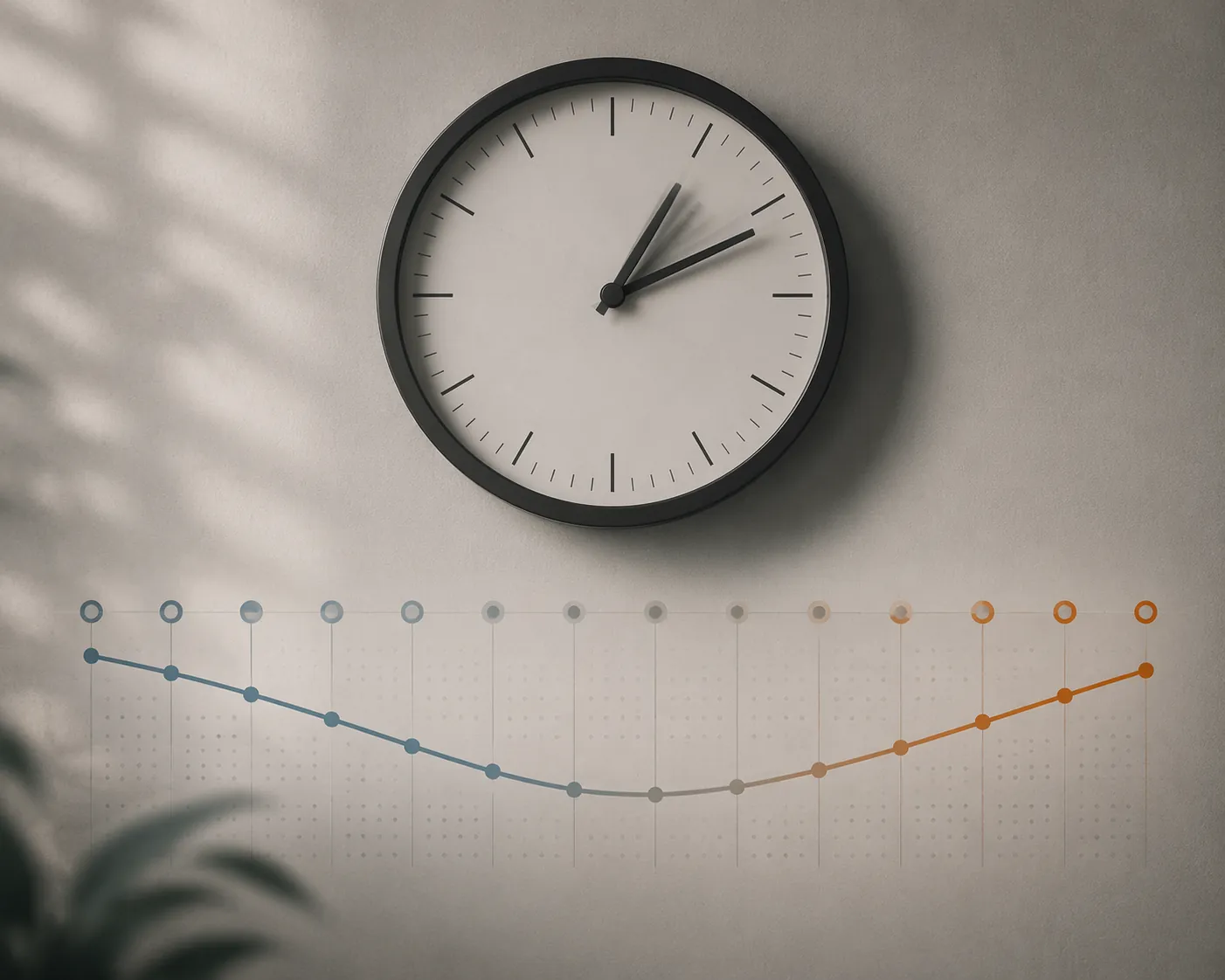
That matters for software teams, but it should not be filed away as a quirky developer problem. Code commits are a useful behavioral trace because they show when real work happens, not when people say they are tired. Similar sleep-disruption patterns show up in injury records, web-use behavior, and judgment-heavy decisions. The common thread is not GitHub. It is the cost of asking people to perform at normal precision after their circadian timing has been moved.
The broader price tag is large, but it should be handled carefully. Chmura Economics estimated that daylight saving time costs US metro areas about $672 million annually from DST-attributable heart attacks, strokes, workplace injuries, and traffic accidents.[2] That is a floor, not a full national invoice. It excludes many softer but expensive categories: delayed output, absenteeism, lower meeting quality, rework, and the manager time spent cleaning up a week that should have been scheduled differently in the first place.
What Actually Changes After the Clock Moves
The spring transition does not just remove an hour from Saturday night. It asks the body to start work on a clock schedule that no longer matches its internal timing. In the first week after the change, people lose roughly 40 to 60 minutes of sleep per night, according to summaries of sleep and workplace research.[3][4][5] That is enough to matter in jobs where the costly errors are small: a missed edge case, a rushed equipment check, a brittle merge, a harsher-than-usual call made before the first real pause of the day.
The University of Oregon GitHub study makes the mechanism unusually visible. The drag is concentrated in the morning, especially before 10 a.m., and workers appear to make up some activity later.[1] On a dashboard, that can look reassuring: the total day may not collapse. In practice, later compensation is not the same as equally good work. A developer who starts slowly may push commits later, when reviewers are less available. A manager who loses the morning may turn the afternoon into a chain of rushed decisions. A team that depends on clean handoffs may discover that “catching up” creates more work for the next person.
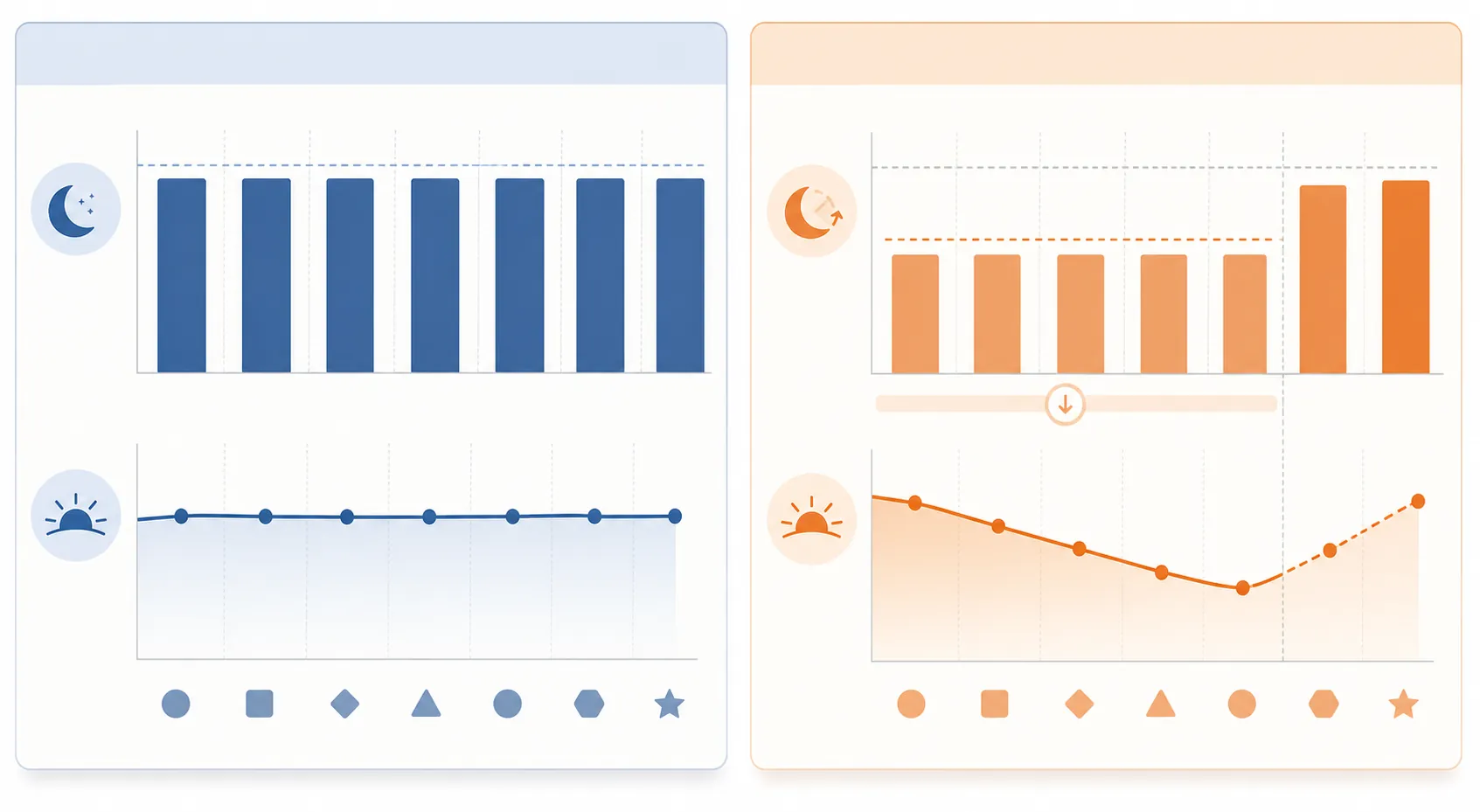
This is why the first Monday is a poor unit of analysis. The worst mood may be visible then, but the operational effect can stretch across sprint planning, review cycles, safety briefings, and customer escalations. If the team’s most coordination-heavy meetings sit at 9 a.m., the schedule is putting its highest-friction work into the lowest-recovery window.
| Observed effect | What it measures | Operational consequence |
|---|---|---|
| Reduced productivity before 10 a.m. for up to 14 days | GitHub activity among 174,505 users | Morning work slows, then shifts later into the day |
| 40-60 minutes less sleep per night in the first week | Sleep loss after the spring transition | Attention and timing degrade before people feel fully recovered |
| 5.7% more workplace injuries on spring-forward Monday | Mining injury records over 20 years | Safety-sensitive work absorbs the clock change as real risk |
| 67.6% more lost workdays after those injuries | Severity of injury outcomes | The harm is not just more incidents, but more consequential incidents |
The Harm Stack: Output, Safety, and Judgment
Office workers often talk about the DST week as a nuisance: more coffee, worse meetings, a few sluggish mornings. The injury data makes that framing too small. A study using 20 years of Mine Safety and Health Administration data found 5.7% more workplace injuries on the Monday after the spring-forward transition, and those injuries led to 67.6% more lost workdays.[3] The first number says incidents rise. The second says the incidents are more severe, or at least more disruptive to work capacity.
That is the same sleep problem showing up in a harsher environment. In a mine, reduced alertness can become an injury report. In an office, it may become a production bug, a bad escalation note, or an avoidable conflict in a performance conversation. The consequences differ, but the scheduling mistake has the same shape: put normal demands on people during an abnormal alertness window, then act surprised when error rates rise.
The behavioral drift is visible even in low-stakes choices. University of Oregon researchers found that entertainment-web surfing rose 3.1% on the sleepy Monday after the time change and 6.4% above baseline the following Monday.[1] That does not prove people become lazy after DST. It points to something more ordinary and more useful for managers: when alertness drops, resisting distraction becomes more expensive. People do not need a character flaw to lose the morning; they need a shortened night and a browser tab.
Decision quality also takes a hit. A study cited in public summaries of DST research found that judges handed down sentences that were 5% longer on the Monday after the spring transition.[3] A courtroom is not a standup meeting, and sentencing is not code review. That is precisely why the example is useful. It shows that sleep disruption can reach into consequential judgment, not just typing speed or mood.
For managers, the takeaway is not that every decision made after the clock change is suspect. It is that the week deserves a lower-risk design. If a decision is irreversible, emotionally loaded, safety-critical, or unusually detail-heavy, there is no virtue in placing it at 9 a.m. during the first days after spring forward.
Why “Catching Up Later” Is Not a Clean Fix
The compensation pattern in the GitHub study is easy to misread. If workers do less early and more later, a manager might conclude that the system self-corrects. Sometimes it does, at least on volume. But many teams are not paid only for volume. They are paid for sequencing, review quality, coordination, and the absence of expensive mistakes.
A hypothetical software team shows the difference. If a developer loses the sharp part of Monday morning, pushes a change late in the afternoon, and the reviewer does not see it until Tuesday, the commit still exists. The calendar cost is hidden in the delay, the thinner review, and the follow-up work created by late-day compression. Nobody needs to be negligent for that to happen. The schedule simply made the weaker path more likely.
This is also where individual wellness advice reaches its limit. Yes, people should prepare their sleep. But if the organization keeps its most demanding early meetings, requires a normal commute on the worst morning, and treats slow starts as a motivation problem, it has converted a predictable biological disruption into an employee-by-employee willpower test.
Spring Forward Is the Problem; Fall Back Is Different
Most documented workplace harm belongs to the spring-forward transition. The fall transition, when clocks move back, shows minimal harm in the University of Oregon research and may even produce a slight productivity improvement.[1] That asymmetry matters. A careful claim is not “daylight saving time ruins productivity all year.” It is that the spring clock change creates a measurable, short-term performance tax.
The policy debate remains unsettled as of July 2026. Permanent-DST proposals have not resolved the question for US workplaces, and major sleep-medicine organizations favor permanent standard time rather than permanent daylight saving time.[6] That distinction is important, but it should not distract managers from the immediate operational issue. Whatever Congress does or does not do, teams still need to decide how they will schedule the next spring transition.
A Practical DST Productivity Plan
The useful response is modest. Nobody needs a two-week corporate recovery ceremony. The goal is to remove the dumbest friction: abrupt sleep timing, high-stakes early meetings, drowsy commutes, and attention-heavy work placed in the weakest window.
For Individuals
- Move bedtime earlier by about 15 minutes per night for 3-5 days before the transition, rather than trying to absorb the full hour at once.[5]
- Get outdoor morning light soon after waking to help shift circadian timing toward the new clock schedule.[4][5]
- Keep naps under 20 minutes if you need one, so the nap restores alertness without creating sleep inertia or making bedtime harder.[5]
- Treat caffeine as a timing tool, not a rescue plan; if you need a tighter protocol, use an evidence-based caffeine timing guide instead of adding more coffee later in the day.
- Move deep work away from the earliest morning blocks during the first few days when possible, then use science-backed focus techniques once alertness has stabilized.
The bedtime shift is the least glamorous item and probably the most useful. It reduces the size of the biological jump before Monday arrives. Morning light then tells the body that the new schedule is real. A nap can help, but only if it stays short enough to avoid creating a second problem.
For Managers
- Cancel or move 9 a.m. meetings during the first week after spring forward, especially planning meetings, incident reviews, performance conversations, and safety briefings.
- Allow flexible start times for the first few days, then judge the week by completed work and decision quality rather than badge-in optics.
- Offer work-from-home Monday where the role allows it, because drowsy commuting adds a risk that does not improve output.
- Shift high-risk physical tasks, production deployments, or irreversible decisions out of the earliest morning window when scheduling control exists.
- Tell the team the adjustment is intentional, so people do not interpret flexible starts as a secret test of commitment.
The work-from-home option is not just comfort policy. Research summarized in mitigation discussions points to higher traffic-accident risk around the transition, including an 11-year New Zealand study reporting 16% more Sunday accidents and 12% more Monday accidents.[4] For teams that can work remotely, removing the commute on the worst morning is a simple way to reduce exposure without pretending productivity depends on a particular chair.
A manager does not need to lower standards for the entire week. The better move is to protect the parts of work most vulnerable to sleep loss: early precision, emotionally loaded judgment, and tasks where an error travels downstream. That might mean asynchronous status updates instead of Monday standup, a later deployment window, or a temporary rule that major reviews wait until after 10 a.m.
For a more detailed day-by-day recovery plan, use the DST productivity recovery guide. The shorter version is enough for most teams: prepare sleep before the change, move light and caffeine earlier, stop scheduling the hardest work at 9 a.m., and give people a safer way to start the week.
The Right Size of the Problem
Daylight saving time is not a productivity apocalypse. Most people recover, most work still gets done, and the spring transition is not an excuse for every missed deadline in March. But it is a predictable two-week performance tax, with measurable effects on morning output, safety, distraction, and judgment.
The teams that handle it best will not be the ones that lecture employees to be tougher. They will be the ones that treat the clock change like any other scheduling risk: known in advance, unevenly distributed, and cheap to reduce if someone is willing to move the meeting.
References
- Daylight saving time linked to lost worker productivity, University of Oregon.
- Daylight Saving Time: How Much Does it Cost?, Chmura Economics, 2024.
- Daylight saving time causes lower productivity and higher health care costs, studies say, PBS NewsHour.
- How To Prevent Lost Productivity When Daylight Saving Time Starts, Forbes, March 7, 2025.
- How to Prepare for Daylight Saving Time, Sleep Foundation.
- Permanent standard time is the optimal choice for health and safety: an American Academy of Sleep Medicine position statement, Journal of Clinical Sleep Medicine.
Comments
Join the discussion with an anonymous comment.